This study aims to explore the elements and attributes of accredited entrepreneurs/start-ups by venture capital (VC) in Vietnam, with its emerging start-up environment in the non-Western context.
The data and methods follow an exploratory study using a mixed method with an exploratory sequential design. The qualitative data analysis involved eight initial interviews with various entrepreneur supporters. Following this, a self-designed survey instrument incorporating the interview results was developed. The entrepreneurial founders of 86 early-stage start-ups participated in the survey to confirm several new or adapted quantitative components.
Several variables based on the conceptual model (Aggregate dimensions: Distinctive criteria from local contexts and Alignment with overseas standards) affect the likelihood of success in a professional VC round: a higher-degree founder has a negative effect; the size of the Total Addressable Market in the pitch to VC, the intention to expand overseas and the founder studied at a foreign university in an English-speaking country have positive effects.
The conceptual model in this study can extend the research stream on entrepreneurship and VC in emerging economies based on the institutional theory with regulatory, normative and cognitive pillars. Moreover, this study is the first broad research on the relationship between VC funding and entrepreneurs’ characteristics in emerging economies, using hand-collected actual funded start-up data.
1. Introduction
The center of gravity of economic activity is shifting from mature market economies to emerging economies (Foo et al., 2020; Bruton et al., 2013). Entrepreneurs have played an important role in facilitating economic growth in emerging economies (Kiss et al., 2012; Bruton et al., 2008). Since companies in emerging economies, including entrepreneurial enterprises, face multiple institutional weaknesses (Hermelo and Vassolo, 2010), the relationship between entrepreneurship and institutions in emerging economies differs from that in developed economies (Puffer et al., 2010).
Venture capital (VC) financing has become the dominant source of financing for high-potential start-ups commercializing risky new ideas and technologies over the past 40 years (Lerner and Nanda, 2020). VC provides financial resources to cash-hungry start-ups, certifies reputational capital and fosters human resources (Baum and Silverman, 2004; Hsu, 2004; Hellmann and Puri, 2002). Hence, entrepreneurs pursuing growth must first be selected by VC. Due to the difference in institutional settings, like entrepreneurship in emerging economies, VC in emerging economies also differs from that in the West (Bruton and Ahlstrom, 2003; Bruton et al., 2004; Ahlstrom and Bruton, 2006; Bruton et al., 2009). Thus, while VC must also select entrepreneurs in emerging economies, the selection criteria may differ from the West, i.e. advanced economies.
Although the relationship between VC funding and entrepreneurial founders’ characteristics, defined as organizational capital (the combination of human and social capital) plus other start-up characteristics, in advanced economies has been examined (Hsu, 2007), there is limited research addressing entrepreneurial founders and VC funding in the context of emerging economies. Specifically, while some research on VC funding focused on social capital perspectives (Batjargal and Liu, 2004; Batjargal, 2007; Wang, 2016), broad research capturing entrepreneurial founders’ characteristics except social capital is limited. This study addresses such a gap with an exploratory study to find out potential variables in a context different from that of advanced economies.
In Vietnam, an emerging economy, entrepreneurship has seen considerable growth over the past decades as part of the ongoing structural change, which started after the Doi Moi reforms in 1986 (Sohns and Diez, 2018; Fujita, 2020). The government aims to have 5,000 start-ups up and running by 2025 (Klingler-Vidra and Wade, 2020). Vietnam has about 208 VC funds operating and investing in start-ups, of which nearly 40 are domestic investment funds (NSSC, 2022). Start-ups by entrepreneurs are the growth drivers of the economy.
Therefore, we explore the elements and attributes of accredited entrepreneurs/start-ups in Vietnam as selected by VC using a mixed-method approach. In this regard, we examine the research question: What elements and attributes are found in entrepreneurial founders selected by VC in Vietnam, with its emerging start-up environment in the non-Western context?
The contributions of this study are threefold. First, our integrative conceptual model can extend the entrepreneurship and VC in emerging economies’ research stream based on the institutional theory with regulatory, normative and cognitive pillars. Second, to the best of our knowledge, this study is the first broad research on the relationship between VC funding and entrepreneurs’ characteristics in emerging economies, using hand-collected actual funded start-up data. Third, this study develops a self-designed survey instrument through a mixed-method approach with an exploratory sequential design.
The remainder of this paper is organized as follows. Section 2 presents a literature review. Section 3 presents qualitative and quantitative research methods and data. Sections 4 and 5 present the qualitative data analysis and findings, and the quantitative design and testing, respectively. Finally, Sections 6 and 7 are discussion and conclusions.
2. Literature review
2.1 Entrepreneurship in emerging economies
As the first major overview, Hoskisson et al. (2000) defined an emerging economy as a low-income, rapid-growth country using economic liberalization as its primary growth driver. Its special research forum on emerging economies examined three theoretical perspectives to introduce the topic: institutional theory, resource-based theory and transaction cost theory (Hoskisson et al., 2000). Since then, numerous publications have built on the perspectives to study the unique social, political and economic contexts as well as firm characteristics of emerging economies (Wright et al., 2005; Meyer and Peng, 2005; Bruton et al., 2008). In particular, companies in emerging economies face multiple institutional weaknesses that increase the probability of exogenous shocks that jeopardize economic rent and consequently compromise the sustainability of competitive advantages (Hermelo and Vassolo, 2010). Entrepreneurial enterprises may also respond to institutional constraints such as bureaucracy in emerging economies (Luo and Junkunc, 2008; Chang and Wu, 2014); thus, new ventures in transition economies are likely to rely most heavily on relational contacting during the early phase of transition (Kiss and Danis, 2010). These institutional forces in the context of entrepreneurship in emerging economies are categorized as the regulative, normative and cognitive pillars (Bruton et al., 2010), and the relationship between entrepreneurship and institutions in emerging economies differs from that in developed economies (Puffer et al., 2010).
While both normative and cognitive institutional pillars draw on culture, there are differences between the two. The normative pillar represents actions that organizations and individuals ought to take; normative pillars are the standards of behavior and commercial conventions of different professions, occupations and organizational fields. The cognitive institutional pillar includes the scripts, schemas and taken-for-granted elements that influence individuals in a particular sociocultural context. The regulatory institutional pillars include the laws, regulations and enforcement (Bruton et al., 2010).
In another stream, Cao and Shi (2021) reviewed entrepreneurial ecosystems in the emerging economies’ literature and revealed three key findings as models of entrepreneurial ecosystem dynamics in emerging economies: the presence of institutional voids, resource scarcity and structural gaps, in which also institutional perspective is included. The model is based on the empirical studies of entrepreneur supporters in emerging economies, such as business incubators (Dutt et al., 2016), accelerators (Goswami et al., 2018), public resources (Cancino et al., 2012; Armanios et al., 2017; Becsky-Nagy and Fazekas, 2024) and triple-helix agents (Guerrero and Urbano, 2017). In Vietnam, the government aims to have 5,000 start-ups up and running by 2025 (Klingler-Vidra and Wade, 2020). Vietnam has about 208 VC funds operating and investing in start-ups, of which nearly 40 are domestic investment funds (NSSC, 2022). Start-ups by entrepreneurs are the growth drivers of the economy. This includes Vietnam’s first “unicorn,” VNG, which achieved a valuation of over US$1bn for its mobile phone-focused video gaming products. However, Vietnam’s technology ecosystem is in an early stage, with start-up activity and venture capital funding multiplying year-over-year since the country’s WTO accession in 2007 (Klingler-Vidra et al., 2021). Government budget trends also reveal the rather low priority attached to boosting science and technology capacity (Klingler-Vidra and Wade, 2020). Such circumstances in Vietnam are also characterized as typical challenges in the entrepreneurial ecosystem in emerging economies.
The entrepreneurial ecosystem has ten elements: formal institutions, Culture, Networks, Physical infrastructure, Demand, Intermediaries, Talent, Knowledge, Leadership and Finance (Stam, 2015; Stam and Van de Ven, 2021; Leendertse et al., 2022). As an entrepreneur supporter, VC can also be involved in several elements of the entrepreneurial ecosystem, such as intermediaries, knowledge and finance, thereby building on Cao and Shi’s (2021) model. Indeed, the study of the start-up ecosystem in Peru shows a high centrality of the investors, being the most connected actors, who have more influence, who are intermediaries among other actors and who have more proximity to others (Hernández and González, 2017).
Furthermore, considering the emerging economies’ situations, typically institutional voids and volatile economies, effectuation (Sarasvathy, 2001) and bricolage (Baker and Nelson, 2005) can also be critical concepts to explain the performance of innovative ventures. In emerging economies, effectuation is a costly and unreliable strategy in stable times yet leads to reliable performance improvements in volatile contexts (Shirokova et al., 2020). The effectiveness of entrepreneurial bricolage on new venture growth is stronger in a context with serious institutional voids (Yu et al., 2020).
2.2 Venture capital
As Lerner and Nanda (2020) pointed out, although VC financing has real limitations in its ability to advance substantial technological change, it has become the dominant source of financing for high-potential start-ups commercializing risky new ideas and technologies over the past 40 years. In addition to financial assistance, VC provides value-added services such as business referrals, extensive monitoring, development of human resources and reputational capital; thus, VC-backed start-ups are different from other start-ups (Hellmann and Puri, 2002; Baum and Silverman, 2004; Hsu, 2004). Furthermore, information and communication technology (ICT) has changed the landscape of business and technology during the last two decades – the period in which VC has also flourished enormously as the digital economy or digital entrepreneurship creates a vibrant entrepreneurial environment that generates deal flow for VC (Khan et al., 2021). Indeed, the development of ICT infrastructure, VC industry and economic growth deepen and reinforce one another (Pradhan et al., 2019).
Like entrepreneurship in emerging economies, due to the difference in institutional settings, VC in emerging economies differs from that in the West (Bruton and Ahlstrom, 2003; Bruton et al., 2004; Ahlstrom and Bruton, 2006; Bruton et al., 2009; Ahlstrom and Bruton, 2006) compared the venture capital function between the Anglo-American system and East Asian emerging economies from the perspectives of institutions with regulatory, normative and cognitive pillars. For example, while the normative practice of VC in East Asia is strongly influenced by practices from the West concerning what venture capitalists should be doing, the weakness in regulatory institutions can make the selection process of firms to fund more difficult and thus more challenging (Bruton et al., 2004). As financial support is not sufficient in emerging economies (Pan and Yang, 2019), foreign VC plays an important role in emerging economies (Dai et al., 2012). However, entrepreneurs and prospective VC investors located in different countries are set apart by linguistic and cultural distances, which implies differences in values, beliefs and practices (Colombo et al., 2019; Tian et al., 2020; Yong et al., 2014). Therefore, while entrepreneurs in emerging economies must also be selected and funded by VC, the selection criteria may differ from the West, i.e. advanced economies.
Regarding selected and funded start-ups in the context of advanced economies, the relationship between VC funding and entrepreneurial founders’ characteristics has been examined, including their degrees, prior founding start-up experience and career experience in prominent firms (Burton et al., 2002; Hsu, 2007; Rojas and Huergo, 2016). By contrast, in the context of emerging economies, although there is some research on the relationships between VC funding and social capital perspectives, such as referral and existing social ties (Batjargal and Liu, 2004; Batjargal, 2007; Wang, 2016), broad research capturing entrepreneurial founders’ characteristics is limited. One attempt to determine whether differences in venture capitalists’ decision policies exist between advanced and emerging economies (Zacharakis et al., 2007) has not yet specified the elements and attributes of entrepreneurial founders in emerging economies as selected by VC, using actual funded start-up data rather than VC’s policy capturing.
3. Research methods
To answer the research question, we conducted an exploratory study using a mixed method approach with an exploratory sequential design (Creswell, 2021), consisting of qualitative data analysis (Section 4) as well as quantitative design and testing (Section 5).
3.1 Qualitative data collection
We first sought to involve a broad set of supporters for Vietnam’s entrepreneurs, purposively selecting informants, including venture capitalists (seed VC and beyond), accelerator managers, investment managers, incubation managers from large enterprises, university representatives and policy representatives. To mitigate potential bias, we approached highly knowledgeable individuals who viewed the focal phenomena from diverse perspectives (Eisenhardt and Graebner, 2007). Considering the nature of the research question, entrepreneurs were not included as informants; instead, they were approached via a survey to confirm the findings of the qualitative analysis.
Data collection began in August 2022. Eight informants provided first-hand data during the initial interviews. Based on this data, we proposed a conceptual model describing the relationship between entrepreneurs in Vietnam and VC. After the quantitative testing, we also conducted follow-up interviews with three of the original informants and two new ones to understand the quantitative testing results, as described in Section 6. Table 1 provides details of the informants.
Lists of informants
| Timing | Informants | Category | Base |
|---|---|---|---|
| Initial interview (Aug / Sep 2022) | A | Seed VC | Vietnam |
| B | Seed VC | Vietnam | |
| C | VC – after seed | Vietnam | |
| D | VC – after seed | Singapore | |
| E | Large enterprise – incubation team | Vietnam | |
| F | University | Vietnam | |
| G | Policy representative | Vietnam | |
| H | Policy representative | Vietnam | |
| Follow-up interview (Jun 2023) | A* | Seed VC | Vietnam |
| C* | VC – after seed | Vietnam | |
| E* | Large enterprise – incubation team | Vietnam | |
| I | Accelerator | Vietnam | |
| J | Large enterprise – investment team | Vietnam |
*Same person as the initial interview
To begin, we based our semi-structured interviews on the research questions. Specifically, during the initial interviews, we asked a common question: As for the start-ups that can get support from VCs, what kinds of elements or attributes do they have? Each informant provided various answers, which we explored further to gain a detailed understanding. In the follow-up interviews, we presented the quantitative testing results first and then invited the informants to share their perspectives and experiences. We also explained the findings and the integrated model in Section 4, confirming whether these findings and model aligned with the informants’ perspectives.
All initial interviews were conducted via Zoom and lasted approximately 60 min each. The follow-up interviews were conducted in person, lasting around 30 min each. All interviews were conducted in English.
3.2 Quantitative data collection
The sample for quantitative testing comprised entrepreneurial founders, intending to confirm new or adapted quantitative components derived from the findings of the qualitative data analysis. Archival data were insufficient for this purpose, as they did not capture the detailed elements and attributes of start-ups and founders. Therefore, we, along with the Japan External Trade Organization (JETRO), surveyed a group of entrepreneurial founders in Vietnam.
JETRO, a government-related organization, launched the J-Bridge project, aimed at fostering collaboration between Japanese companies and overseas start-ups to develop new businesses. As part of the J-Bridge project, the JETRO Vietnam office has been sourcing Vietnamese start-ups since 2020. Its sourcing pool includes VC-backed start-ups and potential start-ups accredited by universities, research institutions and incubation programs.
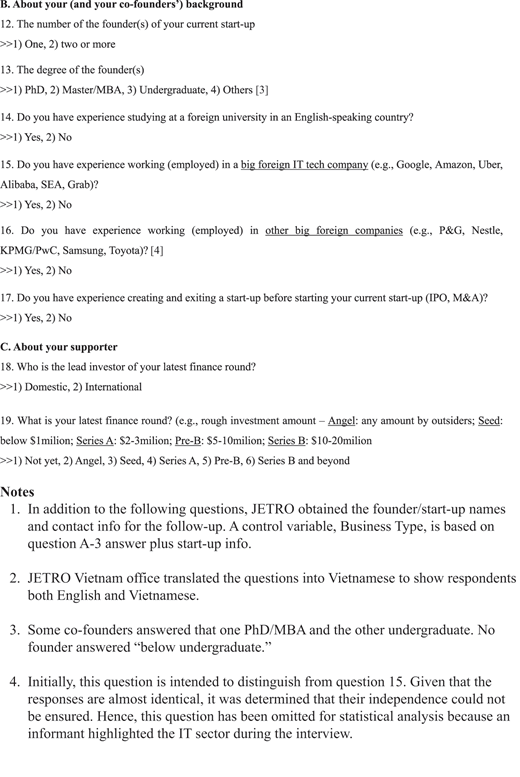
We used this sourcing pool to define a sample population with the following criterion: start-ups seeking VC investment and growth. With this criterion, only small and medium-sized enterprises that do not aim to be high-growth start-ups are eliminated, and various stages of start-ups are captured, creating a sample population of 239. In February 2023, JETRO Vietnam distributed the survey electronically, asking entrepreneurial founders to respond by March 2023. A total of 86 founders (36% of the sample) responded to the survey, which is considered an acceptable response rate based on prior research involving firms with a similar average age of the firms (Lechner et al., 2006)[1]. Due to several misunderstandings regarding monetary units for revenues and the total addressable market in their responses, JETRO Vietnam contacted all respondents to verify and, if necessary, correct the figures. The questionnaire was originally drafted in English and reviewed by multiple parties. Following the review, the JETRO Vietnam office translated it into Vietnamese, presenting the respondents with both English and Vietnamese versions of the questions.
4. Qualitative data analysis and findings
The initial interviews with the informants provided us with different perspectives and insights. Some remarked on the position of venture capitalists, while others shared opinions from broad and objective angles, but all addressed the research question.
We used MAXQDA software throughout the process to assist us in organizing and consolidating the multiple first-order concepts, which tried to adhere faithfully to informant terms. Following this, we moved on to second-order analysis, in which we asked whether the emerging themes indicated concepts that might help us describe and explain the phenomena we were observing. Subsequently, we investigated whether it was possible to distill the emergent second-order themes even further into second-order “aggregate dimensions” (Gioia et al., 2013; Gioia, 2021). The resulting structure of first-order concepts and second-order themes, along with their corresponding aggregate dimensions, is shown in Figure 1.

The emerging data structure (Figure 1) highlights the perspectives of VC’s criteria in Vietnam, which include the relationships with foreign advanced economies. The integrative conceptual model based on the aggregate dimension and second-order theme is depicted in Figure 2.

4.1 Distinctive criteria from local contexts
Distinctive criteria were observed in the context of Vietnam. While many informants addressed the importance of founders in evaluating start-ups, they also highlighted that Market May Prevail Over Founders in the context of Vietnam. Due to market constraints, start-ups must exercise a Choice of Domestic or Regional for Scale, especially in the growth stage, based on the limited size of the market. In particular, regional VC prefers to look at cross-border expansions, and start-ups cannot ignore regional VC. When evaluating founders, VC values more founders’ first-hand experience, while they mentioned that academic background is “a bonus point.” Even if high-profile founders are evaluated, VC might not expect a high return if the entry valuation is high unless the market is sufficiently large.
4.2 Alignment with overseas standards
While we can observe the Distinctive Criteria of Local Supporters to some extent, they Tend to Avoid Totally New, similar to the familiarity frame (Pan et al., 2020). The aggregate dimension of Alignment with Overseas Standards reflects the attitude of local entrepreneurs and VCs in Vietnam. As described in the first-order concepts, both start-ups and VCs tend to check case studies in advanced economies as a starting point; they then consider how to localize products and solutions. In addition, local VCs have the same criteria as foreign VCs, especially when considering the subsequent financing rounds, which foreign VCs must back. Start-ups in Vietnam will eventually need to seek financing from outside the country at a later stage; hence, speaking English well is important for better communication with potential foreign investors. Since Vietnam’s market is not sufficiently sizable and cannot be sustained only by local players, it requires Acknowledgment from Advanced Economies.
5. Quantitative design and testing
5.1 Development of variables
We developed a self-designed survey instrument based on qualitative data analysis. As no comparable questionnaires exist in previous studies, we primarily relied on first-order concepts from our qualitative data analysis, supplemented by previous literature, to formulate questions for entrepreneurial founders.
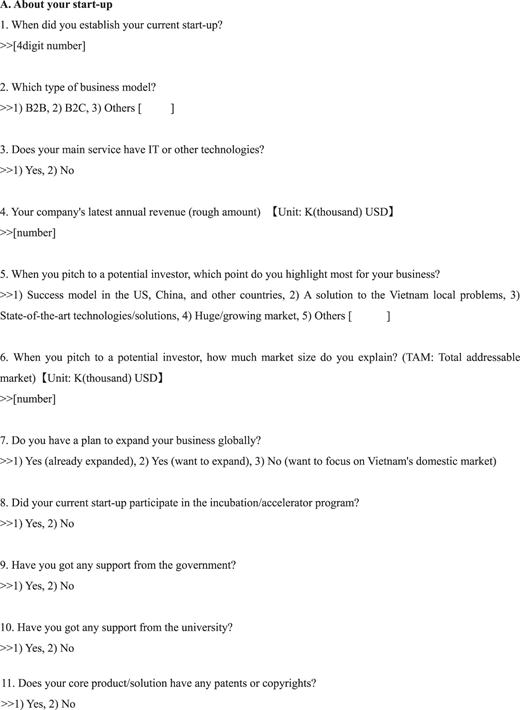
Given that Vietnam’s technology ecosystem is in an early stage (Klingler-Vidra et al., 2021), the data on later-stage finance rounds, including pre-IPO and IPO, is limited. Consequently, we set a threshold of seed finance rounds or beyond (professional VC round) as our dependent variable. In the survey, we specified the latest finance round, providing typical financing amounts in Vietnam to avoid confusion regarding the definition of the finance round. Table 2 lists the induced questions, some of which were derived from first-order concepts not shown in Figure 1. Relevant literature on entrepreneur characteristics and VC funding includes studies by Burton et al. (2002), Hsu (2007), while peripheral studies on pre-IPO financing (Baum and Silverman, 2004), performance (Baum and Silverman, 2004; Klingler-Vidra et al., 2021; Lee et al., 2001), geography distance (Colombo et al., 2019), social network (Wang, 2016) and patents (Conti et al., 2013) informed additional variables.
Induced questions for potential independent variables from the first-order concepts
| First-order concepts | Induced questions | Prior literature | |
|---|---|---|---|
| Founders’ background | Not a solo founder but a founders’ team is preferable | The number of founder(s) of your current start-up | Baum and Silverman (2004); Hsu (2007) |
| Academic background is a bonus point | The degree of the founder(s) | Hsu (2007), Colombo et al. (2019), Burton et al. (2002), Wang (2016) | |
| Speaking english well is important | Do you have experience studying at a foreign university in an english-speaking country? | Klingler-Vidra et al. (2021), Wang (2016) | |
| Value more founders’ first-hand experience (proven track record of managing experience in a big corporation) | Do you have experience working (employed) in a big foreign IT company (e.g. google, amazon, uber, alibaba, SEA, grab)? | Burton et al. (2002), Wang (2016) | |
| Value more founders’ first-hand experience (proven track record of successfully building a start-up and demonstrating liquidity) | Do you have experience creating and exiting a start-up before starting your current start-up (IPO, M&a)? | Baum and Silverman (2004), Hsu (2007), Burton et al. (2002) | |
| Other start-up characteristics | Market size has a lot of impact rather than founding team | When you pitch to a potential investor, how much market size do you explain? (TAM: total addressable market) | n/a |
| A thesis is either a local champion or a global start-up | Do you have a plan to expand your business globally? | n/a | |
| Patents are important for tech start-ups* | Does your core product/solution have any patents or copyrights? | Lee et al. (2001), Baum and Silverman (2004), Conti et al. (2013) | |
| Incubator in Vietnam is young; unicorn did not receive support* | Did your current start-up participate in the incubation/accelerator program? | n/a | |
| University to focus on covering domain tech other than ICT* | Have you got any support from the university? | n/a | |
| Government to conceive support peripherally* | Have you got any support from the government? | n/a |
Note: *First-order concepts not presented in Figure 1
Among the informants, both seed venture capitalists mentioned that they preferred co-founders to solo founders. Baum and Silverman (2004) used the size (number of individuals) of the top management team as human capital, and Hsu (2007) used the number of founding team members as a control variable; hence, we added a question to check the number of founders (s). In prior literature in the context of advanced economies, a higher degree is considered a positive factor (Hsu, 2007; Colombo et al., 2019; Burton et al., 2002); however, based on our qualitative data analysis, the academic background is just said to be a bonus point; instead, VC prioritizes first-hand working experience in a specific domain. Hence, we incorporated a question regarding the degree of founders (s). English capabilities are highlighted more than degrees are from the perspective of Acknowledgment from Advanced Economies. Klingler-Vidra et al. (2021) raised the same issue, examining differences between technology and non-technology businesses, with a focus on transnational experience through education in the USA; hence, a question is whether studying at a foreign university in an English-speaking country as a substitute for both English language skills and transnational experience is incorporated.
Regarding work experience, one informant indicated experience working in large enterprises, especially the IT sector. Burton et al. (2002) had a similar concept, so we added a question to capture this aspect. Similar to work experience in a large enterprise, another informant mentioned past founding and exit experiences, as captured by Baum and Silverman (2004), Hsu (2007) and Burton et al. (2002). Thus, we added this question as well.
In this self-designed survey instrument, we aimed to cover not only the founders’ backgrounds but also other start-up characteristics to confirm the findings of our qualitative data analysis. To examine the impacts of the Market May Prevail Over Founders and the Choice of Domestic or Regional for Scale, we added questions concerning the total addressable market and an intention to expand globally. While no venture capitalists indicated patents during the initial interviews, only one informant from a large enterprise noted the importance of patents. Indeed, Lee et al. (2001) and Conti et al. (2013) used patents as a variable; thus, we added it to our questionnaires. Finally, in the entrepreneurial ecosystem research stream context, VC and other supporters, such as incubators, accelerators, universities and the government, play important roles. Based on this, we included the involvement of such supporters to explore their relationship with professional rounds of finance. The complete questionnaire is provided in the Appendix.
5.2 Administering survey
Table 3 presents a summary of the variables used in this quantitative testing.
Summary statistics and variable definitions*
| Variable | Definition | Mean | Std. | Min. | Max. | |
|---|---|---|---|---|---|---|
| Dependent variable | ||||||
| (1) Latest finance round | Dummy = 1 if the start-up receives seed finance or beyond (professional VC round) | 0.58 | 0.50 | 0 | 1 | |
| Founders’ background | ||||||
| (2) Number of founders | Dummy = 1 if the number of the start-up’s founding team is two or more | 0.88 | 0.32 | 0 | 1 | |
| (3) PhD degree | Dummy = 1 if the founder holds a doctoral degree (reference category: undergraduate) | 0.09 | 0.29 | 0 | 1 | |
| (4) MBA/Master’s degree | Dummy = 1 if the founder holds an MBA or master’s degree (reference category: undergraduate) | 0.47 | 0.50 | 0 | 1 | |
| (5) English university | Dummy = 1 if the founder studied at a foreign university in an English-speaking country | 0.57 | 0.50 | 0 | 1 | |
| (6) Big tech experience | Dummy = 1 if the founder has experience working in a big foreign IT company (e.g., Google, Amazon, Uber, Alibaba, SEA, Grab) | 0.35 | 0.48 | 0 | 1 | |
| (7) Past exit experience | Dummy = 1 if the founder has experience in creating a start-up and exit (IPO or M&A) | 0.29 | 0.46 | 0 | 1 | |
| Other start-up characteristics | ||||||
| (8) Total addressable market (LN) | Natural logarithm of a total addressable market when the start-up pitched to investors | 21.34 | 4.15 | 0 | 29 | |
| (9) Overseas expansion | Dummy = 1 if the start-up plans to expand/has already expanded outside Vietnam | 0.85 | 0.36 | 0 | 1 | |
| (10) Patent | Dummy = 1 if the start-up’s core product/solution has any patents or copyrights | 0.58 | 0.50 | 0 | 1 | |
| (11) Incubator/accelerator support | Dummy = 1 if the start-up participated in the incubation/accelerator program | 0.52 | 0.50 | 0 | 1 | |
| (12) Government support | Dummy = 1 if the start-up got any support from the government | 0.31 | 0.47 | 0 | 1 | |
| (13) University support | Dummy = 1 if the start-up got any support from the university | 0.31 | 0.47 | 0 | 1 | |
| Year and sector control | ||||||
| Start-up age** | The number of years from the start-up’s founding year up to 2023 | 4.91 | 3.14 | 1 | 16 | |
| Sector | Dummy = 1 if the start-up’s primary solution is ICT/software related and 0 if hardware related or service oriented. There is no bio/pharmaceutical business in the sample | 0.83 | 0.38 | 0 | 1 | |
*n = 86; ** The natural logarithm in the following logistic regression analysis
5.2.1 Dependent variable.
The variable Latest finance round indicates whether a start-up received seed-round financing or beyond (mean = 0.58). These data are suitable measures of whether VC supports an entrepreneur/start-up. A value of 0 indicates that an entrepreneur/start-up has not succeeded in any finance or has just received from angel investors.
5.2.2 Independent variable: founders’ background.
The Number of founders variable is a dummy equal to 1 if the founding team has two or more (mean = 0.88), a preference expressed by both seed venture capitalists. PhD degree is a dummy variable equal to 1 if the founder holds a doctoral degree (mean = 0.09). MBA/Master’s degree is a dummy variable equal to 1 if the founder holds an MBA or master’s degree (mean = 0.47). Some co-founders responded to the survey, with one PhD/MBA and another undergraduate. In this case, we adopted the highest degrees. The reference category of these two variables is Undergraduate, which is meant to confirm whether the academic background is just a bonus point; instead, VC prioritizes first-hand working experience in a specific domain. English university is a dummy variable equal to 1 if the founder studied at a foreign university in an English-speaking country (mean = 0.57), with which we intend to capture the capability of English, an element of Acknowledgment from Advanced Economies. Big tech experience is a dummy variable equal to 1 if the founder has experience working (employed) in a big foreign IT company (mean = 0.35). Past exit experience is a dummy variable equal to 1 if the founder has experience creating a start-up and exiting (mean = 0.29). These two variables were meant to confirm the remarks of some participants concerning their past experiences.
5.2.3 Independent variable: other start-up characteristics.
In addition to the founders’ backgrounds, the characteristics of start-ups were measured. Total addressable market is the market size when the start-up pitches to investors. Due to its skewed distribution, Total addressable market was specified in natural logs in the multivariate analysis (mean = 21.34). Overseas expansion is a dummy variable equal to 1 if the start-up plans to expand/has already expanded outside Vietnam (mean = 0.85). These two variables are intended to show the impacts of the Market May Prevail Over Founders and the Choice of Domestic or Regional for Scale. Patent is a dummy variable that equals 1 if the start-up’s core product/solution has any patents or copyrights (mean = 0.58), with which we intend to confirm its importance in Vietnam’s market. Finally, the following three variables–Incubator/accelerator support (mean = 0.52), Government support (mean = 0.31) and University support (mean = 0.31)–are dummy variables equal to 1 if the start-up participated in the incubation/accelerator program, received any support from the government or received any support from the university. Using these variables, we explore the relationships with other supporters in the context of the entrepreneurial ecosystem.
5.2.4 Year and sector control.
Two control variables are used in the quantitative testing: Start-up age and Sector. The former is from the start-up’s founding year up to 2023 (Mean = 4.91). This variable is used because start-up age is related to the progress of the finance round. The Start-up age was converted to a natural logarithm for the following logistic regression analysis. The latter is a dummy variable equal to 1 if the start-up’s primary solution is ICT/software-related (mean = 0.83). Others (=0) were hardware-related or service-oriented. There are no bio/pharmaceutical businesses in the sample.
5.3 Logit regression result
We then estimated the logit model. Because our dependent variable, the Latest finance round, is binary in nature, we applied the logit model to the R package for the estimation.
Table 4 reports the logit estimation results. Model 1 examines the effects of Founders’ Background variables and controls only. Model 2 is for other start-up characteristic variables and controls only. In Model 3, all variables are taken into account. A common way to check for multicollinearity is to calculate the variance inflation factors (VIFs) for the independent variables. In our analysis, the test for multicollinearity in Model 3 yields a mean VIF of 1.54; hence, multicollinearity can be excluded (O'Brien, 2007).
Logit model results for the likelihood of success for professional VC round
| Dependent variable = 1 if the start-up receives seed finance or beyond | |||
|---|---|---|---|
| Entire sample (n = 86) | |||
| Independent variable | Model 1 | Model 2 | Model 3 |
| Number of founders | 1.329 (0.845) | 1.104 (0.960) | |
| PhD degree | −1.762 (0.916)* | −2.309 (1.065)** | |
| MBA/master’s degree | −0.957 (0.555)* | −1.125 (0.657)* | |
| English university | 1.808 (0.623)*** | 1.396 (0.700)** | |
| Big tech experience | 0.074 (0.558) | 0.268 (0.639) | |
| Past exit experience | 0.299 (0.555) | 0.197 (0.645) | |
| Total addressable market (logged) | 0.208 (0.084)** | 0.189 (0.090)** | |
| Overseas expansion | 1.298 (0.691)* | 1.331 (0.758)* | |
| Patent | 0.286 (0.541) | 0.452 (0.625) | |
| Incubator/accelerator support | 0.905 (0.537)* | 0.933 (0.660) | |
| Government support | 0.288 (0.650) | 0.229 (0.800) | |
| University support | −0.297 (0.567) | −0.138 (0.647) | |
| Start-up age (logged) | 0.819 (0.401)** | 0.943 (0.431)** | 1.211 (0.503)** |
| Sector | 0.604 (0.649) | 0.135 (0.690) | 0.217 (0.503) |
| Constant | −2.954 (1.302)** | −7.217 (2.224)*** | −8.464 (2.658)*** |
| AIC | 119.13 | 117.13 | 119.75 |
| McFadden’s pseudo-R2 | 0.1351 | 0.1523 | 0.2325 |
*, ** and *** indicate statistical significance at the 10, 5 and 1% level, respectively
The dummies of PhD degrees and MBA/Master’s degrees imply that the likelihood of success for the professional VC round will decrease compared with founders who only have an undergraduate degree. In the context of advanced economies, a contradictory result was observed; in emerging industry contexts (the Internet sector), the signaling value of a PhD degree may be important in attracting the attention of VC (Hsu, 2007). As suggested by Acknowledgment from Advanced Economies, a dummy for the English university posits a positive effect on the likelihood of success in the professional VC round.
In relation to the Market May Prevail Over Founder and the Choice of Domestic or Regional for Scale, the size of the Total addressable market in the pitch to VC and the intention to expand overseas imply an increase in the likelihood of success for the professional VC round. While variables related to patents and past exit experiences show some positive effects in the context of advanced economies (Lee et al., 2001; Hsu, 2007), they are not significant in this quantitative testing.
6. Discussion
The purpose of this research is to explore the elements and attributes of accredited entrepreneurs/start-ups in Vietnam as selected by VC. First, we conducted eight initial interviews to conceive a conceptual model describing the perspectives of VC’s criteria in Vietnam, which include the relationships with foreign advanced economies. The conceptual model could be interpreted through a lens of institutional theory with regulatory, normative and cognitive pillars (Bruton et al., 2010; Bruton et al., 2004; Ahlstrom and Bruton, 2006). Then, through a survey of 86 entrepreneurial founders, we confirm that several variables based on the conceptual model affect the likelihood of success in a professional VC round (seed or beyond). To understand the quantitative test results and confirm the integrated model (Figure 2), we conducted follow-up interviews with the three same informants plus two new informants.
6.1 Distinctive criteria from local contexts
Distinctive Criteria from Local Contexts consist of Market May Prevail Over Founders, Choice of Domestic or Regional for Scale, and Balance between Founders’ Profiles and Valuation. Such criteria could be explained by the cognitive pillars, which include the scripts, schemas and taken-for-granted elements that influence individuals in a particular sociocultural context (Bruton et al., 2010). Prior literature compared the VC industries in the West and those in emerging economies, such as China, East Asia and Latin America, through the cognitive pillars (Bruton and Ahlstrom, 2003; Bruton et al., 2004; Ahlstrom and Bruton, 2006; Bruton et al., 2009). As our first-order concepts and second-order themes indicated, even in the same emerging economies, the relationship between entrepreneurs and VCs can be captured differently with the lens of the cognitive pillars.
Specifically, the finding that a higher-degree founder is less likely to receive seed finance or beyond contradicts Hsu’s (2007) suggestion, which is rational given that many start-ups are tech-enabled companies. However, in the context of Vietnam, this suggests that a founder with a higher academic degree is not necessarily appreciated by VC. Indeed, Alvarez-Salazar and Seclen-Luna (2023) highlight the relationship between the level of academic studies and startup survival is contradictory, investigating Peru startups with partial least squares structural equation modeling (PLS-SEM). In Vietnam cases, several informants in the follow-up interviews articulated the importance of working experience rather than academic background:
Here in Vietnam, working experience is more important than academic background […] Starting to work early can bring more fails, lessons and learns. In the nature of Vietnam’s businesses, a quick try for ideas and moving fast are more critical.
I think it comes from business types and models in Vietnam start-ups. If a start-up is deep tech, including AI and machine learning, the academic background is important, but most Vietnamese start-ups are more commercial, consumer-oriented software; these types of businesses do not require a degree.
We found that this is due to the nature of Vietnamese start-up businesses, which are not deep-tech or state-of-the-art but rather commercial and consumer-oriented software; hence, the academic background is not a critical element for fundraising in Vietnam, and it sometimes may become negative if a founder has a higher degree but does not have much working experience. For the same reason, we may explain why patents do not have significance in our quantitative testing. As start-ups in emerging economies, except China and India, are less likely to have deep-tech or state-of-the-art technologies, we suggest that, in general, the academic background of entrepreneurial founders is not critical in emerging economies.
Other variables that come from Distinctive Criteria from Local Contexts are the Total addressable market in the pitch to VC and the intention to expand overseas. In addition to the definition of Hoskisson et al. (2000), Cao and Shi (2021) also presented criteria for emerging economies, including GDP per capita, GDP growth rate and extent and stability of the free market system. We suggest another potential threshold for defining a boundary, size, that is, GDP or population. From the perspective of Market May Prevail Over Founders and Choice of Domestic or Regional for Scale, we empirically confirmed that the size of the Total Addressable Market in the pitch to VC and the intention to expand overseas imply a positive relationship with the likelihood of professional VC finance. In particular, while Vietnam is categorized as an emerging economy, it is not as large as that of China or India, and several venture capitalists have remarked that limited sectors can create unicorns only in the domestic market, such as FinTech, e-commerce and real estate. Hence, many start-ups in Vietnam, with a population of approximately 100 million, must consider expanding overseas. Therefore, size may be an essential demarcation for future research in emerging economies. Cumming et al.’s (2022) research revealed that China and India are the top two countries regarding geographical focus for VC research in emerging economies, while research on other countries with smaller populations is limited.
6.2 Alignment with overseas standards
Alignment with Overseas Standards consists of Tend to Avoid Totally New and Acknowledgement from Advanced Economies. This aggregated dimension is consistent with the normative pillars, which are the standards of behavior and commercial conventions of different professions, occupations and organizational fields (Bruton et al., 2010). Like the cognitive pillars, prior literature also conceptualized the VC industries through the normative pillars (Bruton and Ahlstrom, 2003; Bruton et al., 2004; Ahlstrom and Bruton, 2006; Bruton et al., 2009). As our first-order concepts and second-order themes indicated, it can be assumed that some “norm” is the cornerstone in the VC industries regardless of economic stages or each country’s culture, which means completely unique in a specific country is unfeasible.
A notable variable from this concept is the English university. Klingler-Vidra et al. (2021) suggested that high-performing technology companies have more transnational experience, particularly in the USA, using US education as a variable. Like Klingler-Vidra et al. ’s (2021) sample from the CrunchBase search, our hand-collected data sample shows a positive effect on the likelihood of success for the professional VC round if the founder studied at a foreign university in an English-speaking country. Based on Acknowledgment from Advanced Economies, we posited the importance of English capabilities, further confirmed in the follow-up interviews:
Communication skills become more and more critical because Vietnamese start-ups attract regional and global funds, so founders need to communicate directly with them. Even Seed VCs consider later-stage finance rounds; they also prioritize the founder’s English communication skills.
At the same time, the VC valued the founders’ foreign experience in accessing the success model abroad, and the investment manager of a large enterprise observed some challenges for founders who did not study abroad for overseas expansion:
I think the founders who have experience in studying abroad would be better because they have their own networks and know how to reach out to and research the success model abroad.
These findings are consistent with Cao and Shi’s (2021) proposition that returnee entrepreneurs’ foreign exposure fills the gaps in local labor and knowledge markets, facilitating resource access through the adoption and adaptation of international knowledge and business models tested successfully in advanced economies. Our quantitative data indicated that the founders who have experience studying at a foreign university, which is similar to the returnee, are more likely to be selected by VC.
7. Conclusions
Our empirical study makes several important contributions to the literature on entrepreneurship and VC in emerging economies. First, prior research on VC in emerging economies has mainly been built on institutional theory with regulatory, normative and cognitive pillars (Bruton and Ahlstrom, 2003; Bruton et al., 2004; Ahlstrom and Bruton, 2006; Bruton et al., 2009). Alignment with overseas standards and Distinctive criteria from local contexts in our integrative conceptual model are consistent with the normative and cognitive pillars, respectively. Our empirical study underscores the significance of the normative pillars and broadens the underexplored perspectives of the cognitive pillars in the institutional theory in the context of entrepreneurship and VC in emerging economies’ research stream. Second, to the best of our knowledge, this study is the first broad research on the relationship between VC funding and entrepreneurs’ characteristics in emerging economies, using hand-collected actual funded start-up data. Our empirical study adds new perspectives to the prior research on VC funding focusing on social capital perspectives (Batjargal and Liu, 2004; Batjargal, 2007; Wang, 2016) as well as VC’s policy-capturing research with a comparison between advanced and emerging economies (Zacharakis et al., 2007). Finally, this study develops a self-designed survey instrument through a mixed-method approach with an exploratory sequential design (Creswell, 2021). Given the limited research addressing entrepreneurial founders in emerging economies and VC funding with a survey instrument and quantitative testing, our empirical research provides a basis for future empirical research in the context of emerging economies.
Practical implications for entrepreneurs and policymakers are also provided. First, entrepreneurial founders and their supporters in emerging economies that are not as large as China or India should scrutinize in the initial stage whether the business domain a founder intends to initiate is sufficiently large in the domestic market. If the market size is insufficient, they should work on product and business development considering overseas expansion. Second, policymakers should consider incentives and schemes to increase international students, given that founders who study abroad are selected more often by VC. Klingler-Vidra et al. (2021) also suggested that “Motivated to return to Vietnam to start a technology company, the time in the U.S. also endows the entrepreneurs with an ability to perform as technology entrepreneurs.” Third, the lower priority for academic background and patents is due to the current nature of Vietnamese start-up businesses, which are neither deep tech nor state-of-the-art. When we encounter a new type of start-up in the future, we should reconsider the evaluation criteria.
Although our mixed-method approach with an exploratory sequential design provides rich data, empirical findings and results, we acknowledge that this study is limited. First, our findings and confirmations come from a single country: Vietnam. As Goswami et al. (2018) admitted, we also understand that every regional entrepreneurial ecosystem has its own idiosyncrasies, and generalizing from one country to another needs to be done cautiously. Second, although we assume that our sample captures the tendency in the current Vietnamese start-ups, like the case of Lee et al. (2001), it is true that our sample size is not large enough to allow us to analyze the effects of all interaction terms in one equation. Hence, our results are limited to the sample size.
This study provides opportunities for future studies to address these gaps. First, based on the newly defined boundary, which is entrepreneurship in emerging economies but not as large as that of China or India, further explorative studies are worth pursuing because the relationship between VC funding and entrepreneurs’ characteristics in emerging economies is still limited. Through exploratory studies, the generalizability of the findings in this study will be confirmed. Second, future research could rely on the questionnaires developed in this study. Although this study had a limited sample size, future research could address a broader sample and other entrepreneurship in emerging economies. Third, like Alvarez-Salazar and Seclen-Luna (2023) research, PLS-SEM can be an alternative approach to investigating the relationship between VC funding and entrepreneurs’ characteristics in emerging economies.
Note
Like Hsu’s (2007) research, we could not conduct formal statistical tests of a potential response bias. An appropriate distribution would be assumed in this case, given the early round of finance (seed) threshold and its mean.
The authors wish to thank the Japan External Trade Organization (JETRO) for cooperating with the survey of a group of entrepreneurial founders in Vietnam. In particular, they acknowledge the support from Yohei Arai, Mac Hoang Yen and Le Ngoc Mai Uyen from JETRO Hanoi and Ho Chi Minh.
References
Further reading
Appendix. Questionnaire for Vietnam Entrepreneurial Founders [1] [2]