With the advancement of artificial intelligence (AI), organizations are currently remodelling the way they make decisions and assess performance, as well as talent management. Productivity thrives using algorithmic systems which lack emotional intelligence (EI) and can result in incompetence, trust, moral and ethical issues.
The purpose of this paper is to present the AI+EQ framework, a strategic leadership design that enables organizations to achieve the right balance of machine-driven decision-making and human decision-making skills.
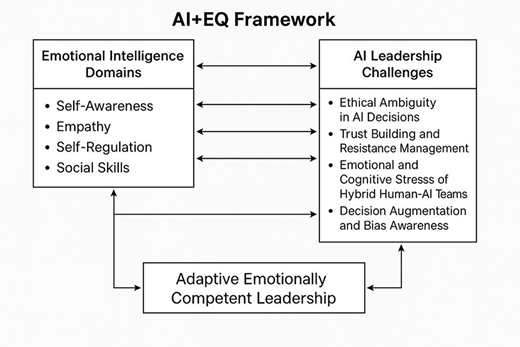
The framework discusses four areas of EI, including self-awareness, self-regulation, empathy and social skills, in the context of leadership challenges created by AI usage, such as algorithmic bias, emotional fluctuations and communication failures.
Practitioner vignettes show how emotionally attuned leadership can compensate for the absence of automation under such difficult circumstances as promotions and layoffs, and during times of change.
Unlike traditional discussions of responsible AI or emotionally intelligent leadership, however, the AI+EQ framework offers tactical advice on how to lead and prosper in the age of AI.
Introduction
Artificial intelligence (AI) has managed to leapfrog from experiment to reality in the fields of human resource management and organizational leadership. Once perceived as an efficiency tool that focuses on technicalities (such as sorting resumes, generating performance scores and standardizing decisions), AI has now found its way into how companies recruit, promote and even fire people. But failures have been propagated by the scaling of algorithms. Reducing truth to a dashboard output can feel dehumanizing, eroding trust and raising moral and ethical concerns.
The task that leaders face is less technical and more human because they have to translate AI outputs into choices that employees are willing to view as fair and equitable. Earlier studies into algorithmic management were based on how risks such as prejudice, obscurity and technocratic stasis might manifest. There is minimal provision on how leaders can offset machine inefficacy with human talent. In comparison, decades of studies exist on the role of emotional intelligence (EI) in terms of relationship building, trust and learning to make ethical judgments. There remains a gap in how these two domains can be effectively combined.
The AI+EQ framework addresses this gap by prioritizing these four areas of EI: self-awareness, self-regulation, social skills and empathy without losing the benefits of automation. It demonstrates there will never truly be an option of AI instead of human judgment, and that the way forward is in coming up with leaders who would learn to apply both concepts effectively. This paper develops its argument in three stages. Firstly, it explores the functionality of EI and its use in the AI-driven work environment. Secondly, it introduces the AI+EQ framework, providing the model of fusing EI and algorithmic decision-making. Finally, it uses practitioner vignettes and theoretical propositions to describe and specific suggestions for praxis to how the model can shift, transforming AI from being a negative force to one of trust, resiliency and human-centred performance.
The overlap between AI and EI continue to shape leadership research. For example, Tambe et al. (2019) stress ways that AI in human resource management improves performance, but necessitates emotional awareness to avoid dehumanization. Syed et al. (2023) also suggest hybrid decision-making that uses algorithmic insights as well as human empathy, demonstrating that emotionally intelligent leadership mitigates the coldness often associated with automated systems. Haenlein et al., (2023) caution against delegating decisions with emotional implications to AI tools, stressing the notion that leaders must maintain agency in emotional interpretation for the sake of steward and authenticity. These findings reinforce the necessity of as a humanizing force alongside increasingly autonomous technology.
Literature review
The concept of EI measured by an emotional quotient (EQ) has been evolving popularly in the learning field since its genesis and associated research in the twentieth century. Social intelligence was first introduced by Edward Thorndike (1920), who defined it as the skill to explain and respond to people in a way that is beneficial to both parties. This hypothetical theorization was eventually reinforced by sociological analysis of interpersonal action, particularly in Goffman, 1967 seminal work Interaction Rituals (1967). This article has critically examined the dynamics of face-to-face interactions, therefore explaining one of the fundamental foundations of the current interpretation of emotional and relational competencies.
Howard Gardner (1983) contributed to this scholarly debate significantly by developing the theory of multiple intelligences. Gardner’s framework differentiated between intrapersonal and interpersonal intelligence, thereby underscoring the pivotal role of emotions in the cultivation of human capabilities. Subsequently, Mayer and Salovey (1990) advanced a definitive conceptualization of EI as a form of social intelligence. EI was particularly defined as the ability to independently observe his/her own and others’ emotions, be able to discern the various emotions correctly and be able to use this emotional data to influence thought and action. Their ability-based model assumed that EI was a measurable skill set and thus this would be different compared to inherent personality types.
With these strong scholarly foundations, Goleman (1995) put EI into the mainstream by simplifying it into an easy model. The model incorporated five elements: self-awareness, self-regulation, motivation, empathy and social skills. The popularization of EI by Goleman made it a part of the organizational and leadership research and practice. Although there are critics, for example, Antonakis (2004) and Locke (2005), who hold that mixed models of EI are not construct clear, citing with high levels of overlap with the existing personality factors and intelligence quotient (IQ), an increasing literature of empirical studies gives credence to the incremental validity of EI in explaining workplace performance and leadership achievement. In particular, meta-analyses by Joseph and Newman (2010) and Miao et al. (2017) support this more recent claim. Moreover, meta-analytic results have strongly supported strong connections between the EI and key organizational principles, such as leadership behaviours, team cohesion, decision quality and overall organizational performance (Mayer et al., 2016. Fernández-Berrocal and Extremera, 2022).
Self-awareness
Self-awareness, recognized as a foundational element of EI, is increasingly critical within AI-driven organizational contexts. In such environments, leaders are expected to be able to make complex algorithmic insights and, at the same time, maintain human judgment. This construct is defined as the ability to perceive personal feelings, values, strengths and weaknesses (Lane et al., 1990; Sutton, 2016). Authentic and ethical practices of leadership are entirely based on self-awareness. Mayer and Salovey (1990) emphasized emotional perception as the first step in emotional processing, and Goleman (1995) emphasized self-awareness as an inseparable part of successful leadership practice.
The empirical investigation of self-awareness has been facilitated by validated measures, including the Levels of Emotional Awareness Scale and the Self-Awareness Outcomes Questionnaire (Sutton, 2016). There is evidence that mindfulness-based leadership development initiatives can supplement metacognition awareness, resilience and decision-making transparency (Tenschert and Furtner, 2021). Longitudinal studies also show that improvements in self-awareness can reduce cognitive biases, including anchoring and confirmation effects (Rastogi et al., 2020), countering biases which can be strengthened by advanced algorithmic systems unintentionally. As leaders grow to have collaborative functions with AI, self-awareness enables them to critically assess the technological outputs, thus avoiding mechanistic decision-making and providing a reasonable balance between human and technological strengths.
Self-regulation
While self-awareness helps leaders recognize bias, self-regulation allows them to act consistently in line with values under pressure. Self-regulation is another fundamental dimension of EI, which includes the ability to control disruptive impulses and stay calm, especially in times of stress. Based on a broad understanding of the social-cognitive theory (Bandura, 1986) and more recent approaches to emotion regulation (Gross, 1998), self-regulation fosters continuity and moral uprightness in leadership practices. In a fast-changing technological environment, leaders often face increased uncertainty and stress, leaving only self-regulation as a method of maintaining ethical decision-making.
Empirical studies have a consistent pattern of showing that mindfulness and self-leadership interventions have a significant effect on emotional resilience, burnout incidence and increase organizational commitment (Tenschert et al., 2024; Tenschert and Furtner, 2021). Such competencies are particularly important in situations when AI-generated suggestions can contradict organizational values or human intuition. Self-managed leaders can efficiently use the strategy of cognitive reappraisal to make meaning out of algorithmic information positively, at the same time removing counterproductive emotional responses. Such a strategy ensures that new technological tools are used to benefit, but not to undermine, human dignity and ethical leadership.
Empathy
Empathy can be described as the ability to understand and resonate with the experiences of other people. It has a conceptual background in the multidimensional construct presented by Davis (1983) and the multi-component model presented by Batson (2009). Empathy has been well known as one of the key aspects of EI (Mayer and Salovey, 1990; Goleman, 1995). These studies carried out in the organizational context all show that empathetic leadership fosters a sense of psychological safety, inclusion and trust among team members (Decety and Cowell, 2014).
As organizations increasingly integrate algorithmic tools, empathy becomes fundamental for interpreting impersonal, data-driven outcomes in a manner that acknowledges and addresses employee emotions. Survey data (EY, 2023; Businessolver, 2025) suggests that empathetic leadership effectively mitigates perceptions of automation as cold or dehumanizing, thereby enhancing morale and engagement. In practical application, empathetic leaders are capable of contextualizing AI-derived evaluations, striking a crucial balance between analytical precision and relational understanding, which in turn preserves organizational trust and cohesion.
Social skills
Beyond individual understanding, leaders must also coordinate relationships at scale through social skills. Social skills encompass a broad range of interpersonal competencies, including communication, conflict resolution, negotiation and influence. All of these are critical for effective leadership within technologically augmented organizations. Early scholarly inquiry by Riggio (1986) established a connection between social competence and occupational success. Furthermore, contemporary EI frameworks, such as those by Boyatzis and Goleman (2007), consistently position social skills as essential for adeptly managing relationships and fostering collaborative environments.
Existing research has shown that leaders with strong social-emotional competencies perform better than their counterparts within an AI-based setting. Socially competent leaders do this by successfully facilitating alignment of teams, triggering cooperation among stakeholders and facilitating problem-solving collectively (Fernández-Berrocal and Extremera, 2022). With a continual increase in routine interactions automated by AI systems, interpersonal skills like subtle negotiation and professional conflict management are given greater importance. While AI systems can undoubtedly provide substantial analytical support, human leaders possess the unique capacity to inspire shared purpose, mediate intricate interpersonal dynamics and sustain psychologically safe and high-performing teams.
Conclusion
This review has systematically traced the theoretical evolution of EI, underscored its established empirical foundations and elucidated its profound relevance to leadership practices within organizations increasingly powered by AI. By integrating scholarship, acknowledging critical perspectives and drawing upon contemporary research, this section unequivocally demonstrates how EI serves as a crucial complement to technological capabilities. Leaders who are adeptly equipped with self-awareness, self-regulation, empathy and social skills are uniquely positioned to humanize AI-driven decision-making processes and ensure the cultivation of ethical and effective organizational leadership.
Artificial intelligence-based leadership and emerging challenges
The current literature recognizes the growing role of AI in decision-making and operational processes. Davenport and Kirby (2016) emphasize the socio-technical complexity of AI integration in the workplace, noting tensions between machine logic and human values. Scholars such as Jarrahi (2018) highlight the importance of human–AI integration yet caution that over-reliance on automation can lead to technocratic rigidity. However, few studies address how leaders can actively mitigate these effects through emotional and relational capabilities.
Emotional intelligence and leadership
EI has been shown to correlate positively with leadership effectiveness, trust-building and ethical decision-making (Goleman, 1995; Ashkanasy and Daus, 2005). Meta-analysis indicates that emotionally intelligent leaders build psychological safety and mitigate organizational stress (SánchezLópez et al., 2022). The literature identifies four core domains of EI: self-awareness, self-regulation, empathy and social skills that directly map onto critical leadership competencies (Boyatzis, 2018). These domains help us understand how leadership can remain human-centred even as automation advances.
Trust in artificial intelligence systems
Lee and See (2004) suggested that human trust in AI systems depends on performance, transparency, emotional congruence and perceived fairness. Without emotional consideration, AI decisions can feel dehumanizing, undermining organizational trust. This challenge is exacerbated in high-stakes contexts where algorithmic decisions must be translated through empathetic human interpretation to preserve morale and engagement.
Methodological justification
This article contributes to the guidelines Jaakkola (2020) and MacInnis (2011) provided on the aspects of theory development. Conceptual studies are useful in uncovering new relations and explaining ambiguity in the current body of literature, and they may lead to models that can inform research. The AI+EQ framework uses literature, systematic knowledge on trust and EI studies and practitioner vignettes to formulate theoretical propositions.
The AI+EQ framework
Overview
The AI+EQ framework is not a rigid prescription but a dynamic approach to AI-driven organizations. It highlights four areas of EI: self-awareness, self-regulation, empathy and social skills, to address dynamic challenges posed by automation. It addresses shifting nature of leadership practice over time by first responding to the initial efficiencies of AI, then adjusting to their unanticipated effects, and finally introducing a feedback loop where human beings and machines constantly remake each other. This cyclical nature results in the framework being more than a conceptual tool. It is a guide to continued practice (Figure 1).
Self-awareness
During the early stage of AI usage, leaders depended heavily on the outputs of the algorithms. With time, they came to realize that these products tended to be biased and/or lacked situational sensitivity. The initial remedial action is self-awareness. Leaders began to ask themselves how they are personally influenced by machine advice, when they are being influenced by personal bias or overconfidence in technology, and that they should be aware of the emotional cues that employees use to feel that a process is unfair. In so doing, self-awareness transcends beyond a personal aspect to the protection of an organization against the sudden and unthinking embrace of automation.
Self-regulation
With the spread of AI systems, change accelerates within organizations, with a subsequent rise in change-related stress. Leaders first respond defensively to employee resistance or fearfully refer to algorithmic authority. Leaders learn through the science of self-control to be slower in decision-making, to be able to control impulses when they are under pressure, and to be morally consistent in situations where AI outputs seem to go against their intuition or values. This eventually stabilizes the organization as it becomes less intimidated by the threats of automation, so that human judgment can remain in the spotlight. Therefore, self-regulation goes beyond controlling personal emotions to establish organizational integrity during turbulent times of technology.
Empathy
The early applications of AI were generally criticized as being impersonal and detached. Decisions that were made, i.e. issues being labelled as a low potential or at risk, detached judgments detached from employee experience. Empathy places these moments back into the human perspective. Through listening, considering context and recognizing lived experience, leaders make machine assessments better, more just and more compassionate. As the practice matures, empathy as an interpersonal executive skill becomes a systemic corrective factor to the point that it becomes proactive. Empathy changes the way AI outputs are conveyed, received and believed by employees.
Social skills
After incorporating AI systems, new stresses appeared in team dynamics: misunderstandings, disputes about confidence in data and difficulties in cooperation between the human-machine working process. Social Skills such as negotiation, conflict resolution and influence mitigate these new stresses. Successful leaders keep teams on track and reinforce trust. Employee voices are represented in addition to machine logic. Social skills develop over time in relationship management and in the management of organizations and hybrid human-AI teams can operate with psychological safety and purpose.
Assumptions of the evolutionary model
EI is not just a buffer of ethical tensions; it constantly reorganizes the perception and implementation of AI.
AI–human leadership is iterative: leadership uses EI, employees react and AI practices change as a result.
Building up trust is not a single event but a circle of openness, understanding and modification.
Leadership vignettes
The following vignettes are examples of how emotionally intelligent leadership shifts AI-driven processes. Each example demonstrates the pre- and post-state where automation was the leading factor that caused alienation, and where EI changed the results. Combined, they reveal that the AI+EQ framework is not a fixed process, but a process that is constantly being updated as leaders use EI in organizational practice.
Vignette 1: self-awareness in performance scoring
Pre: A technological firm came up with AI-based performance assessments. Even though the system was accurate according to the encoded rules, the employees did not trust the results. Scores were impersonal, lacked context and background and made the teams feel disengaged and sceptical.
Post: Self-awareness in the chief human resource officer brought the realization that the system had failed to acknowledge the emotional response of employees. By doubting the process and recognizing the disconnection, leaders reframed the results in the dialogue, clarifying what the AI could and could not do. This openness restored confidence. Self-awareness, which is the realization of the moment when reliance on technology replaced human connection, enabled performance data to be constructive and not alienating.
Vignette 2: self-regulation in layoff decisions
Pre: An organization with a restructuring problem used predictive analytics to identify redundant roles. When managers found themselves under pressure to make cost reductions, they first ceded completely to the algorithm and declared layoffs without providing much warning. The outcome was panic, resentment and a collapse of trust.
Post: Leaders used self-regulation, and did not give in to the urge to take immediate action based on AI outputs. They took a break, analysed other scenarios and implications on culture in the long term. They made layoffs clear and consistent by reducing stress and the speed of decision-making, which provided them with the means of offering support to victims. The employees inevitably disagreed with the decisions, but the process was not so dehumanizing. Self-control made a machine-induced event, which was emotional, into a dignified event.
Vignette 3: empathy as a talent assessment
Pre: In a logistics company, an employee has been designated as having low potential for promotion by an algorithm. The recommendation that was made by the system was highly data-driven due to the recent declines in performance, and the employee was almost put on the sidelines.
Post: Her manager intervened with empathy, stating that the employee was mourning the loss of a loved one. By putting the output of the AI in context using human knowledge, her manager reformulated the evaluation, offered support and enabled her to heal. Several months later, she was one of the best contributors on her team. Empathy facilitated the disjunction between human experience and automated assessment, saving not only one career but also the culture of care at the organization.
Vignette 4: social skills in hybrid team collaboration
Pre: A multinational services firm implemented AI-based project planning. Soon divisions began to form in teams: some believed that the system was the final authority, and others dismissed it as cold and rigid. Poor communication heightened, and teamwork failed.
Post: Leaders were using social skills to arbitrate between groups. Through negotiation, active listening and conflict resolution, they got the teams to speak up. Conversations clarified the misunderstanding and positioned the AI as a partner but not a replacement for natural discussion by stakeholders. Leaders established trust and alignment through dialogue. Social skills reshaped a divided work environment into a hybrid human-AI partnership, proving that influence and communication are human strengths that AI cannot replace.
Theoretical propositions
Leader emotional intelligence (EI) positively correlates with employee trust in AI systems.
Leader empathy moderates resistance to AI implementation by reframing narratives and addressing emotional anticipation.
Self-regulation mediates stress responses in rapid AI-change environments, preserving decision quality.
Social skills enhance team performance in hybrid human-AI collaboration by improving communication and coherence.
The propositions of the research are grounded in yet unverified theoretical mechanisms. Particularly, Proposition 1 is an application of the EI to trust relationship found generally. Social Exchange theory directs P2 and holds the view that affectively responsive leaders build mutual trust, thereby minimizing resistance to supervisory advice. P3 is backed by the affective events theory, whereby self-regulation mediates emotional labour and positively affects task performance. Proposition 4 is supported by the general application of the general relationships between social skills and team performance.
Leadership development design
The development of leadership should keep abreast with the phases of AI integration:
Stage 1 – Efficiency: This is when leaders start to realize how AI functions, but the training should show the dangers of excessive reliance and mitigating strategies.
Stage 2 – Resistance: When employees begin to express the doubt in their own confidence and fairness, EI skills to be developed in self-awareness and empathy to see resistance as feedback instead and to value the employees’ self-efficacy calculus.
Stage 3 – Integration: At this stage, organizations will have to devise systematic training that combines AI literacy and EI (Goleman, 2021; Miao et al., 2017). Along with data analysis proficiencies, programs are to incorporate some mindfulness, empathy-building and conflict resolution.
Stage 4 – Institutionalization: When the AI+EQ practices have matured, the development moves to the introduction of EI-based metrics into the leadership pipelines and succession planning (Jarrahi, 2018). When integrated into a strategic capability, EI is never a soft skill or an addition but a durable skill that empowers and supports technical performance.
Organizational practice
Organizations should treat the AI+EQ framework as a roadmap for adaptive practice:
Stage 1: Implement AI systems to be efficient but keep track of the symptoms of employee distrust (Haenlein et al., 2023).
Stage 2: Present feedback systems – surveys of employees, focus groups – that reflect emotional responses.
Stage 3: Entrench cross-functional leadership task forces which monitor technical outputs as well as the emotional climate. These groups need to combine the accuracy of algorithm with a balance of morale or inclusion and perceptions of fairness.
Stage 4: Maintain, as an AI+EQ mature organizations institutional dashboards based on the combination of affective indicators (trust, resilience, engagement) and performance indicators. Regularly audit bias, not exclusive to AI, but also encompassing the psychosocial impact of AI implementation.
Policy and ethics
The policy responses should also be subject to changes with maturity stages:
Stage 1: The stage presupposes that the decision-making processes based on algorithms should be transparent to ensure the absence of hidden biases.
Stage 2: Within this stage, leaders should be encouraged to record and report on the contextualization of AI decisions with human judgment.
Stage 3: Implement regulatory requirements relating to psychosocial impact assessment, where moral, dignity and trust are assessed, in addition to technical safety.
Stage 4: The most mature stage should have policies that ensure EI-enhanced governance patterns are put in place–where AI implementation regard both productivity and humanity.
Limitations
The AI+EQ framework is founded on the level or extent of the leader’s agency, which does not exist in every industry. In very automated or heavily controlled industries, leaders might be unable to veto or reconsidered in context machine outputs. Moreover, the cultural context is important: empathy and the ability to socialize may not be expressed in the same ways in a collectivist and individualist settings. Implementing the framework will be influenced by industry precedents, history of the organization and the leader’s experience.
The maturity levels in the different industries and cultures need to be experimented with to narrow the boundary conditions. Empirical work is especially needed to evaluate whether organizations truly progress through these stages, or whether they cycle back when new technologies disrupt established practices.
Future research
Much future research could test the hypotheses offered in this work. Repeating previous research related to EI and adaptation to new processes and technology could be repeated with the researchers drawing on existing design-of-experiment structures.
Conclusion
AI has transformed the decision-making process of organizations, but its efficiency is typically traded at the cost of human connection. The early HR automation was confined to resume screening, performance ranking and standardization of promotions. These instruments ensured speed but created an effective vacuum – the procedures seemed logical on paper but foreign to the employees. With the known tensions arising in spheres of trust – fairness and morale- it has become clear that efficiency alone could not maintain healthy workplaces.
The next step is the AI+EQ framework. By integrating self-awareness, self-regulation, empathy and social skills into AI-driven contexts, leaders can buffer automation’s ethical and emotional risks. The framework is not a check list for completion but a living model that is subject to change as organizations implement it. By being capable of and committed to introducing empathy to the cold evaluation of an algorithm or introducing self-regulation to the pressure of automation, leaders not only influence the final product but also alter the perception and reception of AI by employees. In this way, humans establish feedback loops that enhance perceptions of trustworthiness of leaders and of AI use within their organizations.
This evolution can be well illustrated by the vignettes: performance scores that were required to have a human face to create a sense of trust, or a low-potential flag that was reconsidered in context with empathy to save a career. These instances demonstrate how emotionally intelligent leadership renders the use of AI a more human-to-human concept operation. Its use becomes more emotionally intelligent than a mechanistic system through the prism of collaboration. These are iterative processes suggested by AI, contextualized by EI and acquired by the organization. The implications are pressing for human resources and leadership practice. Leaders should be trained not just in AI literacy but also in EI to make AI usable and humane. Leaders are to be alert to low morale and perceptions of unfairness beyond accuracy and should establish cross-functional teams that will audit algorithms and their impact on emotions. Policymakers will also be forced to cease conducting technical audits and begin integrating the psychosocial risk assessments.
AI in the form of ChatGPT was used to edit the final draft of this original manuscript authored by the named authors.