This study aims to investigate how perceptions of emerging digital technologies shape entrepreneurial intention (EI), focusing on blockchain technology (BCT) as a case. Specifically, it examines how perceived usefulness, perceived platform risk and entrepreneurial opportunity recognition (EOR) influence the decision to pursue entrepreneurial activity in evolving digital ecosystems.
A quantitative survey of 155 participants in Greece, including entrepreneurs, professionals, and students, was analysed using partial least squares structural equation modeling. The proposed model tested the direct, mediating, and moderating effects of perceived usefulness of blockchain (PUBT), perceived platform risk (PPR) and EOR on EI.
Results indicate that both PUBT and EOR significantly and positively influence EI, with EOR acting as a partial mediator. Conversely, PPR weakens the relationship between PUBT and EI, underscoring how perceptions of risk temper the otherwise positive role of blockchain. The model explains 53% of the variance in EI and demonstrates strong reliability and fit.
Findings inform entrepreneurs, educators and policymakers seeking to foster blockchain-enabled ventures. Strategies such as literacy programs, risk-mitigation mechanisms and supportive regulatory frameworks can enhance entrepreneurial capacity in digital ecosystems.
By integrating the Technology Acceptance Model with the Entrepreneurial Event Model, this study advances entrepreneurship research beyond traditional technology adoption frameworks. It highlights how entrepreneurs cognitively translate technological affordances into opportunity recognition, while also managing risk perceptions that constrain intention.
1. Introduction
Blockchain technology (BCT) is a decentralised, distributed-ledger system that records and verifies transactions in a manner designed to resist unauthorised alteration and manipulation. Rejeb et al. (2020) show that deploying BCT in contemporary business settings can strengthen transaction security and transparency, two conditions that support trust in uncertain entrepreneurial environments (Schilhabel, 2025). By distributing control across a peer network, BCT reshapes how information is stored, verified and shared, allowing entrepreneurial stakeholders to operate with greater confidence. Because no single party exercises exclusive control over the ledger, BCT may reduce certain risks associated with data manipulation, unauthorised intervention and information asymmetry (Mafike and Mawela, 2022).
However, blockchain adoption remains highly heterogeneous across industries because the technology creates different value propositions, implementation costs, regulatory requirements, and governance challenges depending on the business context. Adoption has progressed more rapidly in sectors where transparency, traceability and transaction integrity are strategically important, such as financial services, supply chain management, logistics, healthcare and agri-food systems. By contrast, industries characterised by lower digital maturity, fragmented digital infrastructures, limited technological capabilities, or uncertain regulatory environments have adopted blockchain more cautiously. Turhan and Akman (2023) demonstrate considerable sectoral variation in organisational blockchain adoption, while Yap et al. (2025) show that adoption decisions are strongly influenced by organisational readiness, technological competence, and perceived implementation barriers. Consequently, entrepreneurs operating across different industries are likely to evaluate BCT through different cognitive and strategic lenses. These sector-specific differences are expected to shape perceptions of blockchain usefulness (PUBT), entrepreneurial opportunity recognition (EOR) and perceived platform risk (PPR), providing a strong rationale for examining how these constructs jointly influence entrepreneurial intention (EI).
Entrepreneurship has long been defined as the process through which individuals identify, evaluate, and exploit opportunities to create new economic value through new ventures or innovative organisational activities (Shane and Venkataraman, 2000). Rather than representing merely the act of establishing a business, entrepreneurship is fundamentally a process of opportunity recognition, resource mobilisation, innovation and value creation under conditions of uncertainty. Within this process, EI constitutes the conscious state of mind that precedes entrepreneurial behaviour and reflects an individual’s commitment to pursuing venture creation (Shapero and Sokol, 1982). As digital technologies increasingly reshape entrepreneurial ecosystems, the ability to recognise technology-enabled opportunities has become a critical entrepreneurial capability. In this context, BCT extends beyond its technical functionality by enabling entrepreneurs to develop new business models, reduce transaction costs, strengthen trust among stakeholders and create decentralised mechanisms for value exchange. Consequently, understanding how entrepreneurs cognitively evaluate BCT, recognise entrepreneurial opportunities, and perceive platform-related risks is essential for explaining EI in contemporary digital ecosystems.
Greece provides a theoretically relevant setting for this study because it combines an evolving entrepreneurial ecosystem with uneven adoption of advanced digital technologies. According to the Global Entrepreneurship Monitor (2025), Greece continues to face comparatively constrained entrepreneurial framework conditions, while entrepreneurial activity is characterised by the coexistence of perceived opportunities and substantial uncertainty, including relatively high fear of entrepreneurial failure. This makes the country particularly relevant for examining cognitive mechanisms involving opportunity recognition and perceived risk.
At the same time, Greece is undergoing an important but uneven digital transformation. European Commission (2024) evidence shows that Greek SMEs continue to lag behind the EU average in digital intensity and in the adoption of advanced digital technologies, despite improvements in digital infrastructure and the development of a dynamic start-up ecosystem. Specifically, in 2023, 43.3% of Greek SMEs had reached at least a basic level of digital intensity, compared with 57.7% across the EU, while 33.5% of Greek enterprises had adopted advanced technologies such as artificial intelligence, cloud computing or data analytics, compared with an EU average of 54.6%. Empirical research on Greek SMEs similarly indicates that digital transformation is shaped by organisational readiness, strategic orientation, managerial engagement, resource availability and digital capabilities (Kargas et al., 2023; Gkika et al., 2025). Taken together, these characteristics position Greece as an informative empirical context in which emerging technological opportunities coexist with capability constraints and uncertainty. This combination makes the country particularly appropriate for investigating how perceived blockchain usefulness, EOR and PPR jointly shape EI.
Boukis (2019) observes that blockchain’s distributed ledger allows entrepreneurs to authenticate transactions directly and cut out costly intermediaries, trimming expenses and tightening managerial oversight; these advantages are especially valuable in trust-sensitive sectors-finance, supply-chain management and e-commerce-where decentralised verification speeds operations while fostering transparency and accountability (Wang, 2024). Uptake, however, hinges on a fine balance: enablers such as traceability, trust and collaborative networks must counter obstacles like low digital literacy, high implementation costs and data-privacy worries (Yap et al., 2025), and the growth of digital ecosystems often heightens tensions between openness and control, cooperation and competition, as illustrated by Sweden’s forest-based innovation cluster (Koukouvinou et al., 2023). Crucially, by removing intermediaries ventures also sidestep the fees embedded in conventional transaction systems (Wang et al., 2023). In ecosystems where investor confidence, consumer trust and regulatory compliance are pivotal, BCT is fast becoming the bedrock on which new ventures are built and scaled (Paajala et al., 2022); its immutable transaction trails boost credibility with financiers and customers, and early adopters often gain a competitive edge because the technology itself signals reliability (Singh et al., 2022), while smart contracts-self-executing code on-chain-further enhance efficiency by automating tasks and reducing failure points (Xu et al., 2021).
Against this backdrop, perceived usefulness (PU) and EOR emerge as psychological conduits through which BCT spurs venture creation, whereas PPR can stifle it, making it untenable to ignore blockchain’s entrepreneurial implications; as adoption broadens, regulatory frameworks will adapt in tandem, cementing blockchain’s role in shaping entrepreneurial trajectories.
Despite these important advances, the existing literature has predominantly examined BCT from technological, operational, and adoption perspectives, with comparatively less attention devoted to the cognitive mechanisms through which entrepreneurs translate blockchain perceptions into EI. While previous studies have documented the benefits and challenges of blockchain implementation, limited empirical evidence explains how PU stimulates EOR or how PPR may constrain this relationship. Consequently, an important research gap remains regarding the combined influence of these cognitive factors on EI within emerging digital ecosystems. Addressing this gap is theoretically important because it advances current understanding of how technology perceptions are translated into entrepreneurial cognition and behavioural intention, extending existing technology adoption and entrepreneurship theories beyond simple adoption outcomes. To resolve this uncertainty, the present study develops and empirically tests an integrated model linking perceived usefulness of BCT (PUBT), EOR, PPR and EI in the context of Greece.
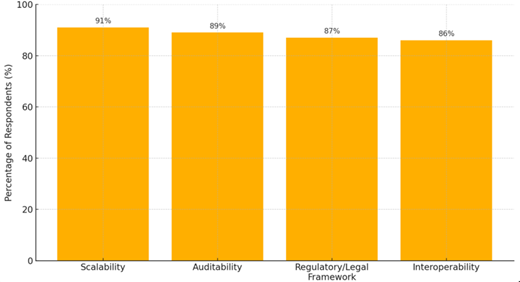
To probe these dynamics empirically, the present study employs Structural Equation Modeling (SEM) to test how PU, Platform Risk and Opportunity Recognition influence EI-constructs anchoring the proposed conceptual framework and hypotheses. Figure 1 illustrates the key blockchain features that underpin the entrepreneurial implications discussed above.
According to PwC’s Global Blockchain Survey (PwC, 2018), 389 businesses developing/blockchain operations successfully responded to the requirements, where the top four capabilities/factors are scalability (91%), auditability (89%), legal compliance (87%) and interoperability (86%). These capabilities decrease fraud, improve efficiencies and create reliable financing opportunities such as tokenization and Initial Coin Offerings (ICOs). Complementing these findings, Boukis (2019) emphasizes that blockchain’s decentralised architecture lets entrepreneurs authenticate transactions independently of traditional institutions, thereby accelerating venture formation. While many of these findings allude to financial transactions specifically, there are also opportunities to secure energy supply-chain verification, intellectual property validation and “smart” loans. Garg et al. (2021) demonstrate that founders can observe capital inflows per investor, automate shareholder agreements and drive accountability on crowdfunding sites to improve innovation potential and investor interest.
Challenges remain. High energy consumption in Proof-of-Work (PoW) consensus raises environmental and scalability concerns (Hariyani et al., 2025). Technical complexity and regulatory uncertainty deter less-experienced founders, while digital-literacy and privacy issues also impede adoption (Rahman et al., 2021). Targeted policy measures and education are therefore essential to realise blockchain’s entrepreneurial potential.
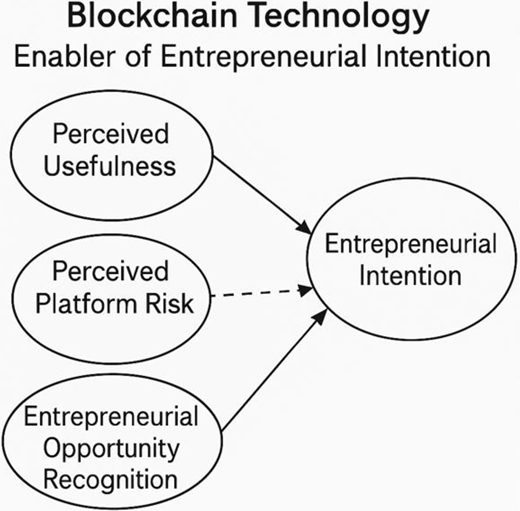
Building on this literature, the proposed conceptual framework links PUBT, EOR, PPR and EI. Figure 2 presents the conceptual framework linking blockchain-related perceptions to EI.
In sum, this study seeks to clarify how BCT enhances entrepreneurial trust, opportunity recognition and perceived platform reliability within evolving entrepreneurial ecosystems, using Greece as an illustrative context.
Accordingly, the overall aim of this study is to develop and empirically test an integrated model explaining blockchain-related EI in the Greek context. This aim is addressed through three specific research objectives, each directly linked to a corresponding research question:
Objective 1: To examine how perceived usefulness of blockchain technology (PUBT) influences entrepreneurial opportunity recognition (EOR):
How does the perceived usefulness of blockchain technology influence entrepreneurial opportunity recognition?
Objective 2: To investigate the direct and indirect effects of perceived usefulness of blockchain technology on entrepreneurial intention (EI), including the mediating role of entrepreneurial opportunity recognition:
To what extent does entrepreneurial opportunity recognition mediate the relationship between perceived usefulness of blockchain technology and entrepreneurial intention?
Objective 3: To evaluate the moderating role of perceived platform risk (PPR) in the relationship between perceived usefulness of blockchain technology and entrepreneurial intention:
To what extent does perceived platform risk moderate the relationship between perceived usefulness of blockchain technology and entrepreneurial intention?
2. Literature review
2.1 Theoretical foundations
To ground the study in established theory, this paper draws on two complementary frameworks: the Technology Acceptance Model (TAM) (Davis, 1989) and the Entrepreneurial Event Model (EEM) (Shapero and Sokol, 1982).
TAM posits that behavioral intention to adopt a technology is primarily influenced by PU and Perceived Ease of Use. In entrepreneurial contexts, PU is especially relevant when a new technology – such as blockchain – is evaluated for its potential to enhance business performance, trust or efficiency. This study extends PU to the domain of blockchain by operationalising it as PUBT, a key construct in the structural model.
EEM, on the other hand, suggests that EI is influenced by perceived desirability, perceived feasibility, and the propensity to act upon opportunities. In this study, EOR maps onto the EEM construct of perceived desirability, capturing the cognitive ability to identify value-creating opportunities in blockchain-enabled environments. EOR thus functions as a mediating construct linking blockchain usefulness perceptions to entrepreneurial intent.
By fusing the TAM with the EEM, this study frames blockchain uptake not only as a question of technical appraisal (per TAM) but also as an entrepreneurial behaviour shaped simultaneously by technology beliefs and venture-focused cognition. That synthesis underpins the SEM‐based structural model, which probes the direct, mediating and moderating links among PUBT, EOR, PPR and EI.
Crucially, the work does not replicate classical TAM adoption studies. Instead, it extends TAM by embedding EOR and PPR to show how would-be founders decide in blockchain-enabled settings. This composite lens resonates with sociotechnical thinking, spotlighting the interaction of individual cognition, technological affordances and institutional uncertainty, and thus applies technology-acceptance ideas to a fresh entrepreneurial context beyond conventional paradigms.
Unlike many digital technologies that primarily enhance operational efficiency, automation, or information processing, BCT possesses distinctive characteristics - decentralization, transparency, immutability, and trustless verification - that fundamentally reshape entrepreneurial interactions. These blockchain-specific attributes enable entrepreneurs to establish trust without relying exclusively on traditional intermediaries, thereby reducing information asymmetry and creating conditions under which new entrepreneurial opportunities become more readily identifiable (Tan and Saraniemi, 2023). Consequently, the present study argues that blockchain influences EI through a blockchain-specific cognitive mechanism in which PU stimulates EOR, while PPR constrains this process. Rather than simply combining TAM and the EEM, the proposed framework explains how blockchain-specific technological affordances are translated into entrepreneurial cognition and ultimately into EI.
Recent studies further demonstrate that technology adoption in entrepreneurial settings extends beyond the traditional determinants of technology acceptance. Jalil et al. (2025), for example, show that PU contributes to blockchain acceptance among entrepreneurs and that its entrepreneurial effects can operate through intervening cognitive and knowledge-related mechanisms. Similarly, Redondo-Rodríguez et al. (2026) identify motivational, enabling and contextual factors as important drivers of entrepreneurial technology adoption, while emphasising barriers such as technological capabilities, education and regulatory conditions. At the ecosystem level, Rawhouser et al. (2024) demonstrate that blockchain can influence multiple dimensions of entrepreneurial ecosystems, including policy, finance, human capital, support and markets. Recent blockchain-specific research also highlights the importance of technological, organisational and environmental adoption barriers (Mohammed et al., 2024), while Patra et al. (2025) identify regulatory, technological and organisational roadblocks that can constrain blockchain adoption among international entrepreneurs. Collectively, this recent literature supports the need to examine blockchain-related entrepreneurship as a context-dependent process in which perceptions of technological usefulness interact with entrepreneurial cognition and perceived risk.
2.2 Advantages and disadvantages of the use of BCT in entrepreneurship
As summarised in Table 1, BCT presents entrepreneurs with both significant opportunities and important implementation challenges. On one edge, it provides opportunities for trust and transparency that are levels above what current systems can offer-assets needed for new ventures (Tan and Saraniemi, 2023). Immutable access to digitally-secured asset repositories, smart contracts that are executed automatically, and identity confirmation on-chain allow founders the ability to eliminate unnecessary, costly intermediaries while simultaneously cutting through red tape (Schilhabel, 2025), generating ancillary efficiencies in quasi real-time (Mafike and Mawela, 2022). Alternative equity through peer-to-peer financing in ICOs or tokenised equity gives cash-strapped start-ups more options to raise funds (Neene et al., 2022). Within the current body of empirical literature testing entrepreneurial perceptions of blockchain, the majority of world wealth generation finds that trust automation, decreased fraud and increased investor exposure are leading benefits of using BCT entrepreneurially (Idrees et al., 2021), increasing PU and thus fostering innovative business plans with scalable intent and regulatory compliance.
Drawbacks, however, are significant. Limited network throughput, volatile fees and energy-hungry consensus algorithms-especially Proof of Work-can overburden lean firms (Ferreira da Silva and Moro, 2021). A parallel skills deficit means many founders lack the technical depth to implement blockchain effectively, stalling adoption and blunting innovative capacity (Familoni et al., 2024). In developing contexts, digital illiteracy and regulatory grey areas create additional friction (Wang, 2024).
Recent evidence underscores this dual reality: blockchain-enabled supply chains markedly improve visibility and efficiency (Wang et al., 2023), yet broad adoption still hinges on education and capacity-building, since many entrepreneurs remain sceptical or unaware of concrete benefits (Paajala et al., 2022); moreover, even when technical trust is feasible, persistent challenges in cybersecurity, data privacy and regulatory compliance must be addressed (Singh et al., 2022). In short, while BCT offers a clear pathway to greater trust, efficiency and decentralised innovation, realising its full potential will require overcoming complexity, scalability bottlenecks and talent shortages through targeted policies, specialised training and supportive infrastructure.
2.3 Factors by which BCT boosts entrepreneurial trust and performance
Researchers identify five inter-locking mechanisms through which BCT heightens trust and amplifies start-up performance: eliminating intermediaries via smart contracts gives founders greater autonomy and faster decisions, cutting enforcement frictions and human error while lowering platform risk and boosting resilience (Schilhabel, 2025); blockchain’s inherent transparency lets any authorised stakeholder audit the ledger, reducing information asymmetry in opaque settings and thereby deepening relationships and widening EOR (Gleim and Stevens, 2021); data immutability ensures records cannot be altered, protecting founders from fraud and retroactive liability and supporting trust-based decisions and smoother dispute resolution (Wang, 2024); real-time product tracking validates provenance, encouraging ethical and compliant supply chains that today’s consumers value (Singh et al., 2022); and decentralised identity management streamlines onboarding, reduces privacy risks and speeds cross-border interactions, directly underpinning scalable growth-collectively positioning BCT as essential infrastructure for entrepreneurial credibility and operational excellence.
2.4 Functional roles of BCT in entrepreneurial activities
BCT fulfils several core functions that underpin venture creation. It facilitates decentralised data storage, autonomous governance and resource traceability-each crucial for lowering friction, ensuring data reliability and meeting compliance demands (Boukis, 2019).
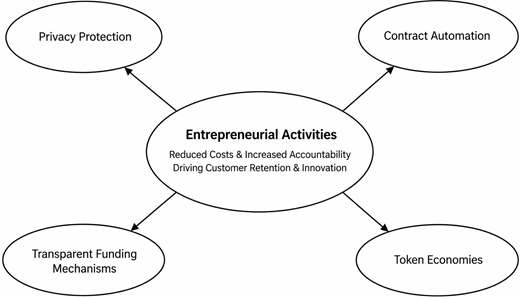
As Figure 3 illustrates, privacy protection, contract automation and transparent funding channels help founders cut costs and enhance accountability. Token economies supporting customer incentives, loyalty programmes and equity-like participation further cement stakeholder engagement and spur innovation (Familoni et al., 2024).
Beyond efficiency, blockchain empowers entrepreneurs to craft novel, decentralised business models and shared-value ecosystems (Wang et al., 2023). Pairing BCT with the Internet of Things (IoT) enables real-time traceability and data-driven decision-making (Paajala et al., 2022).
Blockchain’s potential may be further enhanced when combined with other emerging technologies such as artificial intelligence (AI), the Internet of Things (IoT), and cloud computing. While IoT can generate real-time data and AI can analyse them, blockchain can provide trusted, transparent, and tamper-resistant verification, creating integrated digital solutions with greater entrepreneurial value (Mohammed et al., 2024). Such technological convergence may expand entrepreneurial opportunities, although it can also increase interoperability, cybersecurity, and governance challenges. Taken together, blockchain may create greater value when it operates as part of a wider ecosystem of complementary digital technologies rather than in isolation.
2.5 Future scope of BCT in entrepreneurial ecosystems
Looking ahead, BCT is poised to become foundational infrastructure for decentralised venture creation, covering fundraising, governance, identity management and end-to-end transparency (Stallone et al., 2024). Disintermediation will permit secure interactions without central authorities, slashing transaction costs and friction.
Cross-border entrepreneurship should likewise accelerate as blockchain reduces reliance on local legal frameworks, opening global markets to SMEs previously excluded from international trade (Mafike and Mawela, 2022). Decentralised applications (dApps) and Decentralised Autonomous Organizations (DAOs) offer alternative governance models where founders operate without a single controlling entity (Menon and Mady, 2021).
Smart-contract automation will further streamline business functions, enabling leaner, adaptive ecosystems that optimise operations in real time (Idrees et al., 2021). On the horizon are token-based communities, decentralised marketplaces and programmable-capital frameworks that widen economic participation-especially in underbanked regions (Familoni et al., 2024).
Collectively, these developments foreshadow a deep reconfiguration of entrepreneurship-one defined by digital transformation, stakeholder empowerment and platform-centric economies that stress resilience, agility and technological sovereignty in an increasingly volatile world.
3. Methodology
This study employs a quantitative, cross-sectional survey to explore how perceptions of BCT shape EI. Partial Least Squares Structural Equation Modeling (PLS-SEM) was selected for its predictive focus, ability to model intricate latent structures and robustness with modest sample sizes (Hair et al., 2019).
3.1 Data collection
Data were gathered in Greece through an online structured questionnaire administered between February and June 2025. The survey was distributed via professional and academic networks, entrepreneurship-focused forums, LinkedIn groups and online communities dedicated to BCT, digital innovation, and entrepreneurship to reach respondents familiar with entrepreneurial ecosystems and blockchain technologies. Using non-probability purposive sampling, 155 valid responses were obtained from participants aged 25–66 years. Respondents comprised entrepreneurs, business professionals and university students with differing levels of start-up and tech engagement, enabling broad, cross-generational insight into blockchain’s entrepreneurial role. The inclusion of university students was considered appropriate because EI is widely recognised as a pre-venture construct that develops before the creation of a new business. Their inclusion does not imply that all students will eventually become entrepreneurs; rather, students interested in entrepreneurship and digital innovation can provide valuable insights into the cognitive processes underlying EI at the pre-venture stage. Participation was voluntary and anonymous; informed consent conformed to EU General Data Protection Regulation (GDPR) standards. To minimise the potential for common method bias, respondents were assured of anonymity and confidentiality, participation was entirely voluntary, and all questionnaire items were adapted from previously validated measurement scales, consistent with the procedural recommendations of Podsakoff et al. (2012).
Ethical statement: Participation in the study was voluntary and anonymous. Informed consent was obtained from all participants before completion of the questionnaire. No personally identifiable or sensitive personal data were collected, and all data were handled confidentially and in accordance with the EU GDPR.
3.2 Measurement instrument
The survey contained 16 closed items organised into four reflective latent constructs drawn from the study’s framework. Responses used a five-point Likert scale (1 = Strongly Disagree, 5 = Strongly Agree). Constructs were: PUBT, EOR, PPR and EI. The measurement scales were selected because they capture well-established cognitive constructs that are theoretically applicable to technology adoption and entrepreneurship research. Although some of the original instruments were not developed specifically for blockchain-based entrepreneurial contexts, the wording of the items was carefully adapted to explicitly refer to BCT while preserving the conceptual meaning and psychometric foundations of the original scales. Items were adapted from validated sources to assure content fidelity: PUBT from Kamble et al. (2019); EOR from Schlichte and Junge (2024); PPR from Phamthi et al. (2024); and EI from Suanpong et al. (2025). Full item wording and citations appear in the Appendix.
3.3 Data analysis procedure
Analyses were executed in SmartPLS 4 following a two-phase sequence. First, the measurement model was scrutinised: internal consistency via Cronbach’s alpha and composite reliability (CR), convergent validity via average variance extracted (AVE) and discriminant validity through the Fornell–Larcker criterion plus Heterotrait–Monotrait (HTMT) ratios. Second, the structural model was estimated with 5,000-sample bootstrapping to test path significance. Model quality was further judged by coefficients of determination (R2) and predictive relevance (Q2). A moderation test assessed whether PPR conditions the PUBT → EI relationship.
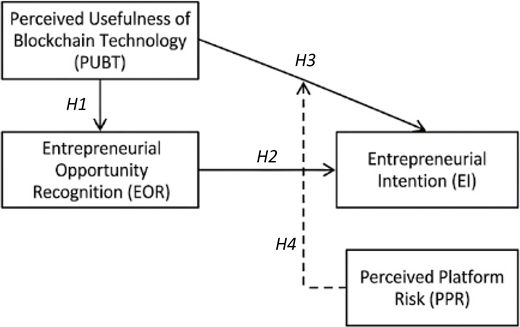
The resulting conceptual model depicts hypothesised paths among PUBT, EOR and EI, with PPR specified as a moderator.
3.4 Conceptual framework and hypotheses development
The conceptual framework integrates the TAM and the EEM, combining perspectives on technology perceptions and entrepreneurial cognition. The model incorporates four latent constructs: PUBT, EOR, EI and PPR.
Building upon the research questions presented in the Introduction, the conceptual framework translates each research question into empirically testable hypotheses. Accordingly, H1 operationalises RQ1, H2 and H3 operationalise RQ2, and H4 operationalises RQ3 by examining the direct, indirect, and moderating relationships among the four study constructs.
Although EOR has traditionally been associated with cognitive schemas, prior knowledge, entrepreneurial alertness, and accumulated experience (Shane and Venkataraman, 2000; Ardichvili et al., 2003; Baron, 2006), research on digital entrepreneurship increasingly suggests that entrepreneurs’ perceptions of emerging technologies also shape the opportunities they recognise. Perceiving BCT as useful does not automatically generate entrepreneurial opportunities; rather, it motivates entrepreneurs to explore potential applications, evaluate new business possibilities, and reinterpret market needs through the unique capabilities of BCT. Consequently, PU is conceptualised in the present study as a cognitive trigger that facilitates the recognition of blockchain-enabled entrepreneurial opportunities rather than as the sole determinant of EOR.
The proposed hypotheses are formulated as follows:
Perceived Usefulness of Blockchain Technology (PUBT) positively influences Entrepreneurial Opportunity Recognition (EOR).
Entrepreneurial Opportunity Recognition (EOR) positively influences Entrepreneurial Intention (EI).
Perceived Usefulness of Blockchain Technology (PUBT) positively influences Entrepreneurial Intention (EI).
Perceived Platform Risk (PPR) negatively moderates the relationship between Perceived Usefulness of Blockchain Technology (PUBT) and Entrepreneurial Intention (EI), such that the relationship is weaker under high perceived risk.
This framework allows for the examination of both direct and indirect effects, including the mediating role of opportunity recognition and the moderating effect of perceived risk on technology-based EIs.
The hypothesised relationships are depicted in Figure 4.
4. Results and analysis
4.1 Demographic profile of respondents
Table 2 summarises the demographic makeup of the 155 participants whose questionnaires were retained for analysis. Men constituted 58.1% of the sample, women 38.7%, and 3.2% declined to state their gender. The age distribution mirrors Greece’s core entrepreneurial cohort: a combined 64.5% fell between 35 and 54 years, with 29.7% aged 35–44 and 34.8% aged 45–54.
Professional backgrounds were deliberately varied to capture perspectives from individuals at different stages of entrepreneurial engagement.
University students accounted for 33.5% of the sample, practising entrepreneurs and founders comprised 28.4%, and business professionals represented 38.1%. The student group was included to capture pre-venture EIs and should not be interpreted as implying that all student respondents will subsequently become entrepreneurs. The heterogeneous composition of the sample reflects different levels of entrepreneurial and professional experience.
4.2 Measurement-model evaluation
Reliability and validity tests preceded structural analysis. As displayed in Table 3, Cronbach’s alpha and CR for every construct exceeded the recommended 0.70 threshold, evidencing strong internal consistency (Hair et al., 2019). AVE values were all above 0.50, confirming convergent validity.
Discriminant validity was supported by both the Fornell–Larcker test – each construct’s AVE square root exceeded its inter-construct correlations – and the HTMT ratios, all below the conservative 0.85 cut-off (Henseler et al., 2014).
4.3 Structural-model evaluation
Partial Least Squares SEM (SmartPLS 4) was used to estimate structural paths, with significance tested via 5,000-sample bootstrapping. The model explains 53% of the variance in EI (R2 = 0.53) and 41% in EOR (R2 = 0.41), indicating moderate explanatory power.
Predictive relevance measures (Stone–Geisser Q2) were all positive, supporting the predictive relevance of the model. The structural results further indicate significant relationships among the hypothesised constructs, including a significant negative moderating effect of PPR on the PUBT → EI pathway.
Collectively, these statistics demonstrate that the hypothesised model is statistically sound and substantively meaningful, capturing how perceived blockchain usefulness, opportunity recognition and platform risk jointly shape EI.
4.4 Model fit
Global model fit was evaluated using the standardised root mean square residual (SRMR) and the Normed Fit Index (NFI). The SRMR value was 0.045, well below the conservative cutoff of 0.08, indicating good model fit (Henseler et al., 2014). The NFI value was 0.91, exceeding the 0.90 threshold commonly recommended in PLS-SEM (Bentler and Bonett, 1980), further supporting the model’s robustness. These indices collectively confirm that the model fits the data well and is statistically sound.
4.5 Hypothesis testing
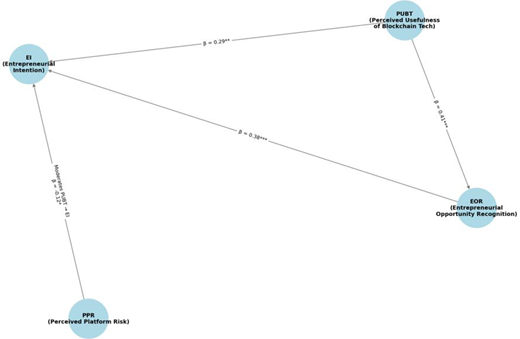
The results of the hypothesis testing are presented in Table 4.
All hypothesised paths were statistically significant and supported, validating the proposed structural relationships.
H1: PUBT → EOR
The first hypothesis posited that perceptions of blockchain usefulness positively influence opportunity recognition. This was confirmed by a strong path coefficient (β = 0.41, p < 0.001), indicating that individuals who view blockchain as useful are more capable of identifying viable entrepreneurial opportunities. This supports the extension of TAM beyond technology use into opportunity-centric cognition, highlighting how PU stimulates value-oriented thinking in entrepreneurial contexts.
H2: EOR → EI
The second hypothesis explored whether recognising entrepreneurial opportunities predicts intention to engage in entrepreneurial action. The result (β = 0.38, p < 0.001) shows a robust relationship, consistent with EEM, where perceived desirability directly drives EI. This underscores the role of EOR as a cognitive linchpin between external technological signals and internal motivational responses.
H3: PUBT → EI
This hypothesis tested the direct impact of perceived blockchain usefulness on EI. The result (β = 0.29, p < 0.01) shows a moderate but significant effect, indicating that individuals may commit to entrepreneurial engagement based solely on positive evaluations of BCT, even without explicitly identifying opportunities. This finding highlights the residual behavioral influence of technology perceptions in entrepreneurship.
H4: PUBT × PPR → EI (Moderation Effect)
The fourth hypothesis investigated whether PPR weakens the influence of usefulness on EI. The moderation effect was significant and negative (β = −0.12, p < 0.05), suggesting that even if blockchain is perceived as beneficial, high levels of perceived risk related to data security, regulation or usability can undermine entrepreneurial intent. This conditional relationship emphasizes the importance of addressing perceived barriers alongside promoting usefulness.
Together, these findings support the proposed conceptual model and offer empirical evidence that PU and opportunity recognition are pivotal drivers of blockchain-related entrepreneurial behaviour. Simultaneously, the moderating role of platform risk draws attention to the real-world constraints that temper optimism, especially in under-regulated digital ecosystems. Figure 5 presents the structural model with the standardised path coefficients obtained from the PLS-SEM analysis.
5. Discussion
The findings provide empirical support for the proposed conceptual framework and demonstrate that BCT influences EI through a sequence of interrelated cognitive mechanisms rather than through technology adoption alone. Specifically, PUBT positively influences EOR, which subsequently strengthens EI, while PPR weakens this relationship. These findings indicate that entrepreneurs do not simply adopt blockchain because of its technological capabilities; instead, they evaluate how its distinctive characteristics can be transformed into entrepreneurial opportunities. This interpretation extends previous blockchain adoption research by positioning entrepreneurial cognition as the mechanism through which technological perceptions are translated into entrepreneurial behaviour.
These findings are broadly consistent with previous studies demonstrating that blockchain adoption is shaped by perceptions of technological value and implementation barriers. However, unlike much of the existing literature, which has primarily examined blockchain adoption at the organisational or technological level, the present study focuses on the cognitive processes through which entrepreneurs translate blockchain perceptions into EI. By explicitly integrating EOR with technology acceptance, the study extends current understanding of blockchain-enabled entrepreneurship beyond technology adoption alone.
The positive relationship between PU and EOR offers an important theoretical insight. Traditional opportunity recognition research argues that entrepreneurs identify opportunities through prior knowledge, cognitive schemas, entrepreneurial alertness and accumulated experience (Shane and Venkataraman, 2000; Ardichvili et al. 2003). The present findings suggest that, within blockchain-enabled entrepreneurial contexts, these cognitive processes are also influenced by entrepreneurs’ evaluation of BCT itself. Unlike many emerging digital technologies that primarily improve efficiency or automation, blockchain introduces decentralisation, transparency, immutability and trust without relying exclusively on traditional intermediaries. These characteristics reduce information asymmetry and enable entrepreneurs to reinterpret existing market inefficiencies as potential entrepreneurial opportunities. Consequently, PU functions not as a direct creator of entrepreneurial opportunities but as a cognitive trigger that stimulates entrepreneurs to recognise new venture possibilities through the distinctive technological affordances of blockchain. This interpretation is consistent with recent work emphasising trust as a defining characteristic of blockchain-enabled entrepreneurial ecosystems (Tan and Saraniemi, 2023).
The findings further demonstrate that EOR plays a central mediating role between PU and EI. This result reinforces the EEM by showing that entrepreneurial behaviour is preceded by cognitive evaluations of opportunity rather than by technology perceptions alone. While the TAM explains why entrepreneurs perceive blockchain as useful, the EEM explains how these favourable evaluations become translated into EI through opportunity recognition. Rather than operating as independent theoretical perspectives, the two models become complementary components of a broader cognitive process in which technology evaluation and entrepreneurial cognition jointly explain EI. This theoretical integration therefore extends beyond an additive application of TAM and EEM by identifying the cognitive pathway through which blockchain-specific technological affordances influence entrepreneurial decision-making.
The moderating effect of PPR further highlights the complexity of blockchain-enabled entrepreneurship. Although entrepreneurs may recognise blockchain as useful and identify promising entrepreneurial opportunities, concerns regarding regulatory uncertainty, cybersecurity, implementation complexity, interoperability, and governance may substantially weaken the translation of these positive perceptions into EI. This finding suggests that entrepreneurial decision-making is characterised by a continuous balance between perceived opportunity and perceived uncertainty rather than by technological optimism alone. The result is particularly relevant for transitional entrepreneurial ecosystems such as Greece, where institutional arrangements and blockchain regulation continue to evolve. Similar observations have been reported in studies showing that organisational readiness, institutional support, and perceived implementation barriers substantially influence blockchain adoption decisions (Yap et al., 2025). This interpretation is also consistent with recent entrepreneurship research showing that technology adoption depends on the interaction of perceived benefits with contextual, capability and regulatory constraints (Redondo-Rodríguez et al., 2026), as well as blockchain-specific evidence identifying regulatory and organisational barriers as important obstacles to adoption among international entrepreneurs (Patra et al., 2025). Consequently, blockchain adoption should be viewed not merely as a technological decision but as a strategic entrepreneurial judgement made under conditions of institutional uncertainty.
The present study intentionally isolates BCT from other emerging digital technologies to identify its distinctive cognitive influence on EI. However, blockchain is increasingly implemented alongside artificial intelligence, cloud computing, and the Internet of Things, and its entrepreneurial potential may be amplified through such technological complementarities (Mohammed et al., 2024). Future research should therefore investigate how these combinations jointly shape PU, opportunity recognition, platform risk, and venture creation.
This study offers three main theoretical contributions. First, it moves blockchain entrepreneurship research beyond technology-adoption outcomes by showing that PU can shape EI through the cognitive process of EOR. In this way, blockchain is examined not simply as a technology to be adopted, but as a technological context through which entrepreneurs identify potential venture opportunities. Second, the study integrates the TAM and the EEM by positioning opportunity recognition as the mechanism linking technological evaluation with EI. This provides a more process-oriented explanation of how favourable perceptions of blockchain can be translated into entrepreneurial motivation. Third, the study introduces PPR as a boundary condition to this process. The negative moderating effect indicates that PU does not necessarily translate into stronger EI when entrepreneurs simultaneously perceive substantial technological or platform-related risk. Taken together, these contributions show that blockchain-related EI emerges from the combined influence of technological evaluation, opportunity recognition and perceived risk rather than from technology acceptance alone.
6. Practical implications
Blockchain is often promoted as a technological solution capable of transforming entrepreneurship. Our findings suggest that technology alone is unlikely to achieve this objective. What appears to matter is whether entrepreneurs are able to recognise business opportunities arising from blockchain applications. For this reason, entrepreneurship education should place less emphasis on explaining how blockchain works and greater emphasis on helping future entrepreneurs identify problems that blockchain can realistically solve. Workshops based on real business cases, mentoring, and early-stage venture projects are likely to be more valuable than purely technical training. For example, students or early-stage founders could evaluate a blockchain-based agri-food traceability case by identifying where product-origin verification, transaction transparency, or supply-chain trust creates genuine customer value.
The results also have implications for incubators, accelerators and investors. Evaluating founders solely on their technical understanding of blockchain may overlook an important aspect of entrepreneurial potential. Opportunity recognition emerged as a key step between PU and EI, suggesting that support programmes should encourage entrepreneurs to explore market needs, validate blockchain-based business ideas, and understand where the technology creates genuine value. For instance, an incubator supporting a blockchain logistics venture could require the founder to demonstrate a specific traceability or verification problem, identify the stakeholders who would benefit, and test whether customers are willing to adopt the proposed solution. In other words, recognising an opportunity appears to be at least as important as understanding the technology itself.
A different message emerges for policymakers and platform developers. Even respondents who considered blockchain useful were less inclined to pursue entrepreneurial activity when they perceived the technology as risky. Reducing uncertainty therefore seems just as important as promoting innovation. Clear regulatory guidance, transparent governance, stronger cybersecurity standards, and user-friendly blockchain platforms may do more to encourage entrepreneurial activity than awareness campaigns alone. A practical example would be a founder developing a blockchain-enabled financial or cross-border transaction service, where access to regulatory guidance, compliance support, cybersecurity expertise, or a sandbox environment could reduce uncertainty that might otherwise discourage venture development. If entrepreneurs continue to perceive blockchain as legally or technically uncertain, many promising opportunities may never progress beyond the idea stage.
7. Conclusion
This study offers strong empirical and theoretical evidence that BCT can act as a powerful catalyst for EI. Its influence reaches well beyond headline features – transparency, decentralisation and immutability – by activating key cognitive and behavioural levers, most clearly PU and opportunity recognition. These psychological forces steer entrepreneurial choices in volatile, innovation-centred markets.
At the same time, the study underscores that PPR remains a formidable brake on adoption. Concerns over security, regulatory clarity and user complexity can erode the trust-building promise of blockchain, especially for novice founders. Unlocking the technology’s full value for entrepreneurial ecosystems will therefore demand coordinated advances in policy, education and digital-infrastructure support.
Conceptually and methodologically, this work extends the classic TAM. Rather than viewing adoption solely through a functional lens, it weaves in EOR and PPR to capture the wider sociotechnical tapestry, where technological affordances, institutional uncertainty and individual cognition intersect.
Future research should examine whether the relationships identified in this study remain stable across different industries, countries, and stages of entrepreneurial development. Longitudinal designs could investigate how perceptions of BCT evolve over time and whether EIs ultimately translate into venture creation. Comparative studies between developed and emerging entrepreneurial ecosystems, as well as sector-specific investigations and different blockchain application domains, would further clarify the contextual conditions under which PU, opportunity recognition, and PPR shape EI. Future studies could also extend the proposed framework by incorporating institutional, regulatory, and organisational moderators to explain how different entrepreneurial environments influence blockchain-related entrepreneurial cognition.
One limitation of the present study concerns the heterogeneous composition of the sample, which intentionally included entrepreneurs, business professionals and university students to capture EI across different stages of entrepreneurial engagement. Although this approach is consistent with the study’s focus on entrepreneurial cognition, future research should examine these groups separately and incorporate additional control variables, such as entrepreneurial experience, to further assess the robustness and generalisability of the findings. In addition, because all variables were collected from the same respondents using a single survey instrument at one point in time, common method bias cannot be completely ruled out. Furthermore, the cross-sectional research design does not permit causal inferences or examination of changes in entrepreneurial perceptions over time. Future studies should therefore employ longitudinal designs, multiple data sources or objective behavioural measures to further reduce these potential sources of bias.
By moving beyond traditional TAM boundaries, the study delivers a richer, sociotechnical account of how blockchain shapes entrepreneurial behaviour through intertwined pathways of opportunity and risk, adding depth to contemporary debates in information, systems and entrepreneurship research.