


We are proud to present the December edition, 52nd issue, of the Journal of Economics, Finance and Administrative Science (JEFAS), offering high-quality publications in English twice a year with double-blind peer-reviews. This standard provides us to be one of the most relevant empirical research open journals in the category of economics, econometrics and finance, according to SCImago Journal Rank, from Latin America to the World. Starting next year, this journal receives the 30th anniversary of its foundation as Cuadernos de Difusión. Therefore, this Editorial wants to start the celebrations by announcing the release of our new Open Journal System with the complete archive containing published papers since Vol. 1 No. 1 (March 1992).
Moreover, seeking to increase the visibility and impact of the journal substantially, JEFAS updated its summary and indexing in multiple databases: “Acceso Libre a la Información Científica” (ALICIA by Concytec); British Library; Cabell's Directory of Publishing Opportunities; Crossref; Directory of Open Access Journals (DOAJ Seal); Directory of Open Access Scholarly Resources (ROAD); EBSCOhost; EconBiz (ZBW); EconLit; EconPapers-IDEAS: Articles; Gale OneFile; “La Red Federada de Repositorios Institucionales de Publicaciones Científicas” (LA Referencia); Latindex Directory; “Matriz de Información para el Análisis de Revistas” (MIAR); “Mutualisation d'Informations sur les Revues et leurs Accès dans les Bases En Ligne” (Mir@bel); ScienceGate; “Système Universitaire de Documentation” (SUDOC); ProQuest; Scopus; Sherpa/Romeo; SciELO Citation Index (Web of Science collection); and WorldCat.
Furthermore, JEFAS reaffirms its institutional commitment to open access by being part of three major world indexes: Directory of Open Access Journals (DOAJ Seal), Directory of Open Access Scholarly Resources (ROAD) from ISSN and SciELO Citation Index from Web of Science to openly contribute on the worldwide scientific knowledge and commit for narrowing the science-practice gap in open science (Aguinis et al., 2020).
Therefore, JEFAS has internationally signed the Declaration on Research Assessment (DORA), which recognizes the need to improve how researchers and the results of academic research are evaluated.
In addition, in these months, we have renewed and extended invitations to be in the portfolio of specialized scientific journals to call, review and publish the best manuscripts accepted in international conferences of the most significant prestige from Iberoamerica: Latin American Council of Management Schools (Cladea), Business Association for Latin American Studies (BALAS), International Finance Conference (IFC).
From published papers
Since the creation of the JEFAS as Cuadernos de Difusión in 1992, subsequently ratified in 2012 with our publisher agreements and global indexes such as Scopus (Figure 1), the positioning of our journal in economic and business research from emerging and developing economies to the World has been growing throughout from all continents, achieving the highest number of publications from Latin America and Asia, followed by Africa, Europe and North America.
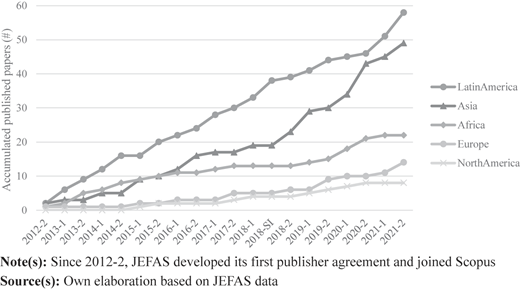
Published papers by the regional origin of the corresponding author
Published papers by the regional origin of the corresponding author
Likewise, as shown in Table 1, of the most representative regions, the publications of Latin America come from the countries of Colombia, Peru, Mexico, Chile, Brazil, Ecuador, Argentina, Costa Rica, Puerto Rico; while Asian publications come from the countries of India, Malaysia, Pakistan, Saudi Arabia, Turkey, Vietnam, China, Indonesia, Iran.
Published papers by the country origin of the corresponding author (2012–2021)
| Latin America | % | Asia | % |
|---|---|---|---|
| Colombia | 28.8 | India | 24.0 |
| Peru | 27.1 | Malaysia | 20.0 |
| Mexico | 13.6 | Pakistan | 14.0 |
| Chile | 8.5 | Saudi Arabia | 10.0 |
| Brazil | 8.5 | Turkey | 10.0 |
| Ecuador | 5.1 | Vietnam | 8.0 |
| Argentina | 5.1 | China | 6.0 |
| Costa Rica | 1.7 | Indonesia | 4.0 |
| Puerto Rico | 1.7 | Iran | 4.0 |
Source(s): Own elaboration based on JEFAS data
Complimentarily, from a systematic literature review, in the previous Editorial (Salcedo, 2021), it was possible to verify the most relevant authors, citations, references, keywords, establishing a roadmap. Therefore, in this Editorial, an additional purpose of sharing with our readers, authors and reviewers is to understand how the journal can continue consolidating its aims, scope and guidelines to encourage successful papers' publication.
From successful structure
One of the essential points that the JEFAS has consolidated is capturing the journal's aims and scope through its published papers, leveraging the competitive advantage of scholars.
Taking the advice borrowed from Lazzarini (2012) as shown in Figure 2, one of the critical aspects to achieve a successful research structure is to consider, from a literature review with a seminal theoretical/methodological framework, the local refinements of the context to be studied. Likewise, to enrich global knowledge, moving from particular data to comparative data among countries has provided the research with a richer vision of our regions for the World.
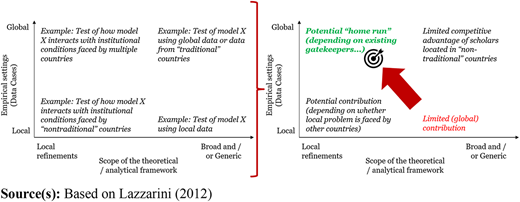
Leveraging the competitive advantage of emerging scholars
Leveraging the competitive advantage of emerging scholars
Along this path, another critical aspect that JEFAS has considered is the manuscript structure. Manuscripts of empirical social science journals usually consist of six parts (Sun and Linton, 2014): introduction, literature review, methodology, results, discussion and conclusions.
According to this structure, first, the introduction should provide background information, by identifying the research gap and proposing the research question(s). In order to achieve this section, a regular suggestion is to follow the editor's comments from the Academy of Management Review (Barney, 2018). Second, the literature review should include background theory(s), conceptualizations, hypothesis formulation and model development. Here, a recommended consideration, as an example, is to follow the practical guide for making theory contributions in strategic management (Makadok et al., 2018). Third, the methodology should minimally focus on research design, data collection and analytical procedure, including descriptive statistics, data profile, validity and reliability. For this section, a suggestion to consider could be an evidence-based best practice study on improving methodological transparency conducted during scientific research (Aguinis et al., 2018). Fourth, the results should report the core research findings and interpretations, especially concerning hypotheses. Fifth, the discussion should compare and contrast the results to existing literature and thought. More importantly, it explores the theoretical implications (Corley and Gioia, 2011), practical – managerial/policy – implications (probably the major paper value-added) and the limitations and future research agenda. Currently, this section requires a genuine pause to reflect on the practical implications/contributions that we can make to managers, firms, institutions, society due to the COVID-19 pandemic context that we are experiencing to the future (Watson et al., 2020). Finally, the conclusions summarize the essential parts and ideas, from the research question to the hypothesis results interpretations of the manuscript.
Concerning the latter and based on the comparative study of desk-rejected vs high-impact papers (Sun and Linton, 2014), as shown in Figure 3, in addition to considering the six sections with their suggestions, we identify two peaks to achieve high-impact papers. The first significant peak is the literature review. Then, as a sustained slope and continuous enrichment, the second peak that arises from the methodology, the results, has its top in the discussions.
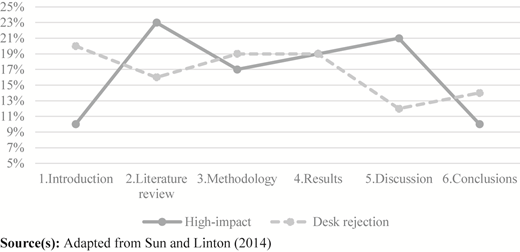
Average structure of desk-rejected vs high-impact papers
Average structure of desk-rejected vs high-impact papers
Therefore, we invite you to read this new issue, which considers a relevant part of the purpose mentioned by the Editorial. Our desire to provide high-quality manuscripts to you and society determines our goal of achieving high standards and new indexations with a committed editorial team, partners and advisors.

