In order to improve the performance of sodium (Na) montmorillonite (MMT), in this study, 1-hexadecyl-2,3-dimethylimidazolium bromide was synthesized and used as a cationic surfactant for the organic modification of sodium MMT. The modification effect of pH was investigated, and the structure of the imidazole organic modifier was characterized by nuclear magnetic resonance and Fourier transform infrared spectroscopy (FTIR). In addition, the modified sodium MMT was systematically confirmed by FTIR and X-ray diffraction. The results showed that the imidazolium surfactant successfully intercalated into the galleries of MMT and enlarged the (001) d spacing of MMT. It was observed that the d (001) peaks largely shift to the left with decreasing pH, indicating low pH-facilitated intercalation, and its effect reached the best at pH 3, where the interlayer distance between MMT platelets increased from 1·31 to 3·52 nm. Thermogravimetric analysis showed that the modified sodium MMT exhibited excellent thermal stability; the onset and the maximum decomposition temperature were 343 and 406°C respectively.
1 Introduction
In recent years, polymer-layered silicate (PLS) nanocomposites have attracted wide attention.1 The layered silicate materials, used as nanoscale reinforcing agents in a polymer matrix, will cause significant improvements in mechanical, thermal, barrier and flame-retardant properties that have not yet been observed in any component.2 Therefore, it is desirable to make appropriate modification of the inherently hydrophilic montmorillonite (MMT) in the preparation of PLS nanocomposites.
The most commonly used organic modifiers are alkyl quaternary ammonium,3,4 amino acids5 and phosphonium cationic surfactants. The modification mechanism can be explained as follows: (a) These organic cations undergo ion-exchange reactions on exchangeable cations of MMT layers, and the organic groups will cover the surface of MMT or insert into the MMT layers, making the surface properties of MMT change from hydrophilic to lipophilic and the interlayer distance increase. (b) The interlayer force is weakened, and this facilitates intercalation. Although these modifiers have many advantages such as lower cost, commercial availability and the ability to render clays miscible with most polymer matrices, they do show poor thermal stability with decomposition temperature from 233 to 310°C.6–8 VanderHart et al.9 found that decomposition will occur and alter the interface between the filler and the matrix polymer if the processing temperature is higher than the thermal stability of the organoclay. Accordingly, the thermal stability of the organic surfactant plays an important role in the preparation and further processing of PLS nanocomposites. Xie et al.6,7 reported that the onset decomposition temperature of MMT, modified with long carbon-chain alkyl quaternary ammonium ions, is approximately 180°C. However, the typical melt temperature used in polymer processing is always beyond 200°C.10,11 To overcome this problem, more stable cations, such as pyridinium and imidazolium salts, have been used to modify layered silicates due to their inherently higher thermal stability.8,12,13
Ngo et al.14 and Begg et al.15 found that imidazole exhibits resistance to ring fission during thermal rearrangements of 1-alkyl- and 1-aryl-imidazoles at temperatures above 600°C, which indicates that the imidazolium cation is more thermally stable than the alkyl ammonium cation. Experimental results8,16–19 concerning imidazolium-intercalated MMT showed an increase in thermal stability as compared to ammonium-modified MMT. He et al.20 reported that the initial decomposition temperature (temperature at 5% weight loss T0·05) of 1-hexadecane-3-methylimidazolium bromine, 1-hydroxyethyl-3-hexadecane imidazolium bromine and 1,3-dihexadecane imidazolium iodine with saturated alkyl groups was higher than 250°C. The T0·05 values of organic montmorillonite (oMMT) were higher than 330°C. In addition, it was found that dihexadecane imidazolium, with two long tails, has the ability to enlarge the interlayer distance to a higher degree as compared to other imidazolium surfactants with only one long tail. Shailesh et al.21 found that the onset decomposition temperature (Tonset) of alkyl-imidazolium salt 1-decyl-2-methyl-3-(11-carboxyundecyl) imidazolium bromide reached 271°C and the Tonset of alkyl-imidazolium-treated layered silicates reached 376°C. The advantageous features of the imidazolium compounds include the imidazole ring offering the compound high thermal stability as compared to that of alkyl-ammonium compounds, and various alkyl substitute groups resulting in improved hydrophobicity of clay and enlarged gallery of silicate layers. Therefore, the authors of the present paper considered the imidazolium salts as a surfactant for modifying layered silicates owing to their inherently greater thermal stability.
The objective of this work was to synthesize thermally stable alkyl imidazolium salts as MMT modification surfactant. Nuclear magnetic resonance (NMR) and Fourier transform infrared spectroscopy (FTIR) were used to characterize the synthesized surfactant. oMMT, modified with this surfactant, was prepared by ion exchange. The intercalation effect and the thermal stability of oMMT were specifically investigated. Moreover, the modification medium as function of pH was also studied.
2 Experimental
2.1 Materials
The raw materials of 1-bromohexadecane (C16H33Br) supplied by Shanghai Aladdin Co. Ltd, 1,2-dimethyl imidazole bought from Shanghai Lingfeng Chemical Reagent Co. Ltd and acetonitrile purchased from Sinopharm Chemical Reagent Co. Ltd were used to form the organic modifier. The solvent ethyl acetate, from Sinopharm Chemical Reagent Co. Ltd, was used to precipitate and wash the synthetic product. Sodium (Na) MMT, with a cation-exchange capacity of 80 meq/100 g, was provided by Zhejiang Fenghong New Material Co. Ltd, and silver nitrate (AgNO3) was supplied by Sinopharm Chemical Reagent Co. Ltd. All reagents used were of analytical reagent grade and used without any purification.
2.2 Preparation of 1-hexadecyl-2,3-dimethylimidazolium bromide
Given the volatility of bromoethane, the molar ratio of 1,2-dimethyl imidazole and alkyl bromide was 1:1·1, while some acetonitrile was added. The mixture was firstly placed in a thick-walled single-necked round-bottom flask equipped with a reflux condenser tube, a thermometer and a magnetic stirrer. Then the mixture was stirred in a water (H2O) bath for 12 h at 90°C in high-purity nitrogen flowing atmosphere. After completion of reaction, the product was cooled to room temperature. In order to remove all unreacted 1,2-dimethyl imidazole, the product was subsequently precipitated, washed and filtrated for several times with ethyl acetate. The wet product was dried in vacuum at 80°C for 24 h, and then the remaining ethyl acetate and pale yellow powdery solid were obtained. Afterwards, the pale yellow powdery solid was dissolved with a small amount of acetonitrile and was precipitated with ethyl acetate to obtain a white solid. The white solid was then washed with ethyl acetate and filtered several times and dried in vacuum at 80°C for 24 h. Finally, the white powder, 1-hexadecyl-2,3-dimethylimidazolium bromide, was obtained.
2.3 Organic montmorillonite
oMMT was prepared based on the cation-exchange procedure.22 Distilled water (125 ml), used as a dispersant medium, was added to a beaker and heated to 80°C in an oil bath. At the same time, the pH was regulated to set values of 1, 3, 5, 7, 9, 11 and 13 and sodium MMT was then added. The mixture was stirred at a high speed to make sodium MMT disperse totally in the distilled water. A certain amount of 1-hexadecyl-2,3-dimethylimidazolium bromide was then completely dissolved in hot distilled water and added into the emulsion. Subsequently, the mixture was stirred for 5 h at 80°C at 800 revolutions per minute and then set aside for 12 h. Removing the foam and the liquid, a milky white flocculent precipitate was obtained. The oMMT was collected by filtration and washed several times with hot distilled water to remove residual salts. Washing was continued until no halide anion was detected by the silver nitrate test. Finally, the oMMT was dried at 80°C for 24 h in vacuum to constant weight and then milled to a fine powder, which was passed through a 200-mesh sieve.
2.4 Characterization
2.4.1 Structure
The structure of 1-hexadecyl-2,3-dimethylimidazolium bromide was characterized by FTIR and NMR. FTIR scans were performed in transmission mode by using potassium bromide (KBr) pellets on a Thermo Nicolet Nexus 670 spectrometer while during NMR measurements, deuterated chloroform was used as a solvent and tetramethylsilane as the reference.
2.4.2 X-ray diffraction
The samples were analyzed by a Bruker D8 Advance X-ray diffraction (XRD) instrument with an incident X-ray wavelength of 1·541 Å and operating at a voltage of 40 kV, a current of 40 mA and a scan rate of 2°/min from 1 to 4°.
2.4.3 Transmission electron microscopy
The interlayer distance of the modified oMMT was characterized by transmission electron microscopy (TEM). TEM images were obtained using a JEM-2100 STEM/EDS transmission electron microscope. The solvent of oMMT was an ethanol solution.
2.4.4 Thermogravimetric analysis
Thermogravimetric analysis (TGA) was carried out on neat oMMT to examine its thermal stability. The experiments were conducted using an STA449c/3/G TGA instrument supplied by Netzsch Company under nitrogen atmosphere. Samples (10–20 mg) were prepared and heated at a constant rate of 10°C/min from 25 to 700°C.
3 Results and discussion
3.1 Characterization of 1-hexadecyl-2,3-dimethylimidazolium bromide
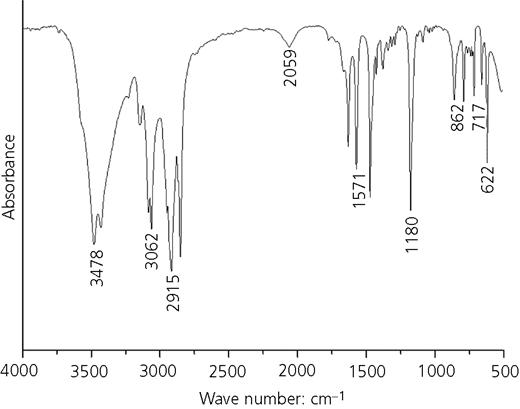
The FTIR spectra of 1-hexadecyl-2,3-dimethylimidazolium bromide is shown in Figure 1. A doublet at 3478 and 3300 cm−1 is assigned to the N–H stretching vibration in the imidazolium ring, and the band at about 1530 cm−1 is assigned to the N–H deformation mode in the imidazolium ring. In addition, a band at 3062 cm−1 is caused by the C–H stretching vibration of the imidazole ring, whereas the band at 2915 cm−1 is caused by the saturated C–H stretching vibration. The band at 1571 cm−1 is assigned to the C=C vibration in the imidazolium ring, the band at 1180 cm−1 is assigned to the C–Br vibration and the bands at 622 and 717 cm−1 are assigned to –(CH2)15 bending vibration.
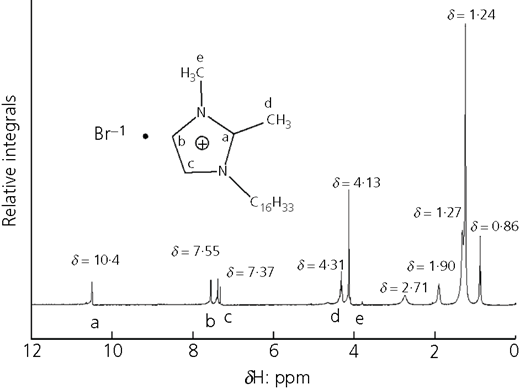
The NMR spectra of 1-hexadecyl-2,3-dimethylimidazolium bromide is shown in Figure 2. It is found that δ between 0·86 and 2·71 represent various hydrogens of 16 alkyl, δ = 4·13 represents –NCH3, δ = 4·31 represents –CCH3 and δ = 7·37, δ = 7·55 and δ = 10·4 represent H5, H4 and H2 of the imidazole ring respectively.
3.2 Characterization of oMMT
3.2.1 Fourier transform infrared spectroscopy
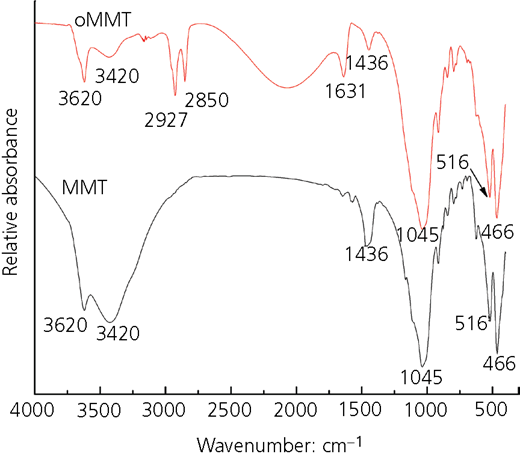
The FTIR spectra of MMT and imidazolium oMMT are shown in Figure 3. The bands at 3620 and 3420 cm−1 are assigned to the –OH stretching vibration. The Si–O stretching band is observed at 1045 cm−1, and a band at 516 cm−1 is assigned to the Si–O bending vibration. A band at 466 cm−1 is assigned to the Al–O bending vibration.
From the FTIR spectra of oMMT, all the bands belonging to typical MMT are reserved after modification, and this indicates the fact that MMT has been modified by the surfactant. A pair of bands at 2927 and 2850 cm−1 is assigned to the asymmetric and symmetric CH2 stretching vibrations. A band at 1631 cm−1 is assigned to the C–N stretching vibration. These bands are absent in MMT, and this suggests that the cationic surfactants have been intercalated into the interlayer of sodium MMT to form oMMT.
3.2.2 The intercalation effect on different pH values
For PLS nanocomposites, the interlayer distance of MMT is an important parameter for evaluating the treatment efficiency of oMMT and the type of the PLS nanocomposites. Therefore, it is imperative to obtain the interlayer distance during the process of preparation. The interlayer distances between the layers of MMT are calculated by using the Bragg equation with the diffraction angle θ of (001).
The Bragg equation is given as
where d is the interlayer distance (nm), θ is the Bragg angle (°), n is the reflection coefficient and λ is the wavelength (nm).
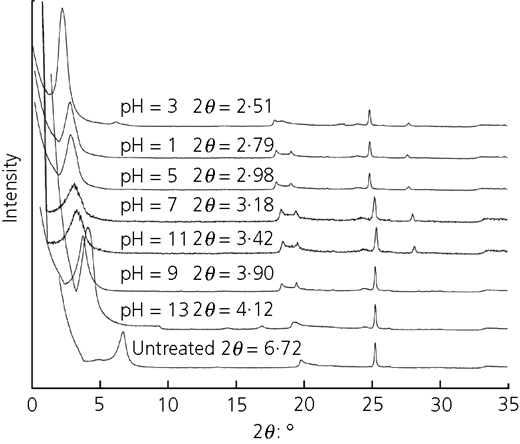
The XRD spectra of oMMT treated at various pH values are shown in Figure 4. It is observed that the change in pH has a significant influence on oMMT and the acidic medium favors intercalation. MMT is made of flaky clay particles with three kinds of charges:23 a permanent negative charge, a variable negative charge and a positive charge. The type and the quantity of charges vary with the type of MMT. The permanent negative charge, constituting more than 95%, is determined by the MMT itself, and its quantity remains stable under various pH values. In the alkaline medium, a hydrogen ion (H+) which is dissociated from MMT combines with a hydroxyl ion (OH−) in the medium to generate water. Thus, the surface of MMT forms negative charges – that is, the variable negative charge.
In the acidic medium, a hydroxyl ion which is dissociated from MMT combines with a hydrogen ion in the medium to generate water, so that the surface of MMT is positively charged. In the alkaline medium, the intercalation effect decreases with increasing pH values. However, in an acidic medium, the intercalation effect increases and then decreases with decreasing pH values. The d(001) peaks largely shift to the left with decreasing pH in Figure 4. The intercalation effect is the best at pH 3, where the interlayer distance reaches 3·52 nm (see Table 1). The reason is as follows: in the alkaline medium, imidazole salt cations are affected by the end face negative charge and adsorbed on both ends of the lamella, which makes it difficult for organic cations to be inserted into layers of MMT. However, in the acidic medium, the end face positive charge has a repulsive force against imidazole salt cations. Thus, the organic cation can be inserted into the layers of MMT easily and replace hydrated cations to achieve a better intercalation effect. Therefore, the acidic medium favors intercalation of MMT.
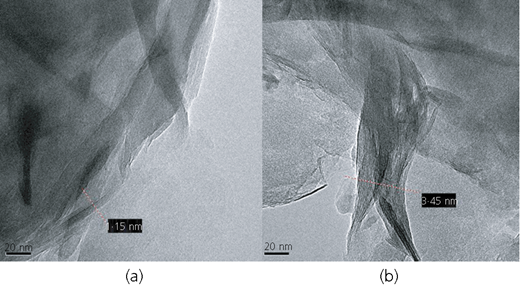
In addition, Figure 5 (TEM images) offers the most explicit visualization of the intercalation effect. Figures 5(a) and 5(b) are for MMT and oMMT treated at pH 3 respectively. It can be seen that the interlayer distance increases from 1·15 to 3·45 nm, and the results are consistent with those shown by XRD.
3.2.3 Thermal stability of oMMT
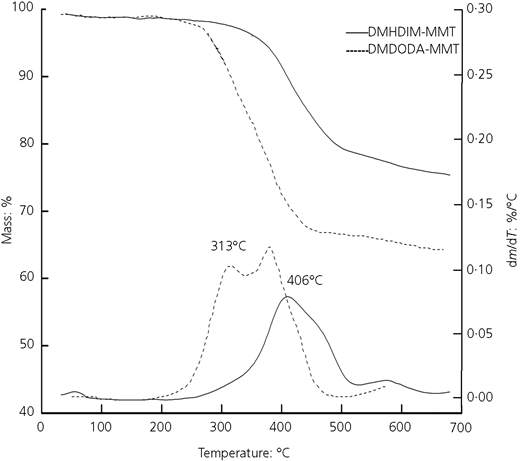
The degradation of oMMT(DMHDIM-MMT) modified by 1-hexadecyl-2,3-dimethylimidazolium bromide and oMMT(DMDODA-MMT) modified by dimethyl dioctadecyl ammonium bromide were monitored by thermogravimetric analysis from 25 to 700°C; the results are shown in Figure 6. The signals from the TGA have been scaled to represent the remaining weight percentage of the modifier originally on the oMMT, since the inorganic constituents in MMT remain stable and its weight will not change during the tests at the used temperature. As expected, the differences in the thermal stability of these two oMMTs are remarkable. Both modifiers have one long alkyl tail; however, their cations are imidazolium and ammonium types respectively. Obviously, the MMT modified using the imidazolium base is much more thermally stable than that modified with the ammonium base.
Figure 6 shows that the imidazolium-modified MMT begins to decompose at 343°C and the peak decomposition temperature is 406°C, whereas the ammonium-modified MMT begins to decompose at 280°C and the peak decomposition temperature is 313°C. The comparison of thermal stability parameters among three kinds of oMMTs8 is given in Table 2. Generally, the alkyl quaternary ammonium salts will show thermal degradation at 200°C either by a Hofmann elimination to give a product that is different from the amine or by an SN2 nucleophilic substitution reaction to produce the amine.6 Higher thermal stability of imidazolium-modified MMT is attributed to the imidazole ring in the imidazole salt.
4 Conclusions
An imidazolium surfactant – that is, 1-hexadecyl-2,3-dimethylimidazolium bromide – was prepared and used to improve the properties of sodium MMT. The structure of 1-hexadecyl-2,3-dimethylimidazolium bromide was confirmed by FTIR and NMR spectroscopy. The cation-exchange reaction, using imidazole salts, was performed on sodium MMT. oMMT was characterized by powder XRD and FTIR techniques to confirm exchange. The intercalation of the imidazolium surfactant in sodium MMT certainly increased the basal spacing of MMT and the low pH favored intercalation. The intercalation effect reached its best value at pH 3. The interlayer distance increased from 1·31 to 3·52 nm. The sodium MMT, based on the imidazolium surfactant, was demonstrated to have excellent thermal stability, which is significantly greater than that of the ammonium surfactant. In addition, the onset and the maximum decomposition temperature were 343 and 406°C respectively.
Acknowledgements
This work was supported by the National Natural Science Foundation of China (Grant Numbers 51173141/E030701).