

In accordance with the twin-shear unified strength theory and the improved Nishihara model, a viscoelastic–plastic creep constitutive function of frozen soil has been established based on the associated flow rules, and the viscoelastic–plastic soft matrix is further derived from numerical calculations. The results show that the viscoelastic–plastic creep constitutive function has considerable influence on the non-linearity and the intermediate principal stress of materials, and it can describe the creep properties of frozen soil as a unified solution. The proposed model herein is applicable to the creep study of frozen soil.
Notation
- b
parameter that reflects the damage extent of the intermediate principal shear stress and the corresponding normal stress
- E1, EH
elasticity moduli (MPa)
- F
yield function of the twin-shear unified strength theory
- G1
viscous elastic shear modulus (MPa)
- GH
instantaneous elastic shear modulus (MPa)
- H1, H2
viscoelastic coefficients
- I1
first invariant of stress tensor (hydrostatic stress)
- J2
second invariant of deviator stress
- α
ratio of tension strength and compression strength, α = σ s/σ c
- ϵ
total strain
elastic strain component
plastic strain component
- η1, η2
viscosity coefficients
- θ
corresponding angle of the twin-shear stress parameter
- σc
compressive yield limitation
- σs
tensile yield limitation
1 Introduction
Frozen soil is a type of special geotechnical material; the mechanical characteristic of frozen soil is sensitive to temperature, water content and pressure.1,2 As its interior contains unfrozen soil and ice, the internal stress and strain are the result of accumulation over time, which means that deformation grows with time under constant load or stress evolves with time under constant deformation.3 With the development of freeze sinking and engineering construction in cold regions, more and more engineering problems are exposed. For example, many freezing pipes rupture because of large creep deformation, and numerous foundations of high-speed roads, railways and large buildings crack due to the creep deformation of frozen soil, which severely affects the normal use of buildings and structures. Therefore, research on creep properties of frozen soil, especially creep constitutive model, has important theoretical significance and engineering value.4,5
Research on creep constitutive model of frozen soil has been conducted since the 1960s. Li et al.6 established a statistical constitutive model by using the continuum damage theory and introducing the Drucker–Prager criterion as its parameter of macroscopic element strength. Yuan7 constructed a viscoelastic–plastic constitutive model on the basis of the Nishihara model, which adds a viscoelastic element and parabolic yield function instead of plastic yield. Wang et al.8 found that the Nishihara model can be improved by substituting the non-linear Newtonian element for the linear one and derived a soft matrix of viscoelastic–plastic materials on the basis of von Mises yield criterion. Li and Wang9 deduced a viscoelastic–plastic damage-coupling constitutive function based on thermodynamics, statistical damage theory and the associated flow rules on the assumption that a new form of frozen soil microunit strength follows the improved Mohr–Coulomb criterion. Although previous research has provided solid theoretical foundations for creep characteristic studies of frozen soil, some deficiencies still exist. Few studies considered the influence of the intermediate principal stress on the creep deformation of frozen soil, and the proposed constitutive model in the present study can be used for one or several special materials.
Based on the results that have been obtained in earlier studies, the non-linear Newtonian element can be substituted for the linear one to improve the Nishihara model. Further, based on the twin-shear unified strength theory and the associated flow rules, the viscoelastic–plastic creep constitutive function has been deduced and a viscoelastic–plastic soft matrix is derived, which is applicable to the subsequent numerical calculations.
2 The creep constitutive function of frozen soil
2.1 The twin-shear unified strength theory
Based on the twin-shear unit and the twin-shear yield criterion, Yu10 established the twin-shear unified strength theory in 1991 by considering all the stresses acting on the twin-shear unit and their effects on damage in different materials. The twin-shear unified strength theory is suitable for different materials and has different mathematical expressions. The stress invariant expression is10
where α is the ratio of tension strength and compression strength, α = σ s/σ c; I 1 is the first invariant of stress tensor (hydrostatic stress); J 2 is the second invariant of deviator stress; b is the parameter that reflects the damage extent of the intermediate principal shear stress and the corresponding normal stress; σ s and σ c are the tensile yield limitation and compressive yield limitation, respectively; θ is the corresponding angle of the twin-shear stress parameter μ τ = τ 12/τ 13 or ; and θ b can be obtained by the equation of F = F′.
Equation 1 consists of a series of failure criteria that vary with b; it can be simplified to many prevailing failure criteria. For example, it reduces to Mohr–Coulomb failure criterion with b = 0. The twin-shear yield criterion is obtained with b = 1, and a series of new convex non-linear strength criterion are reduced with 0 < b < 1. Hence, the twin-shear unified strength criterion should not be regarded as a single special failure criterion but a theoretical system that can be applied to a wide variety of materials.
2.2 The creep characteristics of frozen soils
According to previous experimental results, the typical creep deformation curve is shown in Figure 1.11
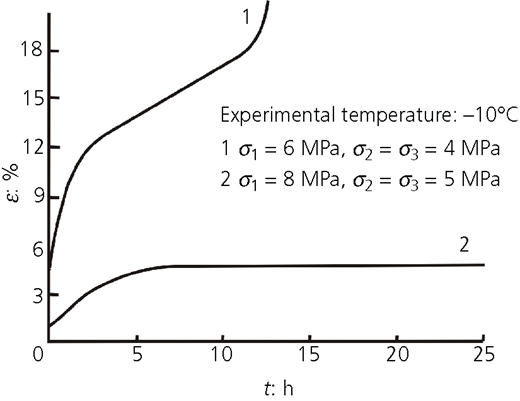
Figure 1 shows that the laws of creep deformation of frozen soils are as follows: (a) instantaneous strain occurs at the initiation of loading, which is 5–10% of total creep deformation; (b) when the deviatoric stress is low, there only appear unsteady creep and steady creep, namely, the first stage and the second stage; and (c) when the deviatoric stress is high, an accelerated creep appears, namely, the third stage.
2.3 The viscoelastic–plastic creep constitutive function of frozen soil
To describe the non-linear viscoelastic plasticity of frozen soil, the Nishihara model is improved by substituting the non-linear Newtonian element for the linear one. The researchers assume that the yield criterion of materials is governed by the unified strength theory, as shown in Figure 2. The improved Nishihara model can be used to analyze the non-linear viscoelastic–plastic creep of frozen soil.
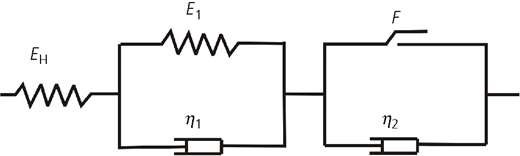
The single-axis viscoelastic–plastic creep constitutive equation is
where F is the yield function of the twin-shear unified strength theory; E 1 and E H are the elasticity moduli (MPa); η 1 and η 2 are the viscosity coefficients, the units of which are, respectively, megapascal-minutes and megapascal-square minutes.
The creep constitutive model, in three-dimensional (3D) stress state, is difficult to describe with visual physical components. Research3 shows that the creep constitutive equation is in accord with the one-dimensional model. By using the method of analogy, the constitutive model of frozen soil, in 3D stress state, is obtained as
where G H is the instantaneous elastic shear modulus (MPa); G 1 is the viscous elastic shear modulus (MPa); and H 1 and H 2 are the viscoelastic coefficients, the units of which are, respectively, megapascal-minutes and megapascal-square minutes.
2.4 The viscoelastic–plastic creep soft matrices
During the process of calculating the non-linear continuum deformation, the total strain ϵ is usually divided into the elastic strain component (including instantaneous elastic strain and linear and non-linear viscous elastic strains) and the plastic strain component (including instantaneous plastic strain and viscous plastic strain). Thus, the expression of the total strain is12
2.4.1 The viscoelastic soft matrix
The elastic strain of frozen soil is obtained by Equation 4 as
Gt is defined as
Then, the following is obtained
where [Ce] is the elastic soft matrix
2.4.2 The viscoplastic soft matrix
Similarly, the plastic strain of frozen soil can also be calculated by Equation 4 as
where F is the yield function, which is determined by Equation 1; for geotechnical materials, F0 = 1.
The plastic matrix can be derived by the following formula
where
C1, C2 and C3 are defined as
Then, the following is obtained.
When 0 ≤ θ ≤ θb,
When θb ≤ θ ≤ 60°,
The viscoplastic creep strain increment can be calculated by the following formula
Based on Equation 9, the following is obtained
By substituting Equation 19 into Equation 18, the viscoplastic strain increment along with time step is obtained as follows
Furthermore, the viscoplastic soft matrix is derived by the aforementioned equation
2.5 The unified solution of viscous elastic–plastic soft matrices
By combining Equations 8 and 21, the viscoelastic–plastic soft matrices based on the twin-shear unified strength theory can be obtained, from which many special viscoelastic–plastic soft matrices can be degenerated. For example, when C 1 = 0, C 2 = 31/2 and C 3 = 0, the twin-shear unified strength theory degenerates to a von Mises yield criterion, and the von Mises-based viscoplastic soft matrix is obtained by Equations 11–13 and 21, which is the same as in the study by Wang et al. 8
According to a unified mechanical model, the twin-shear unified strength theory considers all the stress components and their effects on damage in different materials. It includes a series of yield criteria and adapts to the elastic–plastic analysis of various materials. Therefore, the viscoelastic–plastic constitutive function of frozen soil and the viscoelastic–plastic soft matrices, suitable for numerical calculations herein, can be used as the unified solution to analyze the creep characteristics of frozen soil.
3 Conclusions
According to the twin-shear unified strength theory and the improved Nishihara model, the viscoelastic–plastic creep constitutive function was established and the viscoelastic–plastic soft matrices were derived. The proposed model has considerable influence on non-linearity and intermediate principal stress, and the soft matrices can be added into a large non-linear software to analyze the creep characteristics of frozen soil.
Results in this paper can be extended into various components that are suitable for various materials; they can be considered the unified solution of viscoelastic–plastic creep constitutive model of frozen soil.
Acknowledgements
The authors would like to acknowledge the financial support from the National Natural Science Foundation of China (number 41202191) and The Cultivation Project of Excellent Doctorial Dissertations of Chang’an University (number 310828150018).

