

A series of novel Schiff base photosensitive polymers with coordination property were synthesized through a condensation reaction. Then using the Schiff base photosensitive polymers as macromolecular ligands, a series of polymer rare-earth complexes were prepared through a coordination reaction. The structure of the polymer and their corresponding complex was performed by means of Fourier transform infrared and ultraviolet spectroscopy; the fluorescence properties of the complex were mainly investigated by fluorescence spectroscopy, and the thermal property was investigated by differential scanning calorimetry and thermogravimetric analysis. The luminescence properties of the europium (Eu) (III)/ytterbium (Yb) (III) complex in dimethylformamide solutions were investigated. The experimental results show that the complexes have fine thermal stability and all the europium (III)/ytterbium (III) complexes exhibit characteristic photoluminescence peaks in the visible region and the results indicate that the complexes are promising in the field of light-emitting materials and can be further mixed with a suitable polymer to form functional rare-earth polymers.
1 Introduction
In recent years, photosensitive polymers with coordination property and their rare-earth complexes have attracted significant attention due to their high thermal stability, chemical resistance, optoelectronic properties and efficient blue photoluminescent (PL) and electroluminescent (EL) properties. These functional polymers not only can coordinate with rare-earth ions but can also sensitize the fluorescence emission of rare-earth ions.1–6 In this study, some novel polymer rare-earth complexes with distinct fluorescence properties have been obtained.7,8
Aromatic Schiff base polymers (ASBPs) and their complexes are quite attractive because of their potential applications as luminescent materials.9–13 They have significant advantages over common Schiff base compounds, such as high absorption efficiency, good mechanical properties and processability.14–16 Various ASBPs containing strongly absorbing chromophores can radiate strong fluorescence and undergo easy processing.17–19 In addition, Schiff base polymer ligands with a symmetrical structure can make the system more uniform.20 Another very attractive possibility is to develop such ASBPs and their rare-earth complexes as task-specific materials. One of the important tasks to improve their application as functionalized materials is the synthesis of suitable Schiff base polymers and their rare-earth complexes.21–23
Besides intrinsic academic interest, this work assumes importance because some of these complexes have been found to display a specific optoelectronic activity. Work on Schiff base polymer rare-earth complexes is relatively unknown. In this paper, two novel Schiff base photosensitive polymers with coordination property, hydrazide polymers with a salicylaldehyde terminal group, were synthesized through a condensation reaction. Their europium (Eu) (III) (Eu3+)/ytterbium (Yb) (III) (Yb3+) complexes were also prepared and characterized by Fourier transform infrared (FT-IR) spectroscopy, ultraviolet (UV) spectroscopy and thermal analysis, as well as fluorescence spectroscopy.
2 Experimental procedure
2.1 Materials and chemicals
Rare-earth chlorides were prepared by dissolving the corresponding oxides (99·9% purity) in dilute hydrochloric acid and then heating the solutions appropriately. Distilled water was used in all the experiments. The other reagents and solvents were commercially purchased and used without further treatment.
2.2 Synthesis of europium/ytterbium(dimethyl terephthalate)(hydrazine hydrate) complex
A hydrazide polymer with a salicylaldehyde terminal group was synthesized as follows: dimethyl terephthalate (DMT; 20 mmol) was added to a single flask and dissolved in absolute ethyl alcohol (100 ml); then, hydrazine (20 mmol) was added. After 10 min, salicylal (0·061 g) was added into the solution. After being refluxed and stirred at 75°C for 15 h, the Schiff base polymer was obtained. It was named as L1.
The Schiff base polymer L1 was dissolved in 50 ml of dimethylformamide (DMF). Subsequently, europium (III) chloride hexahydrate (EuCl3·6H2O)/ytterbium (III) chloride hexahydrate (YbCl3·6H2O) was added. The obtained complex was precipitated out with distilled water after the coordination reaction was conducted for 48 h with stirring. Then, the complex was washed thoroughly with ethanol and distilled water, and the final product europium/ytterbium(DMT)(hydrazine hydrate) was obtained and kept in a vacuum desiccator. Moreover, the molar ratio of the ligand (calculated with carbonyl groups) to the europium (III)/ytterbium (III) ion changed (from 1:1 to 5:1) gradually in these solutions.
In this paper, the poly-DMT-co-hydrazine hydrate ligand is abbreviated as L1 and the europium/ytterbium(DMT)(hydrazine hydrate) complexes are abbreviated as C1-1:1, C1-2:1, C1-3:1, C1-4:1 and C1-5:1.
2.3 Synthesis of complex europium(DMT)(hydrazine hydrate)(1,4-phthalaldehyde)
DMT–hydrazine hydrate–1,4-phthalaldehyde condensates was synthesized as follows: DMT (20 mmol) was added to a three-necked flask and dissolved in hot absolute ethyl alcohol (50 ml). Then, hydrazine (40 mmol) was added, and 1,4-phthalaldehyde (20 mmol) was gradually dropped into the preceding solution (completed in 40 min). After 10 min, salicylal (0·5 mmol) was added into the solution. After being refluxed and stirred at 75°C for 15 h, the Schiff base was obtained. It was named as L2.
The Schiff base polymer L2 (0·47 g) was dissolved in 50 ml of DMF. Subsequently, europium (III) chloride hexahydrate/ytterbium (III) chloride hexahydrate was added. The resulting complex was precipitated out with distilled water after the coordination reaction was conducted for 48 h with stirring. Then, the complex was washed thoroughly with ethanol and distilled water, and the final product europium(DMT)(hydrazine hydrate)(1, 4-phthalaldehyde) was obtained and kept in a vacuum desiccator.
In this paper, the poly-DMT-1, 4-phthalaldehyde-co-hydrazine hydrate ligand is abbreviated as L2 and the europium(DMT)(hydrazine hydrate)(1,4-phthalaldehyde) complex was abbreviated as C2.
2.4 Physical characterization
FT-IR spectra were measured on a Nexus 670 FT-IR spectrometer with a potassium bromide (KBr) flake in the wave number range 4000–400 cm−1.
Differential scanning calorimetry (DSC) and thermogravimetric analyses (TGAs) were carried out on an STA 449C TG-DSC simultaneous thermal analyzer in a nitrogen atmosphere in the 25–800°C range and conducted at a heating rate of 10°C/min.
UV spectra were obtained with a UV-2550 UV–visible spectrophotometer. The solutions of resultant polymers and their rare-earth complexes were prepared with DMF as the solvent.
Fluorescence excitation and emission spectra were obtained by using an RF-5301 fluorophotometer in the wavelength range 200–900 nm. The samples were dissolved in DMF with different accurate weights.
3 Results and discussion
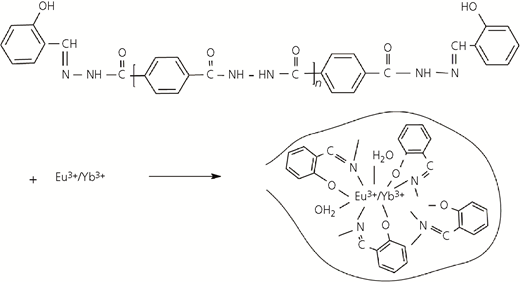
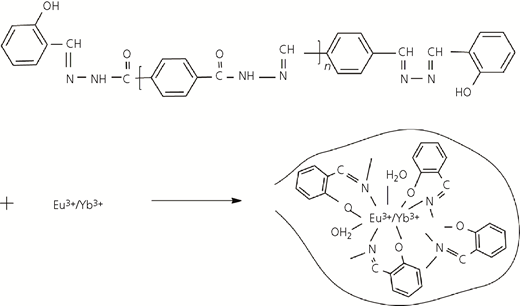
As described previously, the polymer L1 (L2) was first prepared; a coordination reaction between the macromolecular ligands L1 (L2) and europium (III)/ytterbium (III) ion was carried out in a DMF solution, and then the complex C1 (C2) was obtained. The chemical process of preparing the functional polymer L1 (L2) and the complex C1 (C2) is expressed in Schemes 1 and 2.
3.1 Infrared spectroscopy
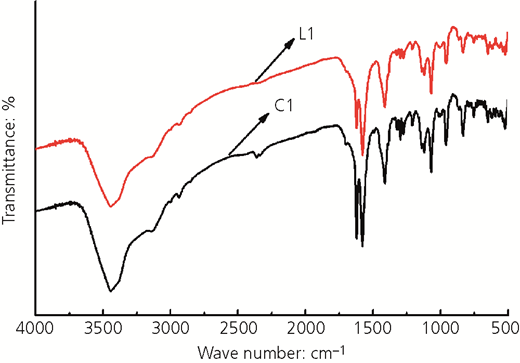
The infrared spectra of polymer L1 and its corresponding europium (III)/ytterbium (III) complexes C1 are compared as shown in Figure 1. The band at 3432 cm−1 was attributed to N–H stretching vibration of the polymer (Figure 1 L1). The absorption band assigned to N–H in the complex becomes broad (Figure 1 C1). This result is attributed to M(O–H) of the water (H2O) molecule in the complex. The carbonyl stretch vibration absorption peak of the polymer appeared at 1726 cm−1 and shifted to 1721 cm−1 after being coordinated to europium (III)/ytterbium (III). These results were attributed to the macromolecular ligand coordinating with europium (III)/ytterbium (III).
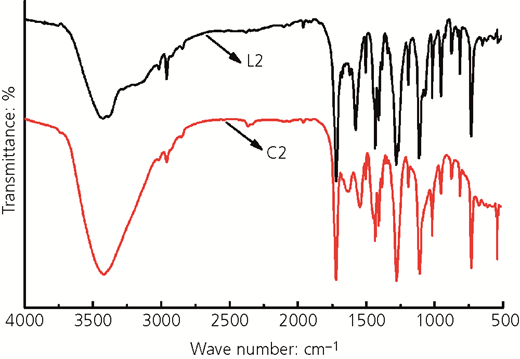
The infrared spectra of polymer L2 and its corresponding europium (III)/ytterbium (III) complex C2 are compared as shown in Figure 2. The band at 3417 cm−1 was attributed to the N–H stretching vibration of the polymer (Figure 2 L2). The absorption band assigned to N–H in the complex becomes broad (Figure 2 C2). This result is attributed to M(O–H) of the water molecule in the complex. The band at 1062 cm−1 is attributed to the stretching vibration absorption of C–N (Figure 2 L2). The absorption bands at 1721 and 1618 cm−1 are assigned to C=O and C=N of the polymer, respectively (Figure 2 L2). The absorption bands assigned to C=O and C=N in the complex shift to 1716 and 1628 cm−1, respectively. This result is attributed to the macromolecular ligand coordinating with europium (III)/ytterbium (III).
3.2 Thermal analysis (TGA)
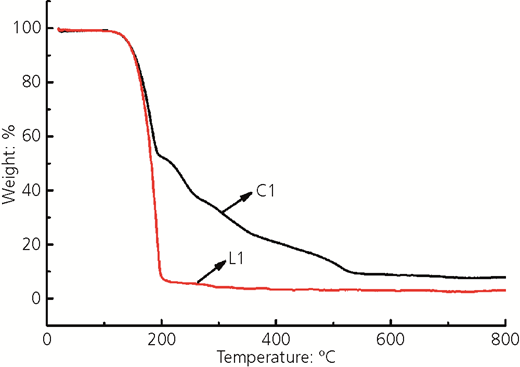
Thermal analysis of polymer L1 and its corresponding complex C1 was carried out, and their TGA curves are illustrated in Figure 3. In the present study, the weight loss was measured from the ambient temperature up to 800°C. From the TGA curves, the main degradation steps can be observed, and polymer L1 and complex C1 show similar trends for change in weight loss. The weight loss occurring in the temperature range 120–204°C is interpreted as the degradation of the ligand. At 534°C, the complex completely converts into europium (III) oxide (Eu2O3)/ytterbium (III) oxide (Yb2O3), and the weight becomes stable.
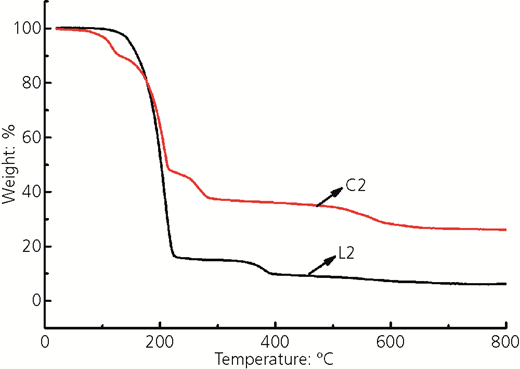
The thermal analysis of polymer L2 and its corresponding complex C2 was investigated (Figure 4). In the present study, the weight loss was measured from the ambient temperature up to 800°C. From TGA curves of L2, it can be seen that the initial weight loss occurring in the temperature range 81–135°C is interpreted as loss of desorption of physically adsorbed water, residual solvent and some aromatic fragments. On further heating, there is decomposition of the organic molecular chains of C2 as shown in the TGA curve. At 584°C, the complex completely converts into europium (III) oxide/ytterbium (III) oxide, and the weight becomes stable.
3.3 UV absorption spectrometry
Figure 5 presents the UV absorption spectra of polymer L1 and the corresponding C1. The following observations can be made from Figure 5: (a) there is one strong absorption peak at 280 nm, and it is ascribed to the π*–π* electron transition of the benzene ring of the polymer. At 323 nm, there is a little absorption peak, and it is ascribed to the n–π* electron transition of the Schiff base ligand of polymer L1. (b) Compared with the absorption spectra of polymer L1, both the spectrum shape and the peak positions are similar to that of complex C1; only the characteristic absorption intensity of the absorption peak is reduced. The reduced absorption peak of the complex implies that the salicylaldehyde hydrazone ligand of polymer L1 has coordinated to europium (III)/ytterbium (III) and the complex C1 has been formed.
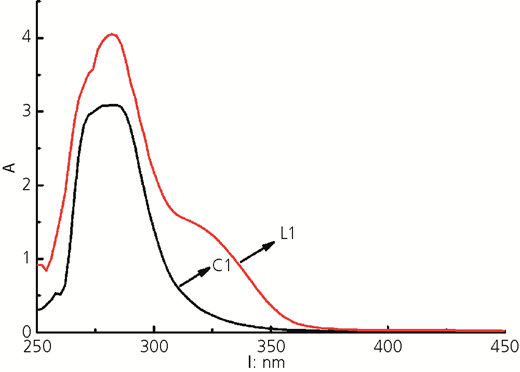
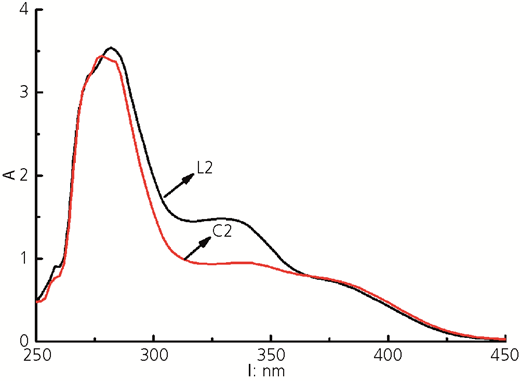
Figure 6 shows the UV absorption spectra of polymer L2 and corresponding C2. The following can be observed from Figure 6: (a) there is one strong absorption peak at 281 nm, and it is ascribed to the π*–π* electron transition of the benzene ring of the polymer. At 333 nm, there is an absorption peak of a lower intensity, and it is ascribed to the n–π* electron transition of the Schiff base ligand of polymer L2. (b) Compared with the absorption spectra of polymer L2, the UV absorption spectra of complex C2 is similar to that of the polymer in shape of the spectrum and peak positions, and only the characteristic absorption intensity of the absorption peak is reduced. The reduced absorption peak of the complex implies that the salicylaldehyde hydrazone ligand of polymer L2 has coordinated to europium (III)/ytterbium (III) and the polymer rare-earth complex C2 has been formed.
3.4 Fluorescence analysis
The fluorescence excitation spectrum of C1 was obtained by monitoring the emission of europium (III)/ytterbium (III) ions at 489 nm, and the optimal excitation peak was found at 463 nm. By exciting at 463 nm, the fluorescence emission spectrum of C1 in DMF solution was recorded. The result is presented in Figure 7.
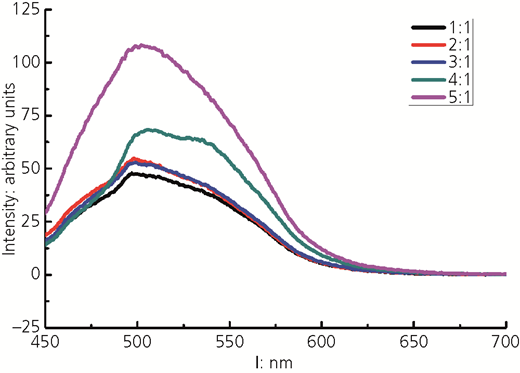
From Figure 7, the following can be observed: (a) the emission spectrum of C1 shows that the complex emits the characteristic fluorescence of the europium (III)/ytterbium (III) ion. In addition, a main emission peak at 506 nm is displayed, (b) When the molar ratio of the ligand salicylaldehyde hydrazone to the europium (III)/ytterbium (III) ion is equal to 5:1, the fluorescence emission reaches a maximum.
The fluorescence excitation spectrum of C2 was obtained by monitoring the emission of europium (III)/ytterbium (III) ion at 254 nm. By exciting at 254 nm, the fluorescence emission spectrum of C2 was determined. The result is presented in Figure 8.
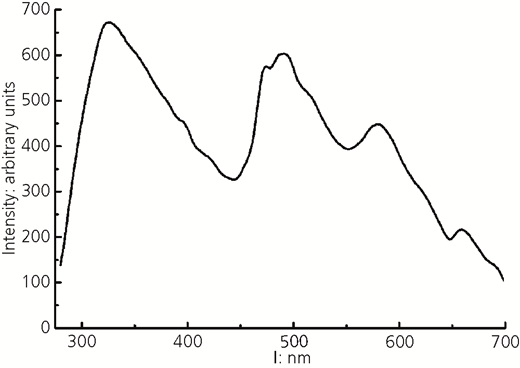
From Figure 8, the following can be seen: the emission spectrum of C2 implies that the complex emits the characteristic fluorescence of the europium (III)/ytterbium (III) ion. In the spectrum of C2, three main emission peaks at 324, 486 and 579 nm are displayed, indicating that the Schiff base ligand of C2 can also sensitize the fluorescence emission of europium (III)/ytterbium (III).
4 Conclusion
Using two Schiff base polymers prepared (L1 and L2) as functionalized macromolecular ligands, two novel Schiff base rare-earth complexes C1 and C2 were prepared through a coordination reaction, and their fluorescence emission properties were investigated in detail. The Schiff base group as a ligand and the europium (III)/ytterbium (III) ion as the central ion can form stable polymer rare-earth complexes. The aromatic Schiff base functionalized ligands L1 and L2 not only can sensitize the fluorescence emission of the central ion but also have excellent mechanical properties. It can be expected that they will have important applications in PL and EL.
Acknowledgements
The authors are grateful to the Science Foundation of State Key Laboratory of Advanced Processing and Recycling of Non-ferrous Metals (SKLAB02014009) and the Natural Science Foundation of Gansu Province of China (1310RJZA044).

