


Samarium (Sm)-doped ceria (CeO2) (SDC), a ceria-based material, is a leading electrolyte for solid oxide fuel cell applications. In this work, fully dense ceria ceramics doped with 20 mol% samarium were fabricated through the Pechini method. Characterization studies including X-ray diffraction (XRD) and scanning electron microscopy (SEM) were performed to investigate the properties of the SDC powders calcined at 400 and 500°C for 4 h. XRD and SEM results showed that a complete solid solution between ceria and samarium was obtained when the sintering temperature and time were 1400°C and 6 h, respectively. The relative densities of the sintered pellets were over 90% of the theoretical density. The spectroscopic properties of the powders were studied by using Fourier transform infrared spectroscopy. Two-probe alternating-current impedance spectroscopy was used to study the grain, grain boundary and total ionic conductivity of the doped samples at 250–750°C.
Notation
1 Introduction
Solid oxide fuel cells (SOFCs) have attracted great attention due to their higher conversion efficiency, high waste heat utilization, superior fuel flexibility and environment-friendliness.1 Zirconia (ZrO2) doped with 8 mol% yttria (Y2O3) (8YSZ) is a commonly used electrolyte material for SOFC applications. However, it has low oxygen ion conductivity below 800°C. For example, at 1000°C, the ionic conductivity of 8YSZ is 1·78 × 10−1 S/cm, whereas at 800°C, it decreases to 1·2 × 10−2 S/cm.2 Ceria (CeO2) doped with rare-earth elements, such as samarium (Sm) and gadolinium (Gd), is a potential electrolyte material for applications in intermediate-temperature SOFCs (IT-SOFCs) because of its perceptible oxygen (O) ion conductivity above 600°C.3–5 Substitution of trivalent ions such as samarium (III) (Sm3+) ions into the ceria lattice results in the formation of oxygen ion vacancies, giving rise to improvement in the ionic conductivity. For this reason, researches are focused on ceria-based electrolyte materials.
To achieve dense electrolyte materials for SOFC applications by sintering, synthesizing ultrafine doped ceria powders is very important. It has been reported that ceria powder can be synthesized by following different techniques such as hydrothermal treatment, precipitation and combustion.6–11
The composition and microstructural properties of the electrolyte material are known to play important roles in improving the ionic conductivity of ceria-based materials. The ionic conductivity of doped ceria increases with increasing dopant concentration, reaches a maximum and then decreases at higher dopant levels due to the formation of microdomains. It has been reported that the ionic conductivity of doped ceria reaches a maximum at a dopant cation concentration of about 20 mol% depending on the dopant element type.4,12,13
In light of this information, in the present study, the total dopant cation amount was kept as 20 mol%; 20 mol% samarium-doped ceria (Sm0·20Ce0·80O1·90; SDC) powder was prepared through the Pechini method using citric acid as the fuel. The effects of the calcination temperature on the structure and electrical conductivity of the doped ceria electrolyte was studied for the 250–750°C temperature range.
2 Experimental section
SDC samples were synthesized by using the Pechini method. The starting materials were high-purity cerium (III) nitrate hexahydrate (Ce(NO3)3·6H2O) (Sigma-Aldrich, 99·99%) and samarium (III) nitrate hexahydrate (Sm(NO3)3 6H2O) salts (Sigma-Aldrich, 99·99%). In order to prepare SDC electrolytes, the nitrates were weighed and dissolved in deionized water at proper concentrations. Ethylene glycol (R.P. Normopur) and citric acid (Boehringer Ingelheim) were selected for the polymerization treatment. Details about the Pechini method are reported in the author’s previous work.14 The X-ray diffraction (XRD) technique was used to determine the crystal structure and phase. The conversion of the so-prepared amorphous precursors into crystalline SDC was achieved by heating the dried precursor particles to either 400 or 500°C and keeping them at the mentioned temperatures for 4 h.
X-ray spectra of the SDC particles were obtained over the 10–90° 2θ range by employing a Rigaku D/Max-2200 PC X-ray diffractometer with copper (Cu) Kα radiation (λ = 0·15406 nm). The calcined powders were pressed to disk-shaped pellets with a uniaxial hydraulic press, followed by cold-isostatic press at 200 MPa. The obtained pellets were sintered at 1400°C for 6 h at a 5°C/min heating rate. The densities of the sintered samples were measured considering the Archimedes principle (water was used as the solvent and ρwater at 25°C is 0·997 g/cm).14
The morphological characteristics of the sintered pellets were investigated utilizing scanning electron microscopy (SEM) (FEI Quanta FEG 450). A PerkinElmer Spectrum 100 Fourier transform infrared (FTIR) spectrometer was employed to analyze the structure of the calcined SDC powders in the range 4000–350 cm−1.
Impedance measurements (electrochemical impedance spectroscopy (EIS)) were performed at 250–750°C in air by using a Solartron 1260 frequency response analyzer and a Solartron 1296 interface. Before conducting the impedance measurements, silver (Ag) paste was painted to both sides of the as-sintered disk-shaped pellets to serve as the electrode. The pellets were then co-fired at 800°C for 30 min.
Alternating-current impedance measurement results were analyzed through the impedance plots (−Z″ (imaginary impedance) against Z′ (real impedance)). By curve-fitting a circle to semicircles on these plots, sample resistances (R) were obtained. The total conductivity (σT) values were then calculated from the total resistance (Rtotal), cross-sectional area (A) and thickness (l) by using the following equation
3 Results and discussion
3.1 Structural analysis
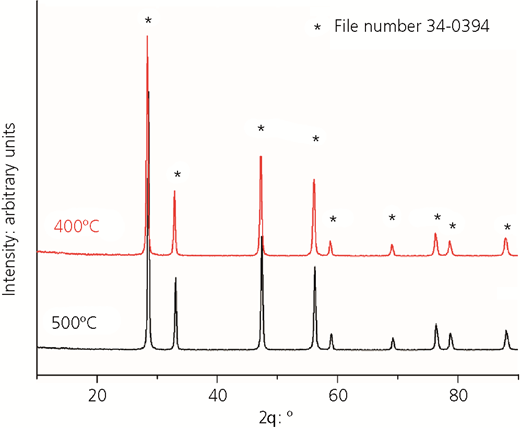
Figure 1 shows XRD patterns of the SDC samples. It is clearly seen that the powders contain only the cubic fluorite structure (Joint Committee on Powder Diffraction Standards Powder Diffraction File number 34-0394). The crystallite sizes of the SDC powders, calculated from the Debye–Scherrer equation, were 11·7 and 13·2 nm for the calcination temperatures of 400 and 500°C, respectively. No crystalline phases belonging to samarium (III) oxide (Sm2O3) were detected in SDC for each calcination temperature. A study by Kuharuangrong4 showed that 10 mol% samarium-, 10 mol% erbium (Er)-, 20 and 30 mol% gadolinium- and 20 and 30 mol% dysprosium (Dy)-doped ceria indicate a single phase of the cubic fluorite structure after calcination at 1200°C. In contrast, additional small peaks of erbium (III) oxide (Er2O3) were seen when ceria was doped with 20 mol% erbium.4 However, in the present study, XRD results showed that the dopant ion (samarium (III) ion) was fully substituted in the ceria lattice.
SEM was used to examine the morphological properties of samples. Figures 2(a) and 2(b) are the SEM images of the sintered pellet surfaces. For both samples, dense microstructures were observed. This is in good agreement with the relative density values of the sintered samples. The density of the sintered pellets produced from the calcined powders is more than 90% of the theoretical density. In order to calculate the mean grain sizes of the sintered samples, the scale bars on the SEM images were used. The mean grain size of the samples was calculated by measuring the size of each grain from the SEM images of ×30 000 magnifications and taking the average of the sizes. The grain size of the sintered pellet that was calcined at 500°C (SDC-500) is a little larger than that of the sintered pellet that was calcined at 400°C (SDC-400). The grain sizes of the sintered pellets that were calcined at 400 and 500°C were found as 0·78 ± 0·21 and 0·85 ± 0·35 μm, respectively.
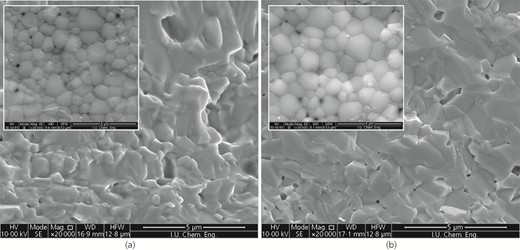
SEM micrographs of the (a) SDC-400 and (b) SDC-500 samples sintered at 1400°C for 6 h
SEM micrographs of the (a) SDC-400 and (b) SDC-500 samples sintered at 1400°C for 6 h
As the grain size increases, the grain-boundary path for ion conduction shortens. For this reason, in the current study, the sintered pellet that was produced from the powders calcined at 500°C had the largest grain size (0·85 μm). Therefore, the smallest percentage of grain-boundary region results in the smallest grain-boundary resistivity. The difference in the grain-boundary resistivity of the Ce0·80Sm0·20O1·90 pellets influences the total conductivity. However, in ceria-based electrolyte systems, contradictory results have been also reported in the literature.15,16 Zhou et al.15 indicated that Ce0·9Gd0·1O1·95 with the finest grain size possessed the highest grain-boundary resistance. In contrast, Christie and van Berkel16 measured significantly lower total grain-boundary resistance values for Ce0·8Gd0·2O2−δ samples with submicrometer mean grain sizes.
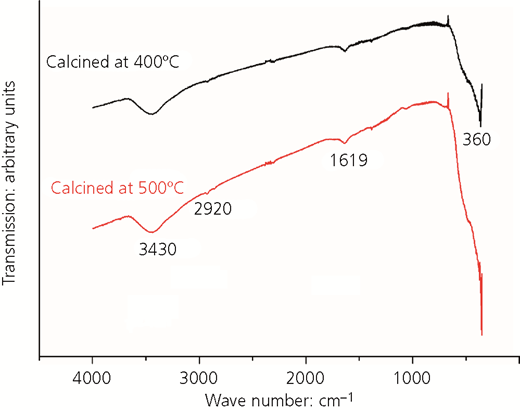
The FTIR spectra of the SDC powders are shown in Figure 3.
FTIR measurements were done using the potassium bromide (KBr) method at room temperature. In this study, the aim was perform structural characterization of SDC samples and investigate the effect of the calcination temperature on the characteristics of chemical functional groups.
The spectrum indicates a weak intense band at around 3430 cm−1 and an intense band at 360 cm−1. In addition, some weaker absorption peaks are also observed at around 1619 and 2920 cm−1. The band at 3430 cm−1 is attributed to the ν(O–H) vibration modes of the physically sorbed water molecules. Potassium bromide exhibits moisture absorption characteristics. As mentioned earlier, the pellets were prepared by utilizing potassium bromide. For this reason, presence of the peak observed in the range 3000–3600 cm−1 is an expected outcome. The peaks observed at 2920 and 1619 cm−1 for both samples are ascribed to the ν(C–H) and δ(CH2) vibration modes, respectively. These are due to the presence of atmospheric organic species in the exposed samples during sample preparation. The bands observed in the lower-frequency region at <700 cm−1 are typical of Ce–O groups with a lower double-bond character and of Ce–O–Ce chains or Ce–O–Sm3+ symmetric stretching of the metal oxide network.17,18
3.2 Electrical properties
EIS was used to determine the ionic conductivity behavior of the SOFC electrolytes, which are oxygen ion conductors.
Typical impedance plots of SDC sample at 250, 400 and 750°C are shown in Figures 4(a)–4(c), respectively. Each plot consists of one or more semicircular arcs, which represent different processes in an ionically conducting sample. It is seen from Figure 4(a) that at 250°C, the plot consists of two semicircles and onset of the third semicircle. The high-frequency arc corresponds to the grain-interior resistance (R Gi), the intermediate-frequency semi-circle corresponds to the grain-boundary resistance (R Gb) and the low-frequency incomplete arc corresponds to the electrode resistance (R e). Grain and grain-boundary resistance arcs are well resolved at 250°C for both samples. It was observed that the grain-interior resistivity is the same for each sample at 250°C. However, the grain-boundary resistivity of the sample calcined at 500°C (SDC-500) is lower than that of the sample calcined at 400°C (SDC-400). The ratio between the grain-boundary resistivity of the mentioned samples is found as ∼1·60 at 400°C. Thus, at this temperature, the pellet formed from the SDC-500 particles had the highest conductivity due to the low resistance of the grain boundary of the pellet. Similar results were also reported by Jang et al.19
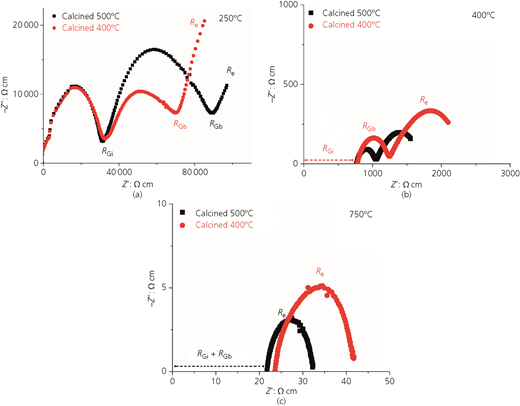
Complex impedance spectrum plots of SDC pellets calcined at 400 and 500°C, measured at 250, 400 and 750°C in air. R Gi, R Gb and R e mean the grain-interior resistance, grain-boundary resistance and electrode, respectively
Complex impedance spectrum plots of SDC pellets calcined at 400 and 500°C, measured at 250, 400 and 750°C in air. R Gi, R Gb and R e mean the grain-interior resistance, grain-boundary resistance and electrode, respectively
The ionic conductivity behavior of SDC solid oxide electrolytes was similar to the ionic conductivity behavior of polycrystalline ceramics.20
The calculated activation energies (E a) and the total conductivities for the samples are given in Table 1. From the impedance results (see Table 1), the maximum ionic conductivity, which is comparable with the results of previous studies, was measured to be 1·62 × 10−2 S/cm for the SDC-500 electrolyte at 600°C. For instance, Dikmen et al.21 reported an ionic conductivity value of 7·53 × 10−3 S/cm at 600°C for Ce0·75Gd0·25O2− δ. Furthermore, Huang et al.22 found that the ionic conductivity of Ce0·83Sm0·17O1·950 is ∼5·70 × 10−3 S/cm at 600°C. The ionic conductivity of the SDC-500 (Sm0·20Ce0·80O1·90) electrolyte is an order of magnitude higher than those of these electrolytes, at the corresponding temperatures. In addition, the ionic conductivity of Z0·835Y0·165O1·92 (YSZ) at 600°C was found as ∼10−4 S/cm by Shuk et al.,23 whereas in the current work, 1·39 × 10−2 and 1·62 × 10−2 S/cm conductivity values were measured for the SDC-400 and SDC-500 electrolytes at the same temperature, respectively. Therefore, in the current report, it can be concluded that the ionic conductivities of the SDC-500 and the SDC-400 electrolytes (σ 600°C ≈ 10−2 S/cm) are two orders of magnitude higher than that of the YSZ electrolyte, which is the widely used conventional electrolyte for the same temperature (σ 600°C,YSZ ≈ 10−4 S/cm).
Electrical properties of the Sm0·20Ce0·80O1·9 0 SDC solid solutions
| Sample | Conductivity: S/cm | Activation energy, E a: eV | |||
|---|---|---|---|---|---|
| σ 600°C | σ 650°C | σ 700°C | σ 750°C | ||
| SDC-400 | 0·0139 | 0·0217 | 0·0313 | 0·0416 | 1·02 |
| SDC-500 | 0·0162 | 0·0240 | 0·0340 | 0·0450 | 0·99 |
With increasing operating temperature (Figure 4(b)), the first semicircle (the high-frequency arc) disappears and only the grain boundary and electrode arcs can be seen. When the operating temperature increases further as in Figure 4(c), the grain-interior and grain-boundary resistances become frequency independent and only one semicircle, which is attributed to the electrode resistance, is visible. At 750°C, a single arc, which represents the electrode, was observed. At 750°C, the grain-interior (R Gi) and grain-boundary (R Gb) resistances are not discrete; only the total conductivity can be calculated. At this temperature, both samples exhibited almost equivalent total conductivities. At 750°C, the total ionic conductivity values were determined to be 4·50 × 10−2 and 4·16 × 10−2 S/cm for SDC-500 and SDC-400, respectively.
As expressed in Section 1, YSZ is the most commonly used solid oxide electrolyte material for SOFCs. However, in this work, the SDC-500 electrolyte has demonstrated better ionic conductivity than the YSZ electrolyte for SOFCs at 600°C.22 Thus, the SDC-500 sample could be considered a better candidate to be used as a solid electrolyte in solid oxide fuel cells.
4 Conclusions
Ceria powders doped with 20 mol% samarium were synthesized through the simple Pechini method in which a relatively low calcination temperature was required (such as 400 and 500°C) compared with conventional techniques such as hydrothermal treatment, to form single-phase cubic fluorite structures such as pure ceria. The obtained small average crystallite sizes of the SDC powders enabled the preparation of highly sinteractive powders. High densification of the pressed samples was achieved by sintering at 1400°C for 6 h, and the calculated relative densities were over 90% of the theoretical densities. FTIR results show that both samples exhibited characteristic peaks of ceria in the lower-frequency region at <700/cm. According to the EIS results, at 750°C, both samples calcined at 400 and 500°C exhibited almost equivalent total conductivities. The ionic conductivity of the SDC-500 pellet (σ750°C = 4·50 × 10−2 S/cm) is higher than that of the SDC-400 pellet (σ750°C = 4·16 × 10−2 S/cm). The small difference between the ionic conductivities of the samples may arise from the differences in the grain sizes of the samples. Based on the EIS results, it can be deduced that the SDC-500 sample is a more promising electrolyte than YSZ for IT-SOFC applications.
Acknowledgement
This work was financially supported by the Research Fund of Istanbul University-Cerrahpasa with project numbers 26040 and 51207.

