Papers published in Engineering and Computational Mechanics are eligible for awards from the Institution of Civil Engineers. Papers from any of the ICE journals can be nominated for several awards. In addition, each journal has awards dedicated to their specific subject area.
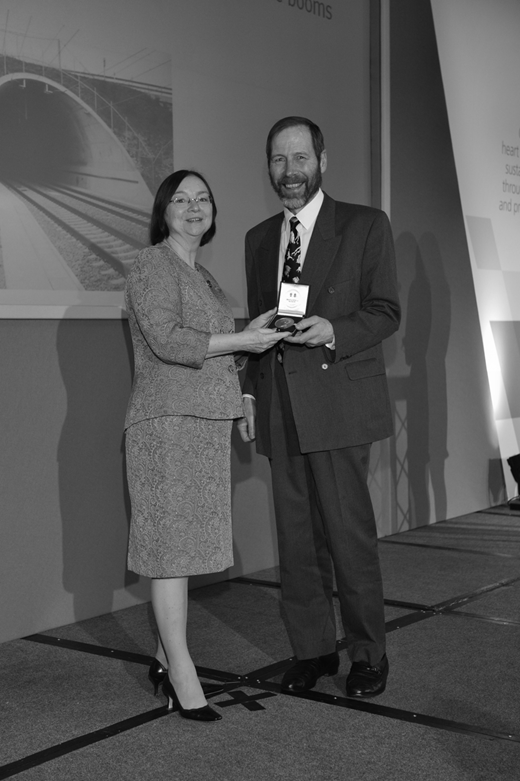
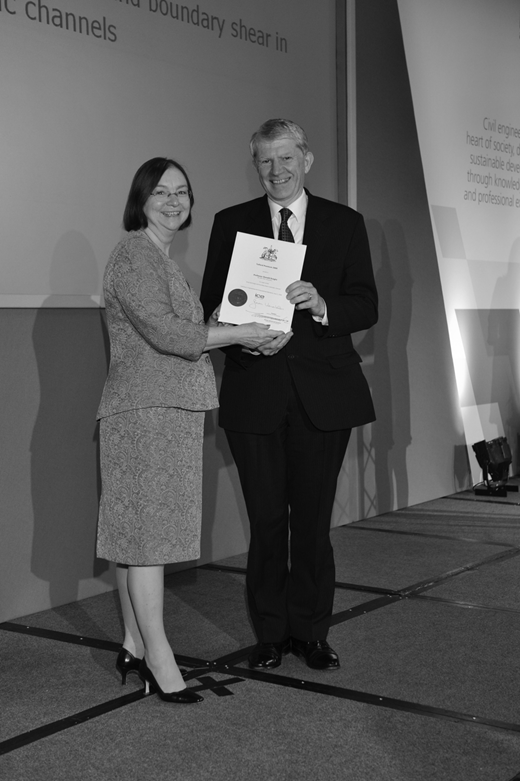
On Friday 23 October 2009, ICE president Jean Venables presented awards to the following papers published in Engineering and Computational Mechanics in 2008. The editorial panel nominated their best papers and an awards committee chaired by Adrian Long allocated the awards.
The Telford Premium, presented for the best paper in Engineering and Computational Mechanics, was awarded to: Knight D and Tang X (2008) Zonal discharges and boundary shear in prismatic channels. Proceedings of the Institution of Civil Engineers, Engineering and Computational Mechanics, 161(2): 59–68, doi: 10.1680/eacm.2008.161.2.59.
ABSTRACT
This paper illustrates a new approach to obtaining analytical stage–discharge formulae for both zonal and total discharges in straight prismatic channels of any shape, based on the concepts of a zero–shear force interface and an analytical solution for the lateral variation of depth-averaged velocity. The analytical solution for velocity is derived from the depth-integrated form of the Navier–Stokes equations, and includes the effects of bed friction, lateral turbulence, and secondary flows/planform vorticity. The analytical formulae for stage discharge are given for both simple and compound trapezoidal channels, together with formulae that permit the boundary shear force to be determined for every linear element on the wetted perimeter. These stage–discharge and shear force formulae depend on the channel geometry and on three hydraulic parameters related to the bed friction factor f, lateral eddy viscosity λ and depth-averaged secondary flow Γ, as required in the original Shiono and Knight method. The analytical results show good agreement with experimental data. Ways of extending this approach to more complex shaped channels are outlined.
The Telford Gold Medal, presented for the overall best paper, was awarded to: Vardy A (2007) Generation and alleviation of sonic booms from rail tunnels. Proceedings of the Institution of Civil Engineers, Engineering and Computational Mechanics, 161(3): 107–119, doi: 10.1680/eacm.2008.161.3.107. Fig. 1
ABSTRACT
The origins of sonic booms emitted from railway tunnel portals are described, and simple design expressions are provided to enable their amplitudes to be estimated, especially for the common case of relatively short tunnels. The paper is targeted primarily at designers wishing to make initial assessments without any need for specialist software or specialist expertise. However, many references are provided to sources of more advanced information. It is shown why the amplitudes of the disturbances tend to increase with tunnel length in the case of slab-track tunnels, but to decrease with length in the case of ballast-track tunnels. The potential effectiveness of various remedial measures is described, especially at tunnel entrances and exits. Some remedial methods would also improve comfort levels for passengers on trains in tunnels, but this is largely fortuitous because the sonic boom effect is influenced primarily by rates of change of pressure whereas passenger comfort is influenced primarily by absolute changes in pressure. Fig. 2