1. INTRODUCTION
There is now little doubt that global warming is happening, that it is largely caused by carbon dioxide (CO2) emissions from human activity, that the effects on some communities will be devastating and that a substantial cut in emissions will be necessary to limit the damage. Politicians have woken up to the problem and have made ambitious commitments, but do they really know how these will be fulfilled? This briefing reviews the targets and commitments and the technology that could be used to meet them in the transport sector.
2. THE COMMITMENT
The Kyoto protocol,1 agreed in December 1997, aimed for a reduction in the ‘aggregate anthropogenic carbon dioxide equivalent emissions of the greenhouse gases’ by at least 5% by 2012 compared with 1990 levels; the UK committed to a 12·5% reduction. There has been a succession of more ambitious targets since then—20% reduction by 2020 and 60% by 2050. Given growth in other parts of world, the Stern Review2 concluded that the developed world would need to achieve cuts of 60–80% by 2050. In 2007, the Intergovernmental Panel on Climate Change (IPCC)3 reported that an 80% cut is needed; soon afterwards David Cameron committed the Conservative party to this target. In November 2007, in his first environment speech as prime minister, Gordon Brown warned that climate change science predictions are now so alarming that cutting emissions by 60% may not be enough and, increasingly, he seems to be committed to the 80% figure.
3. THE PRESENT SITUATION
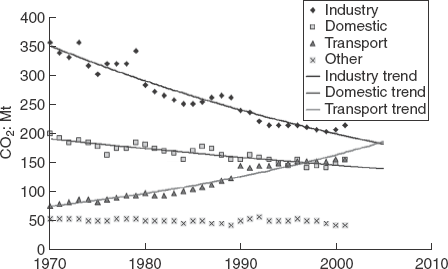
Considering emissions classified by end-user calculated by the National Environmental Technology Centre (Netcen), there are three main generators of CO2—industry, transport and domestic consumption (Fig. 1).4 Emissions from industry in the UK have been reducing for 30 years, but this is mainly because industrial activity has been exported to other countries and goods have been imported to the UK by sea and air—not included in the emissions calculations. In December 2007, Helm et al. reported that the emissions for which the UK is responsible are actually increasing, rather than reducing as indicated by these statistics.5
In March 2008, a National Audit Office investigation6 stated
The basis on which to report against the UK domestic goal of a 20% reduction in carbon dioxide by 2010 is unclear. This reflects a lack of precision in the way in which the goal was originally defined, the absence of clear reporting standards, and insufficient consistency and coordination between departments in presenting emissions data.
Using the methodology of the Kyoto protocol, Britain emitted 656 Mt of CO2 in 2005, and thus the government claims an improvement on 1990 figures. However, the national environmental accounts for 2005 show emissions to be in the region of 733 Mt. Without getting embroiled in the complicated methodology of calculating CO2 emissions and the differences between CO2 and CO2 equivalent, it seems that, in practical terms, Britain has made little progress since 1990. So how can an 80% reduction in UK CO2 emissions be achieved over the next 40 years? Given that the rest of the world will be attempting to make similar cuts, the scope for claiming a reduction, while actually increasing emissions, by buying other countries' quotas (as allowed under carbon trading rules) seems unlikely. Similarly, claiming a credit against today's emissions by planting trees that will take 30 years to grow to a size that has any effect has been shown to be intellectually bankrupt. Real cuts have to be made.
In theory, the UK could concentrate on carbon reduction in one segment of the economy, such as domestic use, which would require less draconian cuts in other segments: this seems unlikely. Supporting papers for the 2007 Department for Business, Enterprise & Regulatory Reform (BERR)7 consultation on nuclear power quoted figures that suggested that the electricity supply industry (which mainly feeds the industrial and domestic sectors) will have difficulties meeting the 60% target and suggested that other sectors might have to cut by more to compensate. Other sectors are telling a similar story. Therefore it is safe to assume that, to meet the national target, every sector will have to make a real reduction of 80%.
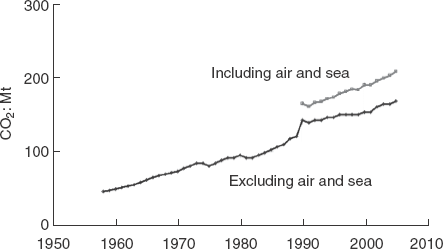
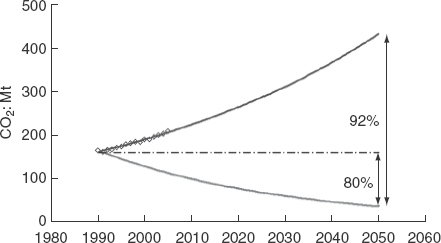
What would such a reduction in CO2 emissions look like in the transport sector? Before projecting forward, we need to look at how emissions have increased over the years. Fig. 2, based on Netcen and Department for Transport (DfT) data,4 shows emissions from transport from the mid-1950s (data for air and marine bunkers are only available since 1990 and do not take into account recent revelations that the latter have been seriously underestimated). Projecting forward the trend until 2050, with a ‘business as usual’ approach, emissions from the transport sector could be double 2008 figures. More importantly an 80% reduction in comparison with 1990 is equivalent to a reduction of 92% with extrapolation of this trend (Fig. 3).
4. REDUCING EMISSIONS
So, how can the dramatic reductions in emissions be achieved? One way would be to keep technology the same but to revert to a 1940s level of mobility. This has been firmly rejected by all politicians of all parties. There is a story that Tony Blair, returning from holiday in Florida, was asked whether he should not be cutting down on long-distance flights. His reply was that society could not ask people to take fewer flights and that scientists (by which he probably meant engineers) would solve the problem. This is not an isolated attitude: politicians, other than Ken Livingstone, are scared of taking any action that might be seen as an attack on individual freedom or ‘the great car economy’. Both the King Review on low-carbon cars8 and the Eddington review9 started from the premise that there will be an increase in personal mobility and the transport of goods.
4.1. Biofuels
A major shift to the use of biofuels can also be ruled out. Although some biofuels, such as Brazilian sugar cane, show up to 90% reduction in greenhouse gases (if one ignores the effects of clearing the land to grow them) many other crops, such as corn grown for fuel in the USA, create almost the same emissions as gasoline.10 Speaking on Radio 4's Today programme in March 2008, Robert Watson, Chief Scientific Adviser at the Department for Environment, Food and Rural Affairs (Defra) said
There are some instances where the biofuels are sustainable and we must make sure that they are the only fuels we use at the moment. What we need to do is invest heavily, both the public and the private sector, in what we call second and third generation biofuels where we use the whole plant for the biofuel. This is probably somewhere between five and ten years away, but if we can do that we do believe there's great potential for it being purely economically, environmentally and socially sustainable.
Others are less certain about the so-called ‘second generation’ biofuels. Any new crop grown on arable land will tend to displace existing cash crops to more marginal land which, in turn, will encourage subsistence farmers to encroach on virgin forests, peat bogs or other land that stores CO2. So the new fuel crops are genuinely sustainable as long as they are grown on land that has no other agricultural use and that will not release methane or CO2 when cultivated and that they do not place unsustainable demands on water or other resources. These provisos drastically cut the available pool of new crops and, if we do find plant species that meet these requirements and places to grow them, it is far from obvious that converting them into road fuel is the most efficient way of using biofuels. A modern wood-burning stove has an efficiency of 80% while the combination of a fermentation/distillation plant and an internal combustion engine is unlikely to have an efficiency better than 20%. The best way of using biofuels might be to use them to heat buildings and use the natural gas thus saved to power fuel-cell vehicles.
There is certainly no dispute over the central policy to restrict biofuels to those that can be shown to be sustainable. As Robert Watson said, ‘It would obviously be insane if we had a policy to try and reduce greenhouse gas emissions through the use of biofuels that's actually leading to an increase in the greenhouse gases’.
4.2. Plug-in hybrids
The first report of the King review on low-carbon cars in October 2007 stated
Long term, clean electric or hydrogen-powered vehicles are a probability. There are many exciting technical challenges to be overcome—e.g. batteries with an order of magnitude increase in energy density and new storage systems for hydrogen—and we have a strong research base to address these. However, while such vehicles will have zero co2 emissions on our streets, they will rely on clean electricity to provide truly low-carbon transport.8
It is the last sentence that contains the real challenge to decarbonising our transport system, but the development of new long-life, high energy density batteries or the infrastructure for making and transporting ‘carbon-free’ hydrogen would be a formidable development activity. Even providing an infrastructure to recharge batteries would be far from simple, bearing in mind how many cars in cities are kept on the streets and that, to recharge a 40 kWh battery in 10 minutes, would require 240kW (1000A at 240 V), assuming the electrochemistry could support that charge rate.
The BERR nuclear power documents7 showed projections for future co2 emissions of the electricity supply industry (ESI). Even the most optimistic forecast showed no significant reduction in emissions from the sector in the period of the study (up to 2030) and implied some undefined process that would make a very significant cut over the following 20 years to meet the 2050 emissions target. Throughout the period, marginal generation (i.e. that brought on-line to cope with short-term demands) would be conventional thermal plant with similar emissions as today.
The total energy demand of our transport systems are of a similar scale to the present electrical load on the national grid. A major switch to plug-in hybrids and electric vehicles would significantly increase the load on the ESI which, with present plans, would be met by fossil-fuelled generation. The King review rightly identified that, challenging as it would be to develop new batteries and the infrastructure to go with electric and plug-in hybrid vehicles, the big problem is decarbonising the ESI, which would be made more demanding by the new transport loads. Such a switch would be technically possible but would imply growth in the nuclear sector even faster than UK secretary of state for business, enterprise and regulatory reform John Hutton predicted when addressing the trade union Unison's conference in March 2008 as well as a massive growth in renewable energy. Whether such an increase is deliverable by ‘market forces’, as the government assumes, is doubtful: a national priority closer to 1940s armaments manufacturing is probably closer to the mark.
4.3. Modal change
There is a strong case for encouraging people to travel, and goods to be carried, by the most efficient mode. For most applications this is the rail network. Although Network Rail has recently celebrated the highest number of passenger journeys since the 1950s, this is against the background of a ten-fold increase in total travel. Today, nine out of ten trips are made by road and the routes where rail is dominant are restricted to intercity journeys into London and city-centre commuting.
A study carried out by Lancaster University for the Rail Safety and Standards Board (RSSB) in 2007 analysed energy use by different transport modes.11 This is more complicated than might be thought because of the different load factors that can be achieved by the various modes. As an example, intercity
coaches operating point-to-point between major cities achieve very high load factors because of the booking system and the flexibility of running more vehicles to meet peak demands. On the other hand, the average occupancy of service buses in urban areas is as few as nine passengers, which gives them much higher emissions per passenger-km.
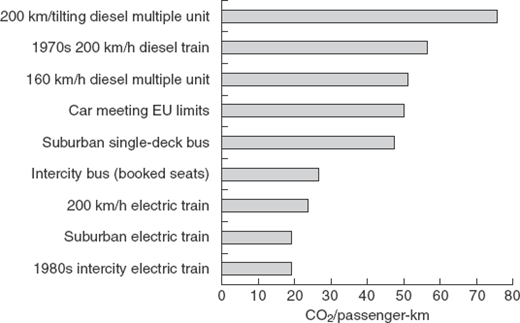
Figure 4 shows that the most efficient transport services (measured in co2 per passenger-km) are electric trains, followed by intercity buses. There is a strong case to be made for transferring travel from the private car to electric trains, but it is difficult to justify funding transfers to fast diesel trains that produce more emissions.
The environmental benefit of electrified railways will become steadily greater as the electricity supply industry is decarbonised. A government serious about co2 emission targets might be expected to be planning for a large expansion of the rail network—perhaps to double or treble the proportion of passenger travel by rail—together with a rolling programme of electrification and a strategy to increase both train lengths and loading gauge to European standards. In fact, the DfT supports none of these; it has initiated the procurement of new high-speed diesel trains and has adopted a policy of fare increases, which has the effect of pricing people off the network—both of which suggest less than full commitment to carbon reduction.
5. THREE FALLACIES
Before considering the way forward, it is important to put to rest three fallacies. The first is that there is a magic bullet that will solve the problem of emissions while allowing continued growth in mobility. Various technologies have been suggested for this role: hydrogen, fuel cells, biofuels and hybrids are recent candidates. Previous sections of this paper have shown how the development of these novel technologies will be very challenging and unlikely to be able to achieve the necessary reduction by themselves.
The second fallacy is that an 80% reduction in emissions can be achieved by setting an appropriate ‘carbon cost' and allowing market forces to make the necessary adjustments. This has been shown not to work. As an example, a Ford Mondeo 2l car has a petrol consumption of 7·9l per 100 km and emits 189 g/km of co2. With fuel tax of 50 p/l, this works out as a tax of £200/t of co2—well above the social cost of carbon discussed in the Stern review, but this has not dissuaded individuals or companies from buying cars of this size.
The third fallacy is that managing transport emissions can be considered in isolation from other policies such as competition, immigration, education, employment or economic growth. All these strongly influence level of travel and thus emissions. For example, a policy of ‘best value procurement', which requires local authorities to invite competitive bids for all services rather than operating a direct works department, is likely to result in contractors from neighbouring areas driving many miles to undertake jobs. Education policies that result in children being driven past a local comprehensive to a specialist college or faith school have a similar effect.
6. A WAY FORWARD
Reducing co2 emissions from transport by 80% over the next 40 years will be challenging, but is achievable. There are many different detailed ways in which this could be addressed but all are likely to include
continued development and application of metros, trams, light rail, battery buses and other electrically powered vehicles so these are the mode of choice for urban transport and commuting
the development and widespread introduction of plug-in hybrid and electric vehicles so they become the normal means of individual transport in rural and urban areas not served by public transport
a doubling or trebling of the capacity of the inter-urban rail network and a rolling programme of electrification to cover all significant lines by 2030
ambitious programmes of renewable energy and nuclear power to ensure that there is ‘low-carbon electricity' to supply all of the above.
Probably the most important change will be the introduction of road pricing, driving restrictions, carbon allowances or other mechanisms to ensure low-carbon transport is used and that transport growth is checked. To be effective, this will have to be accompanied by a reversal of government priorities so that reducing carbon emissions is the policy that can ‘trump’ health, education or even defence.