

It is often stated that the biggest shortcoming of wind power is that it requires a considerable amount of fossil fuel standby capacity to deal with situations in which wind farms generate little electricity. Nuclear power, in contrast, is said by its proponents to be a wholly reliable means of producing the base load electricity requirement in the UK.
Is this view of nuclear correct? Over Christmas 2007, when half the nuclear stations in the UK were shut down, the National Grid had to order the start up of ‘standby’ coal- and gas-fired generating plant. Nuclear plants, like everything else, can be unreliable. Because they are so costly to build, the inclination is to construct the minimum number, and so to rely on some other form of generation when things go wrong. So at the present time, neither nuclear nor wind can do without back-up.
What about the longer term, and the neglected issue of the nonbase load or daytime power requirement? How does nuclear answer these questions? Are there any drawbacks to nuclear that have been overlooked, and is the variability issue of wind energy quite the problem that its opponents make out?
First, one non-problem for wind is whether the UK grid would be in difficulties if there were a cessation of electricity from this source. At present, the largest cause of a sudden power loss in Great Britain is Sizewell B having to shut down. This is a regular occurrence, resulting in a step change of 1·2 GW in the power delivered to the grid. Various techniques are deployed to cope with these step changes. These include instantly disconnectable loads, and putting on-line rapid start generators and spinning reserve fossil plant. However, changes in electricity production from wind farms are gradual and have a much less severe impact on the grid.
Turning now to a much more important issue, which is the inability of nuclear plants to generate anything other than ‘base load power’. In the UK, one reason for keeping obsolete coal-fired fuel plants in operation is that they are good for meeting the daytime demand; that is, they can be shut down and started up reasonably easily. Unfortunately, this is not a characteristic of nuclear. The UK's Magnox and advanced gas-cooled reactor (AGR) plants are simply not capable of being closed down at night when the demand drops, and then being brought back on-line the next morning. The temperature changes would be too severe. But pressurised-water reactors (PWR) and boiling-water reactors (BWR) would also find it difficult. On shut down, ‘poisoning’ by radio-nuclides, like xenon-135, results in absorption of neutrons. It can then take a couple of days fo the radio-nuclides to decay, before it becomes possible to put a reactor back on-line.
So the ‘two shifting’ by which fossil fuel plant deals with the day-to-night variations in demand is not possible for nuclear. But is it feasible to vary the output, so that the nuclear plants can reduce their overnight power? In principle, this can be done, although there is the risk of thermal fatigue even in PWRs and BWRs. The big issue is that of finance. Due to their high capital costs, nuclear power plants need to run at full output all the time. How would this affect the number of nuclear plants foreseeable in the UK? Could the UK reach the French level of 70%?
This 70% figure disguises the fact that any French nuclear plants which are on-line run at virtually full output all the time. Increases in daytime demand have to be taken by hydro and fossil plants, and by a heavy reliance on imports. Conversely, at night, to keep the nuclear plants running at full load, electricity is exported to Germany, Belgium, Switzerland, Italy and England, where much of it is wasted on street, office or shop lighting.
Take for example the situation in metropolitan France on 20 January, 2008, a few days before this article was written (see Fig. 1). There were two daytime peaks of 59·7 GW and 62·7 GW, but in the early morning the load fell to 47·4 GW. The power from the nuclear plants peaked at 54GW during the day, falling to a minimum of 49·1 GW around 0700, when the demand had actually begun to pick up. Over the 24 h, although the demand varied by 30%, nuclear only varied its output by 10%. Part of the overnight output goes into pumped storage, so the night-time demand is artificially raised. (EDF also has a punitive tariff regime that encourages many users to cut themselves off when the grid is under strain.)
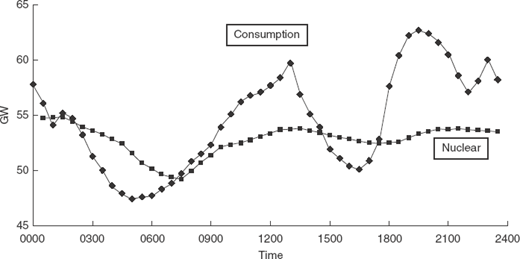
French electricity consumption against nuclear-generated output, 20 January, 2008
French electricity consumption against nuclear-generated output, 20 January, 2008
So the 25GW of ‘hydro back up’ in France is vital. The UK does not have, nor ever will have, this capability. If the UK is to have nuclear, it will need many fossil fuel plants. Exporting large amounts of ‘spare’ nuclear output is not really an option if other countries in Europe go nuclear. Thus, it does seem unlikely that the UK could get to French levels.
How does wind power compare? Given enough wind capacity (around 150–180 GW) and by ensuring that wind farms were
spread out over the UK and surrounding seas, it would be possible to dispense with fossil fuel power plants entirely. There would be no day/night problem. Wind farms can be turned off when not needed. Obviously, for many years, as the wind sector is built up, fossil fuel plants will be needed, but eventually they could be closed. Obviously there will be times when there is excess wind capacity, this situation becoming quite common when the wind capacity exceeds 90 GW. This energy could, however, be used for space heating. This will become more important as UK gas reserves run dry.
The nuclear option actually locks the UK into a situation in which it has to continue to rely on coal- and gas-fired plants. Such units could not be of the ‘clean coal/carbon capture’ type, however. Operating for a few hours a day would make it impossible to capture the carbon dioxide (CO2), which requires steady, near-base load operation.
Finally, given the inflexibility of nuclear plant and the variable nature of wind energy, it will be seen that these two forms of power production are incompatible. Hence, what is considered to be the most ‘politically attractive solution’, giving a zero CO2 energy system, and giving something to both the green and nuclear lobbies, is actually a recipe for disaster.

