

This article sets the new Triton platform concept in the context of the tidal stream resource, the Cinderella of renewable energy. Triton makes possible new levels of generating capacity, ease of installation and simplicity of maintenance. The article is written from the perspective of an engineer who pioneered UK wind power technology in the 1980s and 1990s with the Wind Energy Group, and now sees some of these principles applicable to tidal flows.
1. THE TIDAL STREAM RESOURCE
The tidal flows around the coasts of Britain represent a powerful and neglected source of renewable energy. This resource comes from putting freestream turbines into fast water flows (as with wind turbines) rather than from a tidal barrage (the damming of high tidal range waters such as on the River Severn). Estimates of what is recoverable from UK tidal streams vary between 18 TWh/year (Carbon Trust, 2006) and 60 TWh/year (Bryden, 2006), depending on assumptions made about flow modelling and channel blockage. This is the equivalent of between 5 and 15% of UK electricity demand – a huge resource and estimated to be half of that available for the whole of Europe. Unlike wind, the tidal stream resource is concentrated in relatively few locations close to shore. For example, about half of the UK capacity is located in a single channel – the Pentland Firth between Caithness and the Orkney Islands – that helps fill and drain the North Sea from the Atlantic twice a day with vast flows of water (Black and Veatch, 2005). Other suitable locations are to be found around the north and western Scottish Isles, the Channel Islands, the Severn Estuary, off Portland Bill, and in parts of France, Ireland, Norway and Spain. When one also considers that – unlike wind – it is silent, practically invisible and 100% predictable, it is strange indeed that tidal stream recovery has not been developed earlier.
One reason for this slow commercialisation is that energy recovery from tidal streams is technically difficult and expensive to develop. Although a few prototypes have been installed in shallow water, most of the resource lies in water of depth 60 m or more (e.g. the Pentland Firth). Waters such as this can be extremely rough, with hostile weather conditions for extended periods. In most cases where water is deeper than 35 m, it is not possible to employ barges, jack-ups, large cranes or divers for installation or maintenance tasks; this makes the practicality of operations – let alone their economic viability – questionable. Access to non-surface-piercing or floating turbines for simple tasks such as replacing a sensor is all but impossible without taking the turbine back to base, as experience with wave power devices in Portugal has shown. This means potentially long delays and poor availability whenever access is required.
Some experience has been gained with prototype turbines in shallow or sheltered water. MCT and OpenHydro have successfully tested their devices on surface-piercing structures that allow full recovery of the working parts for on-site maintenance. Hammerfest Strom tested their turbine for some years in waters that allowed barge recovery, and TGL is about to test a prototype that can be detached remotely from its seabed base and towed back to shore for servicing.
However, fixed surface-piercing structures are impractical for deep water, and access then becomes a problem for totally submerged or floating designs. Even simple tasks such as replacing a circuit board or checking a sensor would require recovery of the whole turbine and its removal to base. The offshore wind turbine record, which involves site visits several times a year, suggests that the goal of fit-and-forget for tidal turbines, which see loads as great or greater, will remain unfulfilled.
However, despite the difficulties, there is now a good deal of activity in this field. Many companies are vying for seabed areas in the recent Crown Estates bidding round with the aim of getting running experience with actual hardware.
2. THE TRITON PLATFORM
Present efforts seem likely to result in workable turbines tested in shallow waters. We know from wind energy experience and from the marine traditions of the UK that these can be made to work – given time. So, in seeking to address the technical challenges of the largest resource areas (i.e. deep, fast-flowing channels) head-on, TidalStream Ltd has focused on a support system for turbines rather than on the turbines themselves. The Triton platform is believed to be unique in satisfying three key requirements:
Each seabed installation must carry a large capacity (anchorage deployment and cabling costs in deep, rough water are so high that only multi-megawatt schemes are likely to be viable).
Float-out installation and recovery of the system is required, again to avoid the deployment costs of large offshore lifting equipment.
Ease and safety of access for maintenance are essential. It must be possible to bring turbines to the surface at regular intervals – not only for blade cleaning and minor servicing but also to put people on board safely.
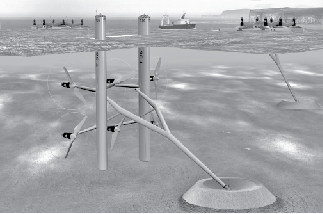
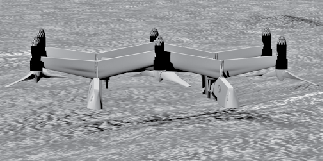
In its deep water form Triton carries six 20 m turbines with a total capacity of 10 MW (Figure 1). It consists of two vertical spar buoys carrying two rows of three turbines each and anchored via a rigid tether arm to a gravity caisson base. The attachment to the base is hinged in all three planes so that the platform can swivel around to follow the tide, flex up in response to wave loadings and rotor thrust, and roll over into a maintenance position with individual turbines out of the water for access (Figure 2).
2.1. Installation
For installation, Triton is towed out to site horizontal and with its tether arm raised (see top left of Figure 1). In this position, the spar buoys are empty of ballast water and Triton has the characteristics of a 1200 t catamaran and excellent sea-keeping stability. Once over the pre-installed caisson (also floated out and ballasted), Triton’s tether arm is lowered and attached along with an electrical supply cable. The spar buoys are half-filled with ballast water and Triton rolls over and sinks into its vertical operating position, as shown in Figure 1. In this position it is also very stable – so stable that it can be re-trimmed to carry on operating with single or even double rotor faults until a weather window permits access for repair. The caisson design shown is a gravity-base not fixed to the seabed; where rock-anchoring is possible (by drill-ship or remote drilling techniques) the size of the base can be considerably reduced.
2.2. Maintenance
For maintenance (see top right in Figure 1 and Figure 2), ballast water is pumped out and Triton rolls back into its horizontal floating position. Duplicated water pumping systems would perform this task in about 30 min under remote control while a service boat was being dispatched. In this maintenance position, the turbines can be accessed via internal walkways in the spar buoys and cross-arms. For turbine removal, a workboat fitted with a small crane can be brought alongside the spar buoys and tethered close to the turbine that needs to be removed. For very minor tasks, Triton can be accessed in its vertical operating position with, as on an offshore wind turbine, landing and ladder access to the control room at the top of one spar buoy.
2.3. Performance
At the best sites Triton should achieve a capacity factor of over 40% – on a par with the best windfarms. Six turbines close to each other will not detract from each other’s flow as long as they remain perpendicular to the stream direction – which is what Triton’s free yawing tether ensures. One key aspect of the modular approach is that a single turbine failing does not put the others out of action. Tow-tank testing has demonstrated that Triton could continue to operate with one or even several turbines stopped, and that ballast trimming could be used to keep the platform on an even and stable keel even in the highest current flow. This is important because waiting times for good weather for turbine exchange could be substantial, whereas the time for the actual exchange (when all turbines would have to be stopped) would be quite short. The overall availability loss for single turbine failure would thus be limited and certainly much less than for competitive systems requiring complete removal in very low sea states.
3. PROGRESS TO DATE
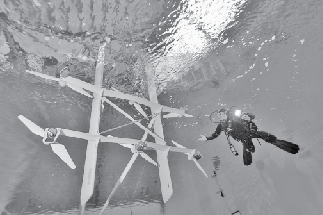
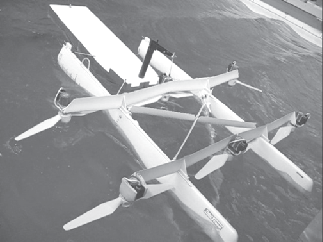
The Triton concept has been proved at model scale and is currently undergoing full-scale structural and mechanical design work. Figure 3 shows the model-scale Triton during tank trials in May 2009. These trials demonstrated the stable platform provided by Triton in both operating and maintenance positions, and in extreme conditions of waves, tidal flow and fault cases. Scaled loadings and performance data are being used in the current design work on Triton and its seabed caisson. A model workboat was moored to the model Triton (Figure 4) and turbine removal in a rough sea was simulated: Triton was shown to be considerably more stable than the workboat, with every indication of safe working given the right procedures.
4. ECONOMICS AND FUTURE DEVELOPMENT
In economic terms, component mass and cost modelling indicate that the Triton platform approach could put tidal stream energy recovery at least on a par with offshore wind, where projects are now costing £2–3 million per megawatt. In fact, relative to wind, savings could be made because tidal turbines are more compact for their capacity, and offshore wind installation and major maintenance involves the use of massive lifting plant. Again, the multi-rotor approach adopted for Triton means large overall capacity with only modest power module sizes – well within the capacity of the current wind turbine component industry. A mid-depth (30–50 m) 3 MW version of Triton, which employs a single row of three turbines, is currently being developed with similar float-out and buoyancy-controlled access provisions.
The environmental effects of freestream tidal turbines, especially with regard to injury to sea mammals and large fish, have raised some concerns. However, it is considered that sea creatures are probably at much less risk from Triton than from traditional shipping. Turbine blade tip speeds of 12 m/s on Triton are lower than the keel speeds of most large ships and much less than the speeds of their propeller tips, which large sea creatures have generally learned to avoid.
The Triton concept is simple, patent-protected and has been described as ‘obvious really’ by industry experts who have seen it. The skills and technology needed for its development have largely come from shipbuilding, with added experience and components from the offshore oil and gas industries. This technology offers a major potential boost to the British shipbuilding industry and could bring thousands of jobs to UK construction and services sectors.

