Papers published in Engineering History and Heritage are eligible for awards from the Institution of Civil Engineers. Papers from any of the ICE journals can be nominated for several awards. In addition, each journal has awards dedicated to their specific subject area.
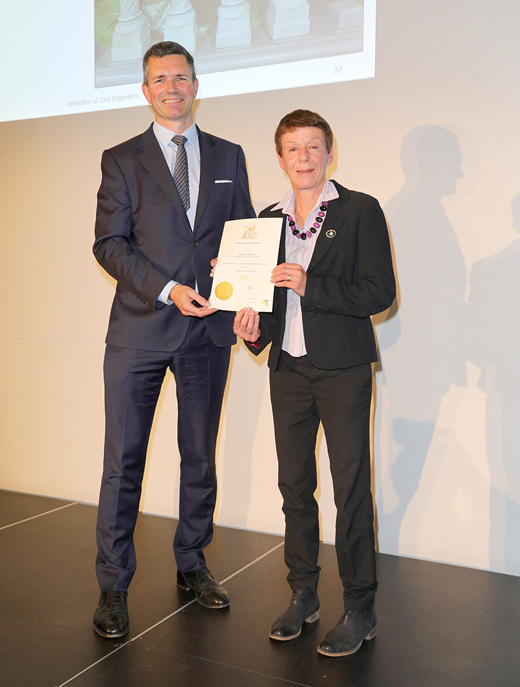
On Friday 4 October 2019, ICE president Andrew Wyllie presented awards to the following papers published in Engineering History and Heritage in 2018. The Editorial Panel nominated their best papers and an awards committee chaired by Robert Armitage allocated the awards.
Charles Manby Prize
The Charles Manby Prize, presented to the best paper that covers information and communications technology/geographic information systems/building information modelling in its broadest sense, was awarded to Gyetvai et al. (2018).
Abstract
This paper introduces a workflow to create the geometric documents for conducting the finite-element-based structural assessment of wrought iron bridges using laser scanning data as the input dataset. First, a methodology for identifying actual cross-sections of the bridge components based on a point cloud obtained from a terrestrial laser scanner (TLS) is presented. Next, a non-parametric regression kernel density estimation is employed to determine overall bridge dimensions to populate a computational model by projecting the position of the web and/ or flange surface of the cross-section (appearing as local maximum peaks of a probability density shape). The process is demonstrated with respect to the previously undocumented Guinness Bridge in Dublin, Ireland, to determine the bridge’s behaviour. The successful generation of this model proves that TLS can surpass other common techniques (e.g. unmanned aerial vehicle-based images) for acquiring the bridge geometry necessary for reconstructing accurate member cross-sections and overall bridge dimensions, regarding the quantity and quality of the data points, and timing. The finite-element analysis showed that the bridge currently satisfies both strength and serviceability requirements under self-weight but would be unlikely to support a new slab and a modern pedestrian load level as per current code requirements for reopening the bridge.
Thomas Telford Premium Prize
The Thomas Telford Premium Prize, presented for the best paper published in Engineering History and Heritage, was awarded to Lazarus (2018).
Abstract
Blackfriars Road Bridge in London, UK, is a Grade II-listed structure dating from 1869 and widened at the start of the twentieth century. In the 1960s, a concrete staircase was constructed linking the east side of the bridge to the riverside park below. The Blackfriars Millennium Pier reconstruction project is being carried out as part of the work associated with the new Thames Tideway Tunnel ‘supersewer’, designed to tackle sewage overflows into the River Thames. It includes removal of the 1960s staircase and its replacement with a new staircase and lift to improve access between the riverside walkway and the bridge. Alterations, which required listed building consent, were needed to the bridge’s ornate cast-iron parapet, namely infilling of the opening created for the 1960s stair and creation of a new opening to accommodate the new access. This paper discusses what was known about the original parapet construction, what was found during the course of the works and the approach that was taken to minimise loss of the original ironwork. It looks briefly at the issue of design loading on the parapet and the works undertaken on the cast-iron parapets of two other bridges of similar age.