This issue of Engineering History and Heritage includes a Briefing by Dimitris Theodossopoulos on the restoration of Notre Dame Cathedral in Paris, France (Theodossopoulos, 2023a). On reading this, I have been reflecting upon the nature of heritage and its place within the modern world. Theodossopoulos asks ‘Is there a scope to leave a testimony of the disaster?’
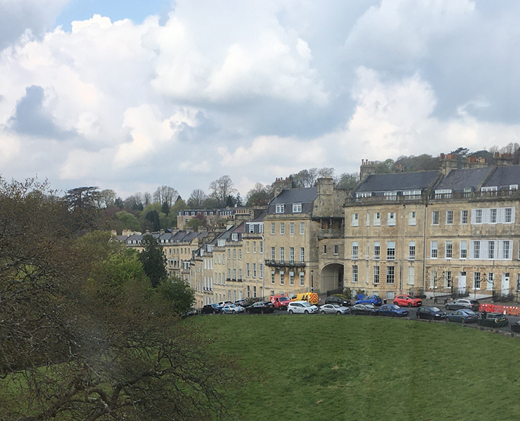
In April 1942, there were several World War 2 bombing raids on Bath, UK. After the war, many buildings were rebuilt. For example, Lansdown Place West had been destroyed and was replaced with a replica, which showed a close resemblance to its original appearance (Figure 1).
Lansdown Place West is connected to Lansdown Crescent, and both were designed by John Palmer and constructed by a variety of builders between 1789 and 1793. Around 1830, William Beckford purchased several of the houses and commissioned a link (probably designed by Henry Goodridge). The curved sweep of the terrace of buildings as it crosses the hillside and continues into Lansdown Place East on the other side of the Crescent is a very fine piece of Georgian architecture. Restoring its original appearance keeps alive the memory of past times, linking us with the Bath of Jane Austen and the extravagant life of William Beckford.
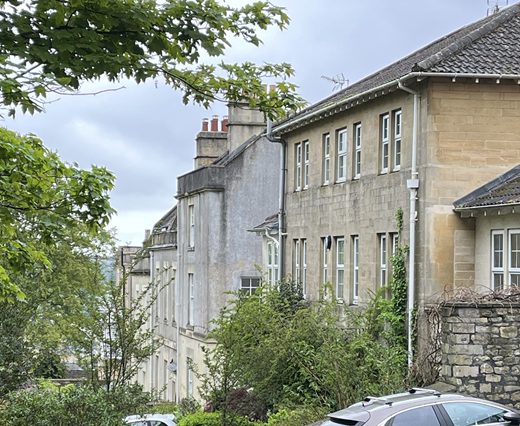
In the same raids, a house was destroyed in Mount Beacon, a few hundred metres from Lansdown Crescent. Here there was no attempt to replicate the destroyed Georgian building (Figure 2). Although the new building was constructed on the same frontage as the previous one, there is now no indication of its original appearance.
The presence of a modern building, in place of the 18th century original, leads an observer to pose the question of what disaster occurred that led to such an intervention. From 1981, when I moved to Bath, to 2016 when I retired from full-time work, I would walk along Mount Beacon twice a day. As a long-time resident of this road, I am constantly reminded of the violent past lived through by former generations and of my fortune to have lived through a period of peace in this part of the world. Memories are reinforced by the choice of design in reconstruction. Here, in one case, it is the sense of a link to a long-gone culture, which in fact has little in common with our own times, and in the other it provides an opportunity to reflect on the nature of the disaster of war and how close it was only eighty years ago.
As at Lansdown Place East, in the post war era (1950–1960s) several significant buildings were reconstructed in Bath, with external appearance replicated but without the same concern over the interior. Alongside this, there was little attention to buildings simply because they were old. Large areas of Georgian terraces were cleared to make way for modern multi-storey housing.
Much has changed in attitude. The International Council on Monuments and Sites (ICOMOS) is a professional association that works for the conservation and protection of cultural heritage places around the world. ICOMOS definitions of reconstruction and restoration are clear – reconstruction allows the use of new materials; ‘the process of restoration is a highly specialized operation. Its aim is to preserve and reveal the aesthetic and historic value of the monument and is based on the respect for original material’ (ICOMOS, 1994). It is likely that if any of Bath’s Georgian buildings were destroyed today, there would be a requirement not only to reconstruct but, as far as possible, to restore. The might of planning law is brought to bear on any who try to change a listed building without full consent – and this invariably means adhering closely to the original interiors and use of historic materials.
Why has the attachment to our cultural heritage changed? The balance from reconstruction to restoration has shifted in response to the realisation that much of our historic townscape was being lost. Engineers are often reactive, providing the service that society requires without thinking about the changes in demand that are taking place, due to the pressure of change.
The built heritage is powerful in providing a physical memory of the past and without memory we lose our identity. In a rapidly changing society, we need to be able to return to historic places and feel safe that we can use them to remember who we are. Recent images of the coronation would have meant much less if they had been staged on a modern platform – the words, costumes and regalia would have been the same, but the sense of continuity would have been lost if the ceremonials had not been played within the ancient walls of Westminster Abbey. Of course, some would argue that, as society changes, so should our institutions. The use of historic sites reinforces the past and is a barrier to this change. The Palace of Westminster was constructed to reflect Victorian values. Should we really be spending billions of pounds on its restoration when a reconstructed building would be cheaper and would help to make a break with the past? Or do we need to protect our old buildings at all costs, to help to keep our memories and identities alive? Do we learn of the necessity of change through our physical links with history, or do they reinforce established hierarchies and unfairness?
Together with our changed attitudes to protecting our heritage, attitudes to sustainability have developed. Twenty years ago, sustainable design was a specialist area; however, the emphasis today is on all activities being considered in the context of their environmental impact. ICOMOS was founded in 1965 in Warsaw, Poland, as a result of the Venice Charter of 1964 and offers advice to the United Nations Educational, Scientific and Cultural Organization (UNESCO). The ICOMOS Paris Declaration on Heritage as a Driver of Development (ICOMOS, 2011) promoted a development process that incorporates tangible and intangible cultural heritage as a vital aspect of sustainability. The recent ICOMOS report (ICOMOS, 2021) provides a basis for considering the aspects of sustainability where conservation of heritage can make a positive contribution.
In the United Nations’ (UN) 2030 agenda (UN, 2011), there is a declaration of Sustainable Development Goals (SDGs). Cultural heritage appears most prominently in Goal 11 on Sustainable Cities and Communities as Target 11.4 ‘to protect the world’s cultural and natural heritage’. The primary scope of this journal is built infrastructure, which is tangible heritage, but beyond this I suggest that it should include all aspects of history and heritage where these link to civil engineering – tangible and non-tangible. ICOMOS makes the case for this.
The report (ICOMOS, 2011) shows that there is potential for work on cultural heritage infrastructure to have benefit beyond the tangible. It includes case studies showing how the work to protect, maintain and restore heritage can provide beneficial impact on nearly all of the UN SDGs. The following is a summary of how the report demonstrates this.
SDG 1 – No Poverty. Work towards maintaining tangible heritage can contribute to eradicating extreme poverty for all. The rehabilitation of historic urban centres, undertaken in full respect of heritage values, can support productive activities, including decent job creation, that make use of local resources and skills.
SDG 2 – No Hunger. Heritage, particularly civil engineering to restore and maintain agricultural and cultural landscapes, can provide ecosystem services and benefits, and livelihood security for millions.
SDG 3 – Good Health and Well-Being. Restoration of heritage sites can provide resources that provide access to and engagement with heritage. Memories help to give identity, which has positive effects on health.
SDG 4 – Quality Education. Both tangible and non-tangible heritage provide learning opportunities through objects, places and experiences to discover the past, strengthen identity and understand the world around us.
SDG 5 – Gender Equality. Many aspects of heritage, as well as traditions and practices, can often stereotype and discriminate among genders. In transforming these practices, heritage organisations can ensure more effective participation and equal opportunities for all genders.
SDG 6 – Clean Water and Sanitation. Throughout history, people have created systems to manage water and support sanitation. Many heritage systems still provide resilient infrastructure. Today these systems need to be recognised for their historic and technological significance. The work needed to keep them safe and functional needs to be properly understood and recognised. In recent issues, Engineering History and Heritage has published several papers showing how historic infrastructure has been adapted and maintained to continue providing safe water and drainage.
SDG 7 – Affordable and Clean Energy. Improving energy efficiency in existing buildings and infrastructure is essential. Adaptation and updating of existing buildings reduce their energy use, while moderating the need for new buildings, which inevitably have a negative environmental impact in their construction. However, the impact on the built heritage of making changes to improve the performance, and operation of existing building requires appropriate materials and techniques to avoid damage to the historic fabric. Traditional methods, materials and techniques and locally sourced renewable materials can be the solution to reduce energy consumption and improve building performance.
SDG 8 – Decent Work and Economic Growth. Heritage places can play a part in attracting creative industries, businesses, inhabitants and visitors, and this leads to economic growth and prosperity.
SDG 9 – Industry, Innovation, and Infrastructure. Centuries of experience and experimentation, innovation and creativity have produced the infrastructure we have today. Understanding the way that our infrastructure was made and the people behind it presents an inspiration for modern day engineers and can lead to new ideas for designers, in adapting traditional systems for contemporary use.
SDG 10 – Reduce Inequality. The sustainability of heritage sites and their sustainable development can help alleviate social inequalities and support the social cohesion of communities.
SDG 11 – Sustainable Cities and Communities. Heritage can contribute to the distinctive character of cities and landscape. Sustainable maintenance and development of heritage infrastructure can provide continuity to communities, preserving identity and memory.
SDG 12 – Responsible Consumption and Production. Heritage sites and traditional practices often demonstrate sustainable productive methods based on an understanding of use and re-use of materials. Conserving, adapting, reusing, restoring and rehabilitating buildings and infrastructure should provide examples of sustainable consumption and production.
SDG 13 – Climate Action. For millennia, climate and environment have changed. Heritage sites and practices, show how, through centuries, human communities have used and adapted their material assets. Knowledge of past methods provides us with valuable lessons for today.
SDG 14 – Life Below Water. Knowledge of heritage practices and infrastructure, when they use the oceans and its resources sustainably, can inform the conservation and management of water resources.
SDG 15 – Life on Land. Heritage buildings and infrastructure cannot be separated from biodiversity, health and well-being. The character of heritage sites is directly connected with their physical, aesthetic and intangible qualities. Natural environment and cultural landscapes constitute living heritage. The safeguarding, conservation, management and enhancement that civil engineering works can provide is vital to the long-term protection of society, its memory and identity.
SDG 16 – Peace, Justice and Strong Institutions. Post-disaster response and recovery of heritage sites can restore cultural identity and help develop peaceful societies.
SDG 17 – Partnerships for the Goals. The establishment of internationally agreed standards and approaches to conservation of heritage should be achieved.
Consideration of the ICOMOS case studies shows the broad scope for civil engineering heritage and this could be reflected in papers in this journal. The controversy over the tunnel design at Stonehenge (Salisbury, UK) demonstrates the potential impact of civil engineering works on cultural heritage (NCE, 2022). In fact, civil engineering impacts every aspect of life and engineers can only produce better designs if they fully understand how and who their work affects. In their service to society, civil engineers need to improve their understanding of the context and cultural impact of their work. This journal should contribute to this by publishing papers that cover all aspects of history and heritage that increase the knowledge and understanding of civil engineers in their work and its impact.
As well as the Briefing mentioned earlier, there are three papers in this issue of Engineering History and Heritage. Theodossopoulos has added to his Briefing on Notre Dame with a paper on ‘The reconstruction of Noyon and Soissons Cathedrals in France after the First World War’ (Theodosspoulos, 2023b). The tradition of centuries of meticulous maintenance was broken by the destruction of the war and reconstruction was carried out through both traditional masonry skills and modern industrial technology. The contrast with the restoration of Notre Dame is striking. The need to recover memory through replacing buildings lost in tragic and traumatic events puts our engineering work into a human context.
The other two papers address the risk assessment and technical issues associated with small dams and reservoirs owned and managed by the National Trust. The National Trust is responsible for some 200 reservoirs. Many of these are large and are regulated by legislation. However, the 150 smaller reservoirs also need to be assessed for their risk and be managed for their dam safety. ‘Non-statutory reservoirs: a journey of discovery’ Roberts et al. (2023) provides insight on the way this process is addressed. It is a fascinating study of how civil engineering expertise can be brought to bear on management and preservation of some of our most important heritage landscapes. It looks to the future in addressing how the process of regulation may change. ‘Remedial works to ornamental ponds within a historic park in the UK’ by Cavanagh and Read (2023) brings us back to Bath to show how the three lakes at Prior Park have been sensitively restored while introducing modern engineering understanding and techniques. The result, once again, is the reinstatement of a landscape that has inspired artists and poets for hundreds of years; it is restored to provide inspiration for future generations.
Having reached the end of the term allowed, this is the last of my Editorials as Chair of the Editorial Panel for this Journal. I would like to finish by thanking all those who have served on the Panel and those who have contributed papers over the past 6 years. It has been a privilege and a pleasure to work with you all. In addition, thank you to Rebecca Rivers, who, as Journal Editor, has provided me with constant support of the highest quality throughout.