

Papers published in Engineering History and Heritage are eligible for awards from the Institution of Civil Engineers. Papers from any of the ICE journals can be nominated for several awards. In addition, each journal has awards dedicated to their specific subject area.
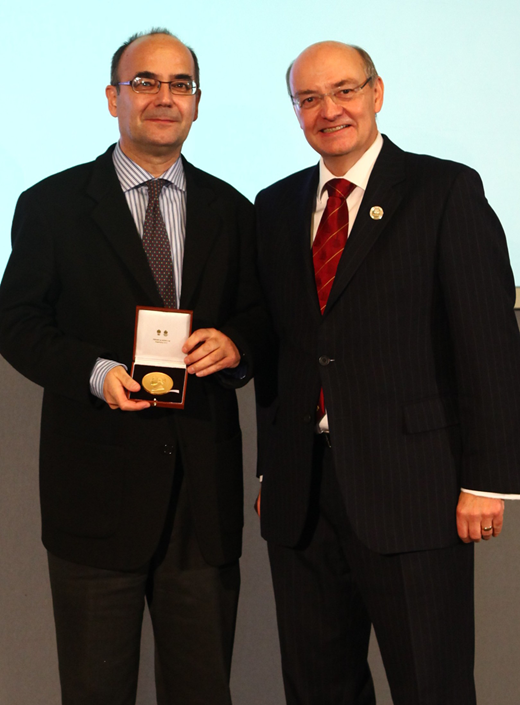
On Monday 24 October 2011, ICE president Peter Hansford presented awards to the following papers published in Engineering History and Heritage in 2010. The editorial panel nominated their best papers and an awards committee chaired by Barry Clarke allocated the award.
Telford gold medal
The Telford Gold Medal, the ICE's highest award for a paper, was awarded to: Huerta S (2010) The safety of masonry buttresses. Proceedings of the Institution of Civil Engineers – Engineering History and Heritage 163(1): 3–24, http://dx.doi.org/10.1680/ehah.2010.163.1.3.
Abstract
The vault is the main element in most historical buildings. Masonry vaults exert an inclined thrust that must be resisted by a substantial mass of masonry: the buttress. The buttress system assures the safety of the whole construction. Most traditional structural design rules addressed the problem of buttress design. Today, an architect or engineer assessing the structural safety of a historical construction needs to estimate the safety of the buttress system with accuracy. This is not an easy matter. Among other possible failures, a buttress may fracture under certain conditions with a substantial loss of stability, it may show a certain leaning or it may be separated from the wall. Furthermore, buttress systems are complex structures – a combination of walls and counterforts, flying buttresses, etc. – made of different types of masonry, and their assessment cannot be handled in an abstract way. This paper outlines the development of buttress design since around 1700 to explain the main approaches used and to provide a historical context. The paper then goes on to summarise the state-of-the-art in modern masonry buttress analysis and to discuss estimations of safety.
Telford premium prize
The Telford Premium Prize was awarded to: Hartley RG (2010) Lessons from Western Australia's goldfields water supply scheme. Proceedings of the Institution of Civil Engineers – Engineering History and Heritage 163(3): 179–187, http://dx.doi.org/10.1680/ehah.2010.163.3.179.
Abstract
In July 1896, the parliament of the sparsely populated colony of Western Australia voted to raise a loan of £2·5 million in London to construct a reliable water supply for its booming Coolgardie goldfield, a sum greater than the total cost of the colony's capital works in any previous year. The scheme, prepared by the colony's engineer-in-chief, Charles O'Connor, involved pumping water 565 km along the world's first steel pipeline, which required 77 000 t of steel plate. This paper argues that the scheme was not one of monumental extravagance as its opponents claimed, but was one that was designed using the latest hydraulic research and ultimately was the only one that could have provided the reliability required to sustain the goldfield past its early years. Logistical problems, both in materials supply and in the construction of the pipeline largely through uninhabited country, were huge by contemporary standards. Two important technical innovations, the locking bar pipe and the mechanical pipe caulking machine, helped keep the cost of the project close to budget. The lessons learnt from the long, but eventually successful, battle against corrosion and leakage benefited hydraulic engineers around the world.

