

Papers published in Engineering History and Heritage are eligible for awards from the Institution of Civil Engineers. Papers from any of the ICE journals can be nominated for several awards. In addition, each journal has awards dedicated to their specific subject area.
On Friday 9 October 2015, ICE president David Balmforth presented awards to the following papers published in Engineering History and Heritage in 2014. The editorial panel nominated their best papers and an awards committee chaired by Quentin Leiper allocated the awards.
Mokshagundam Visvesvaraya Prize
The Mokshagundam Visvesvaraya Prize was awarded to Zhang et al. (2014).
Abstract
Situated at the meeting point of the Yellow River, the Huai River and the Grand Canal of China, the Qingkou complex is a large comprehensive water conservancy project built from the sixteenth to nineteenth centuries to solve the problems for the Grand Canal to join the Huai River and cross the Yellow River. Through the World Cultural Heritage nomination of the Grand Canal, the composition, operation mechanism and evolution of Qingkou complex is comprehensively studied. This paper summarises these findings, and maps a complete view of the Qingkou complex – an engineering masterpiece along the Grand Canal of China.
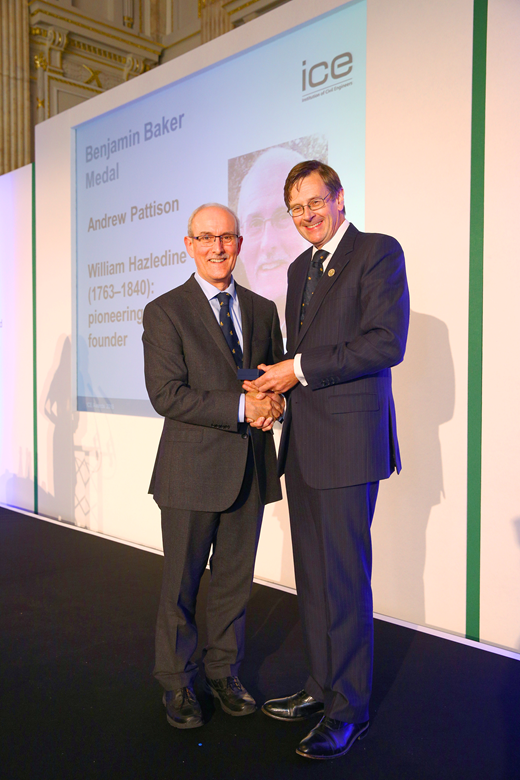
Benjamin Baker Medal
The Benjamin Baker Medal was awarded to Pattison (2014).
Abstract
William Hazledine (1763–1840) is a virtually forgotten figure in the history of engineering. He worked closely with Thomas Telford, and the list of their joint achievements in the UK is unmatched in the history of bridge engineering. These include the aqueducts of Chirk and Pontcysyllte; arch bridges at Bonar, Mythe, Tewkesbury and Craigellachie; lock gates and bridges for the Caledonian Canal and many smaller cast iron bridges; and, not least, the unprecedented suspension bridges at Conwy and Menai in North Wales. Hazledine’s expertise also won him many other contracts, including the suspension bridge at Marlow in Buckinghamshire, and the ironwork for the first all-iron-framed multi-storey building in the world, the Flax Mill at Ditherington in his home town of Shrewsbury. Recent research has begun to reveal his importance in the production of cast and wrought iron for these valued legacy structures. The paper highlights the outstanding quality of the iron that Hazledine made and the rigorous proof tests he undertook to verify the properties of the metal. These results will be of great interest to engineers today working on heritage cast- and wrought-iron structures, if only to learn of the high-quality results that were possible 200 years ago.

