

Papers published in Engineering History and Heritage are eligible for awards from the Institution of Civil Engineers. Papers from any of the ICE journals can be nominated for several awards. In addition, each journal has awards dedicated to their specific subject area.
On Friday 6 October 2017, ICE president Tim Broyd presented awards to the following papers published in Engineering History and Heritage in 2016. The Editorial Panel nominated their best papers and an awards committee chaired by Nigel Wright allocated the awards.
Telford Gold Medal
The Telford Gold Medal, ICE’s highest award for a paper, was awarded to Barthel et al. (2016).
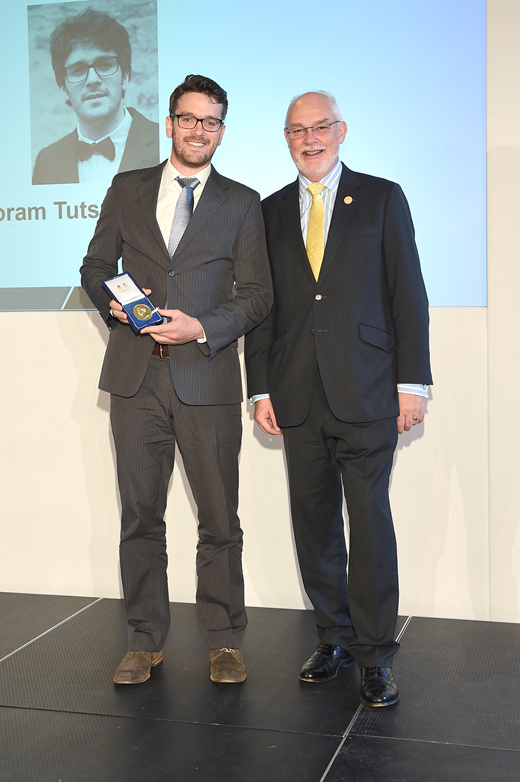
Telford Gold Medal winner Joram Tutsch with ICE president Tim Broyd
Telford Gold Medal winner Joram Tutsch with ICE president Tim Broyd
Abstract
The filigree spire of the 116-m-high west tower of Freiburg Minster, Germany was completed around 1330 AD and is an architectural monument of the highest rank. At 45 m high and constructed using tracery throughout, the spire is the tallest of its kind ever built (Kayser, 2014). It has survived until the present without major damage or alteration. In 2010, after several flaws in the sandstone were detected, a detailed damage survey and a structural analysis were initiated. This paper provides a description of the construction of the spire, the damaged sections that were detected, the material tests and statical calculations undertaken and the implementation of repair measures. A three-dimensional digital model, showing all structural elements, historical alterations and damage, played a particularly important role in understanding the construction and the statical behaviour of the spire. Wind tunnel measurements and a series of material tests were conducted to ensure a realistic estimation of the stability under wind and seismic load. The analysis and the tests are still ongoing; nevertheless, some substantial results can already be presented.
Thomas Telford Premium
The Thomas Telford Premium Prize, presented for the best paper published in Engineering History and Heritage, was awarded to Chrimes (2016).
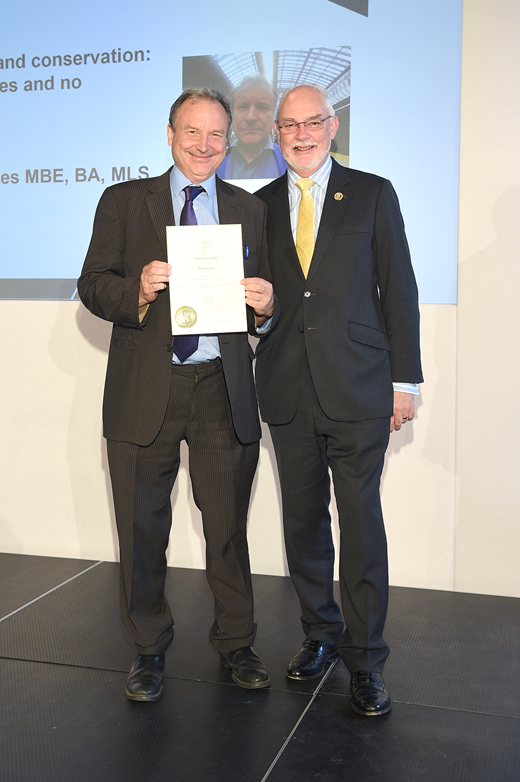
Telford Premium Prize winner Mike Chrimes with ICE president Tim Broyd
Telford Premium Prize winner Mike Chrimes with ICE president Tim Broyd
Abstract
Early engineers drew heavily for exemplars on the achievements of the past. Telford’s employment as a county surveyor involved restoration of existing works. However, engineers were often accused of despoiling the existing environment; Telford himself was involved in the destruction of the precinct of St Katharine’s by the Tower of London, and there are abundant examples of railways showing scant concern for the heritage through which they passed. In contrast, engineers like Benjamin Baker and Francis Fox used their engineering skills to extend the life of threatened structures. There is frequent debate between those seeking to improve the existing infrastructure and those who want such improvements to take account of the historic engineering heritage. Recent examples include the strengthening of Brunel’s Thames tunnel and Network Rail’s improvement works in Manchester. Heritage successes are often based on a few committed individuals using their engineering knowledge to mount successful campaigns. Despite more powerful analytical tools and ever-improving monitoring technology, structures like the internationally significant Union Suspension Bridge are under threat. Some may argue it all comes down to money, but is it in part a result of engineers’ education and their lack of knowledge of their own heritage and sense of place?

