Humanity made its first forays into the field of engineering infrastructure with the management of water. From repelling water where it was unwanted, to harnessing water for irrigation, these twin channels developed in parallel with the annual flooding of the Nile in Egypt. The development in the Middle East of qanats – underground aquifers (UNESCO, 2019a) – enabled cultivation in Persia and the creation of desert cities like Persepolis. Therefore, engineering infrastructure is properly at the core of the earliest civilisations in the UNESCO world heritage list. While other aspects of engineering might appear to be underplayed (four individual bridges, for example, and just one lighthouse), there are 25 world heritage sites that incorporate or focus on aqueducts. The great Roman aqueducts at Segovia (UNESCO, 2019b) and Tarragona (UNESCO, 2019c) in Spain and Pont du Gard (UNESCO, 2019d) in France permitted cities to come into being. Medieval cities dwindled somewhat, so that even the greatest of them, Constantinople (located in Turkey), would depend on extending the life of centuries-old infrastructure like Justinian’s cisterns. Aqueducts at Padre Trembleque (UNESCO, 2019e) and Pontcysyllte (UNESCO, 2019f) are recent additions to that list from 16th century Mexico and 18th century Wales, respectively, impressive for their length, height and deployment of new materials.
Their conservation calls for ingenuity in modern engineers. The Institution of Civil Engineers’ (ICE) resources like the Conservation Information Resource for Civil Engineers (CIRCE) website and Engineering History and Heritage help to point the way, as when best practice is shared, it makes practice even better.
The set of papers published here are unified by having been given a dry run in a meeting on public water supplies hosted at the Museum of Waters in Barcelona, Spain, or arising from the gathering of evidence for a comparative study. James Douet organised that meeting in 2018 for The International Committee for the Conservation of the Industrial Heritage (TICCIH), and he offers a briefing paper arising from those discussions, demonstrating the major contribution water infrastructure made to human development (Douet, 2019). For more information, see the publication available for download on the TICCIH website (Douet, 2018) among other comparative studies compiled for international contexts by the International Council on Monuments and Sites.
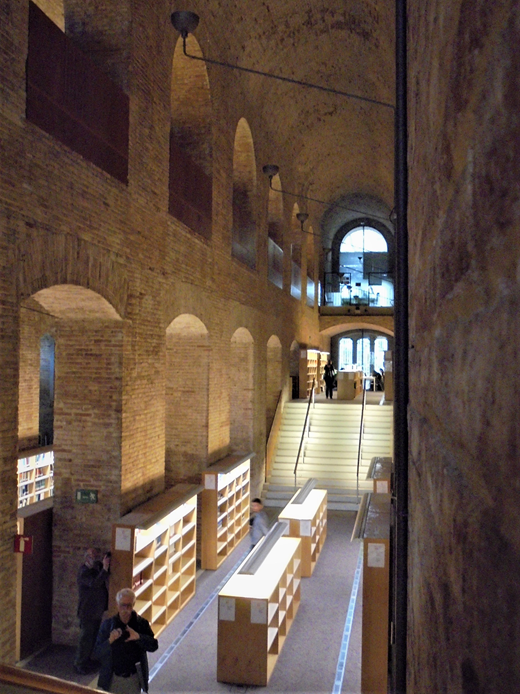
Adaptive reuse of infrastructure: Dipòsit de les Aigües, Barcelona, Spain. A water cistern erected by Josep Fontserè to serve the monumental cascade in Parc de la Ciutadella in Barcelona was repurposed as a university library (Universitat Pompeu Fabra) in 1999 by Luis Clotet and Ignasi Paricio. The cistern supported 15 000 m3 of water from 1876 to 1896, and then a variety of social uses, and is more than strong enough for any of them, even with light wells cut through the vaults. This is mentioned in the article by Hunter Burkett and Burdick (2019) under section 3 (photo © Mark Watson, 2018). Further information and photographs of the converted water cistern can be found on the HIC Arquitectura (2017) website
Adaptive reuse of infrastructure: Dipòsit de les Aigües, Barcelona, Spain. A water cistern erected by Josep Fontserè to serve the monumental cascade in Parc de la Ciutadella in Barcelona was repurposed as a university library (Universitat Pompeu Fabra) in 1999 by Luis Clotet and Ignasi Paricio. The cistern supported 15 000 m3 of water from 1876 to 1896, and then a variety of social uses, and is more than strong enough for any of them, even with light wells cut through the vaults. This is mentioned in the article by Hunter Burkett and Burdick (2019) under section 3 (photo © Mark Watson, 2018). Further information and photographs of the converted water cistern can be found on the HIC Arquitectura (2017) website
Many of the greatest cities in the world today rely on, at least in part, 19th century infrastructure. This is not an indictment of the present so much as recognition that the cisterns, filter beds and routes for water laid down then are serviceable today, appropriately located and hard to improve, other than to replace elements like cracked, time-served, pipes on the ‘Washington’s axe’ principle: the handle and the blade may have been renewed at various times but he would still recognise it. One such burgeoning city is Kolkata (formerly Calcutta) in West Bengal, India. It is encouraging to learn that those now responsible for managing the supply of clean water are well cognisant of the origins of the system with which they work (Patra and Dey, 2019).
De Witt (2019) looks at the challenge of conserving steam engines and the ‘cathedrals of engineering’ that contain them, notably Chestnut Hill pumping station in Boston (MA, USA). Ross (2019) in Canada considers the impact of changing climate on her subject, the R.C. Harris filtration plant in Toronto, a ‘palace of purification’, even as water still flows through it. Hunter Burkett and Burdick (2019) in USA look at the adaptive re-use of elements in the chain of municipal water infrastructure. For every building re-used, another need not be built, and its substantial embodied energy, invested once, may be used again and again in future, thus mitigating climate change.
The guest editors, James Douet and I, hope that the series of papers presented here will stimulate further investigation and discussion, by correspondence to ICE or to TICCIH (via mark.watson@hes.scot). This can only help assure the long-term sustainability of water supply networks on which human life depends the world over.