

We are living in an unprecedented time as many countries are under lockdown due to the Covid-19 outbreak. People are working from home and are maintaining social distancing. Substantial changes in people’s behaviour across the world could happen even after this pandemic is over. One of the challenges in public transportation is that passengers in congested areas will cause the disease to spread easier between humans and makes keeping social distancing more difficult. As a community, it is worth thinking how engineers can help to reshape the world in the post-Covid-19 era.
This issue includes two very interesting and well-timed companion papers on the Ordsall Chord, a new railway connection between two mainline stations in Manchester, UK. This project was completed in 2017 with the aim to reduce congestion and allow new passenger services, and has brought economic benefits. The first paper by Duguid et al. (2020) introduces the background and historic aspect of the site. To minimise the assumption in the construction and alteration, a programme to monitor the displacement of the existing masonry viaducts under traffic loads was carried out. The results facilitated the decision-making process. This really demonstrates the competence of the UK practicing engineers in handling engineering problems with lots of uncertainties. This paper also presents demolition and refurbishment of historic metal bridges. The contribution from Duguid and Bone (2020) is the second paper; it focuses on the brickwork and stonework structures that were affected within the project. It reviews the condition of the structures and explains the survey and how the project-specific specification for repair was developed. In the paper, the Grade I-listed Stephenson’s Bridge is discussed in detail as a case study.
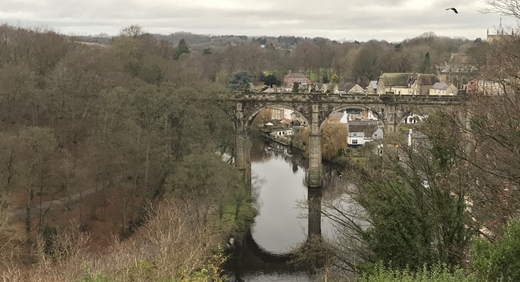
This pair of companion papers shows the gap between academic research works and what practicing engineers really need in a real-world project; we need to close this gap. Masonry arch structures are not new to researchers in the civil engineering discipline – the first paper points out that little is known about the behaviour under service condition. A great deal of effort has been devoted to establish the structural integrity of single-span arches in ultimate limit state, such as earthquakes, rather than focusing on viaducts under service load. It is certainly useful to investigate the failure mechanism of arches and viaducts, especially if engineers want to understand the collapse mechanism of arch bridges, such as the Longteng Viaduct in Taiwan (Figure 1). The viaducts are composed of several small spans of arches and can be easily seen in many railway bridges in urban areas and countryside in the UK (Figure 2). The behaviour of this type of structure under service condition is much less researched.
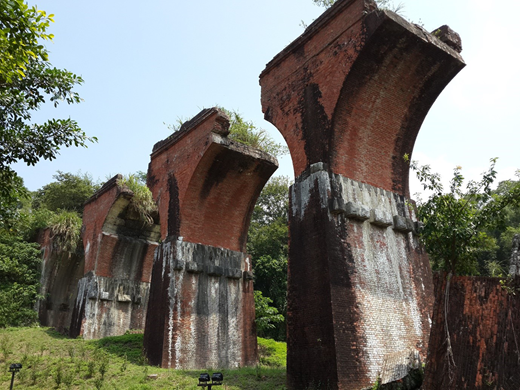
Longteng Viaduct in Taiwan was built in 1906 and was damaged in an earthquake in 1935
Longteng Viaduct in Taiwan was built in 1906 and was damaged in an earthquake in 1935
Academics tend to work on funded projects and sometimes this limits the scope of their works. Very often the funders are only interested in so-called ‘ground-breaking’ research rather than practical research. Projects like monitoring the structural displacement and vibration over the long term often are not seen as ground-breaking and they require resources (equipment and funding, etc.). Therefore, it is not surprising that limited information could be found to facilitate design when it comes to a real project. Although deflections under service load at various points of the viaduct were monitored in the Ordsall Chord project, monitoring vibration in service condition over the long term is also useful in future projects. It will tell us the potential change in dynamic properties of the bridge and the necessity of structural intervention.
Overall, this issue, although small but sweet, leaves engineers to think about (i) how we can help to reshape the world in the post-Covid-19 era and (ii) how can practicing engineers and academics work together to close the gap of works and expectations. For those who are interested in behaviour of masonry viaducts under service condition, the paper written by Harvey and Harvey (2017) shares good insight.
A final note, this journal constantly seeks to recruit high-standard research papers, review papers and case studies, to name a few. Information about how to submit your paper is available at www.icevirtuallibrary.com/page/authors.

