

Shells represent the pinnacle of the creative output of structural engineers. Only the very best had the skills to succeed in this free form – and had to employ physical models to obtain the figures needed to push the theoretical framework of mechanics to the limits of feasibility. These works of art from the age of high modernity will stand as beacons to future generations trapped in the pseudo-creativity of AI and BIM. The days of shells are over. Our task now is to study the shells we have, record their details and ensure they are preserved. In this issue the authors and I would like to awaken in the reader a delight in the upkeep and upgrading of these monuments to the art of engineering.
The first rotationally symmetrical domes appeared in the classical phase of theory of structures. One early example is the gasometer designed by Johann Wilhelm Schwedler (1823–1894) for Berlin’s municipal gas company. August Föppl (1854–1924) took Schwedler’s membrane theory and developed it into a general theory for spatial structures (1892). The structures of Vladimir Grigorievich Shukhov (1853–1939), Richard Buckminster Fuller (1895–1983), Max Mengeringhausen (1903–1988) and the free-form tensile structures of Frei Otto (1925–2015) – the models for today’s lightweight stadium roofs – represent the culmination of that development (Kurrer, 2018).
Reinforced concrete was a new building material with inherent three-dimensional load-carrying properties. Right from its early days, this material departed from the biaxial loadbearing forms of slab and plate and optimised the load transfer, initially employing forms strictly dictated by mathematics, later free-form surfaces. Whereas the first structures adhered to membrane theory, Stodola (1859–1942) and H. Reissner (1874–1967) solved the boundary stresses problem of conical, spherical and cylindrical shells (Kurrer, 2018). Early shells included the hangar (1917) in Tallinn, Estonia, by Christiani and Nielsen, and the structures of Finsterwalder (1897–1988) and Dischinger (1887–1953), which adhered strictly to mathematical shell theory, e.g. the wholesale market hall in Leipzig (1928). The French school around Freysinnet (1979–1962) and the hyperbolic paraboloid and conoid shells of Laffaille (1900–1955) and Aimond (1902–1984) placed the emphasis on design (Espion, 2016). The great shell builders of the early Soviet Union are mostly nameless, and their work must be urgently recorded. The shells of Baroni (1907–1968) and Nervi (1891–1979) arose out of the special path followed by Italian engineers (Tullia and Porretti, 2018). Mathematics and artistic inspiration were combined by the Spanish-Mexican engineers around Torroja (1899–1961) and Candela (1910–1997). Isler’s (1926–2009) free-form concrete shells, e.g. the Kilcher shell in Reicherswil (1965), impressively demonstrate the zenith and the end. Today, the art of shell construction has returned to the rooms of university students. All that remain are the gridshells, which would certainly please Schwedler (Oppe and Gauss, 2021).
Olga Arkhipkina, a student of Werner Lorenz, takes us on a journey into the unknown realms of Russian shells, where the great expanse of Russia and its vast forests made up for the lack of materials. In light of the ongoing discussion regarding the preservation of Frei Otto’s free-form ‘Multihalle’ gridshell in Mannheim, this article is very interesting.
Sebastian Kaminski and his co-authors (Ove Arup, UK) show how skilful conversion work can give shell structures a new lease of life. To do this, they take the example of the hyperbolic paraboloid roof (1962) to the Design Museum, formerly the Commonwealth Institute, beautifully situated in London’s Holland Park.
The students of Prof. Manfred Curbach (Dresden TU) around Philipp Riegelmann have devoted their working lives to carbon-reinforced concrete. Their article describes how Ulrich Müther’s (1934–2007) hyperbolic paraboloid shell in Magdeburg (1969) was saved and upgraded through a retrofit with this environmentally compatible material. Strengthening layers just 10 mm thick bonded to the top and bottom of the existing shell will preserve this unique structure for coming generations.
Finally, Prof. Eugen Brühwiler (Swiss Federal Institute of Technology) introduces us to the world of Heinz Isler (1926–2009). This article on the assessment and upgrading of the pair of triangular shells at Deitingen motorway petrol station (1968) takes the reader beyond the theme of shells by outlining a general concept for the sensitive treatment of existing structures (Brühwiler, 2020a). Prof. Brühwiler has also given us a summary of how existing bridges can fulfil modern usage demands by exploiting hidden loadbearing reserves (i.e. no change to the structure) or using minimally invasive procedures to upgrade the structure (Brühwiler, 2020b).
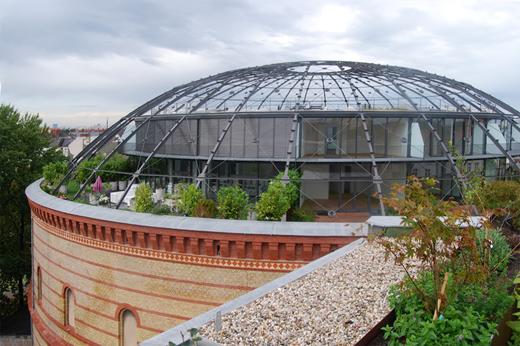
Schwedler Gasometer Dome – refurbished and with new use. Wolfgang Bittner, ZinCo GmbH
Schwedler Gasometer Dome – refurbished and with new use. Wolfgang Bittner, ZinCo GmbH
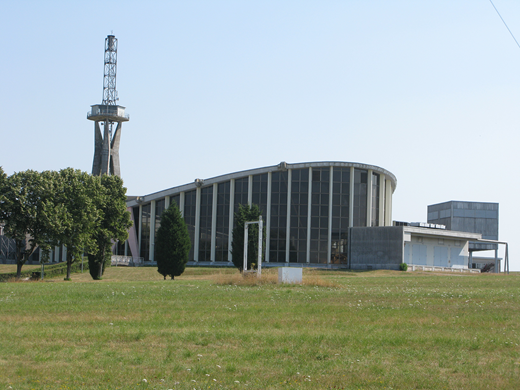
Too flat, too daring: Freyssinet ensured sufficient stability of the shell of the Europe No. 1 broadcast center in Felsberg/Saarland Germany, 1955 (Deutscher Werkbund Saarland (eds) 2020) (private archive Pelke)
Too flat, too daring: Freyssinet ensured sufficient stability of the shell of the Europe No. 1 broadcast center in Felsberg/Saarland Germany, 1955 (Deutscher Werkbund Saarland (eds) 2020) (private archive Pelke)
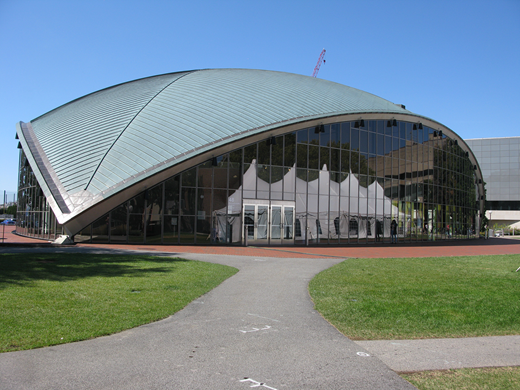
Outside Kresge Auditorium MIT, Cambridge Massachusetts USA, Ammann and Whitney (1955) (private archive Pelke)
Outside Kresge Auditorium MIT, Cambridge Massachusetts USA, Ammann and Whitney (1955) (private archive Pelke)
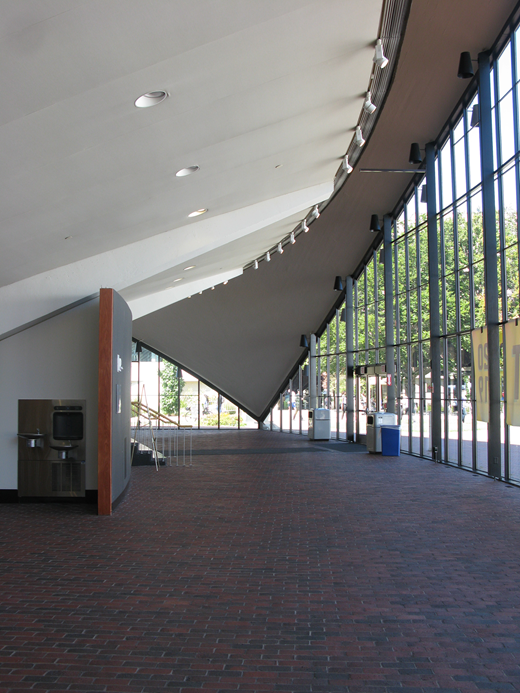
Inside Kresge Auditorium MIT, Cambridge Massachusetts USA, Ammann and Whitney (1955) (private archive Pelke)
Inside Kresge Auditorium MIT, Cambridge Massachusetts USA, Ammann and Whitney (1955) (private archive Pelke)
I was lucky to be a member of the EHH’s editorial team from 2013 to 2019. My tasks were very enjoyable and passing through the door to 1 Great George Street to take part in the annual editorial session was always a very special occasion for me. And along the way I came to love London and the UK. This themed issue is a small gift to say thank you to everyone at the ICE. I hope you enjoy reading these articles as much as I did.

