Welcome to the second issue of Engineering Sustainability.
At the time of writing, there is much activity in the Institution and beyond to promote sustainability in engineering. Sustainability was the key theme for the excellent first annual ICE Conference hosted by Queen's University, Belfast in June. Keynote speeches took us from the elegance of the engineered solution to protect the Leaning Tower of Pisa for future generations via the complexities of contaminated land remediation through to the classroom of Professor Paul Jowitt, where delegates were challenged to solve the social and water problems of the Middle East through delivering engineering solutions.
Education has changed since the days I was a student! It will change again. The Joint Board of Moderators (JBM) is now requiring university courses to include sustainability as an integrated part of civil engineering courses. Many universities are already starting to do this and others are now offering masters courses in sustainable engineering. Students too are applying pressure on course content as they seek courses with a strong environmental and social content.
To help deliver the aspirations of the ICE and the JBM, Professor Jowitt has been asked by the Council to lead a task group to look at how sustainability can, and should, be integrated with the development of civil engineers. Part of this task is to deliver guidance to help all of us understand what ‘sustainability’ means and how it can be applied to the benefit of all. The collective knowledge of the readership of this journal can help. If you have training tools and case records you are prepared to share or have already successfully integrated the principles of sustainability into academic courses, the pages of this journal would be an excellent way to disseminate this knowledge. If you wish to contribute directly to the task force, then please contact the ICE secretariat via Andrew Crudgington (andrew.crudgington@ice.org.uk).
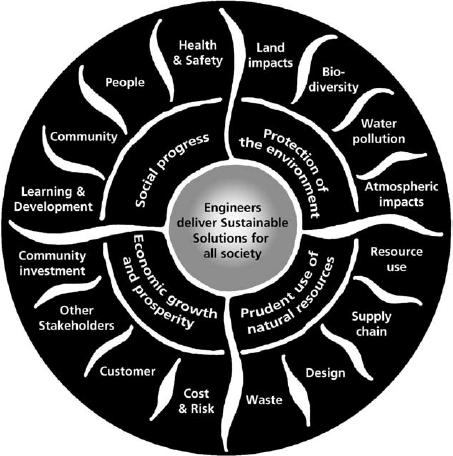
In the issue we continue with the mix of briefing articles, full papers and a meeting report. The topics cover virtually all those which are embraced by the four Government objectives for delivering sustainable development (‘sun’ diagram, Fig. 1)
BRIEFINGS
The first briefing note sets the scene from the global perspective by summarising the output from the Johannesburg Earth Summit and challenging us to think about the next steps for all. This is followed by some news about what your Environment and Sustainability Board is doing and focuses on the CEEQUAL project and the work of Professor Jowitt's task group. Is the Board delivering a service to ICE members? The ‘Board News’ briefing article provides a one-way communication, so please provide comment and respond. Now is the opportunity to have your say!
An initial response to the question ‘what are the ICE doing?’ is provided through the publication of its Charter for Sustainable Development. Readers will note that the charter expects all members understand, foster and promote the concepts of sustainable development. The real challenge is how we might all achieve this!
The final three briefings provide an insight into materials and how trade organisations are responding to the ‘s’ word, which probably appears too frequently in the pages of this journal if we wish to claim that we integrate sustainability into everything we do!
PAPERS
The papers illustrate the importance of effective management of resources and assets. Sohail and Baldwin explore the social impacts of infrastructure development in urban areas and how these can be tackled in low-income countries. The principle applies to all countries. Peden asks if we can continue to rely on the continuity of ‘our’ oil reserves. He suggests that the ‘waste’ stream from the refinery process (bitumen) can be used more effectively by being more environmental and sustainable in its specification and use. Cooper introduces the concept of managing our coastline and creating a link between coastal engineering and development control. Two papers by Shaw and Watson look at how, through design and operational procedures, we can maximise the energy value of tidal power generation. Their second paper discusses the results of investigations into the flexibility of this type of generation and uses published data for a Severn Barrage to illustrate the significance of the findings.
MEETING REPORT
Health and Safety (H&S) in design is currently the number one priority for the Health and Safety Executive. It should also be the priority for all practising engineers. Whether we are designers, planners, writing method statements, constructors, or involved in maintenance, we should recognise our responsibilities and act on them. Ignorance is not bliss—it is dangerous! The report provides expert guidance and a number of key messages.
PANEL MEMBERSHIP
I am pleased to welcome two new members to our editorial panel: Elizabeth Mullings-Smith and Bruno Guillaume.