This issue is published at a time when the UK Government is engaging in a wide consultation to develop its new strategy for sustainable development for the next 20 years. Its first strategy A better quality of life1 was published in 1999, with a promise to review after 5 years. We now have an opportunity to influence the new strategy and its development.
The consultation paper, entitled Taking it on2 seeks views on the following issues
how to explain sustainable development and what it is about
what the vision and guiding principles should be
what the priorities are
how to take forward action
on climate change and energy
on sustainable consumption, production, and use of natural resources
on the environment and social justice
on helping communities to help themselves
to help change behaviour
on sustainable development internationally and in Europe
to get the structures and tools right
to increase the business contribution to achieving sustainable development.
All members of the public have the opportunity to contribute to the consultation paper and respond to the 42 questions online at www.sustainable-development.gov.uk/taking-it-on/index.htm. A downloadable copy of the consultation document is at also available at this web address. In addition to the public consultation exercise, a ‘virtual panel’ of 1400 invited individuals, representing a cross section of UK organisations and groups, has been established. Their comments will be collated and summarised in a report that will also be put on the web to inform and encourage additional comments from the public as well as the virtual panel.
There will be many members of the ICE who have been invited to join the ‘virtual panel’ including your Engineering Sustainability editor. I hope that many of the informed and expert readers of this journal will help to contribute to our national strategy. As engineers, we have a pivotal role in the delivery of sustainable solutions for our infrastructure, transport and communications and have a responsibility to design in safety, to design out waste and to minimise the use of natural resources, be they materials, water or energy.
Background reading to inform the consultation is provided by the UK Government’s last annual report, Achieving a better quality of life,3 published in March 2004, which provides (their view of) an update of UK progress and action to date. A slightly differing view, published by the independent Sustainable Development Commission, chaired by Jonathon Porritt, entitled Shows promise. But must try harder4 is also an important reference document.
Our own Institution of Civil Engineers in it’s The State of the Nation 20045 also provides an assessment of the state of the UK’s infrastructure, covering environment and sustainability, energy, communities, water and wastewater, flood risk management and transport. In each category the key issues, threats and solutions are identified and an assessment of overall performance and one for sustainability has been made.
The consultation document emphasises the need for the new strategy to
encourage strong leadership and ownership among practitioners
emphasise the importance of implementation and identifying outcomes
help create links and networks with all stakeholders
communicate what sustainable development actually means to all sectors of public, educational, commercial and community life.
It is hoped that the ‘new’ strategy will address the problems identified in the three documents mentioned above, in addition to helping establish the key challenges and opportunities we face over the next five years and beyond. The strategy should be presented in a way that is understandable, relevant and useful and is a document that really becomes integral to the way we all think, act and work. A massive and difficult task!
In my view, the consultation will provide a wonderful opportunity to deliver a successful strategy. It will, however, need skilled drafting, skilled wordsmiths and simple, clear and excellent diagrams, which will help us all understand what sustainability is, why it matters, what we can do and how we can do it. If the consultation teams, the consultees, virtual panel and Department for Environment, Food and Rural Affairs and Department of Trade and Industry teams succeed in this task, they will have laid the foundations for a real step change! I wish them all success in this mighty task.
Back to this journal issue:
1. BRIEFINGS
There are six briefing notes in this issue. In the first, Secretary of State, the Right Honourable Margaret Beckett sets the context for, and explains, the sustainability challenges facing the UK and the planned measures for tackling them. Unsurprisingly, the focus is on climate change, energy, resource use and waste. She reminds us that the Government-funded ‘Envirowise’ best practice waste minimisation programme is now helping save £200 million each year and some £800 million since the programme began. It would be interesting to learn how much our own industry has benefited from this programme, especially since construction forms a substantial proportion of all UK waste.
In the second briefing Robert Napier gives his views, as presented to the Better Buildings Summit,6 on whether the planet can afford the buildings we are building today and questions who should be responsible for delivering those badly needed buildings in an appropriately sustainable way.
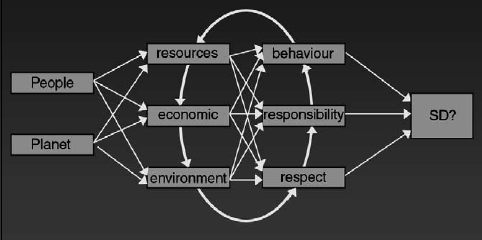
In the third briefing Kendra Okonski challenges the concept of rationing greenhouse gases as a means to limit their predicted increase and the resulting ‘future environmental catastrophe’. Okonski argues that this concept would not only be impractical and inequitable, but that it ignores that fundamental strand of sustainability which all of us, whether individuals or states, struggle to understand, resource and resolve: poverty. I believe that the new UK strategy for sustainable development will have to focus much more on the social equity side than the previous strategy. This is no surprise, since understanding of the social element of sustainability lags behind our environmental understanding by probably 10 years. There is a need therefore to ensure people issues figure more prominently in the new strategy (Fig. 1).
In the fourth briefing Leon Olsen identifies that, although there is a considerable increase in organisations producing social or sustainability reports, the truth is that most stakeholders are simply not interested. The briefing summarises research carried out at the Ashridge Centre for Business and Society that provides some insight into how organisations can ensure successful reporting.
The fifth briefing highlights the problem of used tyre stockpiles in the USA and describes a research project to construct and test a soil-tyre embankment. We have similar problems with tyre waste in the UK and frequently a need for lightweight fills.
The final briefing note describes the outcome of the first London walking conference, Making London a Walkable City, held at the Institution of Civil Engineers in March 2004. The conference reviewed Transport for London’s (TfL) publication Walking Plan for London.7 TfL identifies that there has been a 13% fall in the number of walking trips in London over the last 10 years and aims to reverse this trend by making London one of the world’s most walking-friendly cities by 2015. My challenge is for other towns and cities in the UK to set themselves a similar target.
2. PAPERS
I am delighted that Peter Langford, President of the Institution of Engineers of Ireland (IEI) has accepted our invitation to publish his presidential address. Each year our ICE President is invited to deliver his address to members of IEI in Ireland and the IEI President is invited to London to deliver his address to ICE and IEI members. This year Peter chose sustainable development as his theme. It was indeed a splendid address and a superb analysis of how engineers have contributed so well to society and the advancement of science and engineering. His presentation then sets out the challenges ahead and offers not only solutions, but also examples of where they are already being applied.
I could extract many quotes from both that presentation and his paper to demonstrate his enthusiasm for engineering and to show how, throughout his distinguished career, he has evidently retained a passion for his subject. Instead, I have chosen to share his vision for engineers as leaders in society and an insight of the value we as engineers could deliver for society in the future
We are rightly proud of our heritage as a profession and have learned much from the past achievements of engineers. If we are to meet the challenges ahead we must continue to learn, we must have courage and we must be prepared to lead. The challenges ahead may seem daunting, but the future for engineers in meeting them will surely be both exciting and fulfilling.
We might usefully draw our inspiration from George Bernard Shaw. ‘Other people see things and say: “Why?” & but I dream things that never were—and I say: “Why not?” ’8
In the second paper Paul Jowitt describes the evolution of technology and the development of engineering and notes the emergence of problems the solutions to which extend beyond technology alone. He argues that sustainable development is now absolutely central to the practice of civil engineering and this needs to be reflected in the education and training of civil engineers. He presents outcomes of an ICE Task Group set up to address these issues and suggests that a systems and process based approach is required of our emerging engineers which depends on the development of specific attitudes, systems skills and domain knowledge. Finally he identifies some of the barriers to such an approach and ways of overcoming them.
In the third paper, Hairstans et al. report on the study of a crane-erect method for construction of timber-trussed rafter roofs, emphasising the benefits of pre-fabrication and the potential improved safety and savings in cost and programme time.
In the final paper, Mukesh Limbachiya reports on the results of research investigating the performance of concrete produced with recycled aggregates which provides the construction industry with technical information on a product which should assist in promoting the use of recycled materials in concrete products.