This article discusses the development of the International Hydropower Association's (I HA) sustainability guidelines and assessment protocol for the hydropower industry as a tool for advancing sustainable hydropower.
1. INTRODUCTION
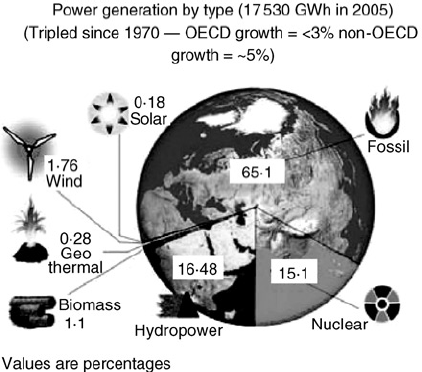
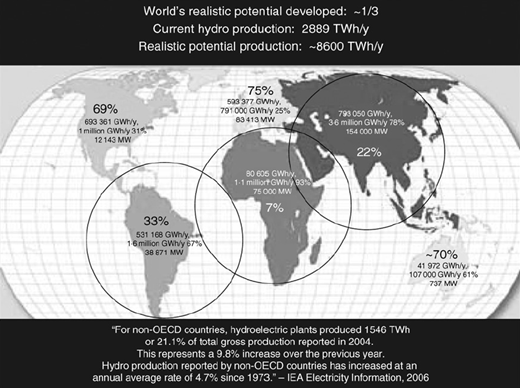
Hydropower contributes one-sixth of the world's electricity generation; this represents five-sixths of the renewables generation portfolio (Fig. 1). Hydropower's realistic remaining potential is about twice the current hydropower production of 2889 TWh/year. With concerns increasing in relation to electricity demand, security of supply and climate change, there has been an extraordinary growth of interest in hydropower investment recently.
Although North America, Europe and Australasia have already developed a high proportion of their economic potential (up to 75% in Europe), South America, Africa and Asia still have significant untapped resources (Fig. 2). Coincidently, these regions are precisely where the needs for water and energy services are greatest.
2. A COLLECTIVE VOICE
In 1995 the International Hydropower Association (IHA) was established under the auspices of UNESCO. The vision of the IHA is to advance sustainable hydropower, with the objectives of championing continuous improvement, building consensus through partnerships and driving initiatives to increase the role of renewables (hydropower in particular).
Today, the association is represented in more than 80 countries, including many of the world's major utilities, companies and authorities.
3. THE CALL FOR SUSTAINABILITY CRITERIA
In April 1997 a meeting was convened by the World Conservation Union and the World Bank to discuss the role of large dams in development. The outcome of this meeting led to the World Commission on Dams (WCD). Three years later, the commission released its final report, Dams and Development: a New Framework for Decision-making.1 The report received a mixed, deeply divided, response. In 2001, the United Nations environment programme (UNEP) agreed to host the dams and development project (DDP), to carry forward the dialogue on the WCD report. After two phases (six years), the project was concluded in April 2007. During this time, UNEP formulated its own position on the WCD report, stating that it does not endorse the WCD report in its entirety. IHA's position was that the need remains for a common practical approach for hydropower development and operation.
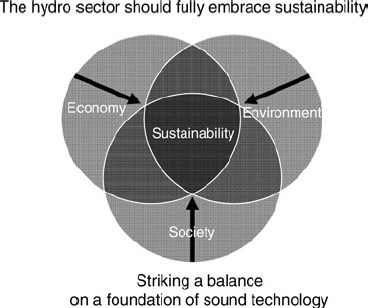
During the period since the completion of the WCD report, IHA launched an initiative to define sustainability criteria (Fig. 3) and produce guidelines that were hydropower-specific and consistent with the aspects of the WCD report which enjoyed broader consensus between industry, civil society and government agencies, particularly in developing countries.
In 2003, the IHA sustainability guidelines were presented for review at various fora, including the DDP meetings and the Third World Water Forum. In 2004, having passed through several drafts, the IHA sustainability guidelines were adopted by the association.
While the IHA guidelines were generally welcomed by various civil society and conservation organisations, the collective message was a call for a compliance mechanism for such guidelines. Subsequently, IHA started work on a sustainability assessment protocol. This tool was intended to assist in the measurement of sustainability performance through a scoring system.
The protocol has three sections. The first section is intended as an overview of strategic planning in terms of needs-, resources- and options-assessment. The following two sections are oriented towards a performance assessment of proposed hydro projects and the operation of existing schemes. In each of these sections, 20 topics are used, covering environmental, social and economic aspects. Each topic is assessed on a scoring system of 0–5, with a score of 3 being considered satisfactory and essentially complying with the IHA sustainability guidelines.
The scoring system requires supporting evidence to substantiate the allocated result for each aspect; both the performance and the related process are evaluated. Provision is made for the assessment to be conducted by internal staff, specialist consultants and third-party auditors. Thus, developers and operators can test their performance by self assessment, prior to a formal audit being conducted.
The protocol has been tested on a variety of types and scales of hydro schemes, and by a range of assessors, throughout the world. The protocol has been through several iterations, and in August 2006 the current draft was adopted by IHA as a working document.
4. THE WAY FORWARD
IHA has encouraged its members to test the protocol on their current projects and existing schemes. Field testing continues in collaboration with third party assessors, especially to refine the assessment process. IHA is conducting training courses to increase understanding of the initiative and to empower members in the application of self-assessment trials within their own organisations.
IHA is also entering into a formal expert appraisal of the protocol, with a view to reviewing proposed refinements of the current draft and to explore endorsements of the protocol by key external organisations. This appraisal will be conducted under the project name ‘hydropower sustainability assessment forum’ (HSAF - see below on HSAF process and output); the first two-year phase of the forum will comprise six categories, each category being represented by two organizations
environment
civil society
economics/finance
developing country policy
developed country policy
hydropower sector.
In addition, IHA has established a protocol reference group, which includes active members that have been involved with field testing, along with the group of assessors that have been assisting in the application and review of the protocol.
4.1. Proposed hydropower sustainability assessment forum
4.1.1. Process.
The HSAF will carry out an expert appraisal of the hydropower sustainability guidelines and assessment protocol, as developed by the IHA, with a view towards a future sustainability standard for the sector. Experts on environmental, social and economic/financing aspects will participate, along with representatives of developed and developing countries involved in hydropower. The membership of the forum will be kept to a sufficiently small number to make its operations practical and focused; there will be two members for each category, including two IHA officers. During its deliberations, the forum will incorporate feedback from the current IHA reference group, and call on the networks of other forum members and external expertise, including people affected by hydropower, to consult on specific issues. By seeking to operate by consensus, the goal of the first phase is to deliver an enhanced protocol that can be endorsed by a range of key stakeholder organisations, and to make recommendations on pathways toward a sustainability standard.
4.1.2. Outputs
to deliver an enhanced protocol that can be endorsed by a range of key stakeholder organisations
to make recommendations on pathways towards a sustainability standard for the hydropower sector.
Copies of the IHA sustainability guidelines and the protocol can be downloaded from the IHA website: www.hydropower.org.
ACKNOWLEDGEMENT
Thanks to Richard Taylor, Executive Director, IHA, who was the main source of information for this article.