

This article discusses the recent strategies employed by the cement and concrete construction sectors in their efforts to further sustainable development.
1. INTRODUCTION
The British Cement Association (BCA) realised during 2001 that it was essential to develop a sustainable development strategy for cement and concrete in construction to address the concerns of stakeholders on issues such as climate change, fossil fuel depletion, resource depletion, and waste. A sustainability team now exists, jointly facilitated by the BCA and The Concrete Centre, comprising senior representatives from companies and trade associations committed to sustainable development, as well as designers, structural and civil engineers, architects, clients and contractors.
In April 2003 the team produced an interim report communicating project progress, some sector initiatives and sector commitments. It is available as a download from the project website (www.concemsus.info).
So far the strategy has focused on three main areas:
cement sustainability
concrete sustainability
promoting and assisting more sustainable concrete design, construction, reuse and recycling.
2. CEMENT SUSTAINABILITY
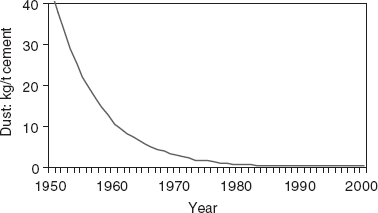
For some years the UK cement industry has been at the forefront of businesses that have been making improvements to their environmental performance (see Fig. 1 for example). All UK plants are accredited to ISO 14001 Environmental Management1, and more than 65% have EMAS accreditation. Between 1990 and 2000 emissions of carbon dioxide have been reduced by 2·6 million tonnes. The industry's environmental performance is reported annually on the Environment Agency's website (What's in your backyard? at www.environment-agency.gov.uk/yourenv/).
The industry recognises that its continued success is dependent on developing sustainably. To this end it is investing heavily in technology and processes, and is implementing a £500 million investment programme to increase efficiency. This sizeable investment in more sustainable production is being made from an industry whose turnover is £600 million per annum. This investment is enabling it to meet a voluntary commitment, under the Climate Change Levy, to improve energy efficiency by 25·6% over the period 1990 to 2010 (see Fig. 2).
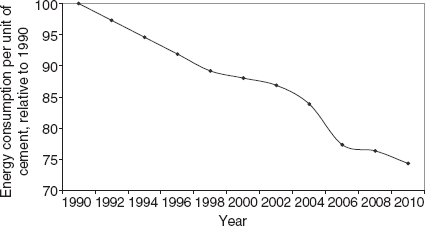
UK cement industry targets for energy efficiency improvements
UK cement industry targets for energy efficiency improvements
The UK cement companies are also among over 160 companies worldwide that have signed up to the Cement Sustainability Initiative (CSI) of the World Business Council for Sustainable Development. There are numerous targeted joint projects and individual company actions arising from the initiative.2 For more information on the CSI see: www.wbcsdcement.org.
3. CONCRETE SUSTAINABILITY
Cement and concrete are essential materials in today's society: they form a fundamental element of a good built environment and infrastructure. The concrete industry has improved its environmental performance on average across a bundle of 13 indicators (including CO2, sulphur dioxide, waste to landfill and extracted minerals) per tonne of concrete by 17% between 1994 and 2001. A report that summarises the environmental performance of the UK concrete industry, Cement, Concrete and Sustainability, is available from the strategy project's website (www.concemsus.info).
Continuing pressures on the construction industry to reduce waste are resulting in an increase in the amount of concrete that is recycled or reused. In the case of buildings, refurbishing or reusing the structures is the least-waste option. If neither of these options is available then it is advisable to recycle or reuse elements as necessary. It is encouraging to hear that some construction companies are regularly managing to recycle over 70%, and up to 95%, of concrete from their waste streams (Fig. 3).
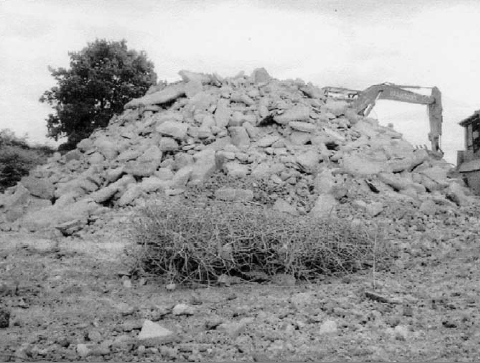
Partly crushed concrete ready for recycling and reuse; shown with segregated reinforcement (courtesy of Bovis Lend Lease)
Partly crushed concrete ready for recycling and reuse; shown with segregated reinforcement (courtesy of Bovis Lend Lease)
The reuse of these materials on, or near, the site where they were generated will bring environmental benefits. Where they have to be transported a significant distance they may or may not prove to be the most environmentally or economically friendly solution, although their use will minimise waste and reduce the use of natural resources. For guidance on the use of recycled aggregates visit the www.aggregain.org.uk website.
Each concrete manufacturing company has its own approach to sustainable development. In addition, British Precast and Quarry Products Association (Ready-mixed Concrete), the concrete manufacturing trade bodies, have made commitments to develop sustainability indicators for their member companies with targets for improvement to be published in 2005.
4. PROMOTING AND ASSISTING MORE SUSTAINABLE CONCRETE DESIGN AND CONSTRUCTION
By providing information, and encouraging the specifiers and users of concrete to think about sustainability, even more gains can be made in tackling climate change and in minimising waste. A computer-aided e-learning module that provides an overview of environmental and sustainable development issues, and which helps users to understand what can be done to achieve more sustainable construction and design in concrete, is available from www.rcc-info.org.uk.
It is possible to use concrete in ways that can reduce the energy consumption, waste, resource use and emissions of a building, structure or component of infrastructure or increase the recycling of raw materials (e.g. Figs 4 and 5). For example, the thermal mass properties of concrete, when considered in the design of buildings, can lead to more sustainable, energy efficient and more environmentally friendly structures that can save money (on installation costs of expensive air-conditioning) and use less energy to power them (e.g. Fig. 6). Fabric energy storage systems, which use ducted air within the concrete slab, provide extra cooling. Compared with air-conditioning, these systems reduce carbon dioxide emissions by up to 50% (with associated savings in energy bills). More savings may be possible in heating or cooling the building if groundwater is passed through embedded pipes in slabs. Information about these systems is contained in two publications: Fabric Energy Storage and Ecoconcrete.3
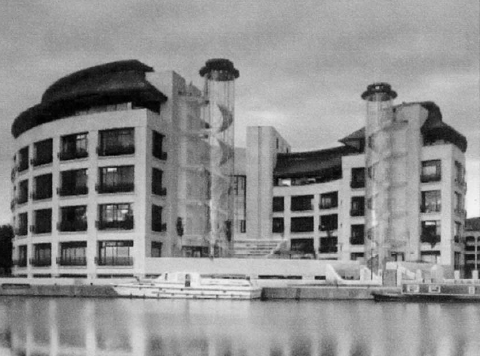
Thames Water HQ in Reading, a highly energy-efficient building: BREEAM ‘Excellent’ rating (courtesy of Trent Concrete)
Thames Water HQ in Reading, a highly energy-efficient building: BREEAM ‘Excellent’ rating (courtesy of Trent Concrete)
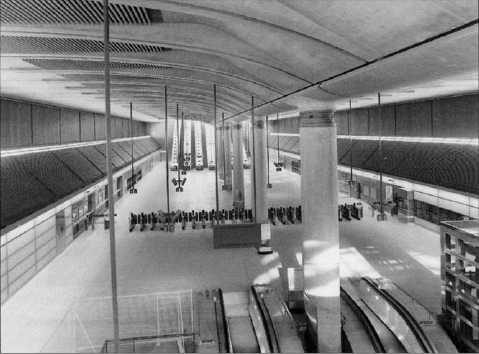
Canary Wharf underground station in London's Docklands region (on the Jubilee Line). The station, designed by Sir Norman Foster & Partners, is an excellent example of sustainable transport. Not only does it use the waste material pulverised fuel ash throughout its concrete structure, it also encourages people to use public transport, reducing congestion and air pollution on London's busy roads (courtesy of the Institution of Civil Engineers, London)
Canary Wharf underground station in London's Docklands region (on the Jubilee Line). The station, designed by Sir Norman Foster & Partners, is an excellent example of sustainable transport. Not only does it use the waste material pulverised fuel ash throughout its concrete structure, it also encourages people to use public transport, reducing congestion and air pollution on London's busy roads (courtesy of the Institution of Civil Engineers, London)
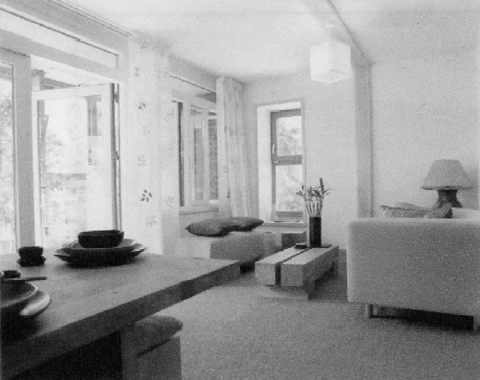
Interior of BedZED development, Beddington, Surrey. Thermal mass of concrete was used in achieving energy efficiency (courtesy of Peabody Trust)
Interior of BedZED development, Beddington, Surrey. Thermal mass of concrete was used in achieving energy efficiency (courtesy of Peabody Trust)
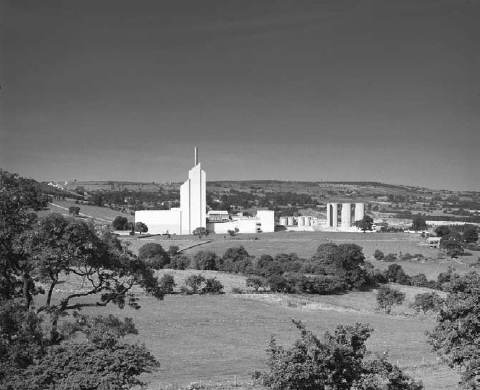
Cement works (courtesy of Lafarge Cement UK)
Cement works (courtesy of Lafarge Cement UK)
5. THE WAY FORWARD
The UK cement and concrete sector acknowledges that it has a responsibility to improve the sustainability of its products. There are two ways in which this can be done:
ensuring responsible concrete product manufacture by developing measures of sustainability and improving performance by meeting defined targets
promoting and assisting the sustainable design, sustainable construction and reuse or recycling of concrete structures and infrastructure.

