

This article provides a brief overview of lime use in traditional buildings and how the benefits identified in conservation work can be applied to sustainable new build projects.
1. INTRODUCTION
Lime is the principal binder of most traditional mortars, plasters and renders. The Romans brought the technology of lime in building to the British Isles, and it was used extensively in mortars and surface finishes from then until the nineteenth century, when patent cements, such as Portland cement, were introduced. Although lime mortar and plaster was used mainly in pre-1900 construction, and is still seen primarily as a method of maintaining and repairing traditional buildings, an increasing number of professionals are discovering that modern buildings can benefit greatly from its use.
The use of lime declined throughout most of the twentieth century, but increasingly over the past 20 years it has been recognised that hard, cement-rich mortars are unsuitable for use on old buildings, and lime is enjoying a strong revival in the building conservation industry. Much of the skill and knowledge needed to use lime successfully had dwindled, so when lime began to be more widely specified for conservation work there was a lack of suitably experienced and skilled craftsmen. The practical techniques required for the use of lime can be mastered by anyone with good building skills or a craft aptitude, together with the adoption of certain basic principles.
2. TRADITIONAL USES
Traditional applications see lime being used in many different ways. Lime mixed with sand to form lime mortar can be used for bedding masonry and for pointing, rendering and plastering (often with animal hair added). For the very fine joints in ashlar masonry or gauged brickwork pure lime putty can be used for bedding.
Lime can also be mixed with carefully chosen aggregates (sands and stone dusts) to make repair mortars for damaged stone-work. Lime also has valuable applications for specialist stone cleaning and conservation techniques.
Lime putty can be diluted with water to make a limewash for painting both internal and external walls, with pigments being added to produce a coloured limewash.
3. THE BENEFITS OF LIME
There are many advantages of using lime mortar. Traditional building construction is based on the use of relatively soft and porous materials such as stone, brick, timber and earth, together with a lime-based mortar for bedding and plastering. These buildings usually have solid walls, with no cavity, and are often built on insubstantial foundations. They are therefore liable to settlement and movement associated with seasonal changes in ground conditions.
Lime mortar is softer and weaker than the stone or brick to which it bonds, and is therefore able to accommodate slight movements caused by settlement or temperature changes without significant cracking. Also, it is permeable and allows evaporation of rising and penetrating damp from within the wall. It is this permeability, or ‘breathing’, that helps to keep the building dry inside without a damp-proof course or chemical treatments.
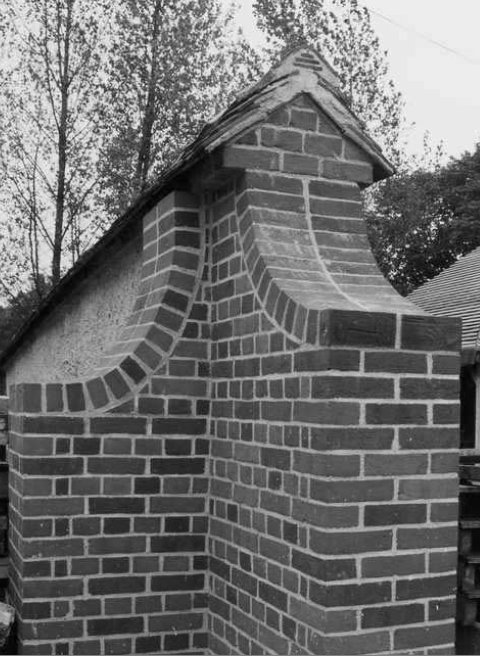
A new brick wall constructed using hydraulic lime mortar and new handmade bricks
A new brick wall constructed using hydraulic lime mortar and new handmade bricks
Cement has very different properties from those of lime. Cement pointing is very hard and brittle, much less porous, and sometimes completely waterproof. Its use on traditional masonry may have a damaging effect in one of several ways. Cement mortar is harder than soft brick or stone, and is too rigid to accommodate settlement or movement in the wall. When movement occurs, the edges of the stone or brick are forced against the hard mortar, spalling and cracking the masonry (Fig. 2).
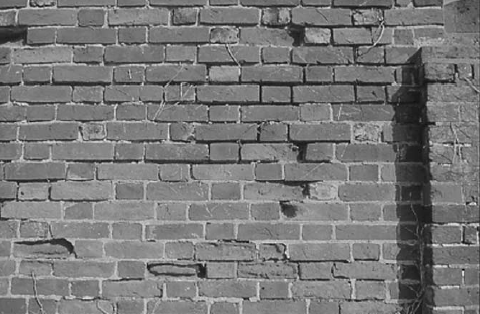
Where this wall has been repointed using cement mortar, the bricks are starting to decay
Where this wall has been repointed using cement mortar, the bricks are starting to decay
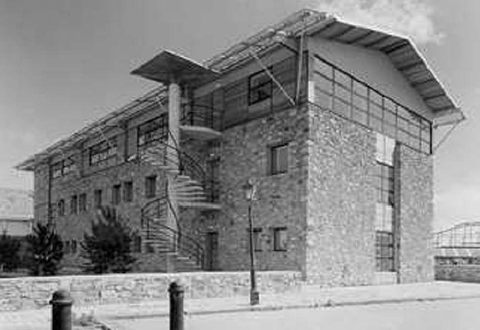
New Government offices, Plymouth. Built using reclaimed stone and hydraulic lime (courtesy of Lias Limes Ltd)
New Government offices, Plymouth. Built using reclaimed stone and hydraulic lime (courtesy of Lias Limes Ltd)
Further damage is caused by rainwater and dampness within the masonry. Because the mortar is not permeable this moisture cannot evaporate from the mortar joint once rain stops. Instead it is forced to evaporate through the face of the brick or stone and soluble salts present in the water crystallise in the surface layers of the masonry, leading to crumbling and decay. This effect is sometimes so severe that the entire face of the stone is lost and the hard cement pointing is left standing proud. Further rainwater is trapped and the decay continues. The concentration of trapped water in the masonry also increases its susceptibility to frost damage in winter.
Soft lime mortar allows moisture movement, being more porous than the masonry, and encourages evaporation and salt deposition in the mortar joints. It is the mortar that decays, not the stone or brick. It is much easier and cheaper to repoint a wall than to repair or replace damaged brick or stone, with less loss of important historic fabric.
The use of cement render causes slightly different problems. Hairline shrinkage cracks inevitably form in the surface of the render as it sets, or afterwards by slight movement in the wall. Rainwater is drawn by capillary action into these cracks and then diffuses into the wall. Once inside the wall, this moisture, together with any rising damp and water vapour generated by daily life, is trapped, as it cannot evaporate through the hard, impermeable render. The moisture levels start to build up in the wall and the moisture shows on the inner surface of the wall, resulting in internal dampness and damage to plaster and decorations. So, strange as it may seem, applying a waterproof render can actually increase levels of damp inside the house.
A porous lime render encourages evaporation of moisture from its surface, helping to minimise the effects of moisture within the wall and keeping the surfaces dry.
4. TYPES OF LIME
Lime is made by quarrying limestone and heating it in a kiln. The purity of the limestone and the burning temperature will affect the qualities of the finished product. Impure limestones (containing silica and alumina) produce hydraulic limes. These set harder and faster than pure limes. They can also set in wet (even underwater) conditions. These types of lime are suitable for modern construction because they set relatively quickly, and are strong enough to cope with the stresses of cavity construction.
5. ENVIRONMENTAL ISSUES
In the UK, 3000 million bricks are fired annually, consuming large quantities of fuel and adding significantly to CO2 emissions. Buildings constructed with lime mortars can be altered easily, and the bricks or stones can be reused. Indeed the masonry can be reclaimed entirely if a building has completed its useful life. This is why architectural salvage yards have second-hand bricks to sell. Bricks bound together with cement mortars, however, can generally never be recycled–except as hardcore. This is especially pertinent to modern commercial buildings, which may be demolished after only a few years. If we continue to use cement mortars we shall have to continue making billions of high-energy bricks each year.
During the manufacturing process the firing temperature between cement and lime is significantly different. Lime is produced at a temperature of around 900–1100°C. Cement is produced at 1200–1500°C. More energy is required to produce a tonne of cement than a tonne of hydraulic lime, thereby increasing CO2 emissions. Additionally, the bulk density of hydraulic lime is half that of cement, leading to overall energy savings when using lime of approximately 30–50%. Lime mortars will also reabsorb some CO2 during their setting process.
As cement production is responsible for 1500 million tonnes of CO2 each year (which is nearly 10% of all worldwide CO2 production), the environmental argument for lime in new building is a compelling one.
6. THE FUTURE OF BUILDING
One hundred and fifty years ago Portland cement was considered to be a specialist material, and no one thought it would catch on in mainstream building because it required grinding during its manufacturing process. However, advances in industrial processes and the demand for faster building, particularly after the Second World War, changed the market conditions and cement took off. Portland cement is a fantastic material for mass concrete and engineering structures, but the last 50 years have shown that it is not the greatest for mortars, plasters and renders. It is too hard, too rigid and too impermeable. This has been particularly noticeable where it has been used on historic buildings. We are now at a crossroads: there is a need to build millions of new homes over the coming decades, but environmental issues are becoming more important to us. There are people who think that lime will never take off again in mainstream building, but small, subtle changes in the market conditions could change the future. The combination of lime with modern technology and higher demand could bring the cost down. The introduction of a carbon tax, or legislation setting targets for recycling of buildings, could make cement impractical. Lime will then be the natural choice. The future is green—lime green!

