

With the threat of rising sea levels and more frequent and intense storms, coastal defence is being considered on a more strategic basis. This aims to enable coastal change to occur as naturally as possible while sustaining both coastal habitats and those developments on the coast for which such a location is necessary. There will inevitably be some compromises but decisions will be made on a much more rigorous basis than in the past. This note outlines the methods being employed and directs the reader to more detailed guidance.
1. INTRODUCTION
Coastal defence is a collective term for defence against flooding from the sea (sea defence) and protection against erosion (coast protection). These two functions have been carried out by numerous bodies in Britain, which has made their control and co-ordination potentially difficult. It is partly for this reason that coastal defences tended to be erected piecemeal in the past, as and when an area needed to be defended, without much regard to the effects elsewhere. Within the last two decades however, the approach to coastal defence in Britain has undergone major changes, driven by leading coastal engineers in conjunction with professionals from other relevant specialisms.
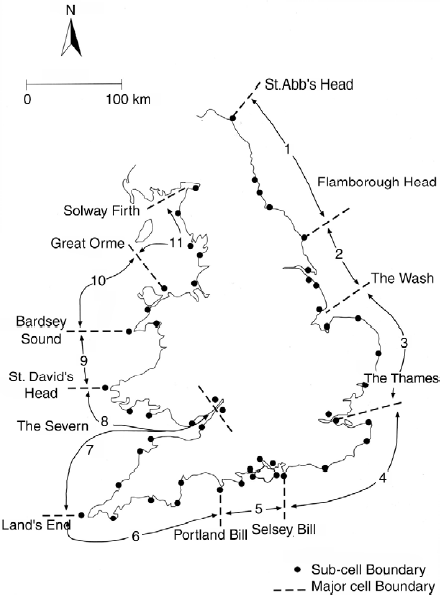
Sea defence in England and Wales is now carried out primarily by the Environment Agency. Powers to carry out or approve coast protection lie with local authorities. In Scotland, local authorities have powers to undertake both. Even so, with landowners, drainage boards, transport bodies and others, there is still a large number of bodies that undertake works on the coastline. To ensure a more strategic approach to coastal management, these bodies and others with an interest in coastal defence, have formed coastal groups. The groups are based on lengths of coastline that are relatively self-contained in terms of the movements of beach sand and shingle (coastal cells or sub cells). Fig. 1 shows the boundaries of the sediment cells and sub-cells for England and Wales. Each coastal group has prepared an initial ‘shoreline management plan’ for its length of coastline which can vary from a single sub-cell to a complete cell. The actual size depended on a balance between maximising the length of coastline being considered while keeping each group to a manageable number of bodies. These plans have been reviewed1 and new guidance issued by the Government2 3 for the preparation of the next generation of plans.
2. SHORELINE MANAGEMENT PLANS
A shoreline management plan should identify the best sustainable means of managing risks over the next 100 years (the shoreline management policy) from flooding and coastal erosion for defined lengths of shoreline (policy units) within each coastal cell. The plan should address, in broad terms, whether to continue defending assets with coastal defences or manage the risks through other means. For each policy unit within the plan area there are five generic policies available to the shoreline manager:
hold the existing defence line while maintaining or changing the standard of protection
advance the existing defence line by constructing defences wholly seaward of the original defences
managed realignment by identifying a new line of defence and, where appropriate, constructing new defences landwards of the original defences
limited intervention by working with natural processes to reduce risks whilst allowing natural coastal change (e.g. dune management, warning systems)
no active intervention, where there is no investment in coastal defence assets or operations.
Each length of shoreline will be managed in one of the above ways but for various reasons, this policy may not continue to be feasible or acceptable at some time over the next 100 years, or sustainable for that period. A shoreline management plan may therefore identify a succession of policies that are likely to be appropriate over that timescale. The choice of preferred policies will be based on a consideration of technical, economic and environmental assessments and a consideration of the risks inherent in each. Where realignment is necessary or there is to be no active intervention, the social impacts will have to be considered.
Sustainability in the context of coastal defence has been defined4 as the degree to which solutions avoid tying future generations into inflexible and/or expensive options. This will usually include consideration of inter-relationships with other defences and likely developments and processes within a coastal cell. It will also take account of long-term demands for non-renewable materials.
The shoreline management plan will be prepared with full consultation with representatives of other coastal interests. It will attempt to meet the aspirations of all, such that it forms one component of the integrated coastal zone management plan. It will help others to understand the constraints imposed by physical coastal processes and in particular assist in guiding development away from areas where its defence will be unsustainable in the longer term.
3. STRATEGIES AND SCHEMES
Having determined the broad direction of policy at the shoreline management plan level, it is then appropriate to consider implementation at a more local scale. Strategy plans5 are a means of considering the major interactions and impacts in terms of the environment, economics and coastal processes over one or a number of policy units. A strategy of this type can highlight any problems that may arise from implementation of individual schemes.
The relationship between the three stages is shown in Table 1 below.
Stages in the appraisal process
| Stage | SMP | Strategy plan | Scheme |
|---|---|---|---|
| Aim | To identify policies to reduce risk | To identify appropriate scheme types to implement policies | To identify the nature of works to implement the preferred scheme |
| Delivers | Broad-brush assessment risk, opportunities and constraints, areas of uncertainty | Preferred approach (i.e scheme type) including economic and environmental decisions | Comparison of different implementation options for preferred scheme type |
| Output | Generic policies (e.g. hold the line, advance the line etc.) | Type of scheme (e.g. beach recharge, seawall, setback, embankment, etc.) | Type of works (e.g. revetment, wall, recycling etc.) |
Preparation of individual schemes follows the same general principles, but also involves refining the choice down to the level where detailed design is undertaken. While much of the basic design outline will have been determined, detailed design will need to consider the final choice of materials, safety and construction issues, site-specific environmental issues and aesthetics. Materials in particular need to be chosen carefully in order to survive the harsh marine environment. Refinement may also be needed for the final structural form, which could require further modelling.
There are aspects that are particular to construction work in the marine environment. Weather can be a major hazard, particularly when disturbance to visitors or nesting birds may rule out summertime working. Particular problems are posed by having to work with changing tidal conditions. Gaining access both to and along a site can pose severe difficulties. Even after the completion of works there is the important matter of monitoring both the works and the environment in general; evaluating the construction and performance of the works and maintaining it to perform effectively over its operational lifetime.
Coastal defence should be an iterative process with information from the preparation of strategic implementation, scheme preparation, post-project evaluation and monitoring being fed by the coastal groups and their advisors back into the preparation of the next shoreline management plan. By following these guidelines, the principle of sustainable coastal defence set out above can be achieved.
4. DESIGN AND PRACTICE GUIDE
The matters outlined in this briefing sheet are the subject of an ICE Design and Practice Guide6 published by Thomas Telford Ltd. in 2002. It is based principally upon the conditions and arrangements within Britain, and draws heavily on recent British experience and practice, but many of the principles could be applied elsewhere in the world. It is one of a series of guides aimed at providing an introduction to the main principles and important aspects of various subjects and to offer guidance as to appropriate sources of more detailed information. The guide is targeted at
practising engineers who are not expert in or familiar with the subject matter
professionals more familiar with the subject who may use it as a handy aide-memoir of the principle issues
other professionals whose work brings them into contact with coastal defence.
A briefing sheet entitled Coastal Defence—Legislation and Responsibilities in England and Wales7 published in the ICE's Municipal Engineer journal also provides useful information.

