On 2 November 2004, the 140th ICE President Colin Clinton delivered his Presidential Address.1 The address, entitled Changing Time, had three key themes:
strengthening our regions;
properly recognising our people, their skills and achievements;
building our profile and influence as civil engineers and as an Institution.
I am not able to provide a seamless link between this journal and the Institution’s regions, except for the fact that our panel members, reviewers and authors come from all parts! I do however wish to reinforce President Clinton’s message about the need to recognise our peoples, their skills and achievements and also recognise how their efforts do indeed raise our profile and influence as engineers and as the Institution.
This is my last issue as Chairman of the Editorial Panel of this journal. I would therefore like to take this opportunity to record my thanks and appreciation to all those who have been responsible for initiating, planning and delivery of the journal over the past two-and-a-half years since the editorial panel was established.
There are too many people to name everyone individually: ICE and Thomas Telford staff, the Environment and Sustainability Board, Journal Panel members, reviewers and authors have all been responsible for the eight issues published so far. The names of the reviewers for 2004 will be published at the start of next year. Thank you reviewers. Without you we cannot establish the quality, credibility and reputation required of an ICE journal. The names of the key ICE and Thomas Telford staff and the panel members are published in every issue. The volunteer effort and contribution in preparing papers and briefing notes and in their peer review and assessment just for this journal is considerable. The volunteer and staff input to all 10 of the ICE journals is enormous. It is a reflection of the importance placed on the learned society function of our Institution. The quality of this contribution and the willingness for authors to share their experience with not only engineers, but all those with an interest in our subject, is at the core of why the Institution was established, in a coffee house, in 1818. The importance of sharing knowledge and in communicating was seen as fundamental to developing engineering skills and knowledge and thereby creating influence.
The engineering output of this Institution is considerable. As an individual I have gained enormous technical and other benefits from attending technical meetings, joining committees and in using the library (the finest engineering library in the world incidentally, with the most knowledgeable and helpful staff you could find anywhere dealing with 30 000 enquiries a year!). Figure 1 is my summary of the extent of the Institution’s engineering knowledge, all of which is available to its members, themselves a massive knowledge bank and network. Through journals, meetings and conferences, much of this valuable knowledge is also publicly available.
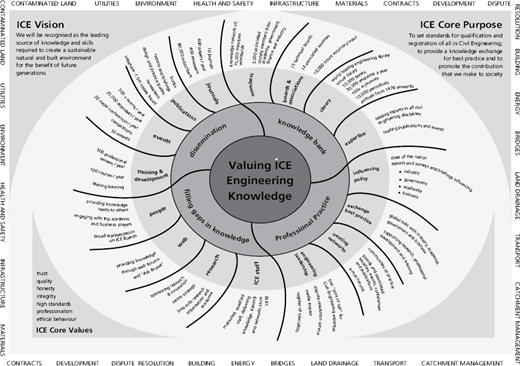
The ICE vision, core purpose and values are also shown in the diagram. Both the vision and core purpose emphasise the importance of engineering knowledge. The vision states: ‘We will be recognised as the leading source of knowledge and skills required to create a sustainable natural and built environment for the benefit of future generations’. The ICE core purpose is to: ‘provide a knowledge exchange for best practice’.
The diagram demonstrates the enormous breadth and depth of the engineering output and the engineering strength of the Institution and its members. In my view, the journal output is the jewel in the crown of the engineering knowledge delivered to society by the ICE. That output is only possible through the sheer dedication and effort of those I have identified above.
I am happy to report that this journal is now established and sustainable. In publishing the journal, this massive team also contributes to the very sustainability of the ICE and, indeed, the wider society.
In addition to introducing his three key themes, President Clinton promised a year of celebration. Our celebration and opportunity to recognise our people, their skills and achievements started just before the new President gave his address. On the morning of 2 November, the retiring President, Douglas Oakervee presided at the 2004 ICE Awards Ceremony. I am delighted to report that, for papers published in 2003, awards have been made to two Engineering Sustainability papers.
Ian Nicholson, Nicky Chambers and Pat Green were awarded the Trevithick Prize for the paper ‘Ecological footprint analysis as a project assessment tool’.2 The Trevithick Prize has now been established as the prize for the best paper in Engineering Sustainability.
Polly Griffiths, Richard Smith and Jeff Kersey were awarded a Halcrow Prize for their paper ‘Resource flow analysis: measuring sustainability in construction’.3 Three Halcrow prizes are awarded annually, for the (corporate member) authors of the best papers published by the Institution on: docks and harbours or other maritime works; tunnels; hydro-electric power or power from other renewable sources.
My thanks and congratulations to these authors and all the authors who have published in the first eight issues of the journal.
Now back to this issue.
1. BRIEFINGS
There are two briefings in this issue. In the first, Tim O’Toole describes the work London Underground are doing to understand the effects of climate change on their network and to minimise waste. Using Oysters (electronic ‘Oyster cards’) to reduce paper is having a dramatic impact. A fascinating thought for the London gourmet!
In the second briefing, Aubrey Meyer explains the development of ‘contraction and convergence’ as a science-based climate policy framework.
2. PAPERS
There are four papers in this issue. In the first, Sohail and Baldwin describe the development and use of performance indicators for community-contracted urban infrastructure provision in low-income countries. The paper identifies the benefits of community contracting and identifies how the delivery of such contracts can be improved.
In the second paper, Müller and Wolter look at the design and performance characteristics of breastshot waterwheels. They identify how the efficiency of the breast shot wheel can be maximised and suggest that they could offer both economic and environmental benefits for low head differences.
In the third paper, Morrison and Richardson investigate the use and possible acceptance of imperial smelting furnace (ISF) slag in concrete. While further research and testing is still required, the work carried out to date is promising and could help reduce the 2·5 million tonne UK stockpile.
In the final paper, Martin seeks to identify and discuss significant themes in sustainability as they affect concrete bridges. After introducing the challenge of sustainability to the concrete industry, a structured means of addressing sustainability issues is presented and the role of concrete in bridge construction is described.
Finally, I am pleased to announce that Professor Richard Ashley will be taking over the role of Chairman of the Editorial Panel. Richard is bringing some great ideas and a great deal of experience and enthusiasm to the role. I wish Richard and the panel all the very best for the future.