

Widening engineering horizons: addressing the complexity of sustainable development
R. A. Fenner, C. M. Ainger, H. J. Cruickshank, P. M. Guthrie
Further to the publication of this paper in Proceedings of the Institution of Civil Engineers, Engineering Sustainability, 2006, 159, No. 4, 145–154, the following amendment should be made.
Figure 1 was printed incorrectly and should have read as below.
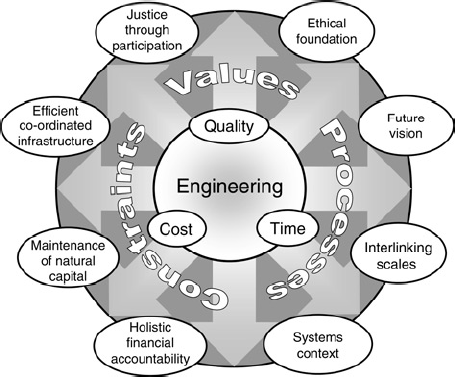
Decision-support tools and the indigenous paradigm
T. K. K. B. Morgan
Further to the publication of this paper in Proceedings of the Institution of Civil Engineers, Engineering Sustainability, 2006, 159, No. 4, 169–177, the following amendment should be made.
This paper was printed without the glossary referred to in section 1. The glossary is printed below.
| Aotearoa | New Zealand (land of the long white cloud) |
| Hapū | Subset of Iwi associated with resource allocation, management |
| Iwi | Tribal group claiming descent from a common ancestor |
| Manakitanga | Prestige associated with caring for visitors |
| Maori | Indigenous people of New Zealand |
| Marae | Communal gathering place usually incorporating buildings |
| Matawhaura | Mountain to the left of photo (our mountain) |
| Maunga | Mountain |
| Mauri | Life essence, binding force |
| Mauri mate | Devoid of life |
| Mauri kino/ | Stagnant, dwindling |
| noho | |
| Mauri mahi | Working, functioning |
| Mauri kaha/ora | Vibrant, alive |
| Moana | Large natural body of water |
| Ngati Pikiao | An Iwi numbering 18000 descendants of Pikiao II, (my people) |
| Pepeha | Saying that identifies geographical and ancestral linkages |
| Rohe | Geographic region typically a water catchment |
| Tāngata | People of the land with authority over that |
| whenua | place |
| Tawhaki | Polynesian ancestor acknowledged in Maori traditional lore with bringing the kumara to French Polynesia from South America |
| Te Arawa | Ancestral canoe of the peoples who occupy the Bay of Plenty and Central North Island of New Zealand (my ancestors journeyed here upon Te Arawa) |
| Te Puna | The wellspring that nutured Rakeiao, |
| Whakareia A | ancestor |
| Rakeiao | of Ngati Rongomai (Our communal gathering place and my place to stand) |
| Te Rangiunuora | Descendant of Tama Te Kapua, captain of the Te Arawa canoe (our ancestral link) |
| Te Rotoiti I | The small lake seen by Ihenga, an ancestor |
| Kitea A Ihenga | who arrived on Te Arawa (our waters) |
| Waka | Canoe |
| Waitangi | The location at which the Treaty was signed in 1840 |
| Whakapapa | Genealogy |
| Whanau | Family unit |

