The transition of the linear model of materials consumption and waste disposal to a circular approach is vital for resilience of global and local economies. There has been an exponential rise in resource consumption since the Second World War (Figure 1). The British Geological Survey estimates that 316 billion tonnes of minerals were extracted in 2015 to support urbanisation and global consumption patterns (Cooper et al., 2018).
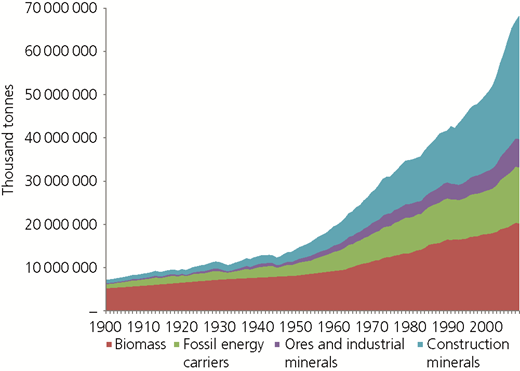
The built environment sector is the largest user of materials globally (WEF, 2016). Construction and demolition waste accounts for around 25% to 30% of all waste arisings in the EU (EC, 2018). Rising demands for resources are predicted to result in escalation of costs as materials become increasingly scarce.
The potential benefits to adopting circular economy principles to the design and delivery of our built environment are well documented. They include reduced carbon dioxide footprint, capital cost savings, reduced vehicle movements, safer working environments and greater resilience to material scarcity. There are also much wider opportunities for value creation. Engaging with the supply chain and collaborating across organisations can bring forward innovative products and new business models.
Emerging policy is likely to place much greater emphasis on reducing the embodied impacts of construction projects through the adoption of circular economy design principles. The new London Plan, for example, includes the requirement to develop circular economy statements as part of planning applications for new developments (GLA, 2017), demonstrating strategies as illustrated in Figure 2.
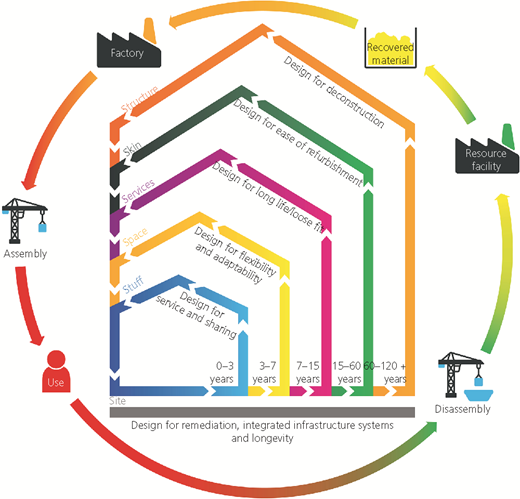
Circular design models for development projects (after S. Brand, Useful Projects, 2017)
Circular design models for development projects (after S. Brand, Useful Projects, 2017)
Yet, while there is industry-wide awareness of the concepts of the circular economy, a study by Adams et al. (2017) highlighted that little research had been undertaken on the systemic approaches and new business models might enable materials to retain high residual values within the construction industry. Further, that there is a lack of guidance and case studies to learn from.
The aim of this themed issue of Engineering Sustainability is to bring together a collection of papers that could help to point to approaches to delivering greater circularity within construction.
We start with a critique of BS 8001, the world’s first standard on the circular economy, and its application to the construction sector (Pomponi and Moncaster, 2019). The standard is intentionally broad and inclusive to suit all types of organisations and products. The authors found that the necessary breadth of the standard, while providing a useful overview to the circular economy, fails to deal with the complexity of buildings. That complexity arises with the large numbers of stakeholders, long lifespans and high uncertainties about future scenarios of buildings that are formed of multiple products interacting both temporally and geographically. The authors conclude that there is a missed opportunity to accelerate the transition to a ‘circular’ built environment. They offer additional documents and resources that could be helpful to those wishing to adopt circular economy principles within the built environment.
In their briefing paper ‘Embedding circular thinking in a major UK infrastructure project’, Charlson and Dunwoody (2019) describe how High Speed 2 (HS2) has used the principles of circular economy to realise strategic project goals. They highlight work undertaken to identify specific circular economy opportunities, including a comprehensive asset condition monitoring programme to support the longevity of infrastructure investment.
As a lean client, they also illustrate the work HS2 is undertaking to communicate and embed circular economy principles into procurement and supply chain innovation processes.
Two papers review the opportunities presented by contemplating buildings as stocks of materials. While reuse of materials is promoted by policy, both papers explore the challenges of making it work in practice.
Hopkinson et al. (2019) investigate the opportunities for recovery of structural products at the end of their life. They highlight the risk and economic barriers to reuse of building materials, in particular the labour required for disassembly of buildings that have not been designed for deconstruction.
In their paper ‘Characterising existing buildings as material banks (E-BAMB) to enable component reuse’, Rose and Stegmann (2019) highlight the tendency to circumvent the waste hierarchy through arguments that justify recycling at the lowest value. They go on to illustrate the role of technology, coupled with better information on the materials within a building, to realise higher values through circular economy business models.
Rapidly renewable materials also have an important role to play in shifting the construction sector away from extraction of raw materials. While a shift to biological materials is a fundamental principle of the circular economy, modifications to enable assembly and protection of natural materials, from gluing to flame-retardant coatings, can inhibit deconstruction and natural decomposition. In ‘Mass timber in the circular economy’, Campbell (2019) highlights approaches that can be adopted to enable reuse and appropriate disposal routes for timber products.
Our last paper in this themed issue tackles the issues of shorter life and more complex multi-material building components. The paper by Saint et al. (2019) highlights how understanding material flows and undertaking life-cycle analysis can help inform a systematic approach to designing for the circular economy, in this case for a solar water heater. By simplifying the design through integration of functions and designing out complexity, the solar water heater can be easily disassembled for reuse at the end of life. The authors demonstrate the whole-life carbon dioxide benefits when compared with alternative systems. In doing so, the authors demonstrate an approach that can be used on many other system choices.
Collectively, the papers in this themed issue illustrate a suite of potential approaches from improved standards and policies for infrastructure projects to life-cycle appraisal techniques and the role of digital information flows. However, all the authors point to further work required to enable a systemic unlocking of the circular economy opportunities.