This study aims to examine the differential impact of remittances, democracy index, their interaction and gross militarization index (GMI) on economic growth across top remittance-receiving lower middle-income countries (LMICs). By dividing nations into two groups based on democracy levels, the research investigates whether institutional context – particularly democratic quality – moderates the remittance–growth relationship.
This quantitative study analyses panel data (2006–2023) from top remittance-receiving lower middle-income nations, split into high and low democracy groups. Estimation employs POLS, Fixed Effects and Random Effects models, with Hausman test guiding selection. The model incorporates remittances, democracy, GMI and their interaction. Robustness is addressed through 2SLS for endogeneity, slope homogeneity tests (Pesaran–Yamagata) and Kao–Pedroni cointegration tests, ensuring valid, reliable empirical findings across both institutional contexts.
Key findings reveal a democracy-based divergence: remittances and democracy negatively correlate with growth in high-democracy nations but positively in low-democracy countries. The interaction term is positive in democratic settings – suggesting synergy – yet negative in weaker democracies, indicating democratization without institutional capacity disrupts remittance effectiveness. GMI shows no significant growth impact. Long-run relationships are confirmed through cointegration. Endogeneity tests (Durbin and Wu-Hausman p > 0.05) confirm no endogeneity, validating panel regression results. These findings underscore the fact that institutional context fundamentally determines whether remittances contribute to productive investment or are absorbed into consumption.
This research contributes to institutional economics by demonstrating that democracy's moderating role in the remittance–growth nexus is contingent on institutional quality. It challenges the assumption that democracy universally enhances remittance effectiveness, revealing instead that institutional capacity determines outcomes. The introduction of GMI as a novel variable adds to militarization literature, though its insignificance warrants further investigation across diverse contexts.
This research contributes original empirical evidence by examining the remittance–growth relationship through an institutional lens, comparing high versus low democracy nations. It introduces GMI as a novel variable in this context, addressing a critical gap in militarization literature. The study's comparative panel approach across democracy regimes, combined with rigorous robustness checks, offers fresh insights into how political context determines remittance effectiveness, informing both theory and policy.
1. Introduction
Economic stability is one of the main objectives of any country by which they try to achieve further economic growth and improve the overall standard of their people. A country's economy is considered stable and growing if the people living there have proper health, education, basic needs and can generate a good source of income. In developed countries, exports and foreign direct investment (FDI) constitute a major part of the country's foreign exchange, but in most developing economies remittances constitute a major portion due to the lack of imports and FDI (Cao and Kang, 2020). Remittances help these countries with foreign reserves and indirectly finance and keep them working. The portion of remittances for countries receiving aid is so significant that it comes second after FDI among other contributors to foreign exchange (Eggoh et al., 2019; Ratha, 2019).
Most of the top remittance recipients are LMICs; in addition, having a large size population is one of the reasons that a considerable population of these nations moves abroad for employment opportunities, to alleviate poverty in their households and improve the standard of living as Adams and Page (2005) regarded poverty as the main cause of migration. Remittances is the money sent by immigrants to their home countries for family's expenses. It is widely recognized by economists as a tool for economic growth and financial stability in countries where the other means of foreign exchange are not sufficient. Remittances flows have been continuously increasing in the LMICs and in 2024 it reached $685 billion (World Bank). Moreover, the International Remittance total is more than the total of FDI and Official Development Assistance (ODA) worldwide as stated by the World Bank. If the governments get successful in channelizing these transfers, the remittance number would be significantly larger in the LMICs as most of these transactions are done through the unofficial private means and not through the banking channels (Adams and Page, 2005; Adugna Chomen et al., 2023; Dutta and Saikia, 2022; McFarlane et al., 2025; Offor et al., 2023).
There are many studies on the relationship between remittances and economic growth resulting in positive outcomes and show that the remittance plays a major role in the reduction of poverty and lead to economic growth (Adams and Page, 2005; Azizi et al., 2023; Chami et al., 2005). However many studies reiterate that in fact it does not contribute towards economic growth and results in inequality between households (Cazachevici et al., 2020; Pradhan et al., 2025). Several studies have contributed this to the role of institutions and governance bodies in not taking active part in strategizing for allocating remittances in growth and productive investments (Islam and Alhamad, 2022; Khan, 2023; Mohammed and Karagöl, 2023).
Democratic governance is described by constitutional freedom, accountability and protection of civil authorities. Countries with democratic governance have witnessed long term economic growth and prioritize public education, health and infrastructure. Nonetheless, remittances also create overreliance on private transfers, and it might reduce the government accountability and doesn't improve the political institutions (Williams, 2024). Increasing militarization is also notable in today's world. It can be defined as the extent to which any country prioritizes military expenditure over human development expenditure. The level of democratic governance can be measured by democracy index with a score between 0 and 10, developed by the Economic Intelligence Unit (EIU) in 2006 and updated every year whereas militarization is measured with the Global militarization index (GMI) developed by Bonn International Centre for Conversion (BICC), measured on the basis of expenditure on military, military personnels and weapons (Elveren and Moghadam, 2022; Rahman and Alam Choudhury, 2014). This study argues that the answer lies in institutional context, which determine whether remittances are channelled into productive investments or absorbed by unproductive expenditures.
Although remittances often surpass FDI and ODA in LMICs, their impact on economic growth remains contested. Existing studies report positive, negative and insignificant effects, suggesting that the developmental consequences of remittances may depend on the institutional environment in which these transfers are received. Although institutional quality has increasingly been incorporated into the remittance-growth literature, comparatively less attention has been given to whether different levels of democracy alter the effectiveness of remittances. Moreover, the role of militarization in the remittance-growth relationship remains unexplored. This creates an important gap because countries receiving comparable levels of remittances may differ substantially in their political institutions and resource allocation priorities.
Accordingly, this study addresses four research questions: (1) What is the relationship between remittance inflows and economic growth in top remittance-receiving LMICs? (2) How is democracy associated with economic growth across higher and lower democracy recipient countries? (3) What relationship exists between militarization and economic growth in these economies? And (4) Does the relationship between remittances and economic growth vary with the level of democracy?
This study contributes to the existing literature in three important aspects. First, it investigates heterogeneity in the remittance–growth relationship by comparing top remittance receiving LMICs operating under higher and lower democratic environments. Rather than if remittances exert a uniform growth effect across recipient economies, the analysis examines whether their association with economic growth varies across institutional contexts. Second, the study evaluates the moderating role of democracy through an interaction between remittances and democracy, thereby distinguishing the individual associations of remittances and democracy from their joint relationship with economic growth. Third, the study incorporates the GMI as an additional institutional and resource allocation dimension that has received limited attention in the remittance growth literature.
From a policy perspective, the study shifts attention from the volume of remittance inflows alone to the institutional conditions under which these resources are received and utilized. If the growth association of remittances differs across institutional environments, policies aimed solely at attracting higher remittance inflows may be insufficient. The findings therefore provide useful evidence for policymakers concerned with governance capacity, institutional effectiveness and the productive use of remittance income in the LMICs.
2. Theoretical framework
Neoclassical approaches to migration explain international migration as a response to differences in wages, employment opportunities and returns to labour between origin and destination economies (Arango, 2000; Faist, 2011; Harris and Todaro, 1970; Massey et al., 1993; Todaro, 1969). Migration subsequently generates remittance transfers from migrants to households in their countries of origin. From a growth perspective, these transfers may relax household liquidity constraints, support consumption, finance education and health expenditure and provide capital for productive investment. Consequently, remittances can contribute to economic activity and capital accumulation. However, their contribution to growth is not automatic. Where remittances are predominantly directed toward consumption, reduced labour-force participation or are not intermediated into productive activities, their aggregate growth contribution may remain weak.
Institutional theory emphasizes that economic outcomes depend not only on the availability of resources but also on the formal and informal rules governing their allocation and use. Strong institutions may lower transaction costs, strengthen property rights, improve financial intermediation and create incentives for productive investment (North, 2018; North and Weingast, 1989; North and Thomas, 1973; Tang and Tang, 2018). In the context of remittances, these institutional conditions may influence whether household transfers are channelled toward investment, entrepreneurship and human capital development or remain concentrated in short-term consumption. This provides the theoretical basis for examining institutional differences in the remittance–growth relationship.
Democracy is treated in this study as one dimension of the broader institutional environment. Democratic institutions may influence economic outcomes through accountability, political participation, transparency, policy stability and constraints on arbitrary government action. These characteristics can shape the investment environment in which remittance-receiving households make financial decisions. Democracy may therefore have not only an independent association with economic growth but may also condition the extent to which remittances are translated into productive economic activity. This provides the theoretical rationale for including the interaction term between remittances and the Democracy Index in the empirical model.
Militarization represents an additional dimension of the institutional and resource allocation environment. A relatively high concentration of national resources in military expenditure, personnel and military capacity may create opportunity costs when resources that could otherwise support health, education, infrastructure or productive investment are redirected toward defence related priorities. In such settings, remittances may become more important in financing household welfare and consumption. However, militarization may also be associated with security and political stability under some circumstances. Its relationship with economic growth is therefore theoretically ambiguous, providing a rationale for examining the GMI empirically rather than assuming a uniformly negative effect.
3. Literature review
There are plenty of studies that have analysed the relationship between remittances and economic growth. But there is still lesser evidence that shows that remittances have a positive impact on economic growth and mixed results have been noticed during reviewing literature depending on different variables, countries and models.
3.1 Positive relation
Some studies found a positive relationship between remittances and economic growth due to factors like consumption, poverty reduction or investment. Khan (2023) studied the positive and negative impact of remittances on India's economy and found that positive shocks boost economy whereas negative shocks have no impact which leads to the policy implication that government should prioritize remittances for investments in SMEs (Small and Medium sized Enterprises) and partner with the sending countries and channel it effectively. Khan (2026c) investigates the relationship between remittance inflows and income-based poverty in South Asia, extending the remittance literature beyond aggregate growth to household and distributional welfare outcomes. The study finds that remittances have a substantial effect on poverty in both the short and long run suggesting policymakers should work to use them for investments than only consumption.
Azizi et al. (2023) examine 113 countries from 1990 to 2015 and find a positive impact in countries having high human capital whereas no impact on countries with low human capital. It was credited to the fact that countries with high human capital consider remittances as investment rather consumption as done by the ones having lower human capital. Khan (2024b) investigates 61 developing countries and concludes that remittances contribute towards growth by increasing domestic capital, enhancing consumption, reducing poverty and play a crucial role in human capital development, particularly in health. Pradhan et al. (2025) study this relationship in BRICS countries and find a positive relationship only when they are below a certain level and affects negatively if exceeds it. Recent research has also examined remittances within the broader context of foreign financial inflows and their macroeconomic determinants Khan (2026a), emphasising the importance of considering the domestic environment in which external financial resources are received and concludes that remittances are positively impacted by GDP growth. Taken together, the positive strand of the literature suggests that remittances can support economic development through several channels, including household consumption, poverty reduction, human capital formation, capital accumulation and productive investment. However, the strength of these effects appears to depend on broader economic and institutional environment, suggesting that remittances do not generate uniform outcomes across recipient economies.
3.2 Negative relation
Conversely, Clemens and McKenzie (2018) investigate the reason why remittances do not impact growth despite a great increase in incoming payments in recent years. They give three main reasons, Firstly, the measurement error due to improper channelling. Secondly, there might be statistical reasons that might have failed to detect the positive results and thirdly it could be endogeneity bias. Even with these challenges it is true that remittances have helped poverty alleviation and have improved the household welfare and global GDP. Cazachevici et al. (2020) performed meta-analysis from 538 studies on remittances and growth and their results revealed mixed results in which 20% of the results show a negative impact and 40% showing no impact. Offor et al. (2023) studied African economies post Covid and found a negative relationship combined with harmful shocks from inflation and restricted private sector credit. The results reveal structural financial weaknesses but still considered remittances vital for household welfare and proved beneficial during crisis surpassing FDI and ODA. They recommend formalizing remittance flows by enhancing financial inclusion, the same recommendations are given in another African study by Adugna Chomen et al. (2023) finding insignificant relationship between remittances and growth. Habib (2024) attributes the negative relation towards consumption rather than investment. Moreover, inequality could be one of the reasons for remittances not positively contributing towards economic growth as suggested by McFarlane et al. (2025) that remittances help the lower income households consumption. Pradhan et al. (2025) also stated that remittances have a negative relationship with economic growth when it exceeds a certain level. Khan (2025) found that remittances are negatively impacted due to strict rules and regulations. Overall, the negative and insignificant findings in the literature have been associated with several possible mechanisms, including remittance-dependent consumption, reduced labour-market participation, financial sector weaknesses and unequal access to remittance income.
3.3 Institutional moderation
Several studies have examined the institutional dimensions of the relationship between remittances and economic growth. Catrinescu et al. (2009) investigate whether institutions influence the contribution of remittances to economic growth. Against the mixed evidence in earlier studies, they argue that although remittances may support growth, they can also generate dependency and reduce labour force participation. Islam and Alhamad (2022) take top ten remittance receiving countries between 1996 and 2019 for studying the impact of financial development and institutional quality on the relationship of remittances and growth. They find that financial development and institutional quality are very crucial for enhancing economic growth in the long run. The causality results also reveal that remittance directly drives growth, suggesting reinforcement of financial markets and institutions to improve remittance inflows. The importance of the domestic financial environment is also supported by recent research examining the facilitators and barriers to financial development in developing economies (Khan, 2026b). This is relevant to the remittance–growth nexus because the extent to which remittance income can be intermediated through formal financial systems may influence its capacity to support productive investment.
Habib (2024) analyses other variables like political stability, government effectiveness and regulatory quality and finds negative and insignificant impacts which indicate that poor institutional mechanism leads to an increase in informal transfers. The study concludes that improving these factors could lead to productive investments. Khan (2024a) examined economic and governance drivers of remittances from the UK, USA and UAE to India and finds heterogeneity across sending countries. The findings further demonstrate that remittance behaviour is shaped by the broader economic and institutional environment of migrant destination countries. Williams (2017b) stated that remittances contribute towards democracy, decreased poverty and increase the investment in education and increase government accountability in SSA countries. Williams (2017a) in another study stated that the political environment is crucial for remittances and growth to prosper therefore strengthening the fact that the democratic institutions would support that. Akobeng (2021) concluded the same finding as well for SSA countries. Acemoglu et al. (2019) found a positive impact of democracy on GDP per capita by 20–25% over 25 years and argued that it improves growth by supporting investments, reforms, health and education. It is also noted that democracy supports economic growth more in countries with higher human capital but overall results state that democratic institutions enhance growth.
Moreover, Crisman-Cox and Park (2024) connected remittances with political regime type and terrorism, demonstrating that the consequences of remittance flows may differ across democratic and autocratic institutional environments. Makhlouf (2025) directly examined whether democracy stimulates remittance flows, further highlighting the relevance of political and institutional conditions in shaping remittance behaviour. Ajide and Raheem (2025) examined the relationship between remittances and terrorism in developing countries and found that remittance inflows may be associated with higher terrorism in some conditions, while remittances relative to GDP can also contribute to economic stability and reduce terrorism. De Haan and Siermann (1996) evaluated both direct and indirect effects of democracy on growth and concluded that the relationship between them is not robust. Heo and Tan (2001) studied the causal relationship between democracy and growth in 32 developing countries and found mixed results. Turkey, Chile and Dominican Republic give a two-way relationship while India shows one way relationship that growth leads to democracy, but Pakistan, Iran and Sri Lanka give no causal links. It is explored that the relationship cannot be generalized, and different economic and institutional settings might have a different impact. One more study by Ghardallou and Sridi (2019) stated that democracy does not affect growth directly but indirectly through many channels like property rights, political stability and technological innovation, the same is also concluded by Doucouliagos and Ulubaşoğlu (2008) in their meta-analysis. The institutional literature is also relevant to militarization. Dizaji and Farzanegan (2023) examined the relationship between democracy and militarization in developing countries. Their result suggests that the political behaviour of governments in developing countries is influenced heavily by their spending on the military sector than by their spending on the nonmilitary sector.
Overall, the literature indicates that the economic consequences of remittances depend on the environment in which the transfers are received. While several studies show that stronger institutions and financial systems can improve the productive use of remittances, the evidence concerning democracy remains mixed, with positive, negative, indirect and context-dependent relationships reported across countries. Recent research has also established important links among remittances, governance, political regimes, security and militarization. Nevertheless, these strands of literature remain relatively fragmented. The present study addresses this gap by comparing top remittance-receiving LMICs across these institutional environments and by examining the interaction between democracy and remittances alongside the GMI.
4. Methodology
4.1 Description of data
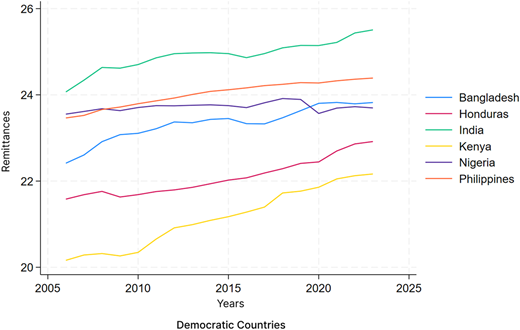
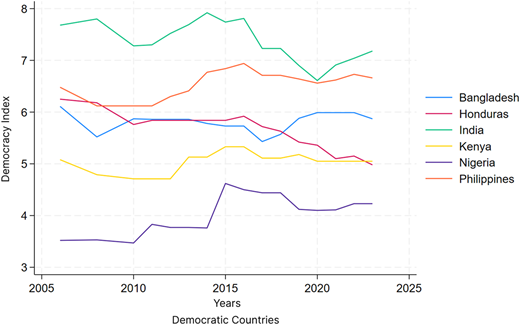
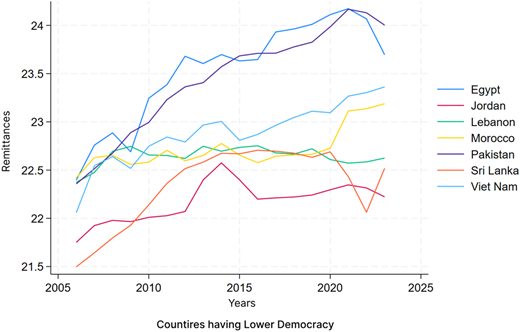
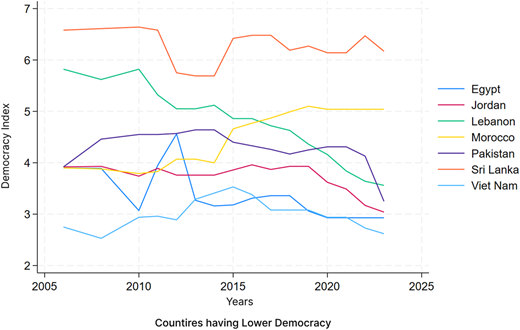
We have taken secondary data from sources exhibited in Table 1. The target for this study is LMICs from 2006 to 2023 for being the highest remittance receiving countries. Following the selection, we selected top remittance receiving countries and divided them into two groups. The first group is having a high democracy index, and the other group is having lower democracy index. The countries are grouped depending on their average democracy index as it lies between 1 and 10 so countries having an average more than 5 are grouped in a higher democracy index group and the countries having an average less than 5 are grouped in the second group. This selection is consistent with the EIU as it classifies countries into four regime types on the basis of their democracy index, full democracies have 8 to 10, flawed democracies 6 to 8, hybrid regimes 4 to 6 and authoritarian regimes have democracy index below 4.00 (Unit, 2024). This variation represents institutional quality and the quality of democracy can be evaluated by the level to which regimes discuss important issues with the public (Unit, 2024), thereby impacting the institutional capacity to absorb remittances. The countries selected in both groups are listed in Table 2. The graphs for total remittances and democracy indexes for both groups can also be seen in Figures 1-4 above. In Figure 1 we can see the overall increase in remittances from 2006 to present and in Figure 2 we can see the overall rise in democracy of the selected countries in Group 1. While Figures 3 and 4 also show the increase in remittances and the declining democracy trend in the selected countries of Group 4.
We have a Gross Domestic Product (GDP) variable is taken as a measure of economic growth which is the sum of final value of all goods and services produced, remittances (REM) which are the personal remittances received by a country on an annual basis, Democracy Index (DEM) which is calculated and published by EIU and are in the ranges from 1 to 10, GMI published by the Bonn International Centre for Conflict Studies (BICC) that calculates the level of government expenditure on the military and weapons. The countries dealing with war, border safety and geopolitical conflicts have higher GMI scores (von Boemcken and Rohleder, 2025). Higher GMI scores may crowd out health and education spending, diverting remittances toward consumption or even sustaining military priorities instead of development and we have Population (POP) included in the study. The POP variable is the total annual population of the country. GDP, Remittances and Population variables have been transformed by Log.
4.2 Estimation method
The main objective of this research is to study the impact of remittances on economic growth considering the institutions' nature and environment. For that we will use the baseline panel regression method like Panel Ordinary Least Square (POLS), Fixed effects (FE) and Random Effects (RE). The selection criteria depend on the Hauman Test between FE and RE. We have two groups on which we will be applying the estimation methods, one having higher democracy index and other having lower democracy index. To ensure robust findings we will be using different sets of equations for validating the results along with using the robust commands in panel regression. To further enhance the robustness of the analysis we will apply Two Stage Least Square (2SLS) and will test for endogeneity, this will be helpful in determining whether there is a need for the two stage least square or the panel regression results are valid. Slope homogeneity and cointegration tests will also be applied in both groups to further confirm the results and ensure robustness of the analysis.
The regression equations can be written as,
5. Results and discussions
5.1 Descriptive statistics
The descriptive statistics are listed in Table 3. The mean GDP for the higher democracy index group is 5.46 and for the lower democracy index group is 5.55, which confirms that both groups lie in the same economic category belonging to the LMICs. Secondly, the mean remittances received by first group are 23.20 and from the second is 22.80, this value also exhibits that both groups have around same level of remittance both belonging to top remittance receiving countries. The third variable, democracy mean value is 5.73 in the first group whereas in the second group it is 4.29. Both groups consist of countries listed in Table 2. Next comes the GMI score, and the first group have mean value of 69.31 and the other one having a mean value of 168.1, we can say that the democratic countries have overall less GMI whereas the weaker democracies have higher GMI values. Last comes the population mean values and both groups show a similar level of values 18.51 for the first group and the second group having 17.38, showing both groups have a positive population growth.
5.2 Slope homogeneity test
A critical step in the analysis involves the application of the slope homogeneity test, as introduced by Bersvendsen and Ditzen (2021), Hashem Pesaran and Yamagata (2008). This test plays an essential role in confirming the presence of variations between cross-sections and it is essential to confirm before proceeding with the analysis. Establishing the presence of differing slopes across countries is crucial for the validity and reliability of the overall analysis, providing a basis for correct interpretations of the empirical results and rigor. It is a measure towards robustness and validating that the model has homogenous slopes and are valid are presented in Table 4.
5.3 Panel regression
Following slope homogeneity tests we applied panel regression. The paramount finding is that remittances have a negative relationship with GDP. In the second model we also took remittances as the dependent variable, and the results are still negative. Another crucial finding in groups consisting of democratic countries is the fact that democracy also has a negative relationship with GDP and remittances. The GMI is found to have no relationship with GDP but gave a negative relationship with remittances. Perhaps in these LMICs, military spending is disconnected from economic production, or remittances are a household-level flow that is immune to government expenditure priorities. The interaction relationship between democracy and remittances is found to be critical as they impact GDP positively. The positive interaction means that in more democratic countries within this group, remittances are more effective. This nuances the negative individual coefficient. This paradox suggests that while remittances and democracy on their own may create inefficiencies, remittances fuelling consumption and democracy slowing decision making, their combination enables accountability. When democratic oversight is applied to remittance flows, governments may be pressured to channel them toward long term investments in health, education or infrastructure, yielding growth. Population has no relationship with GDP and remittances. The results are presented in Table 5.
The second group, consisting of low democratic countries, however, shows distinct results in Table 6. The remittances impact GDP positively and democracy is a crucial factor for these countries as it also shows a positive relationship with GDP. GMI also exhibits negative relationship with GDP, and the interaction of democracy and remittances is negative. In weaker democracies, remittances contribute to growth by directly financing consumption and small business activity. Yet when democratization increases, it may initially destabilize fragile institutional structures, disrupting how remittances are allocated. Thus, the interaction becomes negative, suggesting that partial democratization without institutional maturity can reduce the growth benefits of remittances. Population also impacts GDP negatively.
Democracy and remittances negatively affecting economic growth, these findings align with (Chami et al., 2005; Doucouliagos and Ulubaşoğlu, 2008; McFarlane et al., 2025; Offor et al., 2023; Pradhan et al., 2025; Sutradhar, 2020). Secondly, the interaction relationship between remittances and democracy in the first group shows a positive significant relationship with economic growth. This implies that while democracy and remittances may individually establish limitations under certain conditions, their combination can create synergetic effects when successfully managed. These countries might offer accountability in using remittances and using them towards developmental uses like health, education and infrastructure for long-term growth. This aligns with the studies of Abdih et al. (2012), Catrinescu et al. (2009), Habib (2024).
On the other hand, the results from the second group show an opposite pattern. Both remittances and democracy present a positive correlation with economic growth. It indicates that democratic institutions no matter being limited, the remittances assist in economic progress. We may also infer that if the democracy index is low in this group we might assume that these countries are autocratic, and these institutions work better in terms of allocating remittances to productive investment avenues. If not great, a little effort in bringing democratic measures would be beneficial for these countries and could lead to growth. We can affirm this statement by looking at the interaction relationship between democracy and remittance that came as negative for this group. Remittances can drive growth even in weak democracies but attempts to democratize without institutional readiness may backfire. Policymakers should therefore pursue gradual, capacity building reforms alongside democratization. This could also be a reason for bringing instability to these countries if attempts are made to democratize may lead to disruption and cause decline in economic growth due to not having sufficient institutional capacity. This research findings align with studies on similar groups of countries like Makhlouf (2025), Ojeyinka and Ibukun (2024). Another important result is for GMI. The insignificance of GMI suggests that migrants continue to send money regardless of state spending priorities. However, this may mask deeper inefficiencies, as remittances risk being diverted indirectly toward military led projects instead of development. Dizaji and Farzanegan (2023) show that democracy and militarization are dynamically interconnected in developing countries, suggesting that militarization should not necessarily be interpreted as having a uniform direct growth effect. The insignificant result in the present study may therefore indicate that the influence of militarization is indirect, context-specific or insufficiently captured by a single aggregate index.
5.4 Endogeneity, 2SLS and robustness
To guarantee the robustness and reliability of the regression results, both fixed and RE models were employed, capturing unobserved heterogeneity across panels. However, addressing endogeneity concerns are essential for analysis as FE and RE don't address endogeneity. Therefore, to ensure that no endogeneity is present, and our results of panel regression are valid we applied the Two Stage Least Square (2SLS) method on our model. If there is presence of endogeneity, then we go with the results of the 2SLS method as the results of fixed and random effect can be biased. The results of the analysis can be seen in Table 7 where we have taken both groups and after application of the baseline regression, we applied 2SLS where the lag explanatory variables are taken as instruments. These lagged values are considered relevant because macroeconomic and institutional variables display persistence over time, and their previous values might be correlated with their current values. First, the 2SLS results complement our panel regression results in Table 5 and Table 6 confirming robustness. Second, we tested for endogeneity and could not reject the null hypothesis as the Durbin and Wu Hausman test statistics are greater than 0.05 directing towards no presence of endogeneity and variables being exogenous. Third, the Sargan and Basmann values show the validation of instruments and are not correlated with the error term. The R2 values are also listed and describe the model well. We therefore go with our panel regression results earlier estimated as valid and robust. The absence of endogeneity strengthens our confidence that the results in Group 1 and Group 2 are not spurious but reflect structural inefficiencies in democratic contexts. Additionally, Robust standard errors were applied throughout estimations to address potential heteroskedasticity and serial correlation. Likewise, tests for slope homogeneity confirmed that the slope coefficients are homogeneous across panels. The existence of a long run relationship among the variables was demonstrated through the Kao and Pedroni cointegration tests.
5.5 Kao and Pedroni cointegration tests
To estimate if there is a presence of long run relationship in the panels we applied Kao (1999); Pedroni (1999, 2004) cointegration tests. These tests have been widely used in empirical work recently. The Kao test assumes slope homogeneity whereas Pedroni assumes a little heterogeneity. As our slope came out homogenous in the slope homogeneity test therefore both tests are appropriate. The results show the presence of cointegration in all the panels. The results are listed in Table 8.
6. Conclusion and implications
We aimed to explore the relationship between remittances, democracy and economic growth. GMI was added in the model as a potentially influential variable considering that countries having high GMI are sidelining the public interest and spending on the military therefore it could be closely tied to institutional structure, stability and economic benefit.
The analysis discloses a prominent contrast between the results in key variables of the two groups. Firstly, in democratic countries, both remittances and democracy give a negative correlation with economic growth. This may possibly appear self-contradictory at first, as both remittance and democracy are considered constructive to development, but this reflects institutional rigidities that prevent the effective utilization of remittances and democratic tools for promoting productivity. Democracy alone does not guarantee effective remittance use; institutional inefficiencies can turn remittances into a burden. What matters is the governance capacity to link remittances to investment, not merely the presence of elections. In some democracies, institutional inefficiencies are so entrenched that remittance inflows fail to trigger reform or investment. For example, in democratic settings, greater institutional scrutiny and procedural delays may reduce the speed and flexibility of public investment and policy responsiveness, especially when dealing with informal income sources like remittances.
The findings of this study have several policy implications, especially for the government and international organizations involved in working for LMICs highly dependent on remittances for running their economies. Firstly, the democratic countries should bring institutional reforms like reducing bureaucratic red tape for remittance-funded investments, creating special investment zones or tax incentives for diaspora investments and assess their efficiency, there might be circumstances where their governance is bringing delays and increasing burdens that limit the productive use of remittance. Therefore, working for institutional reforms is more important than financial reforms. Moreover, reforms should be made to strengthen local government to encourage their participation in allocating remittances for education, health and infrastructure. Secondly, the countries having lesser democratic institutions results suggest that stability and effective governance, even if not fully democratic, can channel remittances effectively. Therefore, the focus should first be on building effective and transparent state capacity and rule of law, which may be a precursor to broader democratic reforms. Thirdly, policy makers should be curtailed in allocating high amounts of funds coming from remittances to military spending and simultaneously ignoring the human development expenditures and doing so could yield better long-term outcomes.
6.1 Limitations and future research
Institutional quality is complex and difficult to measure fully through GMI and democracy indices. There might be other cofactors that affect growth with the military expenditure. Moreover, the lack of giving insignificant relationship is not irrelevant but the outcomes might be context based. Future studies could explore the relationship between militarization and variables like political stability, internal security and defence spending and whether it makes any difference in the level of trust in public towards the institutions. Moreover, disaggregating remittances into investment and consumption country wise and preferring a longer time series linking to financial inclusion could also be a good option for future research.