Research on environmental, social and governance (ESG) reporting in family firms has largely relied on aggregate ESG scores, providing limited insight into how family firms prioritize specific sustainability dimensions. This study examines whether publicly listed family firms operating in different institutional contexts exhibit distinct ESG prioritization patterns and whether these differences emerge at the aggregate, pillar or category levels of ESG reporting.
The study analyses 616 firm-year observations from publicly listed family firms in Canada and Mexico between 2018 and 2024. ESG data were obtained from the London Stock Exchange Group database. General linear models, multivariate analyses and repeated-measures models were employed while controlling for firm size, age, economic sector and year.
Family firms in Canada and Mexico exhibit similar overall and pillar-level ESG scores, suggesting convergence in broad reporting practices, though this pattern varies by sector. However, significant differences emerged across ESG categories: Canadian family firms emphasized environmental innovation, community and Corporate Social Responsibility strategy, while Mexican family firms emphasized human rights, product responsibility and shareholder-related practices. Family firms may thus achieve similar levels of ESG reporting while prioritizing different dimensions. A robustness check also showed that family ownership is associated with lower ESG reporting, more strongly in Mexico, and with greater variability in ESG orientation than among non-family firms.
This study provides evidence that ESG engagement among family firms is not homogeneous; family firms vary in the ESG dimensions they emphasize. The findings show that aggregate ESG measures can mask meaningful variation in sustainability priorities and highlight the value of category-level analysis for understanding ESG reporting in family firms across institutional contexts.
Introduction
Environmental, social and governance (ESG) reporting has become an important mechanism for firms to communicate sustainability practices and respond to stakeholder expectations (Rasche et al., 2023). Research has asked whether family firms differ from non-family firms in ESG engagement, since family firms pursue economic and non-economic objectives, including reputation, control and continuity, conceptualized as socioemotional wealth (SEW) (Berrone et al., 2012; Gómez-Mejía et al., 2007), whereas non-family firms respond primarily to external market pressures (Berrone et al., 2010). This research has produced mixed findings regarding whether family firms are more or less ESG-engaged than non-family firms (Herrero et al., 2024; Miroshnychenko et al., 2021; Rivera-Franco et al., 2024) and whether institutional context shapes this relationship (Nimer et al., 2025).
However, most of the research treats ESG as a single construct, comparing firms using aggregate or pillar-level scores that assume ESG engagement is uniform across dimensions (Berg et al., 2022; Larcker et al., 2022), an assumption that may be problematic for family firms, since SEW considerations are not equally relevant across all ESG dimensions and may instead lead family firms to selectively emphasize specific categories rather than uniform engagement. Two family firms could report similar overall ESG scores while pursuing different sustainability priorities. Family business research suggests that firms selectively engage with stakeholder-oriented practices based on SEW and institutional context (Bammens and Hünermund, 2020; Barguilla Sanclaudio et al., 2025; Cennamo et al., 2012), but little is known about how family firms prioritize specific ESG dimensions or whether these priorities vary systematically across institutional contexts (Ali et al., 2017; Mooneeapen et al., 2022; Roy and Mukherjee, 2025). This is important because ESG scores are increasingly used by investors to evaluate firms, and aggregate measures may obscure exactly the differences in emphasis that matter most.
The purpose of this study is to examine whether publicly listed family firms in institutionally distinct contexts exhibit different ESG prioritization patterns and whether these differences emerge at the aggregate, pillar or category level. We study Canada and Mexico because the two countries are economically integrated through North American trade but differ in regulatory tradition and governance strength. Using 616 firm-year observations (2018–2024) from the London Stock Exchange Group (LSEG) database, we find that family firms in Canada and Mexico report similar overall ESG scores, suggesting broad convergence, but diverge significantly at the category level: Canadian family firms emphasize environmental innovation, community and Corporate Social Responsibility (CSR) strategy, while Mexican family firms emphasize human rights, product responsibility and shareholder-related practices. These findings suggest that family firms may not differ primarily in their overall ESG engagement, but in which ESG dimensions they prioritize, a distinction with implications for family business theory, SEW research and how institutional context shapes sustainability behaviour across countries.
Theoretical background
ESG reporting and ESG performance scores
ESG reporting extends sustainability, corporate social responsibility and integrated reporting through standardized metrics and disclosure mechanisms (Isaksson et al., 2025; Rasche et al., 2023), giving investors and stakeholders a fuller view of a firm’s ESG-related opportunities and risks (Cochran and Wood, 1984). Despite the widespread adoption of ESG reporting and the shift towards mandated reporting (O'Dochartaigh, 2022), no single ESG framework has achieved universal adoption, and specific items within the ESG categories vary across reporting standards, from the Global Reporting Initiative (GRI) to stock market-issued guidelines (Larcker et al., 2022). ESG rating agencies integrate reported information into performance scores that are widely used in investment decisions (Cormier et al., 2011; Dkhili, 2024; Manita et al., 2018), aggregating category-level measures into three pillar scores (“E,” “S,” “G”) and one overall score. Although lack of uniform standards and gap between ESG scores and actual firm performance have drawn criticism (Berg et al., 2022; Krueger et al., 2024), ESG scores remain commonly used sustainability indicators (Rajesh and Rajendran, 2020; Waldau, 2025).
ESG reporting and family firms
Family firms are characterized by the influence of family ownership, control and involvement in strategic decision-making (Astrachan and Shanker, 2003), leading strategic choices to reflect not only economic objectives but also family-centred goals such as preserving family reputation, maintaining family control and ensuring continuity across generations (Chrisman et al., 2012; Chua et al., 1999).
Research on family firms’ ESG and CSR activities has produced mixed findings: some studies report stronger sustainability commitment among family firms (Dyer and Whetten, 2006; Herrero et al., 2024; Lamb and Butler, 2018), while others find weaker or inconsistent commitment (Bravo Monge, 2025; Miroshnychenko et al., 2021; Rees and Rodionova, 2015).
Bravo Monge (2025) examined the composition of internal versus external CSR practices among Latin American family firms and found that institutional weaknesses in the region shaped firms’ relative reliance on each type, a distinction closely related to the complement/substitute logic this study applies to Canada and Mexico. Nimer et al. (2025) found that the family ownership–ESG relationship among Gulf Cooperation Council firms diverged from patterns reported in North American and European samples, reinforcing that institutional context shapes how family firms’ ESG engagement is expressed. One explanation for these mixed findings is that ESG is often treated as a single construct. Most studies rely on aggregate ESG scores or broad ESG pillar scores. However, ESG encompasses a diverse set of activities, ranging from environmental innovation and community engagement to shareholder rights and product responsibility. Consequently, aggregate ESG measures may conceal important variation in how family firms approach sustainability.
SEW and ESG prioritization
SEW provides a useful lens for understanding why family firms may emphasize some ESG dimensions more than others. SEW refers to the non-financial benefits family owners derive from their firms, including family identity, reputation, influence, social ties and the intention to pass the business to future generations (Berrone et al., 2012; Gómez-Mejía et al., 2007). A central assumption of the SEW is that family firms evaluate strategic decisions not only in terms of financial outcomes but also in terms of their implications for preserving SEW. Consequently, sustainability initiatives may be attractive when they strengthen family reputation, improve stakeholder relationships or reinforce legitimacy (Bammens et al., 2015; Cennamo et al., 2012). At the same time, ESG initiatives may be viewed less favourably when they threaten family control, require substantial resource commitments or increase external scrutiny (Arena and Michelon, 2018; Cabeza-García et al., 2017). These arguments suggest that family firms prioritize ESG categories that are perceived to generate the greatest socioemotional and strategic benefits and that they do not view all ESG dimensions equally.
Institutional context and ESG prioritization
Beyond SEW, the institutional environment shapes how ESG priorities are interpreted and enacted, since firms operate within systems of regulation, stakeholder expectation and governance norms that define appropriate organizational behaviour (DiMaggio and Powell, 1983; Scott, 1995). ESG reporting varies across countries due to differences in legal systems, regulatory environments, cultural values and stakeholder expectations (Ali et al., 2017; Hoang, 2022; Mooneeapen et al., 2022), and because SEW priorities are expressed through interactions with external stakeholders, the ESG dimensions that contribute most to legitimacy and continuity may differ across institutional contexts.
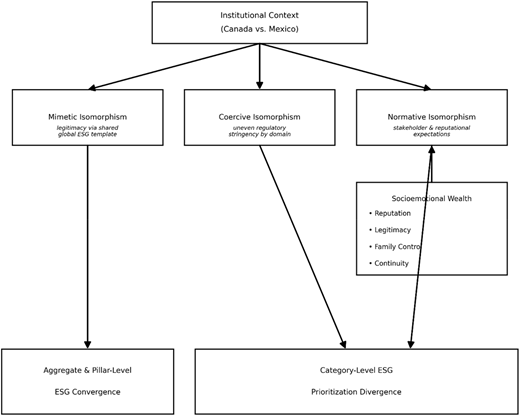
This can be explained by disaggregating institutional theory into its main mechanisms. DiMaggio and Powell (1983) identify three distinct processes through which organizations converge: mimetic isomorphism (imitating peers under uncertainty), coercive isomorphism (conforming to regulatory requirements) and normative isomorphism (aligning with professional and stakeholder expectations). Because these three mechanisms operate through different channels and are unevenly distributed across ESG reporting domains, they offer a plausible account of why family firms might exhibit convergence at some levels of ESG aggregation and divergence at others. Mimetic pressures may drive convergence at the aggregate level. ESG reporting has spread globally as a legitimated practice, reinforced by managers’ adoption of ESG investment criteria and by initiatives such as the UNCTAD-Family Business Network’s promotion of sustainability among family firms (UNCTAD, 2021). Publicly listed family firms are especially exposed to these pressures given scrutiny from investors and rating agencies that reward standardized disclosure (Zuckerman, 1999). Also, since Canadian and Mexican firms shared proximity to the United States, their largest trading partner, this may further intensify pressure to align with US-referenced sustainability norms regardless of domestic regulation, offering a possible explanation for convergence on overall ESG reporting despite differing institutional environments.
Coercive pressures come from formal laws and regulations (DiMaggio and Powell, 1983). Canada and Mexico did not require full ESG disclosure during the study period, but regulation is stricter in some areas than others; for example, environmental and governance rules tend to be better enforced than social ones, and global pressure to adopt ESG practices does not affect every country the same way (Han and Song, 2025). Category-level divergence should therefore track the domains where the two countries’ regulations differ most, rather than appearing evenly across all ten LSEG categories.
Normative pressures arise from professional and stakeholder expectations rather than codified law (DiMaggio and Powell, 1983), and interact directly with SEW concerns, since stakeholder expectations are filtered through firms’ motivation to protect reputation and continuity (Cennamo et al., 2012; Gómez-Mejía et al., 2007). Where formal enforcement is strong, as in Canada, family firms may channel normative pressure towards categories that formalize and publicize their alignment with institutional expectations. Where enforcement is weaker, as in Mexico, firms may instead channel this pressure towards categories that substitute for missing institutional protection, particularly those most closely tied to reputational risk, since reputational damage falls disproportionately on the family name (Cennamo et al., 2012).
The distinction between Canada and Mexico provides an opportunity to examine these dynamics. Although the two countries are economically integrated through North American trade, they differ in regulatory traditions, governance systems and stakeholder expectations. These differences may influence the ESG dimensions that family firms prioritize. Applying Williamson’s (2009) institutions-as-complements-or-substitutes framework to the family firm context, family firms in strong-institution settings may prioritize ESG categories that complement existing formal institutions, while family firms in weaker-institution settings may prioritize categories that substitute for institutional gaps, compensating through firm-level action for protections the formal environment does not reliably provide. Canada scores significantly higher than Mexico on formal institutional strength (9.52 vs. 3.67 out of 10) (Williamson, 2009), and the World Bank’s Worldwide Governance Indicators show the same pattern: Canada scores significantly higher than Mexico in Regulatory Quality (76.35 vs. 51.77), Control of Corruption (80.89 vs. 28.81), Rule of Law (82.11 vs. 37.11) and Voice and Accountability (83.17 vs. 50.93) (World Bank Group, 2025; see Table 1).
These mechanisms suggest that family firms may exhibit similar overall ESG engagement while emphasizing different ESG dimensions across institutional contexts: mimetic pressure favours convergence at the aggregate level, while coercive and normative pressures (the latter operating through SEW) favour divergence at the category level. Figure 1 presents the resulting conceptual model.
Hypothesis development
Building on this reasoning, family firms are expected to prioritize the ESG categories they perceive as most beneficial for preserving SEW (Berrone et al., 2012; Cennamo et al., 2012), with the specific dimensions that matter varying by institutional context (DiMaggio and Powell, 1983; Scott, 1995). At the same time, globalization and the widespread adoption of ESG reporting frameworks may encourage convergence in overall ESG performance such that differences between family firms may be observable only at more disaggregated levels of analysis. We therefore propose:
Family firms in Canada and Mexico will exhibit similar levels of overall ESG engagement but will exhibit distinct ESG prioritization patterns across specific ESG categories.
Methodology
This study used a quantitative research design to examine cross-national differences in ESG performance scores for publicly listed family firms in Canada and Mexico. Data analysis in SPSS 29 included descriptive statistics to summarize key variables and general linear models (GLM) to test the hypotheses while controlling for size, age, economic sector and year.
Data sources and sample
We compiled an unbalanced panel of 88 family firms in Canada and Mexico: 38 Canadian (43.2%) and 50 Mexican (56.8%). The Canadian sample was constructed by intersecting large-cap, family-controlled companies from the National Bank of Canada (NBC) Canadian Family Index with firms holding LSEG ESG scores. The Mexican sample was compiled using a triangulated approach combining the 2024 EY/University of St. Gallen Global Family Business Index, the Expansion Mexico Top 500 ranking, the Bolsa Mexicana de Valores and corporate reports, applying the NBC Index’s 10% voting-rights threshold and using the St. Gallen Index and Expansion ranking to filter for size. Only firms with an LSEG ESG score were retained, restricting the sample to publicly traded companies with continuous data coverage. We also restricted the data to sectors present in both countries: communication services (11%), consumer discretionary (14%), consumer staples (23%), financials (13%), industrials (10%), materials (24%) and real estate (6%).
The Canada–Mexico pairing reflects a deliberate institutional contrast rather than convenience sampling: the two countries are economically integrated through North American trade (Observatory of Economic Complexity, 2024a, b) but differ in institutional strength (Williamson, 2009; World Bank Group, 2025).
The two subsamples were constructed differently because no single index of publicly listed family firms exists for both countries, but three features support comparability: (1) both rely on independently compiled, third-party indices and not on researcher-constructed lists; (2) both apply the same ownership threshold and are restricted to firms with continuous LSEG ESG coverage, which is the main reason the sample is not larger; and (3) both are restricted to the same set of economic sectors, so cross-country comparisons are not confounded by sector composition. The resulting imbalance (38 Canadian, 50 Mexican firms) reflects differences in the number of publicly listed family firms with LSEG coverage in each country rather than a methodological artefact; all models control for sector, and the Country × Sector interaction is reported explicitly to account for any residual imbalance.
The 10% voting-rights threshold follows the NBC Canadian Family Index definition and is consistent with Astrachan and Shanker’s (2003) broad definition of family business, which classifies a firm as family-influenced based on ownership and strategic control rather than requiring majority ownership, and with Chua et al.’s (1999) behavioural definition emphasizing family influence over strategic direction. A relatively low threshold is appropriate because family control can be exercised below majority ownership through mechanisms such as board representation and voting agreements (Villalonga and Amit, 2009).
ESG data for each firm-year observation (2018–2024) were obtained from the LSEG ESG database, yielding 616 firm–year observations. The LSEG aggregates approximately 630 indicators into 10 categories and 3 pillars, using an industry-specific materiality matrix. The scores capture disclosure and consistency rather than operational performance (London Stock Exchange Group, 2024). The LSEG ESG database is a widely recognized source used by researchers, analysts and institutional investors and has also featured prominently in prior research on corporate sustainability (Dal Maso et al., 2020; Pérez-Cornejo et al., 2020; Rivera-Franco et al., 2024; Soni, 2023).
Research variables
Dependent variable
ESG scores were examined at three levels of aggregation: overall ESG scores, three pillar scores (environmental, social, governance) and ten category scores within these pillars (resource use, emissions, environmental innovation; workforce, human rights, community, product responsibility; CSR strategy, management, shareholders). All scores range from 0 to 100, with higher scores indicating higher reporting in that area. Examining multiple levels of aggregation allows us to assess whether differences between family firms in different institutional contexts emerge only when sustainability activities are disaggregated into specific categories.
Factor variable
Country (Canada, Mexico) was used as a categorical fixed factor to capture national institutional context, operationalized at the country level as a proxy rather than a direct measure of specific institutional mechanisms; it captures differences in regulatory environments, governance traditions and stakeholder expectations but does not isolate which specific factors drive ESG reporting behaviour.
Control variables
We included several control variables, since prior research shows that firm size, industry and age affect ESG reporting (Ali et al., 2017). Firm size was proxied using total assets and its natural log (LNAssets), which stabilizes variance, limits leverage from very large firms and improves interpretability; log(assets) was lagged one year to reduce simultaneity, since outcomes in year t can affect end-of-year assets while decisions in t are made at the period’s start. We also proxied size with the natural log of employees (LNEmployees), lagged similarly, to reduce skewness. Age was measured as years since foundation, log-transformed (LNAge) to reduce skewness; this variable was not lagged. Sector was identified using dummy variables for 10 Global Industry Classification Standard *(GICS) sectors. Years were treated as categorical fixed effects to control for period-specific shocks, like COVID-19, so inference on country- and sector-level effects was net of common time effects.
Statistical analysis
Descriptive statistics
We obtained overall descriptive statistics, stratified by Country and Sector, and examined Sector × Country and Year × Country cross-tabulations. Pearson correlations assessed linear associations among continuous variables. Independent-samples t-tests, with Levene’s test for unequal variance, compared Canada and Mexico on overall ESG, the three pillar scores and the ten category scores.
Data analysis
Analyses proceeded from aggregated to disaggregated measures. First, we tested whether overall ESG scores differed between Canada and Mexico using a GLM with Country, Sector and Year as fixed factors, LNAssets, LNEmployees and LNAge as covariates, and a Country × Sector interaction to test whether institutional context varies by sector. Second, pillar-level differences (environmental, social and governance treated as joint dependent variables) were examined using MANOVA. Finally, category-level differences were examined using repeated-measures GLM, with the ten ESG categories as within-firm outcomes; Greenhouse–Geisser corrections were applied when sphericity was violated, and pairwise comparisons used Bonferroni adjustments.
Robustness check
We replicated the H1 model in a pooled sample including non-family firms, adding a FamilyFirm indicator and FamilyFirm × Country interaction, controlling for Sector, Year, LNAssets, LNEmployees and LNAge.
Results
Descriptive findings
The overall ESG score averaged 50.46 (Standard deviation (SD) = 20.48), showing substantial dispersion in ESG reporting across firm-years. Firms were large on average (LNAssets mean = 8.47, SD = 1.52; LNEmployees mean = 9.13, SD = 1.93) and mature (LNAge mean = 3.89, SD = 0.73; see Table 2).
Overall ESG performance
We first compared mean total ESG scores between Canadian and Mexican family firms using an independent-samples t-test. The country means were similar (Mexico: M = 50.73, SD = 22.62; Canada: M = 50.21, SD = 18.26); because Levene’s test indicated unequal variances (F = 13.31, p < 0.001), we report the Welch result: t (420.93) = 0.27, p = 0.790, mean difference (Mexico–Canada) = 0.52, 95% Confidence Interval (CI) [−3.30, 4.33], Cohen’s d = 0.03.
A GLM predicting total ESG from Country, Sector and Year (covariates: LNAssets, LNEmployees, LNAge; type III sums of squares; listwise deletion, N = 451) confirmed no overall country difference, F(1, 434) = 0.006, p = 0.937 (contrast estimate = 0.14, 95% CI [−3.25, 3.53]). Sector was significant, F(6, 434) = 13.41, p < 0.001; year was not, F(6, 434) = 1.78, p = 0.102. ESG increased with firm size (LNAssets) and decreased slightly with age; LNEmployees was not significant (R2 = 0.297). The Country × Sector interaction was significant, F(6, 357) = 4.25, p < 0.001, indicating that country differences vary by sector (see Table 3).
To assess multicollinearity, we examined variance inflation factors (VIF) for LNAssets, LNEmployees and LNAge. All values were well below conventional thresholds of concern (LNAssets: VIF = 1.54, Tolerance = 0.65; LNEmployees: VIF = 1.77, Tolerance = 0.56; LNAge: VIF = 1.31, Tolerance = 0.76), indicating that multicollinearity did not affect the precision of the regression estimates despite the conceptual overlap between the two firm-size proxies.
ESG pillars
ESG pillar scores were analysed using multivariate GLM, which showed a small but significant joint country effect (Wilks’ λ = 0.982, F(3, 426) = 2.66, p = 0.048); follow-up univariate tests showed no country differences in individual pillars: environmental (F = 0.26, p = 0.61), social (F = 2.40, p = 0.12), governance (F = 0.49, p = 0.48). Sector effects were significant across all pillars (p < 0.001); year effects were not. LNAssets was positively associated with all pillar scores (p < 0.001), employees was significant for E and G (p < 0.05) and age was negatively associated with social scores only (p = 0.026). The Country × Sector interaction was significant in both the multivariate test (Wilks’ λ = 0.845, F(18, 1205) = 4.11, p < 0.001) and univariate pillar models: environmental (F = 7.16, p < 0.001), social (F = 3.66, p = 0.001), governance (F = 2.52, p = 0.021), indicating that country differences are sector contingent. These findings, together with the overall ESG results above, support the first part of Hypothesis 1: family firms in Canada and Mexico exhibit similar overall ESG engagement (see Table 4).
ESG categories and prioritization patterns
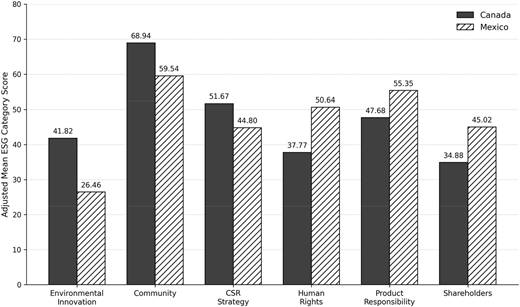
The ten ESG categories were analysed using repeated-measures GLM, which indicated a significant Country × Category interaction (Wilks’ λ = 0.738, F(9, 426) = 16.84, p < 0.001), supporting the second part of Hypothesis 1: ESG reporting differs between Mexican and Canadian family firms at the category level, even though overall ESG reporting does not.
Six of ten categories showed significant country differences: Canada scored higher in environmental innovation, community and CSR strategy; Mexico scored higher in human rights, product responsibility and shareholders. Sector significantly affected category scores, size was positively associated with them and year effects were not significant. These findings suggest family firms in different institutional environments may achieve similar overall ESG reporting while emphasizing different sustainability dimensions, differences that become visible only when ESG reporting is disaggregated to the category level (see Table 5 and Figure 2).
Although the partial η2 values for the six significant categories are modest by conventional benchmarks (0.02–0.06), this reflects the substantial dispersion in category-level ESG scores (SDs frequently exceeding 25–30 points on a 0–100 scale) rather than a lack of practical significance. The absolute magnitude of adjusted mean differences is considerably larger, ranging from approximately 7 points (CSR strategy) to more than 15 points (environmental innovation). Differences of this size represent a meaningful divergence in reporting emphasis, even though country membership explains only a small share of total variance within any single category.
Robustness: family versus non-family firms
To assess whether the observed patterns were specific to family firms, we replicated the analyses in a pooled sample including non-family firms. Within the same country, year and sector, and controlling for firm size, non-family firms generally reported higher overall ESG and pillar scores than family firms.
A GLM (FamilyFirm, Country, Sector, Year as fixed factors; LNAssets, LNEmployees, LNAge as covariates; FamilyFirm × Country interaction; N = 683) tested whether the family-ownership/ESG relationship varies by country. Non-family firms scored significantly higher overall, F(1, 664) = 173.03, p < 0.001, partial η2 = 0.207, qualified by a significant FamilyFirm × Country interaction, F(1, 664) = 55.15, p < 0.001, partial η2 = 0.077. Simple effects confirmed that the gap was significant in both countries but more pronounced in Mexico, F(1, 664) = 121.74, p < 0.001, partial η2 = 0.155, than Canada, F(1, 664) = 18.43, p < 0.001, partial η2 = 0.027. We report raw (unadjusted) means, since the non-family Mexican subsample (n = 35) was sector-concentrated, producing unstable adjusted estimates: Mexico non-family M = 74.06 (SD = 15.42), family M = 50.73 (SD = 22.62); Canada non-family M = 68.37 (SD = 12.08), family M = 50.41 (SD = 18.06). This confirms that family ownership’s relationship to ESG reporting is contingent on national context.
We also tested whether family firms exhibit more homogeneous ESG orientation than non-family firms by comparing variance in the three pillar scores using Levene’s test. Family firms showed significantly greater variance across all three pillars: environmental, F(1, 681) = 45.23, p < 0.001 (family SD = 26.62 vs. non-family SD = 19.08); social, F(1, 681) = 57.33, p < 0.001 (25.02 vs. 17.38); governance, F(1, 681) = 5.16, p = 0.023 (20.53 vs. 18.89), reinforcing that family firms are not a uniform group with respect to sustainability engagement.
Discussion
Family firms in Canada and Mexico exhibit similar overall and pillar-level ESG scores but diverge significantly at the category level, a pattern that would remain hidden if only aggregate ESG scores were considered. Both convergence and divergence are also not uniform across sectors: the Country × Sector interaction was significant at both the aggregate and pillar levels, indicating that convergence and divergence depend partly on the economic sector rather than reflecting a uniform country effect. Both should therefore be read as sample-wide averages that may mask sector-specific variation, and future research disaggregating results by sector would offer a more complete picture of how institutional context interacts with industry pressures. We offer three theoretical contributions to the literature:
ESG prioritization in family firms
First, this study contributes to the family business literature by providing evidence that family firms’ ESG engagement is not homogeneous, at least within the two institutional contexts examined here. Family firms in Canada and Mexico reported comparable overall ESG performance, but emphasized different ESG categories. These findings suggest that, in this context, ESG engagement should be understood not only in terms of magnitude but also in terms of strategic prioritization; whether this pattern extends to other institutional contexts remains an open question for future research.
Implications for SEW theory
Second, we contribute to SEW theory by showing that family firms may pursue SEW preservation through different sustainability dimensions depending on institutional context.
Canadian family firms emphasized environmental innovation, community and CSR strategy, while Mexican family firms emphasized human rights, product responsibility and shareholder-related practices (Barguilla Sanclaudio et al., 2025).
Hypothesis I predicted that family firms in Canada and Mexico would exhibit similar levels of overall ESG engagement but distinct patterns of ESG prioritization across specific categories; it did not specify in advance which categories would diverge or in which direction. The category-level interpretations offered below should therefore be read as exploratory and theory-building rather than confirmatory. Because SEW was not measured directly, these interpretations should further be viewed as plausible mechanisms consistent with the data rather than direct tests of SEW pathways; future research using direct SEW measures and pre-registered category-level hypotheses would provide a stronger test of the explanations offered here. With that caveat, the category-level differences observed between Canadian and Mexican family firms suggest that institutional environments may influence how SEW objectives are expressed through ESG reporting. Canadian family firms placed greater emphasis on environmental innovation, community and CSR strategy, whereas Mexican family firms emphasized human rights, product responsibility and shareholder-related practices. These patterns indicate that family firms may pursue similar goals, such as preserving reputation, legitimacy and continuity through different sustainability dimensions, depending on the context in which they operate.
The stronger emphasis placed by Canadian family firms on environmental innovation, community and CSR strategy is consistent with the SEW perspective. Family firms often pursue initiatives that protect family reputation, strengthen stakeholder relationships and reinforce transgenerational continuity. Recent evidence suggests that environmental innovation can serve as a mechanism by which family firms preserve SEW by responding to stakeholder expectations while safeguarding family identity and legacy (Feuillet et al., 2026). This interpretation helps explain why family firms may devote greater attention to ESG dimensions that are visible to external stakeholders and closely linked to long-term family objectives.
The higher environmental innovation scores among Canadian family firms are consistent with arguments that firms operating in environments characterized by stronger innovation systems and sustainability expectations may be more likely to invest in innovation-related sustainability activities (Hoskisson et al., 2000), and Canada ranks higher than Mexico on the Global Innovation Index, hosting several globally recognized science and technology clusters (World Intellectual Property Organization, 2023). This interpretation should be read with an important caveat: the LSEG environmental innovation category captures the extent and consistency of a firm’s disclosure of innovation-related activities, rather than a direct, independently verified measure of innovation output. A firm’s score can therefore reflect more thorough reporting practices as much as it reflects the underlying scale of environmental innovation itself. The convergence between Canada’s higher scores and its stronger external innovation indicators is therefore consistent with, but does not confirm, a substantive innovation gap between Canadian and Mexican family firms.
Canadian family firms also reported higher scores in community and CSR strategy. The CSR strategy category reflects the extent to which firms formally integrate sustainability into organizational decision-making through mechanisms such as sustainability committees, stakeholder engagement processes, sustainability reporting and adherence to frameworks such as the GRI and the United Nations Global Compact. In institutional environments characterized by different sustainability expectations, visible commitment to community engagement and formal sustainability governance may serve as important mechanisms for protecting family reputation and reinforcing organizational legitimacy (Bendell, 2022).
Mexican family firms, by contrast, reported higher scores in human rights and product responsibility. These categories may be linked to stakeholder protection and reputational risk management. Because SEW is closely tied to family reputation (Cennamo et al., 2012), from an SEW perspective, the higher emphasis on human rights and product responsibility may reflect efforts to protect the family reputation and stakeholder trust.
Mexican firms also scored higher on shareholders, which captures shareholder protection and limits on anti-takeover mechanisms. Family ownership concentration itself has been linked to weak minority shareholder protection. La Porta et al. (1999) show that controlling families are more likely to retain concentrated ownership rather than disperse shares to outside investors in countries (including Mexico) where legal protections for minority shareholders are weak, since losing control under such conditions is especially costly. Although maintaining family control is a central family-firm objective (Gómez-Mejia et al., 2011), tensions with minority shareholders are well documented (Villalonga and Amit, 2009); therefore, greater emphasis on shareholder-related practices may reflect an effort to balance family control with investor confidence, consistent with evidence that shareholder protections matter more where investor protections are weaker (de Holan and Sanz, 2006; La Porta et al., 1999).
ESG measurement
Third, our findings contribute to the ESG literature by demonstrating the limitations of highly aggregated ESG measures. The absence of country differences in overall ESG scores and ESG pillars contrasts with the significant differences observed at the category level. This form of measurement limitation is conceptually distinct from the rater disagreement documented across ESG data providers (Berg et al., 2022), which arises when different agencies apply different methodologies to score the same firm. The masking we identify occurs within a single provider’s data: a single, consistent methodology (LSEG) can still produce similar aggregate ESG scores for firms that prioritize different sustainability dimensions. Aggregation, rather than measurement divergence across providers, is therefore the source of the variation we uncover, and it helps explain inconsistent findings in prior research that relies on aggregate or pillar-level ESG scores.
Robustness: family ownership and ESG reporting
The comparison between family and non-family firms adds an important element to our findings. Non-family firms generally reported higher ESG scores than family firms when compared within the same country, year and sector, consistent with prior evidence that family ownership can be associated with lower ESG engagement due to competing family-centred priorities (Cabeza-García et al., 2017; Rees and Rodionova, 2015). This gap was significant in both countries but more pronounced in Mexico, and the significant Family Firm × Country interaction confirms that the family-ownership/ESG relationship is itself contingent on institutional context, reinforcing that institutional context shapes not only how family firms prioritize ESG dimensions but how family ownership relates to ESG engagement relative to non-family firms.
Additional insights from firm and sector characteristics
Beyond national context, firm-level and sectoral characteristics also shaped ESG reporting. Firm size was a consistent predictor: larger family firms (LNAssets) reported significantly higher ESG scores, consistent with evidence that scale enables resource allocation for sustainability initiatives and increases stakeholder scrutiny (Drempetic et al., 2020). Firm age showed a weaker, sometimes negative association, particularly with social scores, suggesting that older firms may be slower to adopt formal sustainability reporting, a pattern SEW theory may help explain in future work. Sector effects were pronounced, with real estate and materials scoring consistently higher and financials lagging; the Country × Sector interaction discussed previously reinforces that ESG reporting is shaped by the interplay of internal resources and sectoral dynamics as much as institutional context, calling for a layered approach that considers firm size, age and industry pressures together with external institutional demands. Year effects, including potential COVID-19 disruption (2020–2021), were consistently non-significant, suggesting ESG reporting among family firms remained stable despite external disruptions.
Implications
For practitioners of publicly listed family firms in similar institutional contexts, our findings suggest that ESG may be more effectively managed as a multidimensional construct rather than as a single performance score: while the overall ESG score serves as a baseline legitimacy signal, meaningful strategic action occurs at the category levels, where firms may shape risk management and competitive positioning. Managers may benefit from aligning ESG efforts with the dimensions most salient to stakeholders in their environment, though which dimensions matter most is likely to vary by institutional setting.
For Canadian family firms, environmental innovation, community engagement and formal CSR strategy may be important avenues for strengthening legitimacy and long-term competitiveness: where sustainability expectations and formal reporting are well established, visible commitment to innovation, community involvement and sustainability governance may reinforce organizational reputation and continuity.
For Mexican family firms, the findings suggest that human rights, product responsibility and shareholder-related practices may play a particularly important role in protecting stakeholder trust and maintaining legitimacy. Emphasizing these dimensions may help family firms reduce reputational risks, strengthen relationships with investors and customers and support long-term objectives.
These findings also carry implications for policymakers: policy instruments should be disaggregated to be effective, industry-specific guidance may improve comparability given the sector effects observed here and policymakers can support more transparent, credible ESG reporting through governance practices, disclosure standards and reporting frameworks that recognize family firms’ distinctive characteristics.
This is especially relevant given the current regulatory environment. Mandatory disclosure regimes such as the European Union (EU)’s Corporate Sustainability Reporting Directive and the US Securities and Exchange Commission (SEC)’s climate-related disclosure rule reflect the disaggregated, category-based approach our findings support, but both have recently faced substantial rollback: the EU’s 2026 “Omnibus I” Directive cut the Corporate Sustainability Reporting Directive (CSRD)’s scope by an estimated 80%, restricting mandatory reporting to large firms above specific employee and turnover thresholds (European Commission, 2026), while the US SEC proposed fully rescinding its climate disclosure rule in May 2026 on the grounds that it exceeded the Commission’s statutory authority (US Securities and Exchange Commission, 2026), a reasoning commentators suggest could extend to other SEC-mandated ESG disclosures (Gerding et al., 2026). This asymmetry is echoed in our own study countries: Canada’s broader disclosure requirements remain paused and largely voluntary, while Mexico’s regulator introduced new mandatory sustainability reporting for listed issuers in 2025 (Comisión Nacional Bancaria y de Valores, 2025; Government of Canada, 2025). As mandatory disclosure floors narrow or disappear, firms’ voluntary category-level choices become an increasingly important signal of their underlying priorities, reinforcing the value of category-level analysis over aggregate ESG scores alone.
Limitations and future research
This study has several limitations. First, the ESG scores capture ESG disclosure rather than sustainability performance. Although ESG ratings are widely used in both research and practice, differences in provider methodologies and reporting standards may introduce measurement limitations.
Second, the sample is restricted to publicly listed family firms in Canada and Mexico. Publicly listed family firms represent only a subset of the broader family business population and are often subject to greater scrutiny from investors, regulators and other external stakeholders than privately held family firms (Miller et al., 2017; Wagner et al., 2015). Consequently, the findings may not generalize to private family firms, which may face different incentives and constraints regarding ESG reporting. In addition, our use of a 10% voting-rights threshold to identify family firms is relatively permissive compared to definitions requiring majority family ownership or a family Chief Executive Office (CEO); future research should test whether our findings remain when using narrower family-firm definitions.
Third, institutional context is proxied by country rather than through direct measures of institutional characteristics. Therefore, the study cannot determine which specific institutional mechanisms, such as regulatory requirements, governance practices, stakeholder expectations or cultural norms, account for the observed differences in ESG prioritization. Future research should incorporate direct institutional measures and extend the analysis to additional countries to test whether these patterns are specific to Canada and Mexico or reflect broader institutional differences, as well as drawing on complementary frameworks such as varieties of capital (Hall and Soskice, 2001).
Fourth, SEW was not measured directly, so the study cannot determine which SEW dimensions (reputation, continuity, or control) drove the observed prioritization patterns; future research should incorporate direct SEW measures to examine these mechanisms. Future studies could also examine how ESG priorities evolve across generations of family ownership and governance structures, and whether different prioritization strategies carry distinct financial consequences, such as firm valuation or market performance.
Conclusions
This study examined how publicly listed family firms in Canada and Mexico engage in ESG reporting across levels of aggregation, using 616 firm-year observations from the LSEG database. Canadian and Mexican family firms exhibited similar overall and pillar-level ESG scores, suggesting convergence, but diverged significantly at the category level: Canadian firms emphasized environmental innovation, community and CSR strategy, while Mexican firms emphasized human rights, product responsibility and shareholder-related practices, suggesting that family firms may pursue similar legitimacy objectives through different ESG dimensions depending on institutional context.
These findings show that ESG engagement among family firms is not homogeneous; they also extend SEW perspectives by suggesting family firms pursue reputation, legitimacy and continuity through different priorities across institutional environments. This study also highlights the importance of moving beyond aggregate ESG scores: while overall ESG measures provide useful summary indicators, they may conceal meaningful variation in how family firms engage with sustainability-related activities, offering researchers, managers and policymakers a richer basis for evaluating ESG engagement across institutional contexts.
Ethics approval
This study did not involve human participants. Ethics approval was therefore not required.