


The emergence of second generation biofuel industries will be heavily dependent on future prices of ethanol, which could incent landowners to switch land uses from agriculture to growing biofuel feedstocks. In this study, we investigate price levels of ethanol that will be necessary for landowners to grow hybrid poplar. In such an emerging industry, landowners will face a great deal of uncertainty and will consider options to change their production decisions over time. To address this uncertainty, we construct a real options model that considers the dynamic option for Canadian landowners to switch from agriculture to poplar plantations, and also the option to sell poplar plantations for ethanol or pulpwood. The uncertainty in prices for poplar is characterized by time series models of prices for ethanol and pulpwood that characterize price variability as a GARCH process, and reversion to the long term mean average prices. Uncertainty for the value of land allocated to agriculture is characterised by a geometric random walk. Given these price processes, the real options models suggest that current average price levels would have to increase by approximately (i.e. by ) if only ethanol is considered as an end product, but this increase may be reduced to (i.e., to ) if the landowner has options to sell the poplar to either ethanol or pulpwood producers. On low value agriculture lands, estimates suggest that an increase relative to current ethanol prices (i.e., of ) would be needed, which is approximately equal to the current second generation subsidies in Alberta.
Introduction
Canada is one of many countries that have developed policies designed to promote biofuels industries. Campbell et al. (2016) provide an overview of the policy situation in Canada. Canada is still a relatively small player, but the ethanol industry has grown rapidly. Though ethanol production reached a national target of 2.2 billion liters in 2015, the ethanol industry is now approaching a crossroads. Funding by provincial and federal governments has played a key role in increasing domestic ethanol production, through policies such as production subsidies and requirements for biofuels in gasoline. But funding programmes are expiring as governments increasingly look towards the potential of second generation ethanol. Alberta, the focus of this study, is also in the midst of considering policy changes towards cellulosic ethanol and has large areas of agricultural land where dedicated energy crops could potentially be established. Along these lines, this region has also been identified as a preferred location for large bioenergy plants, based on relatively productive land for hybrid poplar and low agriculture land value (Yemshanov and McKenney, 2008; Kumar et al., 2003).
The emergence of a second generation biofuel industry will be heavily dependent on whether feedstock can be produced in a manner that is economically competitive with other land uses. The decision to produce biofuel feedstocks will, in turn, be dependent on the prices of outputs for which the feedstock is harvested and whether those prices are competitive with fossil fuel prices. Higher biofuel prices or lower production costs will increase the financial feasibility of supplying feedstock. Therefore future prices and costs are paramount considerations for investments in this emerging industry. But these future market conditions are fraught with uncertainty. For example, in October 2016 the Liberal Government of Canada announced that a nation-wide carbon tax would be introduced in 2018 at per tonne, increasing to per tonne by 2022. This announcement is potentially good news for prospective producers of biofuels. Though both fossil fuels and biofuels emit carbon dioxide, biofuel feedstock grown from crops also sequesters carbon. Therefore, in an economy with a monetary penalty for carbon, biofuels could gain a competitive advantage, relative to fossil fuels. On an economy-wide basis, such a change has the potential to induce an overall increase in demand for biofuels and associated feedstocks, and thus increase the price of the biofuels such as ethanol. Assuming there were sufficient increases in prices of biofuels, landowners would profitably change land use away from current agricultural land uses towards biomass feedstocks. But how much would ethanol prices have to change from current prices, within the context of competitiveness with fossil fuel prices, before landowners would find it efficient and profitable to switch towards hybrid poplar plantations as a biomass feedstock?
Several studies have considered the potential of using marginal agricultural land in Canada for hybrid poplar plantations. Yemshanov and McKenney (2008) examine the economics of using fast growing hybrid poplar on agriculture lands in Canada for producing bioenergy. Allen et al. (2013) perform an economic analysis of coppice systems in Ontario, while Miville et al. (2013) evaluate the profitability of hybrid poplar in Quebec. Shoostarian (2015) uses standard NPV analysis to evaluate and estimate breakeven prices for ethanol for both short rotation coppice and longer rotation single stem systems for the Peace River region of Alberta and British Columbia. Similar analysis has been conducted in other areas such as the northern great lakes region of the U.S. (Kells et al., 2014). The updated "billion tons" study (U.S. Department of Energy, 2011) has examined feedstock supply and included price responsiveness on an economy wide basis for the United States. All of these analyses ignore the important consideration that landowners operate in an environment with uncertain and volatile prices for both agriculture land use and ethanol.
In response to future uncertainty, landowners are likely to want to remain flexible and consider all options available to adapt to changing price conditions. For this reason, our analysis is done in a real options framework (Copeland and Antikarov, 2001), which allows landowners to dynamically switch between land uses depending on volatile price conditions. This approach improves on net present value methods for evaluating land use change, which research has shown may not accurately describe actual land use behavior (Schatzki, 2003; Musshoff, 2012). Real options theory may explain some of the discrepancies between actual behaviour and that predicted by simple financial analysis because the real options approach recognizes that land use choices can be delayed in order to receive more information and update expectations regarding future returns (Schatzki, 2003). Accordingly, real options have been used by a number of studies to examine land use change and valuation (e.g., Thorsen, 1999; Schatzki, 2003; Isik and Yang, 2004; Musshoff, 2012; Yemshanov et al., 2015). Real options approaches have also been applied extensively in other areas associated with energy, including hydrogen storage (Kroniger and Madlener, 2014); carbon capture and storage and clean development mechanism projects (Zhang et al., 2014; Zhu and Fan, 2011; Park et al., 2014); research and development planning (Wang et al., 2015); fuel price and technological uncertainty (Fuss and Szolgayova, 2010); combined heat and power thermal storage (Kitapbayev et al., 2015); subsidizing photovoltaic projects (Jeon et al. 2015); valuing wind power distributed generation (Diaz et al., 2015); and ethanol and electricity plant investments (Schmit et al., 2009; Madlener and Stoverink, 2012).
Real options have also been used to investigate landowner decisions about when to convert agriculture land to biomass plantations (Song et al., 2011; Di Corato et al., 2013; Hauer et al., 2017). Similarly, Wear et al. (2015) used a real options approach to examine the potential of land use switching between forest plantation species, pine, and eucalyptus. Such an approach can be especially valuable in that it can simulate economic conditions that do not currently exist but may exist in the future. With the emerging ethanol industry, observational data is largely absent, so the objective is to assess alternative potential scenarios of a developing industry. Though the three studies cited above have developed such simulation models, they do not consider whether the grown feedstock may be used for more than one product. Multiple product options may be considered in a couple of different ways. First, landowners may have the flexibility to sell to multiple industries such as the pulp and paper industry or to an emerging biofuels industry. It is also possible to account for co-production opportunities. For example, Sannigrahi et al. (2010) and Porzio et al. (2012) examine the potential within a biofuels industry to use other components such as lignin to create co-products, which may add value to the process of cellulosic ethanol production. In developing our real options model, we focus our analysis on the first way by accounting for landowners' flexibility to sell feedstocks to an alternative industry. In this paper, we model a landowner decision where land may be used to produce agriculture or poplar plantations, and where poplar plantations may be used for either ethanol or pulp, depending on price. An alternate output for the biofuel feedstock increases the decision making flexibility of landowners and increases the chance that their product will yield a high return. With two options for poplar trees, the landowner can now choose to sell their wood to either ethanol or pulpwood producers, depending on who offers the most favourable price. The real options framework ensures that the expected value of land with two output options, as compared to one, can only increase. This increased flexibility in decision making may improve the ability of poplar plantations to compete with agriculture land uses.
Study context
With short harvest rotations and the possibility for improved genetics, poplar trees are considered to be a potential candidate for industrial forest plantations. But, current regulations generally prohibit these improved poplar plantations from being grown on public land in Canada (Johnston et al., 2006). Therefore, under current regulations the establishment of hybrid poplar plantations would likely be on private land, thereby putting poplars in competition with existing agriculture land uses.
Many parts of Canada have high value agricultural land where dedicated energy crops would not be able to compete financially. There are northern parts of the Prairie provinces that have been identified as places where bio-refineries may be able to obtain financially viable energy crops. (Kumar et al., 2003; Yemshanov and McKenney, 2008). However, even in these northern areas, poplar plantations are likely to be competitive only on the most marginal agriculture lands. While agriculture land value will be low if there is low agriculture crop or range productivity, land values can be low for other reasons such as distance from markets or difficult accessibility. Therefore, our study investigates sites within our dataset that have low agricultural land values but high poplar productivity. Our study estimates what level of prices for ethanol is necessary to make it economically feasible to convert the sites that are the most advantageous sites for hybrid poplar (i.e., a combination of low agriculture land value and high poplar productivity). Hauer et al. (2017) provide maps that identify the most likely locations of the sites that fit these criteria. The conversion of less advantageous sites with either higher agriculture land values or lower poplar productivity would require even higher prices than shown in our results. While our study uses agriculture land values based on Alberta data, the results are broadly applicable to the other prairie provinces and some parts of British Columbia.
There have been some studies on financial returns to poplar plantations on private lands in the prairie provinces. Anderson and Luckert (2007) undertook a financial analysis of poplar stands for producing pulpwood and found that financial returns are generally less than returns to agriculture given the conditions at the time. But poplars are also being considered as potential biomass for the next generation of ethanol production (Genome British Columbia, 2014; Ristea, 2014). Shooshtarian (2015) investigates financial returns to poplar plantations for growing feedstock for producing ethanol. Financial returns to two types of management systems are compared; one based on growth trials in Alberta with high intensity, short rotation (i.e., 3 years) coppice approaches; and one based on a single stem, longer rotation systems (based on optimum economic rotations of 20 to 26 years). The analysis indicates that returns are much higher for the single stem longer rotation system; the breakeven selling price for feedstock from the coppice system is approximately , while the value for single stem rotations is approximately -1. Though this later value is generally consistent with other studies by Yemshanov and McKenney (2008); Allen et al. (2013) and James et al. (2010), the amount is considerably higher than reported selling prices of approximately Mg-1 for biomass from residues, and slightly lower than an estimated -1 that bio-refineries could potentially pay (Shoostarian 2015). Because the single stem management system has a better chance of competing with agricultural production, we assume this management approach in our land use change model. Below, we explain further how the costs and returns to poplar plantations on various types of land are integrated into the land use change model.
Methods
There are a number of components needed to describe methods associated with the land use change model, including the modelling framework, stochastic price processes, costs and model parameters, a description of how the model is solved, and definitions of results indicators. Below we describe each of these components in turn.
The modelling framework
The land use change model builds on the approach of Hauer et al. (2017) by adding an alternative product option (i.e., pulp) for the final hybrid poplar harvest. In evaluating the land use change decision, we assume that initially, the landowner has their land parcel allocated to agriculture production. The landowner is assumed to be evaluating the decision of whether to keep the parcel in agriculture production or convert it to poplar plantations. The value of the parcel in agriculture, when no alternative land use options are considered, is assumed to be stochastic and is:
where is the value of the agriculture parcel in period is a dividend rate; is the expected income from the parcel in year is the expected future value of the parcel in year ( E denotes expectation), and i is a risk adjusted discount rate. The value of agriculture land is modelled as the maximum a buyer would pay for the land given that returns are volatile (i.e. risky). The interest rate of is the value that, when used to discount the volatile returns from the land value model over the simulation period, yields an expected value of returns equal to the initial land value. This interest rate is higher than long term risk free rates of and can be interpreted as a risk adjusted rate.
Poplar plantations are an option to the landowner that results in yield , depending on the harvest age s and the output n selected. The landowner receives a net benefit of , for harvesting the plantation at time t when the stand age is s. When the plantation may be sold for pulpwood or ethanol, and depend upon the output n chosen. If ethanol is the selected output, then the landowner receives a net benefit per of . The poplar yield associated with ethanol is . If instead, pulpwood is produced, the landowner receives a net benefit per and yield, . The difference in the yields arises because of the assumption that ethanol uses the gross total tree volume whereas pulpwood uses the gross merchantable volume. For example, at the minimum harvest age of 19 years, the gross total volume is / ha for ethanol, and the gross merchantable volume is ha for pulpwood. Both and are stochastic variables because they are functions of stochastic prices for ethanol ( ) and pulpwood ( ). The price processes are described later in this section.
The cost of establishing the poplar plantation is C. Each year following the establishment of the plantation on the parcel, the landowner must decide whether to harvest the plantation in year t or defer the harvest decision until year . After establishing a poplar plantation, the landowner's harvest decision is based on maximizing the net benefit of the parcel, , conditional on current commodity prices and the underlying value of land in agriculture ( ). The variable is also conditional on the land parcel being allocated to forest and is defined by:
where
Eq. (3) illustrates the choice of the landowner to maximize the current net revenue of the stand between the pulpwood and ethanol outputs. The choice in Eq. (3) is then incorporated into Eq. (2). If ethanol is considered to be the only output from plantations, is zero and, as a result, ethanol becomes the only choice in Eq. (3). Eq. (2) presents the maximization problem where the landowner chooses to either i) harvest in the current period, which gains a current net revenue from the plantation of , in addition to ; or ii) defer the harvest one year, which yields the expected net benefit discounted by one year; or iii) defer the harvest, perhaps indefinitely, if both of the previous values are less than zero. The value of the one year older plantation, , is taken as an expected value because its value is uncertain in period t, due to stochastic prices. The definition of is identical to that of with the exception of the time subscripts. It is defined in Eq. (5) for clarity, and to illustrate the recursive nature of the problem. The variable accounts for the value expected from the current plantation, plus all future options to either stay in plantations or revert back to agriculture. The variable, , (Eq. (4)) is a special case of , and gives the value of the land parcel immediately after harvest. It is derived from choosing the option that gives the maximum of: the expected value of future plantation harvests or the expected value of converting the parcel back to agriculture. The term is the expected value of the plantation at the minimum rotation, m, which is then discounted m years to period t. This expected value is taken at the minimum rotation age because harvesting costs before that are prohibitive, however, it incorporates the best choice of harvest timing after age m using the optimal rule shown in Eq. (2). The value of the parcel when in agriculture land use is , while is the conversion cost of switching from poplar to agriculture. If the values of re-establishing a planation or converting back to agriculture are negative then the third option in Eq. (4) is to choose neither, let the land lie fallow, and receive a value of zero.
The land parcel value when allocated to agriculture, , is defined as:
The first term is the income ( ) gained immediately in the year the land is in agriculture and the expected value, in the next year, that results from the selecting either agriculture or poplar plantations as the optimal land use. The second component of Eq. (6) is the current period expected value of converting land from agriculture to plantations. This new variable for agriculture land value, , is distinguished from the originally defined agriculture land value, , because it includes the option to convert to plantations immediately or in the future.
In Eqs. (1)–(6), the net benefit, , is made up of components which differ according to the output, either pulpwood or ethanol. For ethanol, the net benefit ( ) is:
where is the per litre price of ethanol, is the per unit processing cost of ethanol at the plant, d is a per litre ethanol permanent price increase, and is the plantation harvest costs at age s for ethanol, which includes all transportation costs associated with getting the ethanol biomass to a processing center. Because the harvest cost and poplar yield units are per , and the ethanol units are per litre, a conversion factor, θ, is used to convert from litres to .
The net benefit ( ) for pulpwood is:
where is the price of pulpwood and is the cost of harvesting the planation at age s and transporting pulpwood to market.
Indicators of results: option values and land use probability
To assess land use change and the influence of the additional pulp output option, two indicators of results are calculated. First, option values are presented to quantify the value of having the flexibility to choose either a land use or a plantation output. These values are calculated as the difference between the value of agricultural land in time t, with and without the option to change to plantations:
The option value represents the value added to agriculture land that arises from the possibility of converting to a poplar plantation in the future. We calculate two versions of the option value (Eq. (9)): i) an option value where is based on poplar plantations harvested solely for ethanol production, and ii) another where is based on plantations that may be harvested for either pulpwood or ethanol.
If , the option value is positive and the landowner gains by having the flexibility of an additional land use or plantation output. If , the option values are zero because plantations are unable to compete and are inefficient compared with agriculture land under any of the possible future price conditions. Note that the expected agriculture land value with plantation options ( ) can never be less than the expected agriculture land value without plantation options ( ). This result is assured by the structure of Eqs. (2)–(6) which, together, dynamically choose the most profitable action as a function of prices. The equations incorporate managerial flexibility that includes the options to choose the best land use, but also to defer harvest if harvesting is not immediately profitable, or to let land lie fallow for a period if neither plantations nor conversion to agriculture yield positive returns (see Eq. (4)). This dynamic aspect is not represented in conventional NPV calculations.
We estimate for, both, the case where ethanol is the only output and where a pulpwood option is also available. Taking the difference between these two values allows us to assess the marginal impact of the added plantation option (pulpwood). If the difference is positive, then the increased flexibility of having two poplar outputs adds value to the land and increases the probability that land would be converted to poplar plantations. If the difference is zero, it can be concluded that the additional poplar output has no added value to the landowner and it would not be efficient to plant poplar. As in the previous case, with both output options cannot be less than with ethanol only.
Stochastic price processes
The prices of ethanol and hardwood pulpwood are each modelled using a generalized autoregressive conditional heteroskedasticity (GARCH) specification:
where
In the mean Eq. (10), λn is a constant and acts as a long term average real price. is the error term, which is defined in Eq. (11) as being normally distributed with a mean of 0 and a conditional variance of , given the information set . The conditional variance equation (12) allows the price volatility of to be dependent upon a constant, , lagged error terms, , and lagged volatilities, . The constants, and , are the coefficients on the lagged error and volatility terms, respectively, where k and l denote the total number of lagged error and volatility terms included, respectively. Again, n denotes the poplar output, which may be used for ethanol, e, or pulpwood, p.
The specifications used to model prices are based on Work et al. (2016). That study found evidence of mean reversion and GARCH effects in both monthly ethanol prices and a monthly hardwood pulpwood price index. Those results informed the monthly simulation models for pulpwood and ethanol. The models were estimated to be a GARCH process and used to simulate 50,000 price paths of monthly observations for 100 years. In order to obtain yearly prices, as required by the land use change model, the January observation was used as the value for each year. This approach allowed us to preserve the variability and time-varying volatility behaviour found in Work et al. (2016) in the simulated annual prices.
The structure of the GARCH specifications (Eqs. (10)–(12)) is such that large past volatilities, , or large past errors, , may lead to large current volatilities, , and by extension extreme price, , values. The large volatilities may compound as t increases, thereby leading to a series of extreme values that are assumed to be unrealistic over the simulation period. As a result, we impose maximum and minimum values on the simulated volatility, , and price, , that are based on historical observations from the price data. A Statistics Canada (2013) pulpwood price index is used to estimate the simulation model. Because the data series for pulpwood is a price index, the index must be converted to dollars per using a ratio of the mean index value (i.e. 119) and an assumed mean dollar value of 43 dollars per (Wood Business, 2013). The data used to estimate the ethanol price simulation model is from the United States Department of Agriculture Economic Research Service's (2013) bioenergy statistics for the years 1985 to 2013.
For agriculture land values, we adopt the model outlined in Hauer et al. (2017). The authors tested the data with two alternative hypotheses regarding the stationarity of agriculture land values based on a data set for Alberta from 1921 to 2013 (Statistics Canada, 2016). First, Augmented Dickey-Fuller tests and test of Phillips and Peron (1988) both failed to reject the null hypothesis of a unit root in the agriculture land value data. Second, the KPSS test (Kwiatkowski et al., 1992) was used to test the null hypotheses of level or trend stationarity against the alternative, the presence of a unit root. The null hypothesis was rejected in favor of a unit root. Therefore, the agriculture land data is best characterized by a random walk. The equation for modelling the agriculture land prices as geometric Brownian motion is expressed by:
The model parameters used in the price simulations (for Equations 10–13) are shown in Table 1.
Values of parameters for the land use change model
Values of costs and model parameters are summarized in Table 2 and described below. The dividend rate, δ, is set at 0.03 and is needed to calculate the expected value of agriculture land in year (Eq. (1)). The dividend rate is derived by dividing annual rents, to $169/ha-year in 2012 (Alberta Agriculture and Rural Development, 2014), by the average agriculture land value in Alberta. The combination of drift rate and volatility shown in Table 1 yields an average annual growth rate of simulated agriculture land values of 0.023. This rate can also be derived by noting from equation 12 that , the expected growth rate, is lognormally distributed and therefore . Inserting the parameters into this equation yields the 0.023 expected growth rate for agricultural land values.
Ethanol, hardwood pulpwood, and agriculture land price simulation parameters.
| Price Model | Parameter Description | Parameter Values | |
|---|---|---|---|
| Ethanol | Mean constant | 0.60336 | |
| Ethanol | Volatility constant | 0.00127 | |
| Ethanol | Lagged error | 0.86745 | |
| Ethanol | Lagged volatility | 0.09775 | |
| Pulpwood | Mean constant | 119.0387 | |
| Pulpwood | Volatility constant | 4.54703 | |
| Pulpwood | Lagged error | 0.92613 | |
| Pulpwood | Lagged volatility | 0.13407 | |
| γ | Agriculture land value | drift rate | 0.01893 |
| Agriculture land value | Volatility | 0.08469 |
Values of Model Parameters for Base Run.
| Parameter | Value |
|---|---|
| Agriculture dividend rate ( δ )1 | 0.03 |
| Risk adjusted discount rate (i)1 | 0.053 |
| Minimum rotation age )2 | 19 years |
| Maximum rotation age2 | 35 years |
| Maximum mean annual increment (pulp) ( ) | at 24 years |
| Maximum mean annual increment (ethanol) ( ) | at 24 years |
| Ethanol conversion factor )3 | |
| Processing cost for ethanol 3 | 0.54 $/L |
| Conversion cost: plantation to agriculture (Cfa)4 | 354 $/ha |
| Cost to establish a plantation 5 | 2755 $/ha |
| Transport cost for 50 km hauling distance. | |
| Harvest Costs at maximum mean annual increment (age | |
| 24 years) ( , and ) | |
| Mean of pulpwood prices ( ) | |
| Mean of ethanol prices ( ) | 0.60 $/L |
| Agriculture land value ( ) at | 2000 $/ha |
| Ethanol Price Increase (d) | 0.11 $/L |
Derived from agriculture land value data, CANSIM series v381841.
Based on model simulations.
Based on Phillips et al. (2007); Kazi et al. (2010a,b), National Research Council (2009). The assumed technology is Dilute Acid Prehydrolysis with Saccharification and Cofermentation.
D.A. Westworth and Associates (1994), adjusted for inflation.
Tim Keddy, Canadian Wood Fibre Center, (personal communication 2013).
Adding the dividend rate and the growth rate of agriculture land prices yields the risk adjusted discount rate of 0.053. This discount rate ensures that the expected value of discounted rents from a large sample of simulated land prices is approximately equal to the starting land value, . This discount rate also ensures that when the value of plantation options is zero the simulated land price at time 0 is equal to the original agriculture land value, , or . Minimum and maximum plantation rotation ages of 19 and 35 years are imposed on the model to simplify computational complexity by precluding the search for solutions in areas of low or negative financial returns. Eqs. (4) and (6) reflect the minimum rotation age, m. At the maximum rotation, Eq. (2) does not change but the harvest deferment option is set to a value of zero. In Eq. (7), the processing cost for ethanol, , is assumed to be based on Kazi et al. (2010a), and a conversion factor, is used to convert the price and processing costs of ethanol from dollars per litre to dollars per . The conversion factor θ was based on wood density values reported in Huda et al. (2014) and the midpoint of a range of ethanol conversion ratios found in Phillips et al. (2007); Kazi et al. (2010a, 2010b); Sanchez and Gomez (2014); Huang et al. (2009); Ristea (2014) and National Research Council (2009). With respect to land conversions, we assume that poplar may be planted on agriculture land without conversion cost, but that converting land previously used to grow poplar plantations to land that is ready for agriculture use has a cost of 354 $/ha (D.A. Westworth and Associates, 1994).
The harvest costs for ethanol, , and pulpwood, , vary according to the volume of the harvest, , which is based on a model by Joss et al. (2008). Harvest costs include the costs of cutting and moving the poplar to the roadside, chipping and loading for transportation, and transporting to the pulpmill or ethanol processing plant. The harvest costs for poplar, other than transport, are based on Kuhnke et al. (2002) and harvest costs vary with the volume and age of the stand. At 24 years of age, where the mean annual increment is at a maximum, harvests costs are for pulpwood and for whole tree chips. Transport costs are based on parameters adopted from MacDonald (2006). As there are currently not processing facilities in Alberta, our harvest costs are not based on a specific location. Rather, we assume a transport distance of 50 km, which falls within a range of distances proposed as limits in previous studies (Thomas et al., 2013; Gonzales and Searcy, 2017; Zhang et al., 2017). The combined harvest and transport costs for wood are then approximately if the trees are harvested at 24 years of age. On an oven dry tonne basis this is about ODT. This is a much lower cost than found in studies such as Ristea (2014), likely due to the much shorter rotations of 8 years or less used in that study.
The prices of pulpwood and ethanol vary over time but revert to mean values of and , respectively. For our baseline scenario, we assume a permanent ethanol price increase of . The price increase approximates the current situation in Alberta, where there is a subsidy for second generation ethanol of for the first 150 million litres per year and after that [http://www.energy. alberta.ca/BioEnergy/1826.asp].
As stated in the introduction, we use site parameters that are advantageous for hybrid poplar based on the assumption that these sites could be sought out for such purposes. We start with an agricultural land value (i.e., at ) of ha which is roughly the percentile of land values in a spatial data set of Alberta agriculture land values used in Yemshanov et al. (2015). From there we conduct a sensitivity analysis on agriculture that considers values less than the 25th percentile. Yields may vary according to site suitability, and in this study, we assume a highly suitable site with high yields for poplars in the percentile for mean annual increment in the Yemshanov et al. (2015) dataset. The maximum mean annual increments for land values in year 65 for plantations, which may have a maximum rotation period of 35 years. This approach minimizes distortions to landowner decisions as the end of the planning horizon approaches. Using the approach of Longstaff and Schwartz, (2001), the expected land value functions for plantations in period are estimated by regressing 50,000 simulated land values on current simulated prices in period t. In other words,
where is formed from polynomials of the three current prices at time t, and where the intercept and slope coefficients are estimated using ordinary least squares. The dependent variables in the regressions are formed from calculating based on the 50,000 future simulated prices paths. Because the algorithm works backwards in time, these NPVs also incorporate future optimal decisions derived from expected value functions estimated later in the time horizon, and earlier in the solution process. The future optimal decisions are based on the estimated expected value functions and the decision rules shown in Eqs. (2)–(6). The algorithm for the model is described in detail in Appendix 1.
Results
The analysis begins with the baseline parameters that were presented in Table 2. With these assumptions, conventional deterministic NPV calculations using a Faustmann optimal rotation of 25 years yields NPVs of ha and ha for ethanol and pulp respectively. The option values (as estimated using Eqs. (2)–(8), the price models outlined in section 3.3, and the solution procedure outlined in section 3.4) are also zero for every year of the 65 year simulation period. Therefore, even when landowners have the flexibility to exercise options to plant poplar plantations at times of maximum advantage, as for example when agriculture prices are low, plantations cannot compete with private agriculture land uses, even on sites highly advantageous to hybrid poplar. But because conditions may change in the future, we conduct sensitivity analysis on the price increase parameter d to assess what minimum price conditions are necessary for profitable land use change to poplar plantations beginning on the best possible sites. We also explore results for land values less than $2000/ha.
Sensitivity analysis: ethanol price increases
Given that results indicate no land use change with an average price increase of , we investigate increased amounts of 0.19,0.21, 0.23, and . The parameter d, interpreted above as a permanent increase in average price induced by carbon taxes, may also be interpreted in other ways. In terms of the profitability of ethanol production investments, price increases and cost decreases are interchangeable. Therefore, another interpretation of d is as a decrease in the cost per liter of processing cellulosic ethanol. The addition of to the price is equivalent to decreasing the processing cost by the same amount. If there is a technological advancement that makes the processing of cellulosic ethanol less expensive, then it could be helpful for policy makers to understand the corresponding effect on land use change. Yet another interpretation of d is that it represents a permanent direct government production subsidy.
The option values for the ethanol only and the ethanol plus pulpwood models are shown in Fig. 1, for each level of d and for each period of the model time horizon. Table 3 contains the option values for the first year. Option values for and are zero and close to zero, respectively, throughout the simulation, so are not depicted in Fig. 1. Increasing the average price levels, d, results in larger option values, particularly in the early years of the simulation before agricultural land values rise substantially. When average price increases are small, the option values in the later years eventually reach zero. In comparison, deterministic NPV calculations for ethanol using the conventional Faustmann formula give an NPV less than zero at -$540/ha.
Option values and additional option value added by the pulpwood output ($/ha) at for differing levels of ethanol price increases with a land value of $2000/ha.
| Price Increase (d) | Ethanol Only Model | Ethanol + Pulpwood Model | Additional Option Value |
|---|---|---|---|
| $/L | $/ha | ||
| 0.11 | 0 | 0 | 0 |
| 0.19 | 0 | 9 | 9 |
| 0.21 | 12 | 44 | 32 |
| 0.23 | 133 | 241 | 108 |
| 0.25 | 484 | 552 | 68 |
Adding the flexibility of a second output, pulpwood, increases option values when average ethanol prices are increased (d) over the range from 0.21 to 0.25. At first, the additional option value gained from having two possible outputs increases with higher price increases as shown in Table 3. But the largest option value gain of ha occurs when d is , rather than when d is . The reduced option value gain of ha when d is occurs because the value of the ethanol option begins to dominate the pulpwood option at this higher price increase. The positive option values are obtained because the real options model is flexible and optimally switches back and forth between ethanol and pulp depending on the price conditions. No analogous result can be obtained from the deterministic NPV calculations because they cannot represent this flexible response to prices changes.
Since the options model responds differently to different prices, each of the 50,000 price paths modelled has its own solution. These solutions can form the basis for a frequency or probability analysis. Based on an examination of the frequencies that land use is allocated to plantations in each period over the 50,000 price paths, the probabilities of plantation land use for the different price increases are shown in Fig. 2. Again, following the option value results, the probabilities of plantation use for a price increase of are zero throughout the simulation and are not depicted in Fig. 2. The probability of establishing a forest plantation increases as the ethanol price increases. For the 0.19 and price increases, the probability of plantation land use starts at zero and then increases until approximately year 25.At higher levels of and , the probability of plantation land use is 1 at , representing an immediate allocation of land to poplar plantations. All probabilities start to decline at approximately 20 to 25 years, as land reverts to agriculture after the first harvest of trees because of increasing agricultural land values.
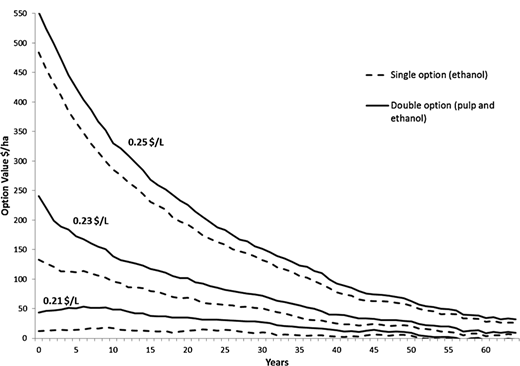
Option values ( ) for ethanol only and ethanol plus pulpwood options at varying ethanol price increases ( ) for a land value of .
Option values ( ) for ethanol only and ethanol plus pulpwood options at varying ethanol price increases ( ) for a land value of .
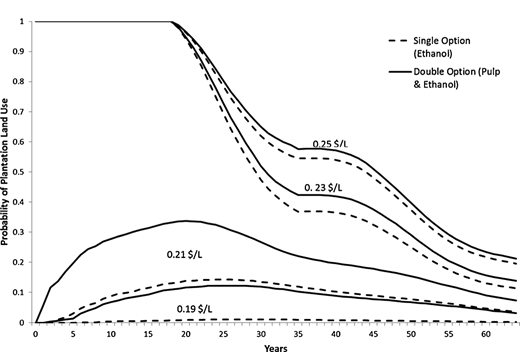
Probability of plantation land use for ethanol only and ethanol plus pulpwood options at varying ethanol price increases ( ) for a land value of .
Probability of plantation land use for ethanol only and ethanol plus pulpwood options at varying ethanol price increases ( ) for a land value of .
The addition of the pulpwood option increases the probability of plantation land use. Without the pulpwood option, if average prices increase by , the probability that landowners would allocate land to plantations remains close to zero throughout the time horizon but does increase slightly over the first 20 years. When the pulpwood option is added, the probability of converting the land to plantations again starts near zero but increases by a much greater amount to a high of 0.12 (Fig. 2) at period 20. If the price increase is extended further to the difference in response when the pulpwood option is added grows even larger. When the price increase is greater than , the marginal effect of adding the pulpwood options is much less because the ethanol prices begin to dominate the pulpwood prices.
Though average ethanol price levels were used as a basis for the sensitivity analysis above, prices for ethanol and pulp are volatile and fluctuate randomly around the mean. The model implements a dynamic harvest rule as shown in Eqs. (2), (3) and (5), where harvest is conditional on current prices, expected land values and expected future prices. Under this harvest rule, prices at harvest can be quite different than the average. These differences are explored in Fig. 5 with respect to a litre increase in the long term average price for a plantation established in the first period. The prices associated with varying harvest ages are depicted in terms of ethanol ( ) and volumes of fibre ($/ODT), at the time of harvest. The average price of ethanol is shown in the Figure to be litre. Two series, relative to this average price, are shown in the Figure. First, a series based on a minimum harvest rule shows the minimum price that is required for a landowner to harvest the stand at each age. Otherwise harvest is deferred. The minimum price declines over the 19-35 age harvesting window, due to a declining probability of getting a higher price before the end of the harvesting window. The closer in age the plantation gets to the maximum of 35 ; the less likely a higher price will occur in the future until, finally, at 35 years the minimum price declines abruptly to a level that just covers the harvest and processing costs. Given this rule and fluctuating prices, plantations in the model are typically harvested at higher prices. The second series shows the average prices of harvested trees depending on harvest ages. The range of average simulated harvest prices is litre when plantations are harvested at 19 years to litre at 34 years. These values are associated with a range of wood fibre prices of ODT to ODT. Because of the dynamic nature of these prices, they are somewhat difficult to compare to breakeven prices found in the literature. Kells et al. (2014) presents a similar analysis to ours in the sense that poplar plantations are compared to the best alternative agriculture land use. However, they used standard NPV analysis and found breakeven prices of ODT to ODT depending on a range of yield and cost assumptions. In $/litre terms the range of litre is similar to the range break even prices found in a recent study by Stephen (2013) of $0.80-1.1/litre using a different method.
Sensitivity analysis: agriculture land prices
With a starting agricultural land price of ha and a price increase of , option values were zero. Therefore, we investigate lower starting agriculture land prices of 1,000,750,500, and ha to investigate whether the land could be efficiently allocated to poplar plantations on more marginal farmland. When ethanol is the only output option, the option values and probabilities of allocating land to plantations are zero. However, when the pulpwood output option is added, option values are positive and are greater for lower agriculture land values (Table 4 and Fig. 3). That is, poplar plantations are not an efficient or profitable land use with current price conditions if ethanol is the only output even for more marginal, lower value agriculture land. However, if landowners have the option to sell their output for an additional use, marginal agricultural land may be efficiently allocated to poplar plantations under some price conditions.
Fig. 4 shows the probability of plantation establishment for the land value sensitivity analysis for the ethanol plus pulpwood model. The figure shows that if the starting agriculture land value is lowered to , there is a small probability, approximately 0.1, of the land being allocated to poplar plantations after 17 years. Probabilities of plantation land use increase with lower starting values of agricultural land, to the point where all land is converted with a probability of one over the entire conversion period with starting land values of .
Option values ($/ha) for differing agriculture land values at for ethanol plus pulpwood options.
| Agriculture Land Value | Ethanol + Pulpwood Option Values |
|---|---|
| $/ha | |
| 2000 | 0 |
| 1000 | 6.94 |
| 750 | 38.48 |
| 500 | 206.68 |
| 100 | 540.45 |
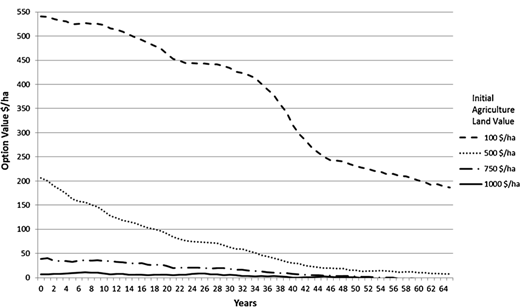
Option values ( ) at varying starting values for agriculture land ( ) for the ethanol plus pulpwood model for a price increase of litre.
Option values ( ) at varying starting values for agriculture land ( ) for the ethanol plus pulpwood model for a price increase of litre.
Fig. 3 shows that option values for plantation decline over time. Fig. 4 shows that the probability of converting to plantations declines after 20-30 years. Both of these results are tied to the underlying differences in price process for agriculture, ethanol, and pulpwood. Both ethanol and pulpwood prices fluctuate around a mean while agriculture follows a geometric walk that generates rising average prices over the time horizon. Therefore, over the time horizon agriculture increasingly generates higher value for landowners, and thus land tends to be allocated to more agriculture over time.
Conclusion
Though the extent that prices for ethanol might increase is uncertain, we can investigate how much ethanol prices would have to increase on average in the long term to induce agricultural landowners to allocate their lands to hybrid poplar plantations. In analyzing this question, we emphasize the importance of modelling landowner decisions as flexible responses to uncertainty and volatility of prices over time. The real options framework we use allows landowners flexibility in three different ways. First, landowners can change back and forth between different crops over time. Second, the forest harvesting model allows land owners to store biomass on the stump and defer harvests until prices are high. Third, harvests of forests may occur in response to changes in ethanol or pulpwood prices. We investigate the importance of this last source of flexibility by comparing results with and without the option to sell poplar for pulpwood.
Overall, including option values in our modelling tends to generate values associated with growing plantations that are higher than traditional methods of valuing forest such as using the Faustmann approach. Nonetheless, like previous studies (Kells et al., 2014; Stephen, 2013) we find significant gaps between current price levels and conditions that would be necessary to incent the planting of poplar plantations even on highly advantageous sites. It would not be profitable to convert agriculture lands, whether of low, average or high value to poplar plantations with low to high yields at current price conditions. Assuming ethanol is the only output option for landowners, average prices would have to rise by at least , or , over current long term average prices for poplar plantations to be efficient on agriculture land worth , even if poplar yields are at their highest. Fig. 5, illustrates that the ability to store wood on the stump and defer harvest would lead landowners to wait until higher prices are available. Average prices at harvest over the 50,000 price scenarios ranged from litre for the final product, or ODT ODT for fibre delivered to the roadside.
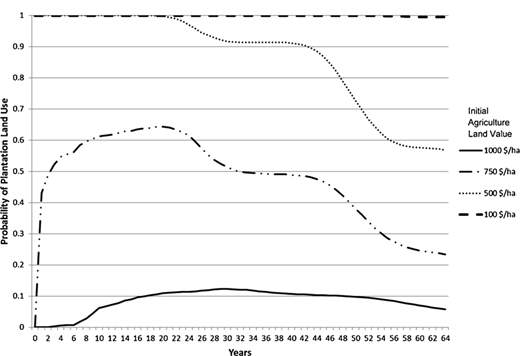
Probability of plantation land use at varying starting values for agriculture land (0.11/litre.
Probability of plantation land use at varying starting values for agriculture land (0.11/litre.
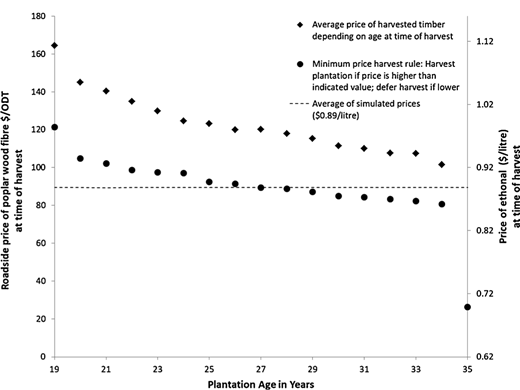
Average wood prices, minimum price harvest rule, and the average price of harvested wood in terms of pulpwood (/L) at varying harvest ages. The average price of 50,000 simulated price paths includes a litre increase in long term average price of ethanol. The roadside price in $/ODT subtracts plant and transport costs.
Average wood prices, minimum price harvest rule, and the average price of harvested wood in terms of pulpwood (/L) at varying harvest ages. The average price of 50,000 simulated price paths includes a litre increase in long term average price of ethanol. The roadside price in $/ODT subtracts plant and transport costs.
Alternatively, if costs decreased by the same amount or the government increased its current subsidies from approximately to landowners may find it profitable to switch to plantations on advantageous sites. However, similar to our assumption of permanent price increases in ethanol prices, governments would have to guarantee the subsidy over a long period of time to induce landowners to switch to poplar plantations. A corollary is that even higher price increases would be required to induce landowners with higher agriculture land values and lower hybrid poplar productivity to convert to hybrid poplar.
If the option to sell trees as pulpwood is added to the option to sell for ethanol, it becomes profitable to switch to plantations on favorable sites at a price increase of instead of , but this is still a price increase of nearly . On lower value agriculture land ( ) results indicate that it may be efficient to switch to hybrid poplar at a lower price increase of but only if the pulpwood output option is available for the landowner. Therefore, the existence of alternative markets for plantations, grown ostensibly for ethanol, but which may be used for other uses, may be needed to induce landowners to switch to plantations.
A key starting point for the real options approach is the characterization of the different price series, based on historical values. Ethanol and pulpwood prices fluctuate around a constant mean, while agricultural land values follow a geometric random walk where the expected value increases over time. The change in agricultural values dominates our results as time progresses, and as a result, we observe that even where option values for planting trees were positive, the option values and probabilities of planting trees decrease over time. These results suggest that, even if the needed increases in prices emerge to induce land use change to poplar plantations, the changes may be temporary if the tendency is for ethanol and pulp prices to drop back down to a long term average. These results also imply that ethanol prices would need to grow over time for induced land use changes to become permanent. But neither previous analysis of ethanol prices (Work et al., 2016) nor more recent analysis (Doll, 2017) supports a trend. These results, however, do not imply that future changes, either in regulations or markets, will not lead to trends (either positive or negative) or jumps in mean prices. But these potential changes are largely unpredictable making it difficult to forecast a time when conditions necessary for landowners to switch to hybrid poplar might occur.
Our analysis has several limitations. While the analysis illustrates the value of an alternate market to landowners, there is also considerable scope for increasing the options available within the biofuel market. For example, Sannigrahi et al. (2010) and Porzio et al. (2012) examine the potential of other components in the biomass, such as lignin, may add co-product options, potentially adding value to the process of cellulosic ethanol production. Moreover, our analysis does not address the possibility that hybrid poplar breeding programs may be able to enhance or alter the composition of wood components such as lignin to make biofuel conversion processes more efficient, as described by Sannigraphi et al. (2010) and Welker et al. (2015).
Another limitation concerns the long term price projections for the commodities ethanol and pulp. While our empirical results show that our commodity prices have been reverting to a mean in the past, it is possible that long term structural changes in markets could lead to jumps or dramatic permanent changes in both price levels and trajectories. The model solution process presented here could accommodate such jumps or changes that could also be represented as a random process. Representations of structural changes, or jumps, in the model, would allow us to identify specific dynamic conditions where land use switching would occur. It would also be possible to add stochastic dimensions to other variables that are represented here as deterministic, such as poplar yield, production costs, and interest rates.
Another limitation to our analysis lies in uncertainty regarding how much of the simulated increase in market prices for ethanol would translate into higher feedstock prices for landowners. If the processing plants were able to suppress feedstock prices, then increases in ethanol prices would not fully translate into feedstock prices as expressed in Eq. (7). In this case, ethanol prices would have to be even higher than our analysis shows in order to induce land use change. However, it is not clear how much market power processors would be able to exert over landowners, given that landowners have multiple land use options and end product markets, and given that landowners may be able to counter potential monopsonist behaviour by processors with their own producer associations. Market structure issues include: possible market control of price by ethanol or pulp producers that buy the feedstock; contractual arrangements between buyers and sellers that share market risk could have an influence on the volatility of prices observed by landowners; and possible hold-up problems associated with the willingness of investors to put up the large amounts of start-up capital necessary if sufficient feedstock supplies from landowners cannot be assured. The influence of various potential market structures on feedstock prices deserves more attention in future research. Finally, though our model does consider transportation costs, our approach largely ignores the spatial dimensions that have been studied in depth with GIS frameworks by Alian and Maclean (2015).
Although the current market conditions in Canada appear unfavorable for the establishment of poplar plantations, there is the potential for technological change. Technological advancements may improve the competitiveness of poplar plantations either in terms of cellulosic ethanol production cost decreases or poplar yield increases. Technological change may also influence future prices (either as increases or decreases) of agricultural products on competing lands. Moreover, government support has substantially influenced the profitability of first generation ethanol in jurisdictions such as the U.S. and could continue to be influential if these types of policies are extended to second generation ethanol. However, our results indicate that required market price changes to incent the growing of poplar feedstocks, even on highly favorable sites and with the advantage of more than one selling option, are significant and would have to remain or grow over a long period of time.
Acknowledgements
This work was supported by Genome Canada, Genome British Columbia, Genome Alberta, Alberta Innovates Bio Solutions, and BioFuelNet Canada.
Appendix 1 Algorithm for solving land use change, options model
Preliminary Steps
1 Let represent trials of yearly time series simulations of agriculture land prices, hardwood pulp prices, and ethanol prices.
2 Given the definition of represents the simulated hardwood pulp price in period t for the j th trial, represents the simulated ethanol price in period t for the j th trial, and represents the simulated agricultural land price in period t for the j th trial. Using
3 Let be the expected long run mean price for hardwood pulp and let be the expected long run mean price for ethanol.
4 Let V be the soil expectation value for poplar plantations, which is maximized given the two plantation outputs, using the traditional Faustmann optimal economic rotation calculation for forests as follows:
Note: For the single option model, where the only plantation output is ethanol, V becomes:
5 Let be the estimated maximized expected net benefit of bare land allocated to plantations, ( ), as defined in Eq. (4), at time t for price trial j. For these values will be preset to ending values as shown in preliminary step 6. For these values will be estimated values from the regressions (see algorithm step 13).
6 Let be the realized value of land immediately after harvest with the option to switch to agriculture. For periods , let .
7 Let be the realized value of agriculture with the option to switch to energy plantations. For period , let .
8 For and compute the following Laguerre Polynomial functions of the prices:
a
c
e
Note: we normalize all the prices first by dividing by the average prices over all trials in a period.
Algorithm
1 Set and .
2 For use Eqs. (7) and (8) to calculate the net benefits and and Eq. (3) to determine the maximum benefit, , at each time t and stand age s :
Note: For the single option model where the only plantation output is ethanol, it is assumed that and the total net benefit defaults to the net benefit received from ethanol production.
3 For compute , the realized value of harvesting if a plantation is harvested at the end of the harvesting window. Set the optimal rotation age for each j, that is planted at period t, to .
4 Set .
5 Using ordinary least squares estimate the expected value of deferring harvest by 1 year, (Eq. (2)) for each trial, j, with the following regression model:
Note: For the single option model both and and the right hand side of the regression (and all subsequent regressions) becomes:
Use the estimated regression coefficients to compute for each j.
6 For each j, compute the expected value of harvesting immediately using the following:
where the first term is the net benefit received for the harvest, see step 2, and the second term is the estimated bare land value calculated in Initial step 6, if , or in Algorithm step 14 if .
7 Given the state of prices, determine the optimal rotation decision to either harvest immediately or defer harvest, according to the following test:
then harvest in the current period and set the optimal rotation age for trial j as . In addition, set the realized value for each trial j as follows:
Otherwise, defer the harvest decision one year, remains unchanged, and the realized value is updated to:
8 If , where m is the minimum rotation period, then go to step 4. Otherwise, go to step 9 .
9 For each j, discount the realized plantation value to time t and subtract the cost of establishing the plantation as follows:
10 For each trial j, estimate the expected value of establishing a poplar plantation with the possibility of switching back to agriculture in the future, using the following regression model:
and then using the estimated regression coefficients to compute .
11 For each j, compute the realized value of agriculture, with the option to later switch to poplar plantations, as follows:
12 For each j, estimate the expected value of agriculture, (see Eq. 5), with the option to later switch to plantations, by first estimating the following regression model:
and then use the fitted values to compute .
13 Estimate (Eq. 5) as follows:
14 Estimated (Equation 3.6) for each trial as follows:
15 For each j, first set as the minimum realized value of the agriculture land, and then compute the realized value of agriculture land using:
In other words, if the expected value of the agriculture option is greater than that of energy plantations and also greater than zero , set the realized land value equal to the realized stream of benefits for agriculture as computed in step 11. Otherwise, the realized value ( ) is set to the realized stream of benefits for the energy plantation ( ) as computed in step 8.
16 For each j, first set as the minimum realized value of the land currently allocated to poplar plantations, and then compute the realized value of plantation land using:
In other words, if the expected value of the agriculture option is greater than that of energy plantations and also greater than zero , set the realized forest land value equal to the realized stream of benefits for agriculture, as computed in step 11, minus the land conversion . Otherwise, the realized value ( ) is set to the realized stream of benefits for the energy plantation as computed in step 8.
17 If , then set and return to step 2. If , stop.

