High energy consumption by higher education institutions (HEIs) structures may enhance air pollution, flooding and land degradation. These hazardous environmental problems can be prevented or mitigated in a green enabling environment. Thus, implementing green construction practices (GCP) in HEI projects may successfully prevent or mitigate environmental threats. There is a paucity of studies regarding barriers facing GCP implementation in Nigerian public HEIs. Hence, this study aims to explore GCP’s barriers and identify measures to improve implementation in Nigerian public HEIs.
The researchers used a qualitative approach through virtual interviews to achieve the study’s objectives. Eighteen interviewees were engaged via a convenient sampling technique and achieved saturation. The researchers adopted a thematic method to analyse the collected data.
Findings identified material, stormwater, waste and energy management practices as the major GCP, showing lax implementation in most public HEIs. Results grouped the encumbrances facing GCP implementation in Nigerian public HEIs into six groups. This includes government, organisation, financial, technical, design team and stakeholders encumbrances. Findings show that identifying measures to address these encumbrances would improve GCP implementation in Nigerian public HEI projects.
The research contributes to GCP literature. It stirs relevant stakeholders, especially public HEI authorities, towards enacting measures via policies and programmes that will improve GCP implementation in Nigeria’s HEI projects. The outcome would advance the existing GCP knowledge and improve achieving sustainable development goal (SDGs) related to education, construction and health and safety performance.
1. Introduction
Physical facilities are key elements that influence productivity in an organisation, including higher education institutions (HEIs). The demand and supply of these facilities, including educational facilities, may be influenced by economic provision Ebekozien et al., 2022c). Ebekozien et al. (2023a) found that infrastructural deficits have hit the education sector. In addition, Jacob and Musa (2020) and Menon and Suresh (2020) found inadequate funding as the major contributing factor. The funding in Nigerian educational budgets is less than the suggested figure by the United Nations Education, Scientific and Cultural Organisation 26% benchmark minimum for developing countries. Ebekozien et al. (2023a) reported that between 2012 and 2016, the highest was 10.63% in 2014. Between 2018 and 2019, the highest was 7.04%; in 2021, it was 5.6% of the total budget. However, besides green construction practices (GCP) adding value and reducing the life cycle cost of projects (Ebekozien et al., 2022a), it addresses the health and safety encumbrances in construction projects (Onubi et al., 2020a, 2020b). Onubi et al. (2021) affirmed that GCP is a means of mitigating the negative impact of construction on the natural environment and guarantees high health and safety performance of construction projects.
This study optimises the education sector’s meagre budget to enhance infrastructure development in Nigerian HEIs via construction sustainability. Hence, the call for building projects in developing countries HEIs, especially with meagre budgets like Nigeria, to navigate ways via feasible policies and programmes to regulate and possibly reduce energy consumption rise during construction activities. Studies showed that using energy-efficient technologies (EETs), such as green buildings, can assist in reducing energy consumption (Menon and Suresh, 2020; Ebekozien et al., 2022a). It has been projected that GHGs may increase by 21% by 2025 in buildings if no drastic policy changes (Energy Information Administration, 2009). This study focuses on green building in Nigerian HEIs to cut building energy consumption and make savings from the meagre budget allocation to the sector. Green buildings in Nigerian HEIs will strive for environmentally sustainable construction. It can have fewer contaminants, is energy effective and provides an improved environment (Richardson and Lynes, 2007; Menon and Suresh, 2020). This is because, during the construction stage, green or sustainable construction uses recycled materials and less water and energy, reducing susceptibility to flooding and land and air polluting emissions (Li et al., 2014). In Nigeria, integrated institutional frameworks via policies promoting and targeting green buildings have yielded few results (Onuoha et al., 2017). The US Green Building Council (2015) reported that performance based on leadership in Nigeria and Malaysia’s energy and environmental design accomplishments is 317,039 m2 and 5,785,244 m2, respectively, of certified green building projects. It implies Malaysia’s performance is better than Nigeria’s regarding green construction.
Studies have showed that research has been conducted on GCP and related areas within and outside Nigeria. Examples are Yeatts et al. (2017), Onuoha et al. (2017), Chan et al. (2018), Ampratwum et al. (2019), Agyekum et al. (2020), Ahmad et al. (2020), Ebekozien et al. (2022a) and Onubi et al. (2020a, 2020b). The distinctiveness associated with developing countries’ HEIs was not captured for the few that added the encumbrances being faced by GCP and related areas. Onubi et al. (2020a, 2020b). The relevance of GCP in HEIs projects would enhance the meagre budgets allocated to the sector for optimal utilisation. Implementing GCP in HEI projects will be apposite for supporting the functionality of HEI building elements and enhancing the capability of infrastructure in the education sector. This is pertinent because of the shortfall of physical infrastructure (Ebekozien et al., 2023). The mechanism may mitigate hazardous environmental issues and promote a green environment. Hence, GCP in buildings, including HEIs projects, may successfully avoid or mitigate these environmental issues. Studies regarding GCP in public HEIs projects during the design, construction and postconstruction and possible encumbrances facing implementation are scarce. Likewise, approaching the study via a qualitative method will contribute to the study’s implications because of the engaged expertise. The research intends to educate and advance GCP theoretical background in HEIs project implementation and fill the study’s gaps. This brings the study to the following questions:
What are the various GCPs?
What are the encumbrances to implementing GCPs in Nigerian public HEI projects?
How can GCPs implementation in Nigerian public HEIs projects be improved?
Hence, the study identified various GCP and their level of implementation in HEI projects, investigated the barriers facing GCP and identified measures to improve implementation in Nigerian public HEIs.
This study comprises seven sections. The introduction section focuses on the background and part of the study’s motivations, including the stated research questions and the aim of this study. The following section summarises extant literature, including GCPs and tabulated potential encumbrances to GCP implementation. Section 3 describes the methodology used for data collection and the qualitative research design for this study. The following section presents findings and discusses themes from the 18 experts engaged via a convenient sampling technique. Section 5 presents the study’s implications. This is followed by the limitations and suggestions for future studies (Section 6), as well as the conclusion and recommendations (Section 7).
2. Review of literature
2.1 Green construction practices
The management of HEI facilities, including maintenance, has become an issue for stakeholders. The availability of finance may have contributed to the issue (Menon and Suresh, 2020; Abad-Segura and González-Zamar, 2021). Addressing the issue(s) is germane to his study. Thus, sustainable construction (green construction) may be an option. This is with some challenges because of the high energy consumption associated with buildings from pre- to post-construction. Global construction activities may have influenced air pollution, harsh flooding and land degradation (Ebekozien et al., 2022a, 2022b). These are hazardous environmental issues. Studies showed that the energy used for building life-cycle accounts for 40% of total energy and contributes 9% to the world’s greenhouse gas (GHG) emissions (Energy Information Administration, 2014). Yeatts et al. (2017) stated that buildings consume higher energy than other energy users. This was validated by Nelms et al. (2005), European Commission (2007) and the Energy Commission of Nigeria (2014). Nelms et al. (2005) discovered that in the USA, Canada and the UK, the energy consumption by buildings is between 30% and 50%. European Commission (2007) reported that 42% of its energy consumption is from buildings, and 35% produces GHG emissions. The Energy Commission of Nigeria (2014) stated that the energy consumption by buildings is above 50% in the country. Studies have projected a global temperature increase of 1.5°C between 2030 and 2052 (Masson-Delmotte et al., 2018).
The construction sector, particularly building projects in HEI needs to get prepared with a meagre budget to mitigate construction operations from the environment. It has become necessary because of the perceived environmental-related risks from increased temperature to livelihoods. The HEIs sub-sector contributes to economic feat and development advancement of nations. Achieving this goal demands educational and physical infrastructure to promote an enabling environment for teaching and research activities. Wentworth and Makokera (2015) avowed that developing countries’ governments need assistance to proffer solutions to the infrastructure backlog. This includes the educational infrastructure. However, Ebekozien et al. (2023) opined that HEI infrastructure is key in renovating higher institutions for sustainability and integrated advancement. This includes influencing and attracting global grants and research and staff development funding. This may lead to significant performance and better output. This corroborated the mission statement of the Tertiary Education Trust Fund (TETFund) Act of 2011 repealed ETF (TETFund, 2011). Infrastructure development is one core area of their funding across Nigerian HEIs (Anaelobi and Agim, 2019). This vision is becoming a mirage because of scarce resources, which are compounded by the meagre budget allocated to education. Enefola (2016) discovered a need for more infrastructure in Nigeria’s educational sector. One possible hindrance is inadequate funding. Construction sustainability via green construction may enhance and bridge the infrastructural gap in HEIs in developing countries if embraced. Kibwami and Tutesigensi (2016) affirmed that construction practitioners have been critically thinking about how sustainable construction can enhance and save costs. Green building is a product of the brainstorming session (Ebekozien et al., 2022a). Darko and Chan (2016) asserted that green construction is advancing, and the initiative has become the main theme of modern construction.
GCP is gaining increased awareness among the stakeholders in the construction industry. Yet, construction contractors and housing developers are confronted with energy consumption, construction and demolition waste, managing stormwater and reducing other harmful environmental practices (Onubi et al., 2020a). Zhang et al. (2018) attributed these issues to insufficient information, policy and behaviour factors because “going green” is declared lucrative from the whole lifecycle perspective. Guy (2017) identified benefits attributed to the adoption of GCP. This includes a positive impact on the health of the environment and society, mitigates operating costs, enhances organisational marketability, increases output and assists in developing a sustainable community. Despite GCP benefits cutting across economic, social and environmental aspects, implementation still needs to be improved, especially in developing countries. Scholarly factors hindering GCP implementation are familiar, but none regarding HEI projects in developing nations. This has become pertinent because of the saving costs and benefits and the meagre budget allocated to HEIs in Nigeria.
Concerning hindrances facing green construction/building implementation, a few studies (Opoku et al., 2015; Chan et al., 2018; Oyewole et al., 2019; Ahmad et al., 2020; Zuniga-Teran et al., 2020; Ebekozien et al., 2022b) have been conducted. None regarding various GCP and implementation in developing countries HEIs. In the UK, Opoku et al. (2015) found a lack of incentive and training, inadequate building and design teams, investment costs, absence of construction codes and regulations and investment risk from stakeholders as hindrances to green construction. Chan et al. (2018) found the five most significant hindrances from the 26 identified hindrances. They clustered them into cost and risk-related, knowledge and information-related, market-related, government-related and human-related. The absence of technology, absence of government support, lack of building codes and regulations, inadequate expertise and inadequate demand were discovered by Oyewole et al. (2019) as the five critical encumbrances. Ahmad et al. (2020) discovered lax government policies and regulations, lack of incentives, high cost of materials, insufficient design team engagement and accessible materials requiring high energy consumption were identified as major encumbrances. Zuniga-Teran et al. (2020) identified design standards, regulatory pathways, socio-economic considerations, financeability and innovation as hindrances facing green construction implementation. Thus, an analysis of encumbrances facing GCP in Nigerian HEI project implementation using a qualitative method and joining the views of experts is worth investigating. Table 1 illustrates summarised potential encumbrances of GCP implementation.
Summarised potential encumbrances to GCP implementation in Nigeria’s public HEI projects
| No. | Barriers | Authors |
|---|---|---|
| 1 | Attitude of experts | Chan et al. (2018), Ebekozien et al. (2022a) |
| 2 | Overall cost of alternate energy sources | Aghimien et al. (2018) |
| 3 | Cost of green building technologies | Aghimien et al. (2018), Chan et al. (2018), Zuniga-Teran et al. (2020) |
| 4 | Lack of incentives | Aghimien et al. (2018), Chan et al. (2018), Ahmad et al. (2020) |
| 5 | Lax financing systems | Aghimien et al. (2018), Chan et al. (2018), Zuniga-Teran et al. (2020) |
| 6 | Absence of local green building materials | Chan et al. (2018) |
| 7 | Absence of local institutes to facilitates R&D of green buildings | Chan et al. (2018) |
| 8 | Absence of client’s awareness regarding benefits | Chan et al. (2018), Ebekozien et al. (2022a) |
| 9 | Absence of expertise and design standards | Chan et al. (2018), Ahmad et al. (2020), Zuniga-Teran et al. (2020) |
| 10 | Lack of green building rating systems and labelling programmes | Chan et al. (2018) |
| 11 | Lack of green housing databases and information | Chan et al. (2018) |
| 12 | Absence of green building codes and regulations | Chan et al. (2018), Zuniga-Teran et al. (2020), Ebekozien et al. (2022a) |
| 13 | Conflicts of interests among stakeholders’ | Love et al. (2012) |
| 14 | Resistance to change from the use of conventional technologies | Chan et al. (2018) |
| 15 | Inadequate promotion of green building technology by government | Aghimien et al. (2018), Chan et al. (2018) |
| 16 | Risks and uncertainties involved in adopting new technologies | Chan et al. (2018) |
GCP involves undertaking construction and its related processes using best practices. This includes environmentally sustainable and resource-efficient processes from construction materials selection to completion (Ojo et al., 2014). Yusof et al. (2019) identified material, stormwater, waste and energy management practices as the major GCP. There is a relationship between GCP and the economic performance of projects (Guy, 2017; Chang et al., 2018; Onubi et al., 2020a). However, some scholars such as Zhang et al. (2015) and Hwang et al. (2017) disagree and avowed that GCP does not lead to the economic performance of projects. They affirmed that it leads to more spending, thus, affecting the contracting firm’s profit. Stormwater management practice is not common compared to others in building projects. It is an environmentally driven mechanism to replicate the natural water flow through designs to control stormwater runoff and quality rather than at a centralised location (Damodaram et al., 2010). Onubi et al. (2020a) identified the use of rain gardens, construction of green roofs, natural site topography maintenance and rainwater harvesting as the major stormwater management practices.
3. Research method
The research used phenomenology, as presented in Figure 1. This qualitative method describes a lived experience of a phenomenon (Creswell and Creswell, 2018). It is followed by analysing the meaning of important remarks in the collected data and narrative themes regarding the experience (Creswell and Creswell, 2018). Creswell and Creswell (2018) asserted that this allows the investigator to conduct several interviews, between 5 and 25, for common themes. The essence is to build a satisfactory data set, seek emerging themes and use other interviewees to validate the results (Ebekozien et al., 2025). It aligned with Ebekozien et al. (2022a) and Guribie et al. (2022). Ebekozien et al. (2022a) used the same method to investigate Nigerian hospital green building implementation barriers. Guribie et al. (2022) adopted a qualitative approach in the first phase of data collection from 18 construction clients regarding the impediments to the demand for green construction in Ghana. The study used a virtual interview method to accomplish the researchers’ aim. The approach was complemented by selected academically reviewed literature.
 The flowchart titled The Research Design presents sequential stages connected by arrows. The first box states The Research Design. The next box states Qualitative with the descriptor Phenomenological. The following box states Participants across Lagos and Abuja, with 18 participants. The next stage states Data Collection with 18 Interview Meetings in Two Populated Cities. The next box states Data Analysis with Thematic Analysis Manual. The following box states Findings, Encumbrances Facing G C P in Nigeria, and Measures to improve G C P implementation. The next stage states Discussion and Triangulation. The final box states Conclusion and Recommendations.
The research design
Source: Authors’ work
The flowchart titled The Research Design presents sequential stages connected by arrows. The first box states The Research Design. The next box states Qualitative with the descriptor Phenomenological. The following box states Participants across Lagos and Abuja, with 18 participants. The next stage states Data Collection with 18 Interview Meetings in Two Populated Cities. The next box states Data Analysis with Thematic Analysis Manual. The following box states Findings, Encumbrances Facing G C P in Nigeria, and Measures to improve G C P implementation. The next stage states Discussion and Triangulation. The final box states Conclusion and Recommendations.The research design
Source: Authors’ work
This research achieved saturation with 18 participants from Lagos and Abuja via a convenient sampling method, as presented in Table 2. Convenient sampling is a non-probability sampling method where units/interviewees are selected for inclusion in the study’s sample (Creswell and Creswell, 2018). The knowledgeable participants were HEIs building contractors, the design team, the HEIs management team and policymakers/government agencies that indicated interest and were interviewed. Regarding the choice of Lagos and Abuja, Ebekozien and Aigbavboa (2021) and Ibrahim et al. (2022) stated that the two cities are known for large construction projects. This study’s saturation was established when there was no new evidence of new constructs from subsequent interviews and aligned with Ibrahim et al. (2022). The interviewees are experienced in green building projects and HEIs. The participants’ designation and assigned codes are stated in Table 2, and they are knowledgeable regarding HEIs and green construction. For example, P2 recently completed a green-driven housing project for a private client, while P6 and P9 have been involved in green construction design until its completion in Nigeria. Also, P14 from the built environment with adequate knowledge of the built environment. The researchers hid the interviewees’ identities for privacy reasons. This aligned with Jaafar et al. (2021), who concealed the identities of their study for ethical reasons. The study analysed the collected data via thematic analysis. The virtual interviews lasted 60 min on average between August 2022 and November 2022. The participants were engaged with questions within the stated objectives. The study coded the collated data. One hundred and four codes emerged from the coding and sub-themes into 12 clusters. From the 12 sub-themes, 3 main themes emerged.
Description of the participants’ background
| S. No. | Participant | Designation | No. | Code |
|---|---|---|---|---|
| 1 | HEIs building contractors | Management staff | 3 | P1 to P3 |
| 2 | Design team | Principal managers/partners | 6 | P4 to P9 |
| 3 | HEIs management team | Management staff | 6 | P10 to P15 |
| 4 | Policymakers/government agencies | Directors/senior staff | 3 | P16 to P18 |
| Total | 18 |
4. Findings and discussion
The section presents findings and discussion to proffer answers to the study’s objectives.
4.1 Theme 1: identify various green construction practices
Embracing GCP in the 21st century is the way to go because of the benefits. The benefits include more energy efficiency, cost-saving, reducing material waste, saving natural resources, improving quality of life, tackling climate change and leaving a better environment for the future. This sub-section allows participants to identify major GCP in the industry. Findings identify stormwater management, waste management, energy management and material management practices as the major GCP in Nigeria but insist that implementation in most HEI projects is lax. Findings agree with Yusof et al. (2016). In their study regarding environmental regulations, as they are concerned with green practices on corporate financial performance, they found material management, energy management, waste management and stormwater management practices as the major GCP. Participant P8 says:
[….] the issue of weak regulations or absence of institutional framework may have contributed to the lax implementation even with the high level of GCP awareness of their benefits to the stakeholders and the industry….
Findings show that setting up energy savings (major), value management of energy strategies (major), precise life-cycle costing (major), awareness to design team regarding energy efficient materials and techniques (major), energy considered during the planning stage (P3, P6 and P14), environmental impact assessment tools (P1, P8 and P17) and investigations regarding energy opportunities (P5, P10 and P18) emerges as the energy efficiency practices in construction projects. The energy performance of buildings, including HEI projects, has to be monitored to mitigate the global threat of climate change (Ciancio et al., 2020). Similarly, standardisation of design to minimise waste (major), staffers environmental academic background (major), recycling and waste disposal firms (major), incentives and waste minimisations (major), waste auditing (major), penalties for poorwaste management (P3, P13, P17 and P18), off-site prefabrication (P10 and P14) and on-site material compactors (P1, P2 and P15-P17) emerges as the waste minimisation practices in construction projects. Construction activities are a major industry issue, especially in renovation work because of urbanisation (applicable to HEI projects). Efficiently managing this waste is pertinent to mitigate the detrimental impacts of construction and demolition waste on the environment (Kabirifar et al., 2020). Findings regarding the emerged stormwater management practices agree with those of Onubi et al. (2020a). They identified the use of rain gardens, the construction of green roofs, natural site topography maintenance and rainwater harvesting as the major stormwater management practices.
4.2 Theme 2: perceived encumbrances
Theme Two presents the encumbrances facing GCP implementation in public HEI projects, especially in developing countries like Nigeria. This theme offers the interviewees the privilege to identify the encumbrances. Findings show that encumbrances facing GCP implementation in HEI projects are similar to those of other building projects. Findings reveal lax in relevant Acts and government agencies such as the National Policy on the Environment, the National Environmental Standards and Regulations Enforcement Agency and the Environmental Protection Agency Act 1988 (P6, P12, P15 and P17). “…. the Act’s lacuna may have contributed to implementation issues in HEIs .…” Participant P6. Sixteen perceived issues emerged as barriers facing GCP implementation in public HEI projects. Results grouped 6 of the identified 16 encumbrances facing GCP implementation in Nigerian public HEIs. This includes government, organisation, financial, technical, design team and stakeholders encumbrances, as presented in Table 3. From the 16 encumbrances, the absence of green building codes and regulations, insufficient promotion of green building technology by HEIs and government via research and development, funding challenges, insufficient training of green practitioners and absence of awareness and benefit to users/clients were frequent among the participants as perceived encumbrances facing GCP implementation in Nigerian public HEIs projects. Findings slightly agree with Guribie et al. (2022). They clustered the hindrances to demand green buildings into communication deficiencies, expertise and technology, cost-related barriers, nature of the market and attitudinal/perception barriers.
Clustered encumbrances facing GCP in HEIs project implementation
| Clustered encumbrances | |||||
|---|---|---|---|---|---|
| Government | Organisation | Financial | Technical | Design team | Stakeholders |
| Absence of green building codes and regulations (majority) | Insufficient promotion of green building technology (majority) | Funding challenges (majority) | Resistance to change (P5, P10 and P11) | Inadequate attention to green building technologies in HEIs (P4, P11, P12, P15 and P17) | Insufficient promotion of green building technology (majority) |
| Absence of green building rating systems and labelling programmes (P1-P4, P10, P12 and P18) | Inadequate attention to green building technologies in HEIs (P4, P11, P12, P15 and P17) | Expensive green building technology (P2, P11, P13, P16 and P17) | Expensive green building technology (P2, P11, P13, P16 and P17) | Resistance to change (P5, P10 and P11) | Inadequate attention to green building technologies in HEIs (P4, P11, P12, P15 and P17) |
| Insufficient promotion of green building technology (majority) | Insufficient training of green building experts (majority) | Higher initial cost of construction (P5, P8, P13 and P16-P18) | Insufficient training of green building experts (majority) | Lack of experience (P1, P10 and P18) | Resistance to change (P5, P10 and P11) |
| Insufficient training of green building experts (majority) | Absence of awareness and benefit to clients/users (majority) | Shortage of materials (P2, P7 and P15) | Complex conditions in adoption (P5, P9 and P14) | Attitude of experts (P1, P4, P10 and P13) | |
| Absence of awareness and benefit to clients/users (majority) | Lack of experience (P1, P2, P4, P8, P10 and P18) | Lack of design team expertise (P2, P7, P9 and P14) | Absence of awareness and benefit to clients/users (majority) | ||
| Attitude of experts (P1, P4, P10 and P13) | Attitude of experts (P1, P4, P10 and P13) | Conflict of interests (P3, P13 and P16) | |||
| Absence of awareness and benefit to clients/users (majority) | |||||
From the 16 emerged encumbrances, the absence of green building codes and regulations, insufficient promotion of green building technology by HEIs and government via research and development, funding challenges, insufficient training of green practitioners and absence of awareness and benefit to users/clients were frequent among the participants as perceived encumbrances facing GCP implementation in Nigerian public HEIs projects. Findings agree with Mahdiyar et al. (2020), Li et al. (2020) and Guribie et al. (2022). Mahdiyar et al. (2020) found a lack of awareness and knowledge and high initial cost as the most significant barriers to green roof installation, a building component of green construction. Li et al. (2020) found that despite the tremendous progress of the green revolution to improve the living environment, there are still specific and limited aspects. Guribie et al. (2022) found poor advertisement, high implementation cost, inadequate expertise, inadequate financial motivations and complexity of design as the impediments to demand for green building. Findings reveal that governments (state and federal), HEIs management teams and HEIs regulatory agencies need to do more regarding policies and programmes tailored towards promoting GCP implementation in HEIs (majority). Participant P6 says, “…besides funding confronting our HEIs, policymakers should revamp GCP policies and programmes. Management of HEIs should create an enabling environment as pilot-base for implementation……” A pilot base for GCP is missing in many Nigerian HEI projects.
Concerning the absence of green building codes and regulations, including insufficient promotion of green building technology by HEIs and government via research and development, funding challenges, insufficient training of green building experts and absence of awareness and benefit to users/clients, results aligned with Aghimien et al. (2018) and Alqadami et al. (2020). Aghimien et al. (2018) found that the funding challenge is one major encumbrance of GCP and recommended that experts should be enlightened regarding the cost benefits. Alqadami et al. (2020) found funding challenges, weak legislation, higher cost of green materials, policy formulation, construction projects gap and lack of capacity to innovate green solutions as top encumbrances hindering green procurement adoption. Participant P17 says:
[…] stakeholders should not always focus on the government to take full responsibility in funding and policies but should complement little government effort via engagement and construction consultation and contribution to promoting green building projects…. This is missing. What is the extent of green practices in our HEIs curriculum that enhance knowledge during practice? I doubt if there is significant upgrading regarding the curriculum because of green construction….
The 2021 revised Nigerian Polytechnics curriculum captured Introduction to Sustainable Construction for Quantity Surveying students for a semester. Many schools have yet to adopt the curriculum (P11 and P14). Hence, very few HEIs teach GCP-related courses, including design. This has to be added to break the knowledge gap. Technology transfer, research and development in greening is slow, especially in developing countries (Ebekozien et al., 2022a). This area needs to be addressed.
4.3 Theme 3: identified measures
The sub-section presents measures to improve the implementation of GCPs in Nigerian HEI projects. Findings agree that the relevant government agencies, via policies and programmes and HEIs management team, have a pertinent role in improving GCP implementation in Nigerian HEIs (majority). Ten major measures to improve GCP in HEI projects emerged. This includes a green institutional implementation framework via policies and programmes such as developing Nigeria’s Green building code or incorporating green building in the National Code (government regulations), financial support to promote green construction projects, government intervention via incentives (subsidies and tax incentives) to building contractors, creating more awareness with emphasis on the benefits, zero waste approach in HEIs sites, site waste management plan in HEIs sites and upskilling and reskilling of green practitioners. Other measures are investing in research and development, re-orientating clients and construction practitioners and the availability of alternative, scarce green building materials. From the 10 main measures, green institutional implementation framework via policies and programmes, site waste management plan, zero waste approach, financial support to promote green construction projects, government intervention via incentives (subsidies and tax incentives), investment in research and development and upskilling and reskilling of green practitioners were frequent among the participants as perceived measures to improve GCP implementation in HEIs projects.
This study revealed a site waste management plan (SWMP) and zero waste approach (ZWA) are critical construction waste management approaches. Participant P17 says:
[….] Nigerian construction sites should be reawakened in line with global best practices. In many countries, SWMP is a legislative requirement for construction activities, including HEIs projects. But enforcing it in a system with alleged cancerous corruption is another issue to address…….
Findings agree with Kabirifar et al. (2020). They highlighted various countries with SWMP or legislative framework as mandatory requirements before planning approval of some construction projects. This includes Australia, Hong Kong and the UK. Regarding ZWA, findings reveal that the mechanism assists in encouraging sustainable consumption and production, including resource recovery and recycling. Findings agree with Li and Du (2015). They asserted that besides resource recovery and recycling, ZWA averts construction wastes from burning and landfilling using waste-to-energy technology.
Regarding subsidies and tax incentives as possible measures to improve GCP in HEIs, findings agree with Onubi et al. (2021). They suggested that governments at all levels should intensify efforts to provide tax waivers, subsidies and other incentives to housing developers and construction contractors who are adopters of GCP. The outcome would ensure the economic performance of HEI projects and guarantee high health and safety performance. This further corroborates Debrah et al. (2022), who suggested that international organisations and governments are encouraged to collaborate with the academic community to increase GCP through research. The findings of the recommended green institutional implementation framework and government regulations agree with Sanchez et al. (2014) and Onuoha et al. (2017). In construction contracts, Sanchez et al. (2014) recommended incentives to mitigate greenhouse gas. Onuoha et al. (2017) suggested that the Nigerian Government should develop a globally accepted green building index (GBI) tool to evaluate and certify the environmental design and pre- and post-construction of buildings. Incentives and government regulations drive GCP in HEI projects in developing countries, including Nigeria. Participant P14 says, “….I doubt if we have an indigenous tool for assessment. Besides evaluation, the tool can assist in promoting energy saving, recycling of materials, and adapting materials….” The issue raised by P14 is critical and should be given attention. Also, the findings of the upskilling and reskilling of green practitioners agree with Asiedu et al. (2021). They found that many construction staffers have weak skills and suggested eight main skills to enhance their job, including green construction skills.
5. Implication and benefit of this study
This research extends and offers further explanations to the studies of Onubi et al. (2020a, 2020b) and Hwang et al. (2017) by emphasising GCP in HEIs projects instead of the impact of GCP on the health and safety performance of the stakeholders. Scholarly literature on the encumbrances facing GCP in HEIs project implementation has been curiously silent, especially in developing countries such as Nigeria. This study will fill the theoretical gap. As part of the implications, there is a need to engage more in sustainable construction in HEI projects. HEIs infrastructure is key in renovating higher institutions for sustainability and integrated advancement. Besides influencing and attracting global grants and funding for research and staffer development, it ensures minimal negative environmental impact and enhances optimum economic, social and environmental benefits. The outcome would lead to significant performance, better productivity and construction sustainability to bridge the infrastructural gap in HEIs. The various GCP from the study will form part of the theoretical contribution to global green construction. Examples are setting up energy savings objectives, value management of energy strategies, precise lifecycle costing and awareness to the design team about energy efficient materials and techniques. Similarly, standardisation of design to minimise waste, environmental academic background of staffers, recycling and waste disposal firms, motivations for waste minimisations and waste auditing emerge as waste minimisation practices in construction projects.
Regarding the practical contribution, this research identified various GCP and their level of implementation in HEIs projects, investigated the barriers facing GCP and identified measures to improve implementation in Nigerian public HEIs. Findings will equip developers/construction contractors, site managers, project stakeholders, HEIs Chief Executive Officers (CEOs) and their representatives with the necessary knowledge, strength and benefits of GCP in HEI projects. Also, the research findings contribute to the existing knowledge base (greening construction) by reiterating the need for holistic mechanisms in integrating GCP in HEI projects. Considering each construction project’s peculiarities, this supports the need for an all-inclusive GCP institutional framework. The research highlights the need for operators of GCP in HEI projects to understand the changes in the construction site environment and the required upskilling and reskilling to match specific green construction projects. Managing stormwater, solid and construction waste and energy efficiency for the facilities requires training and retraining to prevent safety barriers and enhance productivity. The findings intend to support and offer a rich insight into GCP, especially regarding implementing them in public HEI projects in developing countries, including Nigeria. Improving GCP in public HEIs can assist in infrastructural development sustainability and green construction institutionalisation to address compliance issues and standards, including capacity building and regulations. The suggested measures to improve GCP in HEIs are useful to the HEI policymakers, CEOs and construction contractors/housing developers. Findings enhance decision-making regarding greening and improve accomplishing GCP implementation in HEI projects in developing countries, including Nigeria. This is a component of the study’s practice implications. Regarding the study’s relevance to sustainable development, it intends to improve HEIs infrastructure via GCP as one mechanism to promote sustainable development. Using greening via GCP in HEIs projects can improve the well-being of the users and sustainable infrastructure projects, mitigate environmental dilapidation and save construction and maintenance costs.
6. Limitations and suggestions for future studies
This study has some limitations. First, the researchers adopted a qualitative approach for this study’s data collection. It was adopted because the constructs or variables regarding GCP in HEI projects were inaccessible from existing literature. Future studies could use a quantitative or mixed methods approach to validate the encumbrances facing GCP in HEIs project implementation. Second, the data collected for the study were from two locations. This may not affect the credibility of the collected data because these locations are construction commercial hubs with a good representation of expertise. Future studies could consider a wider coverage to validate the study’s findings.
7. Conclusion and recommendations
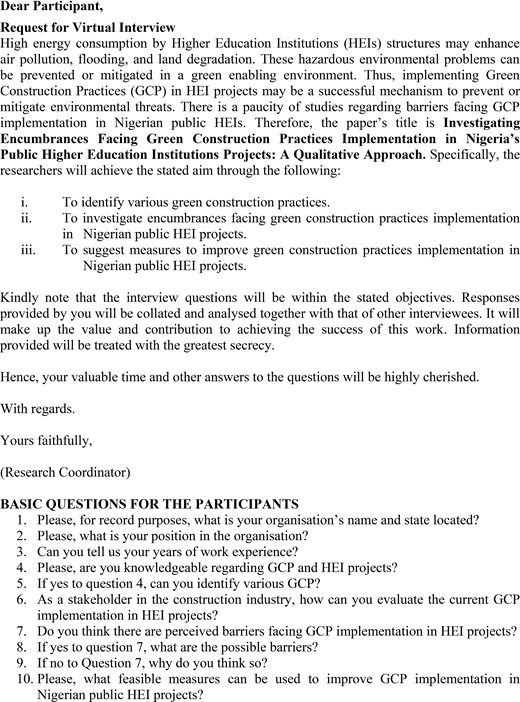
Environmental concerns play a pertinent role in construction projects, especially in developing countries’ HEIs, which have scarce resources to meet the minimum infrastructure facilities requirements. The relevance of infrastructure in developing countries with expanding growth in youth population would increase construction activities at a rapid pace across HEIs. This has increased environmental concerns, and construction activities are encouraged to go green and promote sustainability. It has motivated a wide range of GCP. This includes reduce, reuse and recycle mechanisms. The study identified stormwater, waste, energy and material management practices as the major GCP in the construction industry. Also, there is GCP growing awareness among the stakeholders, but lax implementation is on the extreme, especially in HEIs projects. GCP has come to stay in the 21st century but faces some encumbrances. These encumbrances threaten GCP’s health and safety performance and SDGs and may lead to the underperformance of HEI projects if not curbed. Hence, the study investigated the encumbrances facing GCP implementation in Nigerian public HEIs projects and suggested measures to improve the concept. The study collected data via virtual interviews and supplemented it with reviewed literature ( Appendix). The findings would fill the theoretical gap and contribute to HEIs’ GCP advancement as part of the contribution to green construction evolution in the 21st century. Therefore, the research recommended the following measures:
Stakeholders, especially government green construction agencies/departments and HEIs management teams, should promote green construction project technology in HEIs at all levels. Regarding policies and programmes that will drive or promote green construction projects (government regulations), governments should review their policies and programmes in line with the best global practices to adopt standardised international institutional framework for HEIs construction projects and provide grants/subsidies as incentives to promote GCP in Nigerian HEIs projects.
The absence of localised green rating systems for periodic evaluation to assess the sustainability of construction processes, such as Green Star, to foster construction processes in an environmentally friendly manner, cannot be over-emphasised. Also, the lifecycle costing model is germane to evaluate the financial contributions of decision-making to either go green or not. These should be addressed if there would be progressive outcomes. Hence, stakeholders, especially green policymakers, researchers, green material manufacturers and housing developers/construction contractors, should integrate ideals to develop a localised rating system and a model or adapt from countries such as Malaysia and South Africa or developed countries such as Australia.
Also, the government should support the relevant authorities to enhance Nigeria’s GBI development. This is pertinent to GCP implementation, including in developing countries HEIs. To achieve this task, key stakeholders’ behavioural change towards embracing GCP in HEIs projects to tackle climate change, leave a better environment for the future, improve quality of life, save natural resources and cost savings and achieve some of the SDGs is germane. Other benefits of GBI development are material waste reduction and more energy-efficient evaluation for HEI projects.
The strategies for waste and energy management practices are key to achieving GCP in HEI projects if well understood by the practitioners. It would enhance appropriate decisions to manage the construction project’s lifecycle from the planning and design stage to the demolition stage. Thus, policymakers and legislators should review existing environmental laws guiding construction sites to integrate site waste management plans and zero waste concepts as a requirement for approval of construction projects, including HEIs projects.
The authors specially thank the participants for providing scholarly contributions to enhance the findings of this study and also thank Dr S.S. Umar (Rector, Auchi Polytechnic) and his team for creating an enabling environment to contribute to this research. The authors appreciate the comments, suggestions and recommendations provided by the anonymous reviewers, which honed and strengthened the quality of this manuscript during the blind peer review process.
Funding: The research was funded by the Faculty of Engineering and the Built Environment and CIDB Centre of Excellence (No. 05-35-061890), University of Johannesburg, South Africa.