

Can the use of a social media and SMS based information platforms be used to improve the healthcare in Thailand?
Article Type: Editorial From: Journal of Facilities Management, Volume 12, Issue 2
1 Introduction
1.1 Introduce the problem
Healthcare is an important factor that can contribute to several Millennium Development Goals (MDGs), currently Thailand has a universal healthcare coverage – something that only a few OECD nations have achieved. The issue of healthcare education and information along with access to healthcare professionals are important because they all act as barriers to increasing and improving healthcare coverage. The reported issues that contribute to the barriers opposing healthcare coverage in Thailand; range from illegal immigrants and overcrowding to uninsured international tourists.
1.2 Explore importance of the problem
Further research is needed within this field as it addresses barriers that are consistent with a range of nations, especially in neighbouring regions. The use of an SMS or social media based system overcomes the barriers of time, cost and geography all of which are not unique to Thailand and are transferrable to a host of industries. All countries should stride for a better healthcare system, however funding and technology infrastructure pose as barriers to such development. Not only is there a need for appropriate infrastructure to be present, but also a realistic strategy to implement such a platform over a predefined time period. As with all technology forms a social media network can be misused which can become damaging to both an individual/employee and an organization/employer, therefore it is important to produce protective usage policies.
2 Literature review
2.1 Background
Since the turn of the century Thailand has seen a rapid growth of internet users and most noticeably a huge uptake of social media web sites, such as Twitter and Facebook. Figures 1 and 2 demonstrate just how this particular demographic is growing – this emerging market holds many opportunities for a range of industries; especially healthcare (KPMG International, 2011; Computer Sciences Corporation, 2012). There is now a reported 18 million users who regularly use social media networks in Thailand alone (Millard, 2013).
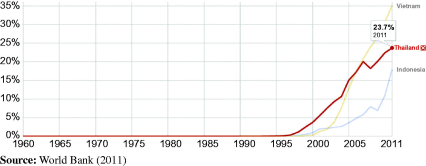
Figure 1 Internet usage in Thailand – percentage of population
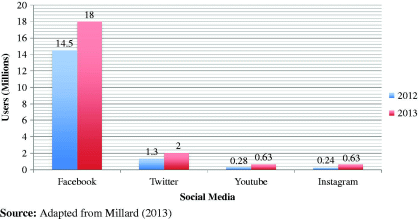
Figure 2 Social media uptake in Thailand
2.2 What is social media?
Social media [noun]
Websites and applications that enable users to create and share content or to participate in social networking.
Recent studies have shown that citizens within developing nations are more likely to use social media as opposed to citizens in fully developed nations (Benson-Colpi, 2013; McNaughton, 2012). Also there is evidence to suggest that one of the key drivers for social media uptake is the increased "internet penetration" within developing nations (Benson-Colpi, 2013). Both trends are being witnessed within Thailand today. It is expected that social media usage will continue to rise as internet penetration and mobile coverage increase (McNaughton, 2012).
2.3 Potential business opportunities
The integration of social media into modern business practice has allowed for single companies to reach out and communicate with thousands of consumers in a way that was never before possible (Mangold and Faulds, 2009). Social media empowers the consumer through the "freedom of speech" which alleviates all elements of control that companies previously had on the scope, type and direction of feedback that was previously possible (Mangold and Faulds, 2009). Ultimately the use of social media over comes three traditional barriers geography, time and cost (Computer Sciences Corporation, 2012).
2.4 Use of social media in healthcare
Increased access to the Internet and mobile communication combined with strategic uses of Social Media can bring public health information to many more people, more quickly and directly than at any time in history (McNab, 2009).
Currently there are several cases of organisations using social media within healthcare; the results have shown that improvements have been noticeable in the following areas (Computer Sciences Corporation, 2012):
* communications;
* information sharing;
* clinical outcomes; and
* speed innovation.
It is important to note that with the use of social media in healthcare there is strong recommendation to implement a "protective policy" to ensure that employees use social media safely and correctly. If health organisations chose to not develop a social media profile, it is still important to develop appropriate policies in order to mitigate against risk posed by misuse from employees (Computer Sciences Corporation, 2012).
Europe has seen a steady rise in use of internet searches and social media tools by patients in the search of healthcare information (Computer Sciences Corporation, 2012). A trend more suited to the younger adult, with the older generation primarily seeking information from a health professional. However, there is evidence to suggest that this stereotype is changing and that older adults are seeking more health information from internet sources. Similarly there is a continued rise in health professionals using some form of social media to locate information and or to share with their peers (Computer Sciences Corporation, 2012).
2.5 Recent issues with social media
Recently, there have been an array of controversy surrounding the use or misuse of social media, ranging from political unrest to hate speeches. In 2013 the police in Thailand opened an investigation into "false rumours" regarding a military coup being circulated around several social media sites (predominantly Facebook) (Associated Press, 2013). A statement by then Army Chief Gen. Prayuth Chan-ocha was released condemning the rumours and encouraging everyone to be "sensible" with what they chose to share via social media. Under the 2007 Computer Crime Act it is deemed an offence to create or share information that could lead to panic or be seen as a threat to national security – punishable by up to five years in prison and a fine of 100,000 baht (£2,000) (Associated Press, 2013).
2.6 Introduction of SMS system
Vensa Health is a leading mobile health (mHealth) solution company based in Auckland, New Zealand (Vensa Health, 2013a, b, c). The CEO Ahmad Jubbawey claims the company holds around 70 per cent of the market share in New Zealand and plans to roll out their products to hospitals in the South East Asia region (Vensa Health, 2013a, b, c).
Currently a trial of the product mHealth+3 is under way at the Vibhavadi Hospital in Bangkok for a two-month period (Jalote, 2013). The product is a SMS based notification system that will provide appointment reminders, medication reminders, health advice and lab results (Vensa Health, 2013a, b, c). The ambition of this product is the not only to improve healthcare services but to reduce missed appointments by as much as 50 per cent – hoping to save millions (Jalote, 2013). Figures 3 and 4 show how the number of mobile phones is on the rise and has reportedly eclipsed the population in Thailand – making the mHealth+3 product a well-established medium to contact patients.
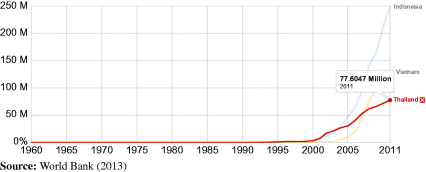
Figure 3 Mobile cellular subscriptions
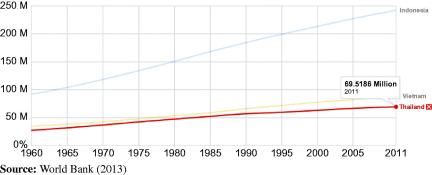
Figure 4 Population
2.7 Problems with current systems
There are several reported problems that affect the healthcare in Thailand; most of them surround the issue of migrant workers. According to Americas State Department the level of illegal immigration and forced labour in Thailand is on par with Afghanistan, Iraq and Niger (The Economist, 2013). Reports suggest that around 2 million migrant workers currently inhabit Thailand with the vast majority coming from the neighbouring nation of Myanmar (IRIN, 2013). Illegal immigrants do not contribute to the national budget and therefore have large financial impacts; Umphang Hospital reports losses of 28 million baht (£562,408) annually (National Health Commission of Thailand, 2012). However, the flip side to that is the migrant workers produce a report 60 million baht (£1.2 m) to the Thai economy annually (National Health Commission of Thailand, 2012).
Many are smuggled into Thailand and sold by brokers to factories, with reported exposure to physical abuse, unpaid wages and even confiscated papers, all of which are common occurrences (The Economist, 2013). However, there are stories of migrants who enter Thailand legally for work and are unaware of the social healthcare structure requirements (OToole, 2013). Illustrated through the case of Nang Lu who tragically died of kidney disease after being refused care from three hospitals for not having a social security card. The Lu family were not aware of the procedure required to gain access to social healthcare and could read little Thai. Under Thai law employees are to pay 4 per cent of their income, which is matched by employers in order to be protected by social healthcare. Failure to enrol employees is against the law, however it is a common occurrence due to negligence and the induced costs for companies (OToole, 2013).
3 Discussion
The literature covered in the above editorial highlights a changing demographic of users and how their online activity. Social media has the potential to act as a medium to reach patients that traditionally where un-contactable. Such a development leap would enhance a healthcare facilitys ability to share information and raise awareness. The implementation of such an approach was not covered and a possible trial would be needed to explore the benefits claimed in the literature that was reviewed, however it is clear that the healthcare industry should adopt this new form of communication as quickly as the citizens of Thailand have.
Kieran Mulholl and Michael Pitt
References
Associated Press (2013), "Thai police summon Facebook users over coup-rumor posts, threaten to jail people for ‘liking’", available at: http://www.washingtonpost.com/world/asia_pacific/thai-police-summon-facebook-users-over-coup-feared-posts/2013/08/05/932e71d8-fdad-11e2-8294-0ee5075b840d_story.html (accessed 15 August 2013)
Benson-Colpi, M. (2013), "Social media use in the developing world supported by rising internet penetration", available at: http://oxfordbusinessgroup.quora.com/Social-Media-Use-in-the-Developing-World-Supported-by-Rising-Internet-Penetration (accessed 12 August 2013)
Computer Sciences Corporation (2012), Should Healthcare Organisations Use Social Media?, CSC, Falls Church, VA
(The) Economist (2013), "A deadly cocktail", available at: http://www.economist.com/news/asia/21572800-long-standing-worker-abuses-get-some-serious-attention-deadly-cocktail (accessed 21 August 2013)
IRIN (2013), Thailand: Migrant Workers Unprotected and Uninformed, available at: http://www.irinnews.org/report/75261/thailand-migrant-workers-unprotected-and-uninformed (accessed 21 August 2013)
Jalote, S. (2013), "Thai Hospital adopts m-Health solution", available at: http://www.futuregov.asia/articles/2013/jul/09/thai-hospital-adopts-m-health-solution/ (accessed 15 August 2013)
KPMG International (2011), Increasing Importance of Social Media in Healthcare, KPMG, Amsterdam
McNab, C. (2009), What Social Media Offers to Health Professionals and Citizens, World Health Organization, Coogee
McNaughton, M. (2012), Developing Countries See Rapid Social Networking Growth, available at: http://therealtimereport.com/2012/01/06/developing-countries-see-rapid-social-networking-growth/ (accessed 12 August 2013)
Mangold, G.W. and Faulds, D.J. (2009), "Social media: the new hybrid element of the promotion mix", Business Horizons, Vol. 52 No. 4, pp. 357–365
Millard, S. (2013), "Thailand now has 18 million social media users (INFOGRAPHIC)", available at: http://www.techinasia.com/thailand-18-million-social-media-users-in-2013/ (accessed 11 August 2013)
National Health Commission of Thailand (2012), The Number of Migrant Workers Reaches 4 Million, available at: http://en.nationalhealth.or.th/node/294 (accessed 21 August 2013)
OToole, B. (2013), "Thai system fails Myanmar migrants", available at: http://www.mmtimes.com/index.php/national-news/7622-thai-system-fails-myanmar-migrants.html (accessed 21 August 2013)
Vensa Health (2013a), "Home", available at: http://hp.vensahealth.com/ (accessed 15 August 2013)
Vensa Health (2013b), "mHealth+ for hospitals", available at: http://hp.vensahealth.com/Solutions/mHealthforHospitals/mHealthforHospitals.aspx (accessed 15 August 2013)
Vensa Health (2013c), "Vensa Health makes finals of 2013 Red Herring Top 100 Asia Award", available at: http://hp.vensahealth.com/LatestNewsEvents/NewsArticle/tabid/166/smid/535/ArticleID/49/reftab/134/t/Vensa-Health-makes-finals-of-2013-Red-Herring-Top-100-Asia-Award/Default.aspx (accessed 15 August 2013)
(The) World Bank (2013), GINI Index, available at: http://data.worldbank.org/indicator/SI.POV.GINI (accessed 26 August 2013)
Further Reading
abc News (2013), "Thai police summon Facebook users over postings", available at: http://abcnews.go.com/International/wireStory/thai-police-summon-facebook-users-postings-19868913 (accessed 15 August 2013)
Cheyne, M. and Newcombe, L. (2013), "Social media: protecting patient confidentiality", Health Service Journal, 5 August
Chowdhury, M. and Phaholyothin, N. (2012), "Healthcare in Thailand: a story to inspire confidence", available at: http://www.nationmultimedia.com/opinion/Healthcare-in-Thailand-a-story-to-inspire-confiden-30180854.html (accessed 15 August 2013)
Deloitte (2008), Medical Tourism: Customers in Search of Value, Deloitte, Washington, DC
Kaplan, A. and Haenlein, M. (2010), "Users of the world unite! The challenges and opportunities of social media", Business Horizons, No. 53, pp. 59–68
Online News Heard Now (2013), "Thailand Eyes Medical Insurance for Tourists to Thailand", available at: http://www.onlinenewsheardnow.com/thailand-eyes-medical-insurance-for-tourists-to-thailand/2032/ (accessed 21 August 2013)
Sakunphanit, T. (2008), Universal Health Care Coverage Through Pluralistic Approaches: Experience from Thailand, International Labour Organisation, Bangkok
Servaes, J. (2008), Communication for Development and Social Change, Sage, New Delhi
Smitasiri, S., Attig, G. and Dhanamitta, S. (2010), "Participary action for nutrition education: social marketing vitamin A-rich foods in Thailand", Ecology of Food and Nutrition, Vol. 3 No. 28, pp. 199–210
Williams, C. (2012), "Executive ‘forced out of job’ over LinkedIn CV", available at: http://www.telegraph.co.uk/technology/social-media/8992541/Executive-forced-out-of-job-over-LinkedIn-CV.html (accessed 15 August 2013)

