Before witnesses to a crime identify a suspect from a lineup, law enforcement routinely requires witnesses to provide a facial description or facial composite of the suspect. However, research suggests that witnesses who engage in facial recall of suspects could have impaired subsequent recognition performance of that suspect. This study aims to compare facial description and facial configuration tasks and examine whether these procedures influenced memory strength and response criterion during recognition. In a verbal facial description task, witnesses describe the facial features of a suspect. In a visual facial configuration task, witnesses choose individual facial features that resemble the suspect from arrays of feature alternatives.
Participants in the study witnessed a surveillance video depicting a burglary. Next, participants either provided a description of the suspect’s face, being prompted to describe the facial features, or engaged in a facial configuration task of the suspect’s face, selecting the facial features that best resembled the suspect from arrays of other facial feature options. Participants in a no-recall control condition did not recall the suspect. Last, participants attempted to identify the suspect from either a target present or target absent showup recognition task.
Results showed no evidence of reduced memory strength. However, participants in both facial recall conditions adopted more conservative response criteria than those in the control condition, particularly participants in the facial configuration condition.
Findings have important theoretical implications for theory development regarding how witness facial recall of suspects impacts recognition performance and applied implications for eyewitness investigative procedures.
Verbal overshadowing research has examined the effects of facial recall on recognition for 30+ years; however, few studies have directly compared verbal facial descriptions with visual facial configuration procedures within the same paradigm.
Eyewitnesses to crimes often provide verbal facial description and visual facial composites of suspects that law enforcement can use to identify and locate suspects. Once police locate a suspect, the witness might be asked to identify the suspect. Research, however, suggests that witnesses who engage in recall of suspects, such as provide a verbal facial description or visual facial composite, could have impaired subsequent recognition performance of that suspect. Researchers who study this effect of recall on recognition performance in the context of crimes use a typical paradigm (e.g. Baker and Reysen, 2020; Schooler and Engstler-Schooler, 1990). First, participants are exposed to a simulated crime video, such as a bank robbery or burglary, making participants ostensibly mock witnesses to the crime. Next, mock witnesses are required to engage in either a recall task, such as providing a description of the suspect’s face, or a no-recall control task. Finally, mock witnesses attempt to identify the suspect in a recognition task like a lineup or showup. The findings of this research largely show that if mock witnesses engage in recall of the suspect, then their recognition performance of the suspect will be compromised (e.g. Meissner and Brigham, 2001; Schooler and Engstler-Schooler, 1990).
Researchers interested in the deleterious effects of recall on recognition performance in the context of crimes have primarily focused on two types of recall tasks: describing a suspect’s face and engaging in a facial configuration task. Researchers who require mock witnesses to recall and provide a description of a target suspect typically instruct participants to provide a detailed description of the target suspect’s facial features. Impaired recognition performance of a suspect after providing a description of the suspect’s face is known as verbal overshadowing (Schooler and Engstler-Schooler, 1990). Early (e.g. Alogna et al., 2014; Dodson et al., 1997) and recent (e.g. Baker and Reysen, 2020, 2021; Brown et al., 2014) researchers have replicated the effects of facial description recall on recognition performance. The effect has proven to be difficult to replicate over the years (Schooler, 2014; Sporer, 1996), and studies separating discriminability from response bias using receiver operating characteristic analyses have reported reduced discriminability alongside only weak evidence of a criterion shift (Smith and Flowe, 2015; Wilson et al., 2018). However, a classic meta-analysis by Meissner and Brigham (2001) confirmed an overall negative impact of facial descriptions on recognition performance.
Three main theories have been proposed to explain verbal overshadowing, or the harmful effect of facial descriptions on recognition performance (for a review, see Schooler et al., 1997). First, according to the recoding interference theory, poor recognition performance occurs when mock witnesses’ descriptions include incorrect information about the suspect’s face. When witnesses are asked to identify the suspect, the incorrect information is accessed, interfering with subsequent identification accuracy (Schooler and Engstler-Schooler, 1990; Meissner et al., 2001). Second, Schooler and Engstler-Schooler also offered the transfer inappropriate processing shift theory, which posits that when mock witnesses are required to describe features of a perpetrator’s face, witnesses shift their processing strategy from an initial holistic approach to a featural approach. The shift from holistic to featural processing is theorized to impair access to the original holistically encoded face (Schooler, 2002). Third, Clare and Lewandowsky (2004) proposed the criterion shift theory, which was premised on the assumption that mock witnesses who recall the suspect’s face find the recall task difficult. When subsequently confronted with the face recognition memory task, mock witnesses who provided a description would then be less likely to make a positive response than witnesses who did not provide a description.
Researchers interested in facial configuration, or similarly facial composite, tasks require mock witnesses to recall the facial features of the suspect by instructing participants to choose various facial features that best resemble the suspect’s features from a bank of features (Frowd, 2017; Frowd et al., 2010; Frowd and Fields, 2011; McQuiston-Surrett et al., 2006; Valentine et al., 2010). For instance, mock witnesses may be presented with a series of noses and asked to choose which nose best resembles the suspect’s nose. Evidence that constructing a face impairs the constructing witness’s own subsequent recognition of the suspect is considerably more limited than the corresponding verbal overshadowing literature. Most facial composite studies evaluate the quality of the image that is produced rather than administering a separate identification task to the witness who built the face (e.g. Frowd et al., 2010; McIntyre et al., 2016; Skelton et al., 2015; Valentine et al., 2010). Additionally, Frowd and Fields (2011) set out explicitly to test whether, describing the suspect prior to a facial composite task, a verbal overshadowing effect, would interfere with facial composite construction. The researchers observed a weak effect: facial composite quality was poorer when the facial construction task immediately followed a description than when no description was given. While researchers have examined facial configuration tasks broadly, pertinent to the current study is whether engaging in such tasks interferes with recognition performance of the face. Notably, several studies that did include a separate identification task suggest facial composite tasks can interfere with recognition (e.g. Comish, 1987; Topp-Manriquez et al., 2016; Wells et al., 2005). For instance, after a one-week delay, Topp-Manriquez et al. (2016) found that participants who engaged in the facial construction task had worse recognition performance compared to participants who did not engage in the facial construction task. Similar to the label, verbal overshadowing for verbal facial recall, one might refer to a detrimental effect of engaging in a facial configuration task, a type of visual facial recall, on recognition performance as “visual overshadowing.”
Across studies, the primary and most widely accepted explanation used to describe the effects of facial configuration recall on recognition is situated in a processing shift, or levels-of-processing, framework (Baddeley, 1979; Craik and Lockhart, 1972; Tulving and Thomson, 1973; Wells and Hryciw, 1984). According to this processing shift explanation, engaging in the facial configuration task encourages participants to engage in a featural processing strategy, which interferes with the holistic processing strategy necessary for accurate encoding and recognition (Patterson and Baddeley, 1977; Wells and Hryciw, 1984). An earlier, less researched, explanation for the effect of facial configuration recall on recognition mentioned in the literature focuses on the quality of the recall provided during facial configurations. This account suggests that engaging in facial configuration recall, while simultaneously trying to hold the encoded image in memory, may interfere with the quality of the recall produced during the facial configuration task and thus performance during the recognition task (Brooks, 1968; Christie and Ellis, 1981; McQuiston-Surrett and Topp, 2008). Finally, while not a formal theory established in the literature, there is also a theoretical justification that supports that engaging in the facial configuration task impacts the strategy mock witnesses use when they approach the recognition task. That is, engaging in the facial configuration task might encourage mock witnesses to adopt a more conservative approach during the recognition task. Early memory researchers suggest that when participants monitor their recall combined with their expectations about how they might perform on a subsequent recognition memory task, then their willingness to choose someone during recognition might be reduced (Brigham and Pressley, 1988; Comish, 1987; Winkielman and Schwarz, 2001).
There are important differences between the two types of recall tasks focused on in the current study: verbal facial description and visual facial configuration tasks. The most apparent difference is that the facial description task is a verbal recall task in which mock witnesses are asked to verbalize their description of the previously encoded suspect. Contrary to the verbal nature of the facial description task, the facial configuration recall task is a visual recall task where mock witnesses are asked to choose features that best resemble the suspect from various facial feature sets. The facial description and configuration tasks are also different, in that they encourage mock witnesses to engage in different memory strategies during recall. The facial description task requires mock witnesses to engage in a type of cued recall memory task. Studies in which researchers use the facial description recall task, mock witnesses are typically given cues to guide their description of the suspect (“…describe the shape of the eyes, eyebrows, ears, nose, mouth…”) and are then allowed to freely record their description either verbally, in writing, or typed out (e.g. Baker and Reysen, 2020; Meissner, 2002; Schooler and Engstler-Schooler, 1990). Facial configuration tasks require mock witnesses to engage in a type of “cued recall-then-recognition memory” task. Unlike the cued recall task used in facial description recall studies in which participants are cued to describe the specific facial features, participants in the cued recall-then-recognition task in facial configuration studies are cued to recall a specific facial feature of the suspect (i.e. the suspect’s eyes) and then recognize which facial feature, among options of other features (i.e. bank of other eye pairs), most closely resembles the suspect’s feature (e.g. McQuiston-Surrett et al., 2006).
Despite the apparent differences between the nature of the facial description and configuration recall tasks, there are similarities between the theoretical accounts put forth to explain each type of recalls’ effect on recognition performance. First, researchers who have examined both types of tasks on recognition performance have proposed theories focusing on the quality of recall. That is, each type of facial recall has theories that suggesting the quality of the recall produced relates to the quality of the recognition performance (e.g. McQuiston-Surrett and Topp, 2008; Meissner et al., 2001). Second, researchers have offered a processing shift theory explaining impaired recognition performance is due to competing processes used during encoding, recall and recognition. It is proposed people encode and recognize faces holistically, and when people engage in recall tasks such as facial descriptions or configurations, the featural nature of the recall tasks cause interference during the holistic recognition task (e.g. Meinhardt-Injac et al., 2013; Schooler, 2002). Third, both types of tasks could impact mock witnesses’ response criteria during the recognition task making their performance more conservative and reluctant to make an identification (Brigham and Pressley, 1988; Clare and Lewandowsky, 2004).
The current study was couched around the similar theories put forth to explain how facial description and configuration recall tasks might affect facial recognition performance. Specifically, the study had two main goals: 1) contribute to theory development regarding the effects of facial recall on recognition performance and 2) examine the extent to which both verbal facial description and visual facial configuration tasks impact recognition performance.
Importantly, the current study was not intended as a simple replication of prior verbal overshadowing research. Rather, the study was designed to directly compare two forms of eyewitness facial recall – verbal facial descriptions and visual facial configuration tasks – within the same experiment. This comparison is important because police procedures frequently involve obtaining verbal descriptions and, in some investigations, facial composite information prior to identification procedures. Additionally, we used a signal detection theory (SDT) framework to examine whether both forms of facial recall influence memory strength (d′), response criterion (C), or both. Memory strength, d′, is a measure of how well a witness can discriminate a face that was seen before from a face that was not and is calculated as z(hit rate) – z(false alarm rate). A d′ of 0 means the witness cannot discriminate the guilty suspect from an innocent suspect, so that a positive identification is equally likely whether or not the person shown is the culprit. Larger d’ values mean better discrimination. Response criterion, C, is a measure of how likely a witness is to respond “yes,” or make a positive identification. It is calculated as −0.5 × [z(hit rate) + z(false alarm rate)]. A C of 0 indicates neutral, or unbiased, responding, in which the witness is equally willing to make and to withhold an identification. C values greater than 0 indicate conservative responding. d′ and C are mathematically independent, so a facial recall procedure can change how willing a witness is to identify someone without changing the strength of the underlying memory, and vice versa (DeCarlo, 1998; Wixted and Mickes, 2014). Recent work suggests that theoretical explanations for verbal and visual overshadowing can be clearly understood within an SDT framework that distinguishes memory strength from response criterion (Bacharach and Baker, 2024; Goldman and Baker, 2025). SDT models of eyewitness identification propose that recognition decisions reflect both the strength of the memory signal and the criterion witnesses use when deciding whether to make an identification (Clare and Lewandowsky, 2004; Clark, 2003). Within this framework, facial recall procedures could impair recognition performance in at least two ways: first, recall procedures may reduce memory strength by disrupting holistic face processing and encouraging featural processing during the recall of the suspect (Schooler, 2002; Wells and Hryciw, 1984). Second, recall procedures may alter witnesses’ response criterion by increasing uncertainty about the quality or completeness of their memory, thereby making witnesses less willing to make a positive, or “yes,” response during identification (Clare and Lewandowsky, 2004). The present study focused specifically on distinguishing these possibilities by separately examining d′ and C.
In the current study, participants witnessed a staged burglary video and were likened to mock witnesses. Next, mock witnesses either provided a description of the suspect’s face or engaged in a facial configuration task of the suspect’s face. Mock witnesses in a no-recall control condition did not engage in a recall task of the suspect’s face. Finally, mock witnesses attempted to identify the suspect from either a target present or target absent showup recognition task. Mock witnesses were required to say “yes” or “no” to the showup. Consistent with SDT, the “yes/no” recognition measure allowed us to assess important interactions and or main effects that could indicate memory strength or response criteria effects, respectively (Bacharach and Baker, 2024; Sauerland et al., 2008; Wells et al., 2015; Wixted and Mickes, 2014; Wright et al., 2009). Additionally, in Meissner and Brigham’s (2001) meta-analysis of verbal overshadowing studies, results of their review showed that impairing effects on recognition were stronger under certain conditions: for instance, when participants engaged in elaborative description procedures and when the recognition task immediately followed the recall task. The present study intentionally employed cued facial recall tasks, both verbal and visual, and an immediate identification procedure because those conditions provided an opportunity to examine whether similar memory strength and/or criterion shift effects emerged for both verbal and visual facial recall tasks. Additionally, in true investigations, police may ask witnesses just prior to an identification to recall the suspect’s face: for instance, they may want the witness to have their memory of the perpetrator freshly in mind or they might want to verify that the witness still remembers the suspect’s appearance. The primary theoretical question was whether facial recall tasks would influence memory strength, response criterion or both. If facial recall procedures reduced memory strength by disrupting holistic processing, then participants in the facial recall conditions should demonstrate reduced discrimination between target present and target absent showups. Operationally, this effect would appear as lower d′ values and an interaction between the facial recall and showup conditions. If facial recall primarily influenced response criterion, then participants in the facial recall conditions should adopt a more conservative tendency to make identifications, reflected in lower overall rates of “yes” responses in both target-present and target-absent conditions, or higher values of C. Because prior research has rarely directly compared verbal facial description and verbal facial configuration procedures within the same design, comparisons between those facial recall conditions were exploratory.
According to processing shift theories, mock witnesses in our study who engaged in the facial recall conditions, both the verbal facial description and visual facial configuration groups, should experience an incompatible featural process during the recall stage that would interfere with subsequent performance during the recognition stage. H1: Based on the processing theories, we hypothesized that mock witnesses who engaged in the recall conditions would have poorer memory strength compared to mock witnesses in the no-recall control condition. Recognition performance between mock witnesses in the facial description and facial configuration recall conditions was also examined, although we did not have a specific hypothesis regarding which recall method might demonstrate worse memory strength. According to response criteria theories, mock witnesses who engaged in the facial recall conditions would be reluctant to make a response during the recognition phase and, as a result, would respond more conservatively, or be more likely to reject the showup, during the showup task compared to mock witnesses in the no-recall control condition. Specifically, an overall decrease in positive identifications, or “yes” responses during the showup task should occur in the facial recall groups. H2: We hypothesized that mock witnesses who engaged in the facial recall conditions would have more conservative response criteria compared to mock witnesses in the no-recall control condition. We had no empirical reason to expect differences in response criteria between the facial recall conditions – examining this difference was exploratory in the study. According to recall quality theories, mock witnesses in the facial recall conditions who have less accurate recall should have poorer recognition performance than mock witnesses who have more accurate recall. Our study was designed to test the processing shift and response criteria accounts of verbal facial recall and visual facial configuration effects on recognition performance. Because mock witnesses in the current study were engaging in different recall tasks, the quality of mock witnesses’ recall and its effect on recognition performance could not be compared in the present paradigm. For that reason, we were unable to directly test recall quality theories in the current study.
Method
Design
The design of the study was a 3 (facial recall type: facial configuration, facial description or no-recall control) × 2 (showup type: target present or target absent) between-subjects design. The dependent variable was the probability of a “yes” response during the showup task. All participants were randomly assigned to conditions.
Participants
Participants (N = 410) were comprised of a national sample recruited using Prolific’s online crowdsourcing website and a sample recruited from the undergraduate research pool at the researchers’ university. Initially, 305 participants were obtained on Prolific. Forty-nine subjects were removed from the sample because of incomplete data making the final Prolific sample size NProlifc = 256 (Mage = 38.01, %Female = 50.40, %Male = 44.50, %, Other = 5.00%). Prolific participants were compensated $1.40 for their participation. In total, 159 participants were obtained from the undergraduate pool, and five subjects were removed because of incomplete data. The final undergraduate sample was Nundergraduate = 154 (Mage = 18.92, %Female = 74.70, %Male = 25.30). Undergraduate participants were given credit in their psychology courses for participating. The final total sample in the study consisted of Ntotal = 410.
The study was programmed using Qualtrics online surveying software. All stimuli were presented, and all responses were recorded using computers. Both Prolific and undergraduate participants completed the study online on their personal devices.
Materials
Encoding task. Prior to watching a crime video, participants were told to pay attention to the video with the following instructions: You are going to view a brief video. Pay attention. You will be asked about the video later. Participants were presented with these instructions for 1 min, after which they were automatically directed to the crime video stimuli.
Crime video. Participants viewed a video depicting a home burglary. The video was approximately 30 s long. In the video, the burglar is shown breaking into a locked door, entering the home and stealing various items from a cabinet and purse. The burglar is shown briefly looking toward the camera – the face of the burglar is visible for approximately 5 s. The video was presented in color. The video used in the study was created and used by Baker and Reysen (2020).
Recall task. After watching the video, participants were randomly assigned to engage in one of the recall tasks for 2 min.
Verbal facial description. Participants in the facial description condition were required to describe the face of the burglar in the video. Participants were given cued recall instructions and told to focus their descriptions on the facial features:
Now, compile a description of the face you saw in the video. Your task is to compile a facial description of the person in such a way that your description would aid someone else in attempting to identify the person. Your description should focus on facial features. Write about the shape and size of the eyes, eyebrows, nose, mouth, and chin. Create a description of the facial features that you believe best describes the face you saw in the video.
The facial description instructions were adapted from previous research (e.g. Baker and Reysen, 2020; Meissner and Brigham, 2001; Smith and Flowe, 2015). Participants typed their responses.
Visual facial configuration. Participants in the facial configuration condition were required to identify five facial features they believed belonged to the burglar in the video. Participants attempted to identify the burglar’s eyes, eyebrows, nose, mouth and chin. Participants were instructed:
Now, compile a composite of the face you saw in the video. Your task is to compile a facial composite of the person in such a way that your facial composite would aid someone else in attempting to identify the person. The facial composite will focus on facial features. You will be presented with photos of various eyes, eyebrows, noses, mouths, and chins. Select the photos of the facial features that you believe best resemble the face you saw in the video.
Participants attempted to choose the facial feature that best matched the burglar’s facial features among an array of five other foil, or distractor, facial features. Participants made their decisions using their device’s mouse or keyboard. The distractor facial features were cropped from foil photos in the six-person target present lineup used by Baker and Reysen (2020). Each feature array contained six alternatives: the burglar’s own feature and five distractor features, one cropped from each of the five lineup foils used by Baker and Reysen. The foil faces were consistent with a general description of the burglar, so the distractor features were drawn from faces like the target. The procedure is consistent with the isolated feature selection procedure used by Skelton et al. (2015) who found that composites built using isolated feature selection were subsequently named less accurately by other participants than were composites built while the whole face remained visible, indicating that isolated feature selection is the more demanding form of the task. Participants were only required to recall and recognize the features in this task. Participants did not create and view a full facial composite with their chosen facial features (e.g. Brown et al., 2020; Frowd and Fields, 2011).
To ensure that the facial features participants were encouraged to recall were as similar as possible between the facial configuration and description conditions, only the five facial features described in the instructions were the subject of recall in the facial recall conditions. Hair and other external features were deliberately excluded from both recall tasks. This was done so that the description and configuration conditions targeted exactly the same set of facial features. Additionally, research suggests that external features, such as hair, can carry substantial diagnostic weight when the face is unfamiliar (Ellis et al., 1979) and can distract witnesses while they construct faces (Frowd et al., 2012).
No recall. Participants in the no-recall condition played Tetris rather than recall information about the burglar’s face. The goal of the no-recall condition was to encourage participants to engage in a task other than recall of the burglary video. Tetris has been used before in no-recall conditions (e.g. Baker and Reysen, 2020), and implementation of the Tetris game was a practical task for our online sample. The study was programmed so that the game was presented in a new window positioned on the right side of participants’ screens. After 2 min passed, participants were directed to stop the Tetris game and continue with the study. The Tetris (2024) game used is open source.
Recognition task. After engaging in the recall tasks, participants were required to identify the burglar from a single photo. Before seeing the showup, participants were instructed: Now you will be asked to identify the person who you believe committed the burglary in the video that you saw previously. You will be shown 1 photo. This instruction is similar to a “neutral” or “standard” instruction (Mickes et al., 2017; Smith et al., 2018). When presented with the photo, participants were asked: Is the person shown in the photo the same person you saw commit the burglary in the video? Participants attempted to identify the burglar from either a photo of the burglar, the target present condition, or a photo of a foil, the target absent condition. Participants could either respond “yes” or “no.” The target present photo was a separate photo of the burglar and not a still frame taken from the burglary video. The showup photos depicted the face of either the target or foil, similar to a police booking/release photo. Participants were not given the option to say, “I don’t know.” In forensic literature, this type of identification task is referred to as a showup task. In cognitive literature, it is commonly referred to as a 1AFC task (Clark, 2003). Participants made their response using a computer and mouse.
Procedure
Participants completed the study online. All participants provided informed consent and then watched the 30 s crime video. Immediately after watching the video, participants were randomly assigned to engage in one of the three recall conditions for 2 min: participants either completed a facial configuration task of the burglar’s face, provided a description of the burglar’s face or completed a no recall control task and played a game of Tetris. Following the recall task, participants engaged in the recognition task and were either shown a target present or target absent photo of the burglar. Participants chose whether they believed the photo depicted the burglar or not. Finally, all participants completed a demographic questionnaire, were debriefed and compensated for their participation. From start to finish, the duration of the study was approximately 10 min.
Analytical approach
First, we examined recognition performance using logistic regression. Logistic regression analyses were used to examine the effects of facial recall type and showup on “yes” responses. Instead of computing hits and false alarms as has been done in traditional forensic face recognition studies (e.g. Baker and Reysen, 2020, 2021), the eyewitness decision that each participant makes (“yes” or “no” in a 1AFC or showup task) was the dependent variable (e.g. Bacharach and Baker, 2024; Sauerland et al., 2008; Wells et al., 2015; Wixted and Mickes, 2014; Wright et al., 2009). Logistic regression analysis allowed us to assess for main effects and an interaction between the factors. The interaction with showup indicated a memory strength effect, while main effects for “yes” indicated response criteria effects. See DeCarlo (1998, 2010) for excellent descriptions of how regression can be used to estimate signal detection measures such as d’ and C when using “yes” responses as the dependent variable. Second, we computed differences in memory strength, d’s, and response criteria, Cs, between the facial recall conditions.
Using G*Power (version 3.1.9.7, Faul et al., 2009), we performed an a priori power analysis for a sample size estimation based on data from Baker and Reysen (2021)[1]. Baker and Reysen (2021) used odds ratios to describe their effect sizes, ORs ranged from 0.05–5.12. ORs observed in their study are considered to be large. With a significance criterion of OR = 5.00, α = 0.05 and Power = 0.95, the minimum number of subjects per experimental condition equaled n = 47, indicating that the total sample size needed to detect an effect in the current study was n = 282 for logistic regression analysis. As a result, we believe the obtained sample size of n = 410 was adequate to test our hypotheses.
Results
We initially tested for an effect of sample type on recognition performance and ran a logistic regression consisting of sample type (coding: Prolific = 0, undergraduate = 1) on our primary dependent variable, “yes” responses (coding: no = 0, yes = 1). Results revealed no difference in recognition performance between the Prolific (33.2%) and undergraduate (35.1%) samples, Wald(1) = 0.15, p = 0.700, OR = 1.09, 95% CI [0.71, 1.66]. Sample type was dropped from all subsequent analyses.
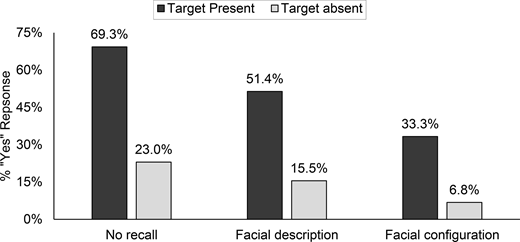
To examine the effect of facial recall on recognition performance, a logistic regression consisting of facial recall type (coding: no recall = 0, facial description = 1, facial configuration = 2), showup type (coding: target absent = 0, target present = 1) and the interaction between the two factors was conducted on “yes” responses. Odds ratios below 1, and the corresponding 95% confidence interval, are reported as their reciprocal (1/OR) so that all reported odds ratios are greater than 1; this transformation does not change the direction or significance of any effect, only the framing of the comparison. Results of the full model, –log likelihood = 432.11, revealed main effects of facial recall type, Wald(2) = 6.81, p = 0.033 and showup type, Wald(1) = 29.50, p < 0.001. There was no interaction effect between facial recall type and showup type, Wald(2) = 0.23, p = 0.892. As expected, the odds of a “yes” response were higher for mock witnesses shown the target present showup (52.7%) compared to the target absent showup (15.1%), OR = 7.58, 95% CI [3.65, 15.75]. See Figure 1. To increase the power to detect an interaction between facial recall and showup, we combined the two facial recall conditions into a single facial recall group and performed another logistic regression consisting of facial recall (coding: no recall = 0, facial recall = 1), showup and the interaction. Results, –log likelihood = 439.00, revealed main effects of facial recall, Wald(1) = 5.34, p = 0.021, OR = 2.50, 95% CI [1.15, 5.41] and showup type, Wald(1) = 29.52, p < 0.001, OR = 7.58, 95% CI [3.65, 15.75]; however, there was no interaction effect between facial recall type and showup type, Wald(2) = 0.13, p = 0.717, OR = 1.20, 95% CI [0.45, 3.20]. Because there was no interaction effect, or apparent memory strength effect, another logistic regression was performed consisting of facial recall on “yes” responses without showup type or the interaction term. This new model, –log likelihood = 500.29, revealed an effect of facial recall on “yes” responses, Wald(2) = 22.69, p < 0.001. Results showed that compared to the no recall control group (46.3%), the odds of a “yes” response was substantially lower for the facial configuration recall group (18.8%), Wald(1) = 22.69, p < 0.001, OR = 3.73, 95% CI [2.17, 6.40]. There was a marginal difference in the odds of a “yes” response between the no recall group and facial description recall group (35.2%), Wald(1) = 3.52, p = 0.061 OR = 1.59, 95% CI [0.98, 2.56]. The odds of a “yes” response was lower in the facial configuration condition compared to the facial description condition, Wald(1) = 8.67, OR = 2.34, p = 0.003, 95% CI [1.39, 4.13].
Differences in d’s and Cs for the eyewitness recall conditions were computed. To compute differences in d’s, the G statistic was computed for the comparisons between all facial recall conditions (Gourevitch and Galanter, 1967). Consistent with the lack of interaction observed in the logistic regression analysis, results showed that memory strength, d’s, did not differ among the facial recall groups, all values were < 1.96. Additionally, we pooled the facial recall conditions to a single facial recall group and compared its d’s to the no recall group d’s. Results showed that the facial recall group still did not differ from the no recall control group. See Table 1 for d’s and variance for d’s (Vd’) for the facial recall conditions. See Table 2 for differences in d’s.
To compute differences in C among the facial recall conditions, we calculated the 95% confidence interval around the differences between the conditions’ C values and determined whether the conditions could be distinguished from each other. Results revealed that compared to the no-recall control group, mock witnesses’ response criteria in the facial configuration (95% CI [0.49, 1.18]) and facial description (95% CI [0.04, 0.69]) recall groups were more conservative. Additionally, mock witnesses’ response criteria in the facial configuration group was more conservative compared to mock witnesses in the facial description condition (95% CI [0.11, 0.84]). See Table 1 for Cs and variance for the Cs (VC) for the facial recall groups. See Table 3 for differences in Cs. Taken as a whole, the findings showed that mock witnesses in the facial recall groups adopted a more conservative decision criteria when engaging in the recognition task compared to the no recall condition.
Discussion
The theories proposed across facial description and configuration studies to explain their detrimental effects of recall on recognition performance essentially define their “verbal” and “visual” overshadowing effects as an increase in false alarms and decrease in hits for mock witnesses who engage in the facial recall conditions compared to witnesses who do not (e.g. Schooler, 2014). Based on this definition, the findings in the current study did not provide support for H1, or a verbal or visual overshadowing effect. That is, we did not observe an interaction effect between the facial recall and showup factors on “yes” responses. The findings in the current study, however, revealed a potentially important finding in support of H2: mock witnesses who engaged in the facial recall conditions had a significantly more conservative response criteria during the recognition task. Specifically, compared to mock witnesses in the no recall control group, mock witnesses who engaged in the facial recall tasks were most conservative, or less likely to respond “yes” when attempting to identify the suspect. Both hits and false alarm rates were lower in the facial recall groups compared to the rates associated with the no recall group, see Figure 1. Relative to mock witnesses in the no-recall condition, mock witnesses in the facial configuration condition were most conservative followed by mock witnesses who engaged in the facial description task. Responding was most conservative in the facial configuration condition, even compared to performance in the facial description condition.
We believe the findings in the current study, at least moderately, contribute to our two main study goals: inform the theoretical accounts regarding the effects of facial description and configuration tasks on recognition performance and better understand the extent to which both facial description and configuration tasks influence recognition performance. Regarding our first goal, we interpret these findings as support for response criteria theories of facial recall on recognition (e.g. Brigham and Pressley, 1988; Clare and Lewandowsky, 2004; Schraw, 1998). We observed a robust effect of conservative responding, a decrease in both hits and false alarms, overall associated with the facial recall groups during the recognition task.
Regarding processing shift theories for the effects of facial recall on recognition, it is unclear whether the results of the present study provide any support for that explanation. Based on processing shift theories, we should have observed an interaction between the facial recall and showup factors on “yes” responses showing an effect on mock witnesses’ memory strength for the suspect’s face. We found no such effect on memory strength, and it does not appear that mock witnesses in the facial recall conditions experienced a shift to featural processing during recall that interfered with subsequent holistic processing during recognition and resulted in poorer recognition performance. Even after pooling the two recall conditions to increase power, we failed to observe a memory strength effect. We observed mock witnesses in the facial recall conditions were experiencing a reluctance to say “yes” during recognition. We therefore favor an explanation in which facial recall changes the decision strategy witnesses bring to the identification task rather than the strength of the underlying memory. However, this is not to say that processing shifts are irrelevant: we offer a nuanced, though simple, explanation that combines elements of both the processing shift and response criteria theories. Consistent with the bulk of research on facial processing and retrieval, facial recall might require mock witnesses to engage in a featural process that interferes with a holistic process required at recognition (e.g. Baddeley, 1979; Baker and Reysen, 2021; Brown et al., 2014, 2020; Craik and Lockhart, 1972; Patterson and Baddeley, 1977; Schooler, 2002; Tulving and Thomson, 1973; Wells and Hryciw, 1984). As a result, mock witnesses could experience a change in memory strength, a shift in their tendency to respond, or both. After all, shifts in mock witnesses’ response criteria can occur without changes in memory strength, as was observed in the current study, and changes in memory strength can occur independent of shifts in response criteria (e.g. Bacharach and Baker, 2024). Future theory development regarding how facial recall tasks impact recognition performance should focus on both mock witnesses’ memory strength and response criteria during the recognition task.
The second goal of the study was to examine how recognition performance might compare between facial description and configuration tasks. We interpret these findings as an indication that facial configuration tasks impact mock witnesses to a greater extent than the facial description tasks. Based on how we operationally defined the facial configuration recall task in the current study, we believe that the nature of our facial configuration task affected our mock witnesses’ tendency to make a positive response during recognition. Two features of the configuration task may explain why. The first is its structure. We previously described the facial configuration task as a type of cued recall-then-recognition memory task. Mock witnesses in that condition were required to recall and recognize five main facial features of the suspect. Each facial feature (e.g. nose) was chosen from a set of other features (e.g. five other noses). By contrast, the facial description task was a cued recall memory task. Mock witnesses in the facial description condition were simply cued to recall and then describe the suspect’s five facial features and were not required to engage in recognition of the features. It is possible that the additional recognition step required in the facial configuration cued recall-then-recognition memory task encouraged mock witnesses to experience a higher level of reservation during recognition. Early facial memory researchers proposed that memory tasks that require participants to hold a visual image in memory while simultaneously trying to compare the visual likeness of the face to various facial features could interfere with their performance during recognition (Brooks, 1968; Christie and Ellis, 1981; Shepherd and Ellis, 1996), whereas producing a description of the facial features may not be subject to the same level of interference and may not impact their recognition performance accordingly (McQuiston-Surrett and Topp, 2008). Our findings, overall, support this past research. The second is that the facial features were presented in isolation. Skelton et al. (2015) showed that feature selection carried out without the whole face in view resulted in less identifiable composites than selection made within a whole-face context, which indicates that isolated-feature selection is a more demanding form of the task. If task difficulty drives the criterion shift, then the isolated-feature procedure used in the current study could have produced a strong criterion shift, and a configuration task administered within a whole-face context, as recent modern feature systems do, might produce a smaller shift.
The study’s findings have practical implications for law enforcement and investigative procedures. Obtaining descriptions and facial configurations of suspects from witnesses is an important aspect of investigating crimes, and the present findings should not be read as suggesting that police should stop obtaining eyewitness descriptions or composites. Instead, the current findings suggest that cued facial recall, especially visual facial configuration tasks, may temporarily alter witnesses’ response criteria during subsequent identification procedures. One possibility is that the highly specific featural nature of the facial recall might make witnesses more aware of gaps or weaknesses in their memory of the suspect’s face, thereby increasing reluctance to make an identification. Police should consider that facial configuration tasks, such as IdentiKit, Photofit, Faces and PROfit, which are commonly used by police to generate facial composites of suspects are necessary in searching for and locating suspects. However, having a witness engage in such tasks right before an identification procedure may come at the expense of the witness’s conservative identification performance. We emphasize, however, that this recommendation is bound by two features of our design:
the identification task followed recall immediately; and
recall was typed by participants rather than elicited by an interviewer. It is unclear whether the criterion shift would persist across the delays typical of real investigations, or under interviewer-led spoken recall.
Finally, facial recall tasks are difficult. Describing a face accurately is hard even when the face is familiar (Sporer, 1996). A major challenge for police when obtaining facial descriptions is that some witnesses may lack the necessary vocabulary to communicate descriptions accurately to police. Additionally, the officer recording the facial recall may not share the same understanding of descriptions provided by the witness (e.g. how big is a “big nose?,” how round is a “round head?”). There may also be limitations inherent to the development of facial recall tasks and variability in how different facial configuration programs operate. Law enforcement should be cautious when estimating the certainty of witnesses’ identifications made after difficult facial configuration tasks.
Limitations and future directions
As with most mock witness research, our study has several limitations. To begin, although we implemented some insurances that participants attended to the stimuli in the study, our participants, both the Prolific and undergraduate samples, completed the study online using their personal devices. We acknowledge there may be concern regarding whether participants were attentive during the study (Behrend et al., 2011; Paolacci and Chandler, 2014). This may cause concern regarding the validity of the study’s findings, however, recent research supports the utility of online data collection (Baker et al., 2016; Bartneck et al., 2015). In fact, researchers have adopted the methodological approach of obtaining both online samples and in-person samples to address such concerns (e.g. Mickes et al., 2017), and the researchers have reported no effects of sample, or study administration, on performance. Regardless, our use of an online sample may diminish the likelihood that our research is taken seriously by researchers and police. A related concern is that online administration of the study may have restricted the sample. Participation required a suitable device, stable connection, digital familiarity and adequate visual acuity, and such requirements might covary with age, socioeconomic status, etc. Additionally, screen-based presentation introduced unmeasured variation in image size, resolution and viewing distance. Because of these concerns, future researchers might replicate the study using an in-person sample and/or measuring device characteristics.
Another limitation with regard to the ecological validity of the study relates to the methodology. As with the classic forensic eyewitness paradigm used in many studies, mock witnesses in our study engaged in simulations at each memory stage. During the encoding stage, mock witnesses viewed a video of a staged burglary. During the recall stage, mock witnesses engaged in recall of the burglar’s face (or not and played Tetris). Finally, mock witnesses were required to identify the burglar from a showup in the recognition stage. This procedure was completed on a computer and was absent from the stressors of a real crime and interactions with law enforcement. Additionally, the recall tasks were necessarily more simplistic than what would be asked of witnesses to true crimes. For instance, we regard our facial configuration task as a simplified version of the more sophisticated software that law enforcement agencies use. Overall, we recognize that it is possible that mock witnesses’ recognition decisions could have been affected by the fact that their decision had no real-world consequences. However, using a type of field experiment in which mock witnesses might witness a more realistic crime and be able to interact with law enforcement during the recall and recognition procedures would involve a number of issues concerning practicality and confounding variables. Traditional mock witness paradigms are therefore a necessary methodology to study theoretical and applied issues regarding eyewitness identifications. Nonetheless, we acknowledge that participants’ responses may have differed if they believed their decisions had actual consequences. For instance, true witnesses to crimes might be very motivated to identify a suspect and experience a liberal response criteria than was observed in the study. Or, true witnesses might be concerned about the risk of potentially identifying someone incorrectly and experience an even more conservative response criteria. These are important issues that might be addressed in future research.
An additional limitation concerns the short interval between the facial recall procedures and the recognition task. In the present study, the entire sequence from crime exposure to facial recall to recognition occurred within approximately 10 min. This procedure is consistent with many laboratory studies of verbal overshadowing and closely resembles the conditions identified in Meissner and Brigham’s (2001) meta-analysis as most likely to produce impairing effects on recognition. However, actual criminal investigations often involve delays of days, weeks or months between initial witness descriptions and identification procedures. Additionally, and consistent the with present study’s design, police may require witnesses to recall the suspect once more before the identification. It remains unclear how long the conservative criterion shifts observed in the present study persist over time and with additional recall of the suspect. Future research should systematically examine whether criterion effects remain stable across longer retention intervals as well as additional opportunities to recall the suspect prior to identification that might more closely approximate real investigative procedures. A second and related procedural limitation concerns the modality of recall. Participants typed their facial descriptions, whereas in typical practice (e.g. through the cognitive interview), face recall elicited verbally by a trained officer and precedes rather than replaces face construction. Research by Portch et al. (2025) suggests that recall modality can be consequential for later face construction and typed self-report removes the interviewer’s opportunity to ask follow-up questions, probe, etc. A design in which recall is spoken, interviewer-led and followed by construction, as is standard practice, might result in a different pattern of criterion shifts from the one observed in the present study. Relatedly, we also acknowledge that, in forensic practice, the two forms of recall, verbal and visual, are not administered in isolation from one another; for instance, face construction is normally preceded by a face-recall interview, so that a witness who produces a composite has almost always described the face first (Frowd and Fields, 2011; Portch et al., 2025; Skelton et al., 2015). Because our design deliberately separated description from configuration, our results do not speak to the combined procedure that is normal in face construction where a witness describes the face and then builds it. Future work could investigate whether the two facial recall tasks in sequence produce an additive criterion shift.
Finally, attempts were made to develop facial recall conditions that were similar in nature regarding the quantity and quality of content it required mock witnesses to recall (five facial features). However, the fact that the facial recall tasks were obviously different types of recall tasks and yielded different forms of qualitative data, comparing recall quality or accuracy was not possible in the present study. As a result, the study could not provide a test of the recall quality theories regarding facial recall on recognition. Research appears to report stronger support for the processing shift and response criteria explanations; however, we are aware of no studies that preclude recall quality theories at this time. Future iterations of this research should specifically attempt to test recall quality theories in light of the current study’s findings. That is, just as a processing shift might, or might not, produce changes in response criteria during the recognition task, the nature of the relationship between recall quality and response bias could be similar.
Conclusion
The present study extended the existing literature on the effects of facial recall on subsequent recognition performance by directly comparing verbal facial description procedures with visual facial configuration procedures using SDT. The findings indicated that facial recall procedures did not meaningfully reduce memory strength, but they did influence witnesses’ response criteria during the showup identification task. Specifically, witnesses who engaged in facial recall procedures adopted more conservative response criteria than witnesses in the no-recall control condition, with the strongest effect observed in the facial configuration condition. These findings support the interpretation that eyewitness facial recall procedures may alter decision strategies rather than substantially impair memory strength of a suspect. The findings also highlight the importance of distinguishing memory strength from response criteria when evaluating eyewitness identification performance. Future research should further examine how different forms of facial recall, varying retention intervals between recall and recognition and more ecologically valid investigative procedures affect eyewitness recognition decisions.
Implications for practice
In the present study, neither verbal facial description nor visual facial configuration tasks reduced witnesses’ ability to discriminate a guilty from an innocent suspect in a showup recognition task. Findings suggest that neither facial recall procedure should be avoided on the grounds that it damages a witness’ memory for the face.
Both the verbal facial description and visual facial configuration tasks affected witnesses’ willingness to make an identification of the suspect in a showup task: mock witnesses were less likely to make an identification after engaging in the facial recall tasks. Investigators and courts should consider that a rejection during identification, after engaging in facial recall of the suspect, may reflect a more conservative response criterion rather than a failure to recognize the suspect.
Because hits and false alarms both decreased in the study, a conservative shift in response criteria is not simply a loss of accuracy: it is a reduction in mistaken identifications of innocent suspects as well as a reduction in correct identifications of guilty suspects. This trade-off should be made explicit whenever the value of a facial recall task prior to identification is being weighed in court.
Given the growing use of holistic facial composite procedures (e.g. Frowd et al., 2010; Valentine et al., 2010), which require selection from arrays of whole faces, additional research should examine whether holistic composite systems produce the same conservative criterion shift as feature-based facial composite procedures and/or whether the two tasks in sequence produce an additive criterion shift.
Samantha Leo is based at the Department of Psychology, Coastal Carolina University, Conway, South Carolina, USA.
Melissa A. Baker is based at the Department of Psychology, Coastal Carolina University, Conway, South Carolina, USA.
Authors Note
Samantha Leo, B.S., was a Research Assistant, Department of Psychology, Coastal Carolina University. The author is currently a Graduate Research Assistant, Department of Psychology, Florida International University, can be contacted at: sleo008@fiu.edu.
Melissa A. Baker, PhD, is an Assistant Professor, Department of Psychology, Coastal Carolina University, Link to Melissa BakerLink to the website of Melissa Baker.
Data collection was completed at the authors’ institution, Department of Psychology, Coastal Carolina University.
Portions of this study were presented at the American Psychology-Law Society conference.
All procedures performed in studies involving human participants were in accordance with the ethical standards of Coastal Carolina University’s institutional review board and with the 1964 Helsinki declaration and its later amendments or comparable ethical standards.
The data that support the findings of this study are openly available in Mendeley Data at Link to Eyewitness Facial RecallLink to the website of data.mendeley, doi: 10.17632/tfd2h9xgmw.1.
Correspondence concerning this article should be addressed to Melissa A. Baker at Department of Psychology, Smith Science 210, 109 Chanticleer Drive East, Conway, SC 29526 Phone: 843-349-2539.
Note
Baker and Reysen (2021) used correct identifications (hits and correct rejections) as the dependent variable in their study. The current study’s dependent variable is “yes” responses. However, the researchers used a similar factorial design and reported ORs. Thus, we believe we have a sufficient theoretical and empirical justification to base the current study’s sample estimation on their reported effects.