

This study aims to conduct a comprehensive bibliometric analysis to evaluate the impact of Industry 4.0 technologies on firm performance, with special attention to the transformative implications of the COVID-19 pandemic. The study examines the direction and dynamics of scholarly output from 2017 to 2024, shedding light on emerging themes, theoretical frameworks and research shifts.
The study employs bibliometric methods using data extracted from the Scopus database. Performance analysis techniques are used to identify publication trends, whereas science mapping techniques help visualize contributions by authors, institutions, journals and countries. The analysis focuses on two periods: pre- and post-COVID-19, to understand the pandemic’s influence on research activity.
The analysis reveals a sharp increase in publication output after 2020, with China emerging as the most prolific country and Harbin Institute of Technology as the leading institution. Influential authors such as Samuel Wamba Fosso and journals like Sustainability have driven scholarly output. Core research themes include digital transformation, AI, big data analytics and competitive advantage. Four keyword clusters were identified, emphasizing digital adoption, sustainability, strategic performance and technological innovation. The study also uncovers significant research gaps – particularly the underrepresentation of SMEs, limited longitudinal studies and a need for broader theoretical frameworks.
This paper offers a timely and novel contribution by being among the first bibliometric studies to examine Industry 4.0 and firm performance through a COVID-19 lens. In contrast to earlier reviews that lacked temporal differentiation or performance focus, this study identifies scholarly shifts, conceptual frameworks and strategic themes emerging during a global crisis. It provides actionable insights for academics, practitioners and policymakers seeking to leverage Industry 4.0 for resilient and sustainable business practices.
1. Introduction
Industry 4.0 has transformed the global industrial landscape, bringing a new era of innovation (Javaid et al., 2022). This transformative era is characterized by digitalization, automation and the integration of advanced technologies such as artificial intelligence (AI), the Internet of Things (IoT) and big data analytics (Abulibdeh et al., 2024; Jan et al., 2023). Commonly known as the Fourth Industrial Revolution, Industry 4.0 emerged in November 2011 through an article published by the German government. This concept originated as part of a strategic initiative aimed at advancing high-tech innovation under the 2020 agenda (Zhou et al., 2016). Firms worldwide increasingly adopt Industry 4.0 practices to enhance their operational efficiencies, foster innovation and gain a competitive edge in rapidly evolving markets (Javaid et al., 2024). This study presents a bibliometric analysis focused on understanding how Industry 4.0 technologies impact firm performance. By using bibliometric methods, the paper reviews existing literature, aiming to provide a big picture view of research trends, major contributing journals, the overall structure of knowledge in this field and providing insights for further research.
Firm performance (FP) involves assessing how effectively a company achieves its objectives and goals (Santos and Brito, 2012; Taouab and Issor, 2019). This evaluation often relies on various determinants that can be broadly categorized into two dimensions: financial performance includes profitability, growth and market value (Yadav et al., 2021), whereas strategic performance covers employee satisfaction, customer satisfaction, environmental performance, environmental audit performance, corporate governance and social performance (Martiny et al., 2024). Each dimension represents a specific aspect of the company’s overall outcomes and is evaluated using a distinct set of indicators(Selvam et al., 2016). These dimensions collectively provide a comprehensive view of a firm’s success and its ability to sustain competitive advantages over the long term (Chopra et al., 2024).
Recent economic disruptions have underscored the need for financial flexibility and prudent investment in driving firm performance. During crises like the COVID-19 pandemic, companies with strong cash flows and adaptable financial strategies were better positioned to absorb shocks. Supply chain interruptions and market volatility prompted many firms to revisit the efficiency and effectiveness of their investment decisions. Empirical evidence supports this emphasis on flexibility: firms that maintained higher financial agility and sound governance showed improved resilience and performance through downturns (Wu et al., 2024). In parallel, a surge of interest in advanced technologies especially AI is reshaping corporate strategy. The technology, media and telecommunications sector, for example, has experienced a resurgence in merger and acquisition activity as companies race to strengthen their AI capabilities and capitalize on generative AI innovations (Feyisetan et al., 2025). These trends highlight the dynamic environment in which Industry 4.0 investments and firm performance are intertwined.
In the academic discourse, several recent studies have examined the drivers and impacts of Industry 4.0 adoption from different angles. For instance, Hussainey et al. (2022) found that effective corporate governance can enhance transparency by increasing the extent of narrative reporting on Industry 4.0 initiatives. Alkaraan et al. (2023) highlighted that Industry 4.0 technologies like big data and AI are reshaping strategic investment decisions and enabling more sustainable, circular supply chain models in UK firms. The COVID-19 shock itself has been a catalyst for digital transformation; one study observed that small- and medium-sized enterprises (SMEs) that swiftly embraced disruptive technologies (e.g. AI, cloud computing, robotic automation) were better equipped to withstand pandemic-related disruptions (Al Mulla et al., 2025). Furthermore, integrating Industry 4.0 with innovative business models can amplify performance benefits, Alkaraan et al. (2025) demonstrated that the adoption of Industry 4.0 tools facilitates green servitization strategies in supply chains, especially when coupled with strong governance support, thereby maximizing sustainable performance outcomes. These diverse findings underscore that the effect of Industry 4.0 on firm performance is multifaceted, influenced by organizational factors (like governance quality), external shocks and complementary innovations, which together shape the value firms derive from digital transformation.
Conceptually, this study is grounded at the intersection of technological innovation and performance management theories. Industry 4.0’s impact on firm performance can be interpreted through frameworks such as the resource-based view (where advanced technologies act as strategic resources for competitive advantage) and dynamic capabilities (where a firm’s ability to integrate and reconfigure digital technologies enhances its resilience and agility in turbulent environments). By employing a bibliometric analysis, we extend beyond a traditional literature review to map the intellectual structure of this research domain. This approach uses quantitative methods to reveal key research themes, influential works, collaboration networks and the evolution of ideas over time (Donthu et al., 2021). Such a data-driven overview not only uncovers knowledge clusters and emerging trends (Mukherjee et al., 2022), but also strengthens the theoretical foundation of the field by showing how disparate studies connect to broader conceptual frameworks. In particular, examining the literature from 2017 through the post-pandemic period allows us to identify shifts in scholarly focus, such as a growing emphasis on digital resilience, sustainability and governance in leveraging Industry 4.0 for performance gains that inform emerging theoretical perspectives. This bibliometric foundation not only contextualizes the current study but also provides a springboard for future research at the nexus of Industry 4.0 and firm performance.
Researchers around the world have extensively explored Industry 4.0 from various perspectives. However, the progression of research themes and trends related to performance remains insufficiently understood. Analysing current research trends and identifying key contributors, such as leading institutions, authors, journals and research gaps in prior studies, can provide valuable insights into the field and help guide future studies (Donthu et al., 2021). Therefore, it is essential to conduct a comprehensive study that systematically gathers and analyses data to evaluate research efforts on Industry 4.0 and firm performance, the study will cover the period from 2017 to 2024 to capture two critical stages: before and after the COVID-19 pandemic. Bibliometric studies use quantitative methods to examine the bibliometric data of a particular field. This method enables researchers to obtain a thorough understanding of the area, identify gaps in knowledge, generate new research ideas and evaluate their impact on the discipline (Öztürk et al., 2024). By establishing a solid foundation, bibliometric research plays a pivotal role in driving significant and innovative advancements in the field (Mukherjee et al., 2022).
Against this backdrop, the present study seeks to address four specific research questions:
What are the trends in Industry 4.0 and firm performance publications?
Who has made the most contributions and had the greatest impact on the field of research (authors, institutions, journals and countries)?
What are the most prevalent topics discussed in the existing literature?
What research gaps and future directions can be identified in the literature on Industry 4.0 and firm performance?
The researcher utilized performance analysis techniques to address RQ1, whereas science mapping techniques were applied to answer RQ2 and RQ3. In addition, a critical synthesis of prior studies was conducted to address RQ4. The structure of the study is organized as follows: Section 2 outlines the methodology employed in this research, Section 3 presents the results and discussion and Section 4 concludes the study by highlighting its limitations and suggesting avenues for future research.
2. Data and methodology
This study employs a three-step process for data extraction. The first step involves selecting a suitable database. For this purpose, the Scopus database was chosen due to its credibility and reliability as a tool for bibliometric analysis. Scopus provides extensive coverage across publishers without favouring any specific one, ensuring an unbiased approach (Ding et al., 2014; A. Khan et al., 2022). Relying on a single database for bibliometric analysis is recommended, as variations in data formats across databases can introduce errors, using a single authoritative source minimizes duplication and inconsistencies. To ensure reliability and minimize bias, the study followed strict, transparent and reproducible criteria and conducted comprehensive literature searches of published articles. The decision to use Scopus was guided by its extensive indexing of peer-reviewed journals in engineering, technology, management and social sciences fields closely related to industry 4.0 research. Unlike web of Science, Scopus offers greater coverage of recent publications, including open-access journals, making it suitable for tracking the post-COVID scholarly surge.
Second step we began with an initial search using the keywords Industry 4.0 and Firm Performance. Drawing on a preliminary review of the search results and keywords commonly employed in prior literature reviews (Alkaraan et al., 2022; Cobo et al., 2018; Khan, 2022; Lemstra and de Mesquita, 2023), we developed the following comprehensive list of keywords:
Set 1(Industry 4.0 keywords): (“Industry 4.0” or “Fourth Industrial Revolution” or “Industry 4.0 Technologies” or “digital transformation” or “digital technologies” or “digital innovation” or “information technology” or “fourth industrial revolution” or “Internet of things” or “3D printing” or “Robotics” or “Smart Factories” or “Artificial Intelligence” or “Big data” or “Cyber-physical systems” or “CPS” or “Clouding” or “Interoperability” or “ Digital Technologies” or “smart manufacturing” or “additive manufacturing”).
Set 2 (Firm Performance keywords): (“Firm* Performance” or “Corporate* Performance” or “Financial* Performance” or “Performance assessment” or “Competitive Advantage” or “Innovation Performance” or “ Marketing Performance” or “Non-financial Performance”). The initial search using the specified keyword resulted in a total of 1,102 articles. The choice of keywords was carefully structured to cover both technological and performance-oriented terminology. Wildcards (e.g. “Firm*”) were used to maximize matches, whereas Boolean operators (“OR”, “AND”) helped capture synonymous phrases. The keyword strategy was benchmarked against highly cited bibliometric studies to ensure replicability and comprehensiveness.
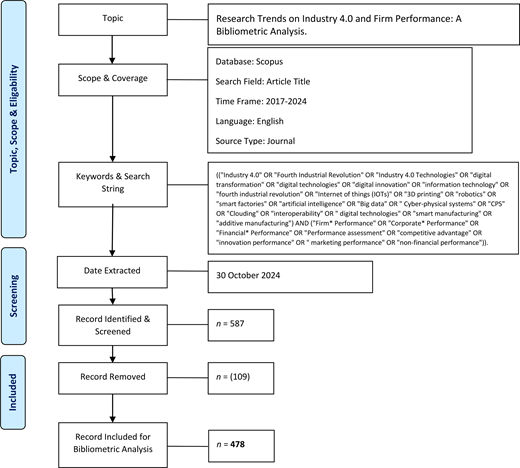
In October 2024, an advanced search was conducted in the SCOPUS database using two sets of keywords, focusing specifically on searching by titles rather than titles, abstracts and keywords (Mateen et al., 2013). This approach was adopted to ensure greater accuracy, as searching by titles reduces the inclusion of irrelevant papers where keywords might appear incidentally in abstracts. The process involved four filtration stages: database search, source type filtration, language filtration and document type filtration (Donthu et al., 2021). After the data screening process, 478 documents were finalized for bibliometric analysis, which were exported in CSV format for processing, the search process is illustrated in Figure 1. Inclusion criteria included peer-reviewed journal articles published between 2017 and 2024, written in English and accessible through Scopus. Exclusion criteria filtered out conference papers, book chapters, editorials, non-English documents and duplicates. These parameters were selected to ensure focus on academically rigorous and comparable outputs.
Thirdly, the retrieved data were used to plot a graph showing publication growth and total citations of scientific articles related to Industry 4.0 and firm performance from 2017 to 2024. For visualizing bibliometric networks, VOSviewer (version 1.6.20) was employed due to its user-friendly interface and diverse visualization options. VOSviewer was chosen for its proven accuracy in science mapping tasks, ability to handle large bibliometric files and capacity to produce interpretable visualizations of co-authorship, co-citation and co-occurrence networks. Unlike alternatives such as Bibexcel or CiteSpace, VOSviewer’s layout algorithms and cluster detection are optimized for research field structuring. The networks were displayed as visualization maps, where colours represented clusters or groups, circle sizes indicated productivity or citation volumes and line thickness depicted collaboration strength (Bukar et al., 2023).
3. Results and discussion
This section presents the results of the bibliometric analysis, covering five key areas:
number of publications by year;
number of citations per year;
highly cited articles;
source of publication;
most influential authors;
most influential countries;
the most productive institutions; and
keyword analysis.
3.1 Number of publications by year
Figure 2 demonstrates the annual publication trend in Industry 4.0 and firm performance research from 2017 to 2024, highlighting a steady increase in scholarly contributions. The field began modestly in 2017 with 21 publications, and whereas there was a slight decline to 19 in 2018, the topic gained traction from 2019 onwards. By 2020, the number of publications grew to 36, indicating rising interest as the significance of Industry 4.0 technologies became clearer. However, a minor dip to 32 publications occurred in 2021, likely due to the global disruptions caused by the COVID-19 pandemic, which impacted research activities across various fields. Despite this, the topic gained substantial momentum in 2022 with 73 publications and witnessed exponential growth, peaking at 155 articles in 2024.
 This line graph illustrates the progression of document publications from the year 2016 to 2024. The horizontal axis represents the years, ranging from 2016 to 2025, while the vertical axis indicates the number of documents, marked from zero to one hundred eighty in increments of twenty. Data points correspond to the years 2016 through 2024, with values of twenty-one in 2016, nineteen in 2017, twenty-seven in 2018, thirty-six in 2019, thirty-two in 2020, seventy-three in 2021, one hundred fifteen in 2022, and one hundred fifty-five in 2024. The graph features a continuous line connecting the data points and includes circular markers at each data point. There are no grid lines between zero and twenty. The graph demonstrates an increase in published documents over the years, particularly notable from 2021 onwards.
Evolution in the number of publications
Source: Authors’ analysis (2024)
This line graph illustrates the progression of document publications from the year 2016 to 2024. The horizontal axis represents the years, ranging from 2016 to 2025, while the vertical axis indicates the number of documents, marked from zero to one hundred eighty in increments of twenty. Data points correspond to the years 2016 through 2024, with values of twenty-one in 2016, nineteen in 2017, twenty-seven in 2018, thirty-six in 2019, thirty-two in 2020, seventy-three in 2021, one hundred fifteen in 2022, and one hundred fifty-five in 2024. The graph features a continuous line connecting the data points and includes circular markers at each data point. There are no grid lines between zero and twenty. The graph demonstrates an increase in published documents over the years, particularly notable from 2021 onwards.Evolution in the number of publications
Source: Authors’ analysis (2024)
The rapid increase in publications from 2022 to 2024 reflects the growing importance of Industry 4.0 technologies, such as IoT, AI and automation, in enhancing firm performance (Khan et al., 2023). Notably, 80% of the total research output (385 out of 478 publications) occurred in the last three years, underscoring the field’s novelty and relevance. This surge in interest may be attributed to firms’ increasing adoption of digital technologies to improve productivity, resilience and competitiveness in a post-pandemic world. The rising publication trend signals the integration of Industry 4.0 as a critical research area within business and operations management, paving the way for future explorations into its applications and impacts (Tao and Chao, 2024).
3.2 Number of citation per year
According to Figure 3, the annual citation trends for Industry 4.0 and firm performance research from 2017 to 2024 reveal notable fluctuations tied to influential publications, thematic evolutions and global disruptions. Citations peaked in 2017 (2,616), reflecting foundational works, which formalized Industry 4.0’s conceptual basis (Lasi et al., 2014). This coincided with government-backed programs (e.g. Germany’s Industrie 4.0, the US Smart Manufacturing) that spurred academic and industrial engagement (Thoben et al., 2017). A drop in 2018 (1,077) suggests the field’s transition from initial conceptual hype to deeper exploration. The rebound in 2019–2020, culminating in 2,438 citations in 2020, aligned with a surge in empirical studies connecting Industry 4.0 technologies to firm performance outcomes such as productivity, innovation and flexibility (Frank et al., 2019; Xu et al., 2018).
 The image displays a vertical bar graph illustrating the number of citations per year from 2017 to 2024. The horizontal axis is labeled "YEAR" with years ranging from 2017 to 2024, while the vertical axis is titled "Citation Per Year," indicating the number of citations with increments of five hundred. Each year features a distinct bar representing the total citations: 2616 for 2017, followed by a drop to 1077 in 2018, with numbers fluctuating in subsequent years 1886 in 2019, a peak of 2438 in 2020, then decreasing to 2174 in 2021, 2158 in 2022, and 1768 in 2023. The lowest value is indicated for 2024 at 510 citations. A dotted line runs through the bars, illustrating a linear trend in citation numbers over the years. Each bar includes a specific citation number displayed at the top for clarity.
The citation trend of publications
Source: Authors’ illustration based on Scopus data (2024)
The image displays a vertical bar graph illustrating the number of citations per year from 2017 to 2024. The horizontal axis is labeled "YEAR" with years ranging from 2017 to 2024, while the vertical axis is titled "Citation Per Year," indicating the number of citations with increments of five hundred. Each year features a distinct bar representing the total citations: 2616 for 2017, followed by a drop to 1077 in 2018, with numbers fluctuating in subsequent years 1886 in 2019, a peak of 2438 in 2020, then decreasing to 2174 in 2021, 2158 in 2022, and 1768 in 2023. The lowest value is indicated for 2024 at 510 citations. A dotted line runs through the bars, illustrating a linear trend in citation numbers over the years. Each bar includes a specific citation number displayed at the top for clarity.The citation trend of publications
Source: Authors’ illustration based on Scopus data (2024)
The COVID-19 pandemic in 2020 further amplified attention. As companies adopted digital tools to ensure resilience, researchers increasingly cited Industry 4.0 literature to examine operational continuity and crisis response (Spanò et al., 2023; Ziółkowska, 2021), McKinsey and Company (2021) observed that the pandemic ended a plateau in interest and reignited focus on smart manufacturing solutions. From 2021 to 2023, citations remained high but plateaued (2,174–1,768), reflecting both the maturity and diversification of the field. Themes such as innovation ambidexterity, organizational readiness and sustainability integration emerged, expanding the academic scope beyond technical implementation (Elnadi and Abdallah, 2023; Rodriguez, 2023). The sharp drop to 510 citations in 2024 can be attributed to the typical lag in recognition for recent publications. However, this also aligns with a strategic shift toward Industry 5.0, which emphasizes human-centricity, resilience and sustainable value creation, potentially drawing scholarly focus away from traditional Industry 4.0 frames (Fogaça et al., 2025). These insights underscore that citation counts in this domain have been driven not just by the age of publications, but by the evolving narrative of Industry 4.0 itself from concept inception and enthusiastic adoption to critical examination of its impact on firm performance and beyond. The observed citation trends thus mirror the developmental milestones of the field, marking how Industry 4.0 research has matured and where it is poised to head in the coming years.
3.3 Highly cited articles
Regarding impactful research in the field of Industry 4.0 and firm performance, the data set highlights the ten most significant studies in terms of publications presented in Table 1. The most cited work, Big Data Analytics and Firm Performance: Effects of Dynamic Capabilities(Wamba et al., 2017), accounts for 30.24% of total publications. Other notable studies focus on artificial intelligence capabilities, big data analytics and digital transformation, collectively comprising a substantial share of the research landscape. These works emphasize the role of technological advancements in enhancing firm performance and innovation, highlighting the critical intersection of digital tools and organizational outcomes.
The highly cited articles
| Study title | Total publications | % | |
|---|---|---|---|
| 1 | Big data analytics and firm performance: effects of dynamic capabilities | 1373 | 30.24 |
| 2 | Artificial intelligence capability: conceptualization, measurement calibration and empirical study on its impact on organizational creativity and firm performance | 487 | 10.72 |
| 3 | Big data analytics capabilities and knowledge management: impact on firm performance | 422 | 9.29 |
| 4 | Big data analytics and firm performance: Findings from a mixed-method approach | 401 | 8.83 |
| 5 | Influence of artificial intelligence (AI) on firm performance: the business value of AI-based transformation projects | 378 | 8.32 |
| 6 | The effect of big data and analytics on firm performance: an econometric analysis considering industry characteristics | 320 | 7.05 |
| 7 | External knowledge and information technology: implications for process innovation performance | 316 | 6.96 |
| 8 | Digital technologies and firm performance: the role of digital organizational culture | 308 | 6.78 |
| 9 | Does digital transformation enhance a firm’s performance? Evidence from China | 276 | 6.08 |
| 10 | Assessing the impact of big data on firm innovation performance: Big data is not always better data | 260 | 5.73 |
3.4 Source of publication
Scientific journals play a pivotal role in disseminating research findings and providing researchers with insights into key outlets for publishing their work (Ross-Hellauer et al., 2020). In the field of Industry 4.0 and firm performance, a total of 478 research documents have been published across 177 journals, with 28 journals contributing more than three articles on the topic and 33 garnering over 100 citations. Notably, many of these journals fall under the Q1 and Q2 categories in the SCIMAGO Journal rankings, underscoring their high impact and the critical importance of Industry 4.0 and firm performance as a research area. These findings offer valuable guidance to prospective researchers seeking impactful publication venues.
Figure 4 presenting the most prolific journals, determined by the highest number of articles. A closer examination of journal contributions reveals that Sustainability (Switzerland) stands out as the most prolific journal, with its output peaking at 11 articles in 2024, reflecting its sustained focus on this field since 2019. Similarly, Technology Analysis and Strategic Management has demonstrated a significant rise, increasing from one article in 2019 to six in 2024, indicative of its growing emphasis on the strategic implications of technological advancements. While Technological Forecasting and Social Change has shown steady growth with four articles in 2024, journals such as Journal of Business Research and Cogent Business and Management exhibit more intermittent activity, with the latter reaching a peak of seven publications in 2024. This growth in publications, particularly after 2020, aligns with the increasing recognition of Industry 4.0 technologies as essential tools for economic recovery and performance enhancement following the COVID-19 pandemic (Javaid et al., 2020). The pandemic not only accelerated the adoption of these technologies in firms but also spurred academic interest, as evidenced by the expanding body of research across diverse journals. This trend highlights the multidisciplinary appeal of Industry 4.0 research and its relevance to understanding and enhancing firm performance.
 The image features a line graph illustrating the publication counts for four journals: Sustainability (Switzerland), Technology Analysis and Strategic Management, Technological Forecasting and Social Change, and Journal of Business Research, across the years from 2016 to 2025. The horizontal axis is labelled "Year" and ranges from 2016 to 2025, while the vertical axis is labelled "Publication" with values from zero to twelve. Each journal is represented by a different coloured line: Sustainability in blue, Technology Analysis and Strategic Management in orange, Technological Forecasting and Social Change in grey, and Journal of Business Research in yellow. Data points indicate the number of publications each year, with lines connecting them to represent trends over time. The graph includes grid lines to aid in visual interpretation.
The most prolific journals
Source: Authors’ illustration based on Scopus data (2024)
The image features a line graph illustrating the publication counts for four journals: Sustainability (Switzerland), Technology Analysis and Strategic Management, Technological Forecasting and Social Change, and Journal of Business Research, across the years from 2016 to 2025. The horizontal axis is labelled "Year" and ranges from 2016 to 2025, while the vertical axis is labelled "Publication" with values from zero to twelve. Each journal is represented by a different coloured line: Sustainability in blue, Technology Analysis and Strategic Management in orange, Technological Forecasting and Social Change in grey, and Journal of Business Research in yellow. Data points indicate the number of publications each year, with lines connecting them to represent trends over time. The graph includes grid lines to aid in visual interpretation.The most prolific journals
Source: Authors’ illustration based on Scopus data (2024)
3.5 Most influential authors
The landscape of authorship demonstrates significant contributions from key scholars who have shaped the academic discourse in this field. A total of 160 authors representing diverse institutes and countries contributed to the 478 publications that were examined.
Figure 5 shows the list of the most influential authors, among these authors, Samuel Wamba Fosso emerges as the most prolific, with six publications, followed by Shivam Gupta with five. Both scholars have significantly contributed to advancing knowledge in Industry 4.0, particularly in its intersection with firm performance and digital transformation. In addition, Shahriar Akter and Rehman, S.U. are noteworthy contributors, each with four publications, solidifying their roles as pivotal researchers in this growing domain.
 The image shows a bar graph representing the number of articles authored by different individuals. The vertical axis indicates the number of articles, ranging from zero to six, marked at intervals of one. The horizontal axis lists authors' names, including Fosso Wamba S., Gupta S., Akter S., Rehman S.U., Arora B., Aziz N.A., Ghasemaghaei M., Ilmudeen A., Jermsittiparsert K., and Mardani A. Each bar, in varying heights, corresponds to the total number of articles attributed to each author. Notably, Fosso Wamba S. has the most articles with six, followed closely by Gupta S. with five, while the other authors have a total of three or four articles each. The bars are presented in light blue, with numeric values displayed above them for clarity.
The most influential authors
Source: Authors’ illustration based on Scopus data (2024)
The image shows a bar graph representing the number of articles authored by different individuals. The vertical axis indicates the number of articles, ranging from zero to six, marked at intervals of one. The horizontal axis lists authors' names, including Fosso Wamba S., Gupta S., Akter S., Rehman S.U., Arora B., Aziz N.A., Ghasemaghaei M., Ilmudeen A., Jermsittiparsert K., and Mardani A. Each bar, in varying heights, corresponds to the total number of articles attributed to each author. Notably, Fosso Wamba S. has the most articles with six, followed closely by Gupta S. with five, while the other authors have a total of three or four articles each. The bars are presented in light blue, with numeric values displayed above them for clarity.The most influential authors
Source: Authors’ illustration based on Scopus data (2024)
Other authors, each with three publications, reflect the broader diversity of perspectives and expertise contributing to the field. With a total of 39 publications represented by these authors, their collective works have provided valuable insights into topics such as technological adoption, firm performance metrics and strategies for leveraging Industry 4.0 technologies. The concentration of high publication counts among a small group of authors indicates their influential role in shaping the research agenda, while the contributions of others underline the field’s growing global engagement. As Industry 4.0 continues to evolve, these scholars’ contributions will remain critical to advancing both theoretical and practical understanding of its impact on firms.
3.6 Most influential countries
In the current study, research on Industry 4.0 and firm performance has gained substantial traction across 81 countries worldwide. Figure 6 highlights the contributions of the top 10 publishing countries in this research domain, collectively accounting for 54.84% of the total publications. These countries include China, India, the USA, Indonesia, the UK, France, Malaysia, Italy, Spain and Pakistan, all of which have demonstrated active engagement in advancing Industry 4.0 and firm performance studies. China leads significantly with 132 publications, representing 18.01% of the total output in this field. The increase in publications from 2020 to 2024 demonstrates, underscores its pivotal role in the Industry 4.0 landscape. This progress is attributed to China’s leadership in manufacturing and digital transformation, driven by its national initiatives like “Made in China 2025”, which prioritizes industrial modernization and the adoption of advanced technologies (Li and Branstetter, 2024; Wang et al., 2020). In addition, the economic disruptions caused by the COVID-19 pandemic have likely spurred further exploration of digital resilience and firm performance, areas central to Industry 4.0 research.
 The world map presents publication distribution across countries. China has 132 publications, India 47, United States 39, Indonesia 34, United Kingdom 29, France 28, Malaysia 28, Italy 25, Spain 21, and Pakistan 19. Countries are shaded to indicate their respective counts, with China and India contributing the highest numbers.
Most influential countries
Source: Authors’ illustration based on Scopus data (2024) using Link to cited article.
The world map presents publication distribution across countries. China has 132 publications, India 47, United States 39, Indonesia 34, United Kingdom 29, France 28, Malaysia 28, Italy 25, Spain 21, and Pakistan 19. Countries are shaded to indicate their respective counts, with China and India contributing the highest numbers.Most influential countries
Source: Authors’ illustration based on Scopus data (2024) using Link to cited article.
India follows with 47 publications (6.41%), demonstrating its growing emphasis on integrating Industry 4.0 technologies to enhance manufacturing competitiveness and firm performance (Kamble et al., 2018). Similarly, the USA ranks third with 39 publications (5.32%), reflecting its continued leadership in digital transformation and innovation across various industries. The analysis also highlights notable contributions from Indonesia, the UK (3.96%), France (3.82%), Malaysia (3.82%), Italy (3.41%), Spain (2.86%) and Pakistan (2.59%), each showcasing diverse research foci, including sustainability, advanced manufacturing and digital innovation. For instance, European countries like the UK, France and Italy emphasize the integration of Industry 4.0 with green technologies and sustainability practices, a critical aspect of global industrial policy, This is consistent with the study of (Dias Lopes et al., 2023).
3.7 The most productive institutions
The institutional analysis presented in Figure 7 reveals the pivotal role of leading academic institutions in advancing research on Industry 4.0 and firm performance. The Harbin Institute of Technology (China) and NEOMA Business School (France) stand out as the most active, each producing 9 publications, followed by the Università degli Studi di Torino (Italy) with 8 publications, emphasizing themes like digital transformation and sustainable business practices. Similarly, Shenzhen University (China) contributed 7 publications, reflecting China’s dominance in this field. Other influential institutions include TBS Business School (France), University of Wollongong (Australia) and Norges Teknisk-Naturvitenskapelige Universitet (Norway), with 5–6 publications each, focusing on competitive advantage and technology integration. Institutions such as Xi’an Jiaotong University, Beijing Normal University and South China University of Technology, all in China, also demonstrate strong engagement in this field.
 The bar chart shows publications from ten institutions. Harbin Institute of Technology ranks highest with 9 publications, followed by N E O M A Business School with 8, Universit degli Studi di Torino with 7, and Shenzhen University with 6. T B S Business School, University of Wollongong, Norges Teknisk Naturvitenskapelige Universitet, Xi an Jiaotong University, and Beijing Normal University each record 5 publications. The chart highlights institutional contributions to research output.
Most influential institutions
Source: Authors’ illustration based on Scopus data (2024)
The bar chart shows publications from ten institutions. Harbin Institute of Technology ranks highest with 9 publications, followed by N E O M A Business School with 8, Universit degli Studi di Torino with 7, and Shenzhen University with 6. T B S Business School, University of Wollongong, Norges Teknisk Naturvitenskapelige Universitet, Xi an Jiaotong University, and Beijing Normal University each record 5 publications. The chart highlights institutional contributions to research output.Most influential institutions
Source: Authors’ illustration based on Scopus data (2024)
These findings emphasize that among the ten most productive institutions in Industry 4.0 and firm performance research, five are based in China. This highlights China’s prominent role in advancing research and innovation in this domain, reflecting its strategic focus on leveraging Industry 4.0 technologies for economic and industrial growth (Tao et al., 2024). Institutional analysis in this sector highlights the key academic institutions driving research on Industry 4.0 and firm performance. This result enables researchers and practitioners in the field to identify potential collaborators and establish partnerships with these leading institutes to advance knowledge and innovation.
3.8 Keyword analysis
The keywords identified in the studies provide a concise representation of the core themes and research focus within Industry 4.0 and firm performance. Keyword co-occurrence analysis, performed using VOS viewer, offers valuable insights into prominent research areas and thematic connections within this field. A minimum threshold of keyword occurrences was applied, using a full counting method to explore the relationships among terms. The visualization in Figure 8 highlights “Firm Performance” as the most frequently mentioned keyword, occurring 120 times, followed by “Digital Transformation” (96 occurrences) and “Competitive Advantage” (71 occurrences). The analysis identifies four distinct clusters representing interconnected concepts. Larger nodes in the network represent more frequently occurring keywords, while thicker links between nodes indicate stronger co-occurrence relationships, illustrating the multidisciplinary nature of research in this domain.
 The co-occurrence network maps keyword relationships from research publications. Firm performance is the most prominent node, linked with competitive advantage, financial performance, industry 4.0, and commerce. Digital transformation forms another large cluster connected to industrial performance, innovation, and manufacturing. Big data analytics links strongly with data analytics, decision making, and business value. Smaller clusters include financial and digital technologies. The visual shows interconnections across themes of performance, digitalisation, and analytics.
VOSviewer visualization of the keywords
Source: Authors’ illustration based on Scopus data (2024)
The co-occurrence network maps keyword relationships from research publications. Firm performance is the most prominent node, linked with competitive advantage, financial performance, industry 4.0, and commerce. Digital transformation forms another large cluster connected to industrial performance, innovation, and manufacturing. Big data analytics links strongly with data analytics, decision making, and business value. Smaller clusters include financial and digital technologies. The visual shows interconnections across themes of performance, digitalisation, and analytics.VOSviewer visualization of the keywords
Source: Authors’ illustration based on Scopus data (2024)
Cluster analysis reveals distinct subfields within the broader landscape of Industry 4.0 and firm performance research. The red cluster focuses on keywords such as “big data analytics”, “decision making” and “competitive advantage”, emphasizing the role of advanced analytics in improving firm efficiency and achieving strategic goals. The blue cluster centres on “digital transformation”, “innovation” and “technology adoption”, reflecting the transformative impact of new technologies on industrial and manufacturing sectors. The green cluster highlights “sustainability” and “industrial performance”, showcasing the growing emphasis on integrating sustainable practices with competitiveness. Finally, the yellow cluster is associated with “financial performance”, “investments” and “dynamic capability”, underlining the financial and strategic advantages of Industry 4.0 adoption. To enhance analytical rigor, the cluster interpretations were further analysed through the lens of established theoretical frameworks. For instance, the red cluster’s focus on competitive advantage and analytics relates to the resource-based view (rbv), where big data analytics serves as a strategic resource. The blue cluster’s inclusion of innovation and technology adoption corresponds to innovation diffusion theory, emphasizing how technological change is incrementally assimilated across organizational contexts. The green cluster aligns with sustainability theory, illustrating industry 4.0’s potential to promote environmental and social performance. The yellow cluster engages dynamic capabilities theory, demonstrating how firms reconfigure resources to respond to changing market conditions through strategic investments.
In addition to mapping co-occurrence relationships, the direction of cluster interactions suggests an evolving research agenda: from operational optimization toward strategic and societal outcomes. This transition indicates a thematization shift, where early works focused on implementation are now being replaced by studies on value creation, governance and resilience in post-COVID contexts. Thus, this analysis does not only capture what is frequently studied, but also signals where the field is headed. This co-occurrence network analysis provides an in-depth understanding of the interconnectedness between technological innovation, financial outcomes and sustainability, offering valuable insights and guidance for future research directions in this domain.
4. Research gaps in prior studies
Despite the increasing scholarly interest in Industry 4.0 and its impact on firm performance, several research gaps remain unaddressed. One notable gap is the limited focus on small and medium-sized enterprises. Most existing studies primarily examine large corporations, overlooking the unique challenges SMEs face in adopting Industry 4.0 technologies. Given their resource constraints, SMEs may struggle with the financial, technological and workforce-related aspects of digital transformation, necessitating further investigation. Another significant gap is the lack of longitudinal studies assessing the long-term effects of Industry 4.0 on firm performance. While short-term impacts on financial and operational performance have been widely studied, there is little empirical evidence on how Industry 4.0 influences firm resilience, competitive advantage and innovation over extended periods. Longitudinal research could provide a deeper understanding of the sustainability of digital transformation benefits. Furthermore, whereas AI and big data analytics are widely recognized as critical components of Industry 4.0, their direct impact on firm performance is still underexplored. Existing research tends to focus on the technological aspects of AI and big data rather than their strategic and financial implications for businesses. Future studies should examine how AI-driven automation, predictive analytics and data-driven decision-making influence firm productivity, efficiency and profitability. The sustainability and environmental implications of Industry 4.0 also remain an underexplored area. With a growing global emphasis on sustainable business practices, more research is needed to assess how digital transformation contributes to energy efficiency, waste reduction and the adoption of circular economy principles. Understanding the role of Industry 4.0 in environmental sustainability can help firms align their digital transformation strategies with corporate social responsibility and environmental, social and governance goals. Finally, there is a theoretical gap in the frameworks used to analyse Industry 4.0 adoption. Many studies rely on traditional business strategy models such as the resource-based view and dynamic capabilities framework, which may not fully capture the complexities of digital transformation. Alternative theoretical perspectives, such as institutional theory, socio-technical systems theory and digital ecosystem models, could offer a more comprehensive understanding of Industry 4.0’s impact on firm performance.
5. Recommendations for future research
To address these research gaps, future studies should focus on examining Industry 4.0 adoption in SMEs. Research should explore the specific barriers and enablers affecting SMEs’ digital transformation, including financial constraints, workforce skill gaps and technological readiness. In addition, policymakers and industry leaders would benefit from studies investigating the role of government incentives, financial support programs and strategic partnerships in facilitating Industry 4.0 adoption among SMEs. Another critical area for future research is the longitudinal analysis of Industry 4.0’s impact on firm performance. Long-term studies should assess how firms evolve after implementing Industry 4.0 technologies, particularly in terms of profitability, innovation capabilities and market positioning. In addition, researchers should examine how external disruptions, such as economic crises or pandemics like the COVID-19 period, affect firms that have integrated digital transformation strategies. Understanding these dynamics can provide valuable insights for businesses seeking to build resilience through Industry 4.0 initiatives.
Future studies should also investigate the relationship between AI-driven decision-making and business performance. Research should explore how AI and big data analytics contribute to corporate governance, financial reporting accuracy and risk management. In addition, empirical studies are needed to assess how AI-driven technologies enhance decision-making accuracy, streamline business operations and contribute to overall firm performance across various industry sectors. In addition, future research should explore the interaction between industry 4.0 and emerging theoretical frameworks beyond traditional models. These include digital ecosystem theory, socio-technical systems and institutional theory to better understand technological embeddedness, organizational adaptability and innovation culture.
6. Conclusion
This study was conducted to provide an extensive bibliometric analysis of the research landscape surrounding Industry 4.0 and firm performance, with a particular emphasis on the implications of the COVID-19 pandemic. Industry 4.0 technologies have emerged as a cornerstone of modern industrial transformation, offering innovative solutions to enhance organizational efficiency, resilience and competitiveness in an era marked by significant global disruptions. The analysis highlights a surge in academic interest in Industry 4.0, as evidenced by a marked increase in publications since 2020. This trend underscores the growing recognition of the transformative potential of Industry 4.0 technologies, particularly during periods of economic uncertainty brought on by events such as the COVID-19 pandemic. The study identifies prominent contributors to the field, including influential authors such as Samuel Wamba Fosso, leading institutions like Harbin Institute of Technology, and countries like China, which emerged as the most prolific with 132 publications. The analysis further reveals that “Firm Performance” and “Digital Transformation” are among the most frequently explored themes, reflecting the critical relationship between technological innovation and organizational outcomes.
Moreover, the study identifies key trends and patterns within the literature, including the formation of knowledge clusters around specific research themes. By examining the prevailing topics, this analysis demonstrates the growing academic and practical relevance of Industry 4.0 technologies in addressing contemporary business challenges. Collaboration among leading nations and institutions has also played a pivotal role in advancing the field, as evidenced by cross-national partnerships and co-authorship networks. This study advances several theoretical frameworks. First, it strengthens the resource-based view by identifying industry 4.0 technologies as strategic resources that drive competitive advantage. Second, it expands innovation diffusion theory by documenting thematic transitions before and after COVID-19, indicating adaptive technology adoption. Third, it illustrates how dynamic capabilities enable firms to reconfigure resources during external shocks, highlighting organizational agility as a crucial driver of performance. For the managerial implications, practitioners can leverage industry 4.0 tools to improve performance through strategic alignment of digital initiatives with firm goals. Firms should prioritize investments in AI, big data analytics and smart manufacturing to gain efficiency and competitive edge. Managers, particularly in SMEs, must focus on digital capability-building, skill development and partnerships to navigate resource limitations.
This review not only maps the current state of research but also provides a roadmap for future investigation. It suggests a need for exploring the interplay between technological advancements and sustainable business practices, particularly in the context of rapid industrial and societal changes. In addition, researchers can use these findings to identify underexplored areas, guide their efforts towards emerging research streams and seek collaboration opportunities with active institutions and authors identified in the analysis. While our bibliometric analysis has provided valuable insights, it is important to recognize certain limitations that should be addressed in future research. Firstly, data extraction was conducted exclusively from the Scopus database, which is widely utilized by researchers (Sarker and Bartok, 2023). However, this approach may have excluded relevant studies from non-indexed publications. To enhance the comprehensiveness of future analyses, researchers could integrate data from multiple databases, such as Web of Science, EBSCO and ProQuest, to ensure broader coverage and to provide a more comprehensive understanding of Industry 4.0’s transformative role in firm performance. To enhance comprehensiveness, future studies should integrate multiple databases such as web of Science and ProQuest. In addition, the current analysis is limited to title-based searching, which may exclude relevant articles mentioning key terms in abstracts or keywords. Another limitation is that bibliometric methods focus on structure and trends but do not provide deep qualitative insight into causal relationships. Combining bibliometrics with systematic literature reviews or meta-analysis could provide a more robust understanding.
In addition to mapping the scholarly landscape, this study offers actionable insights for researchers, practitioners and policymakers. Theoretically, it strengthens frameworks such as the resource-based view, dynamic capabilities and innovation diffusion by showing how firms adopt Industry 4.0 technologies to achieve resilience and competitive advantage, particularly in response to covid-19. The findings recommend strategic alignment of digital initiatives with firm goals, investment in AI, big data analytics and partnerships to overcome resource limitations – especially for SMEs. Policymakers in emerging economies can leverage these results to design targeted incentives and multi-stakeholder digital transformation programs. Moreover, the analysis informs curriculum design in business and engineering education, promoting the integration of digital strategy, technology adoption and pandemic-resilient business models. These implications highlight the practical relevance of industry 4.0 research and its potential to drive innovation, policy reform and societal resilience. The findings of this study serve as a foundation for academics, industry professionals and policymakers to foster innovation and resilience in an evolving industrial landscape.
The authors would like to express their sincere gratitude to Professor Khaled Hussainey for his invaluable guidance and support, and to Dr. Hafizah Hammad Ahmad Khan for her kind assistance. The authors are also grateful to the participants of the International Scientific Conference on the Occasion of the Hungarian Science Festival (7 November 2024, University of Sopron) for their insightful comments. This research was supported by the project RRF-2.1.2-21-2022-00011, financed by the Government of Hungary within the framework of the Recovery and Resilience Facility.

