This study aims to investigate the determinants of bank profitability in Sweden, focusing on the impact of bank-specific, macroeconomic and industry-specific factors within a regulatory and compliance framework.
The study uses a panel data set of Swedish banks and three econometric models, ordinary least squares (OLS), fixed effects (FE) and panel-corrected standard errors (PCSE), to address unobserved heterogeneity, heteroskedasticity, contemporaneous correlation and serial autocorrelation.
The findings reveal the critical role of bank-specific factors in shaping banks’ profitability, while macroeconomic and industry variables have a negligible impact. Capital adequacy emerges as a robust determinant, underscoring its regulatory significance. Lagged profitability exerts a persistent influence across models, emphasizing the role of historical performance. Banks’ revenue growth also shows consistent positive and significant effects across all models. Macroeconomic variables (GDP, inflation) show negligible impacts, while monetary policy indicators (interest rates, money supply) display instability.
The study’s originality lies in its methodological rigor and focus on Sweden, a developed yet understudied market. The study offers novel insights into how regulatory frameworks, bank strategies and macroeconomic conditions interact to shape profitability. By contrasting OLS, FE and PCSE results, the study advances methodological discourse on panel data analysis in banking, providing a template for future research in regulated financial systems. These contributions bridge theoretical, empirical and policy gaps, enriching global understanding of profitability drivers in stable, high-compliance economies.
1. Introduction
Banks’ profitability represents a fundamental indicator of financial sector health and economic stability, with implications extending beyond individual institutions to systemic resilience and credit provision capacity (Berger et al., 1999; Demirgüç-Kunt and Huizinga, 2013). Understanding the determinants of bank profitability is essential for effective prudential regulation, as profitable banks are better positioned to absorb economic shocks, maintain lending during downturns and contribute to financial stability (Athanasoglou et al., 2008; Tan, 2016). This relationship between profitability and stability becomes particularly critical in bank-centered economies where financial institutions dominate capital allocation and economic intermediation (Beck et al., 2006; Levine, 2005). Despite extensive international research on bank profitability determinants, significant gaps remain in understanding how these factors operate within highly regulated, concentrated banking systems characteristic of Nordic economies (Molyneux et al., 2019).
The Swedish banking sector provides a particularly valuable context for examining profitability determinants due to its distinctive structural and regulatory characteristics. Sweden’s banking system is highly concentrated, with four major banks accounting for 63% of the Swedish credit market, operating under stringent regulatory frameworks that exceed European standards, and demonstrating remarkable resilience during international financial disruptions (Andersson and Jonung, 2024; Copenhagen Economics, 2025; Sveriges Riksbank, 2022). Sweden’s approach to banking regulation has deep historical roots, with capital adequacy playing a crucial role in maintaining stability since at least the early 20th century (Larsson, 2024). Furthermore, Sweden’s experience with unconventional monetary policy, including extended periods of negative interest rates from 2015 to 2019 and quantitative easing programs, offers unique insights into how banks maintain profitability under extraordinary monetary conditions (Erikson and Vestin, 2019; Flug and Honohan, 2022). These characteristics make Swedish banks an ideal laboratory for testing whether traditional relationships between bank-specific, macroeconomic and regulatory factors hold in modern, highly regulated financial systems.
Against this backdrop, this study investigates the determinants of bank profitability in the Swedish banking sector using a comprehensive data set of 19 commercial banks from 2007 to 2022. The study addresses three principal research questions:
Which factors, bank-specific, macroeconomic or industry-related, most strongly determine banks in Sweden’s highly regulated banking system?
How do these relationships compare with findings from less regulated or more competitive banking markets internationally?
Do traditional theoretical predictions about bank profitability hold in the context of unconventional monetary policy and stringent regulatory requirements?
We use three econometric approaches, ordinary least squares (OLS), fixed effects (FE) and panel-corrected standard errors (PCSE), to address these questions. This methodological rigor, combined with Sweden’s unique regulatory environment and policy responses during recent crises, provides new insights into how internal bank management decisions outweigh external economic conditions in determining profitability within a well-regulated banking system.
This study makes three distinct contributions to the bank profitability literature beyond updating prior analyses with recent data. First, we provide the first application of PCSE methodology to Swedish banking data, addressing a critical econometric issue previously overlooked in this literature. Swedish banking’s concentrated structure creates substantial cross-sectional dependence, as systemic shocks affect all institutions simultaneously (Beck and Katz, 1995; Reed and Ye, 2011). While previous Swedish studies used OLS or FE (Öhman and Yazdanfar, 2018; Nilsson et al., 2014), these methods assume independent bank errors, potentially leading to biased standard errors and invalid inference. By comparing OLS, FE and PCSE results, we demonstrate that methodological choices substantially affect conclusions about profitability determinants, with implications for banking research in other concentrated markets. Second, our study captures a unique monetary policy experiment unavailable to previous research, the complete cycle of Sweden’s negative interest rate policy (2015–2019) and subsequent normalization, along with quantitative easing programs (Erikson and Vestin, 2019; Andersson and Jonung, 2024). Previous Swedish banking studies either predate this period (Bengtsson et al., 2012; Nilsson et al., 2014) or capture only its initial phase (Öhman and Yazdanfar, 2018), while our comprehensive coverage allows us to test whether traditional relationships between interest rates, money supply and bank profitability hold under extreme monetary conditions, a question of global relevance as central banks increasingly resort to unconventional policies (Borio et al., 2017; Molyneux et al., 2019). Third, and most importantly, our findings challenge the conventional wisdom regarding macroeconomic influences on bank profitability, with profound theoretical and policy implications. While international studies consistently find significant effects of GDP growth, inflation and interest rates on bank performance (Albertazzi and Gambacorta, 2009; Athanasoglou et al., 2008; Bourke, 1989; Demirgüç-Kunt and Huizinga, 1999), we document negligible macroeconomic effects across all model specifications, suggesting that highly regulated banking systems with stringent capital requirements, comprehensive deposit insurance and active macroprudential policies may insulate banks from macroeconomic fluctuations (Gropp and Heider, 2010; Jiménez et al., 2017). This finding indicates that microprudential tools may be more effective than monetary policy for influencing bank behavior in highly regulated environments.
The remaining sections of this article are arranged in the following order: Section 2 presents an overview of the extant literature to create the necessary background for the study. Section 3 provides the theoretical framework grounding our empirical specification in established banking theories. Section 4 describes the data and research methods, including the sample, econometric models and variable definitions. Section 5 presents the empirical results, including descriptive statistics, correlation analysis and regression findings. Section 6 provides comprehensive discussion, including comparison with prior literature, theoretical implications, practical implications for stakeholders and acknowledgment of limitations with directions for future research.
2. Literature review
Many studies have investigated the determinants of bank profitability and how these factors are linked. Most studies in this area differentiate between two categories of such determinants: internal (or bank-specific) and external (or macroeconomic and industry-specific). Internal determinants are those factors that are within the control of banks. These factors are significant in defining banks’ basic organization and working and their capacity to earn profits, bear risks and remain solvent. External factors, however, are exogenous to the banks and put pressure on them. These factors are not controllable by any single bank and therefore require flexibility, good positioning and risk management to address the associated risks. This dual perspective emphasizes that the performance and sustainability of banks depend not only on their internal actions and management but also on their ability to understand and respond to the changing macroeconomic and industry environment. Hence, analyzing both the internal and external determinants of bank performance provides a comprehensive view of the complex nature of bank performance.
2.1 Internal determinants
The internal determinants include size, age, capital, revenue growth, risk management, liquidity, ownership and governance (Athanasoglou et al., 2008; Dietrich and Wanzenried, 2011). For instance, it is usually assumed that big banks can minimize their fixed costs because of the large number of transactions they process (Berger and Humphrey, 1992). In addition, large banks have better access to resources such as more investments, an extensive portfolio, a strong brand and easy access to equity capital and other forms of financing (Aggarwal and Jacques, 2001). These advantages enable larger banks to decrease operating costs (Goddard et al., 2004) and guarantee profitability by diversifying their revenue sources (Demsetz and Strahan, 1997). However, there is also a disadvantage of the larger size in terms of organizational complexity and increased risk (Stern and Feldman, 2004). Hence, previous research on the impact of size on bank profitability remains ambivalent. For instance, Demirgüç‐Kunt and Huizinga (1999) and Goddard et al. (2004) agree that there is a positive effect, while Athanasoglou et al. (2008) and Cardone-Riportella et al. (2013) fail to establish a significant relationship between profitability and size and advance the idea of a non‐linear relationship whereby profitability first increases with size, then decreases.
Another important bank-specific factor studied in detail by previous literature is capital adequacy as a ratio of equity to total assets. This means that well-capitalized banks are in a better position to take advantage of market opportunities and have more deposits, which are likely to be funded at lower costs, leading to higher interest income and more diversification of earnings (Adelopo et al., 2018). Previous studies have generally established a positive relationship between the capital ratio of banks and their profitability (e.g. Charitou, 2019; Demirgüç-Kunt and Huizinga, 1999; Dietrich and Wanzenried, 2011; Hutchison and Cox, 2007; Rahman et al., 2015; Xu et al., 2019. A large capital base makes banks stronger and more stable in response to external shocks, and they have a better chance of achieving profitability through lending (Ghosh, 2015). Within the Swedish context, little previous research has also examined the relationship between capital adequacy and profitability (e.g. Bengtsson et al., 2012; Larsson, 2024; Nilsson et al., 2014; Öhman and Yazdanfar, 2018). The study by Larsson (2024) provides an essential historical perspective, examining capital adequacy regulations during the 1915–1935 crisis period and demonstrating that Swedish banks’ profitability problems during First World War and the subsequent deflation crisis were closely linked to capital regulation effectiveness. This historical analysis shows that the capital-profitability relationship we investigate has deep institutional roots in Swedish banking. More recent Swedish studies include Nilsson et al. (2014), who examined liquidity and capital structure following the financial crisis, and Öhman and Yazdanfar (2018), who found positive relationships between capital ratios and profitability using 2007–2016 data. Our study extends this limited Swedish empirical literature by providing a more comprehensive econometric analysis and covering the unconventional monetary policy period.
Age of the firm has also been found to be one of the most essential properties of organizations and a key predictor of financial performance. Younger firms are usually unprofitable in the initial years as they focus on market share, brand recognition and customer base while neglecting financial health (Athanasoglou et al., 2005). This means that as firms grow, they gain experience, become more efficient in their operations, have a well-established network and can allocate their resources effectively, which is favorable to their financial results. However, the age-performance relationship is inconclusive in the empirical literature. For instance, work done by Berteji and Hammami (2016) and Derbali and Ayeche (2014) shows that age positively affects performance, and older firms are in a better position to produce better financial outcomes due to their stability and experience. Conversely, studies by Beck et al. (2005) on Nigerian banks or the research by Dietrich and Wanzenried (2011) on Swiss banks indicate that new banks are even more profitable than old ones. This means that new banks are better at identifying new ways to make a profit. Therefore, a long history of service, which would otherwise be an advantage in terms of reputation, is not necessarily good for a bank. Other research by Malik (2011) showed that the relationship was either weak or inconclusive.
In line with the theoretical framework, higher revenue growth creates possibilities for more resource acquisition, which creates a competitive advantage and enhances profitability (Goddard et al., 2004; Yazdanfar and Öhman, 2015). In the developed economies, research evidence is quite conclusive of the positive relationship between revenue growth and bank profitability (e.g. Doumpos et al., 2016; Lepetit et al., 2008; Öhman and Yazdanfar, 2018). For example, Saunders et al. (2020) found that non-interest income sources such as trading and fees improve profitability and decrease the risk-adjusted losses of the banks in the USA. Likewise, Lepetit et al. (2008), using European data from the period 1996–2002, found out that income diversification especially in smaller banks increases profitability but may increase insolvency risk based on the activity. Trading income, however, has fewer risk implications than fee-based activities. According to Doumpos et al. (2016), effective risk management enhances the profitability of revenue diversification in European banks. The connection between revenue growth and profitability is unclear in emerging markets. For instance, Asif and Akhter (2019) discovered that revenue diversification increased profitability only when the market conditions were favorable, but had the opposite effect when the market was volatile. Within the Swedish market, Öhman and Yazdanfar (2018) established that revenue growth has a positive relationship with profitability among the Swedish banks.
2.2 External determinants
Among the external determinants of bank performance, inflation, economic growth, money supply and the central bank’s interest rate are the most widely recognized. The findings of previous studies on the relationship between inflation rate and bank profitability are inconclusive. While many studies have established a positive relationship (e.g. Demirgüç‐Kunt and Huizinga, 1999; Dietrich and Wanzenried, 2014), Goddard et al. (2011) found an insignificant relationship. The existing research also reveals that the effect of inflation on bank profitability depends on the level of inflation accurately anticipated and passed through to customers (Athanasoglou et al., 2008), and this is likely to be poor during periods of uncertainty, such as financial crises. Hence, banks may not be able to increase prices of their services as they do during ordinary inflationary pressures, since the environment is somewhat risky. In other words, banks may be unable to cover the increased business costs due to inflation. However, productive activity may increase during inflationary periods as entrepreneurs can profit more. An increase in productive activity is usually a favorable trend for banks in terms of lending and, therefore, in terms of profitability.
On the other hand, economic growth has been consistently associated with positive impacts on bank profitability through increasing the rate of credit expansion, encouraging investment and enhancing the creditworthiness of the borrowers (Athanasoglou et al., 2014; Bikker and Hu, 2002; Demirgüç-Kunt and Huizinga, 2001). Research reveals that GDP growth enhances the demand for and repayment of credit, which, in turn, enhances bank performance. This relationship may become ambiguous during the crisis period as national productivity declines due to the crisis and a reduction in bank lending. This cautious attitude appears to persist for quite some time, even after the crisis and may result in a decline in bank profitability during and after the crisis (Adelopo et al., 2018).
From an empirical perspective, central bank interest rate has often been reported as a significant factor influencing the profitability of commercial bank sectors across many economies (Brei et al., 2020; Kumar et al., 2020). Previous findings in this regard can be categorized into three different contexts: developed economies, developing economies and studies conducted within the Nordic and Swedish context. Studies from developed countries have reported both positive and negative results in the short term and long term. For example, a study by Borio et al. (2017), focusing on 109 large international banks across 14 developed economies from 1995 to 2012, indicates a positive correlation between short-term interest rates and bank profitability [return on assets (ROA)]. Campmas (2020) explored the effect of European policy interest rates on banking profitability across 445 banks and 26 European economies from 1999 to 2015 and found a negative impact of monetary policy on bank profitability. Previous research in developing countries has also largely reported a significant association between the policy rate and bank profitability. For example, a study by Ezirim et al. (2020) in Nigeria from 2007 to 2017 revealed a positive correlation between bank profitability and the policy rate. Few previous studies on the Nordic and, notably, Swedish context have also reported a significant association between the central bank’s monetary policy and banks’ profitability. For example, Madaschi and Pablos Nuevo (2017) found that bank profitability increased during negative interest rates in Sweden and Denmark.
Previous research has examined money supply as a measure of market size to determine banks’ profitability. Nevertheless, findings regarding the effect of money supply on bank profitability have not been conclusive. Some earlier research has reported a positive impact of money supply on banks’ profitability (e.g. Haron, 1996). On the contrary, other analysts notably established a negative relationship between growth in money supply and bank income (e.g. Badarudin et al., 2009).
The external influence of the banking industry is often captured by a variable, banking sector development, which is a measure of the sophistication of the banking sector relative to the rest of the economy. The size of the banking sector is a common measure of the sector’s development, using the ratio of banking sector assets to GDP. It is, therefore, a gauge of the sector’s sophistication and integration with the rest of the economy. Hence, a high level of banking sector development is associated with a strong financial market structure, more availability of banking facilities and services and more efficient financial intermediation. Consequently, as the banking sector develops, the demand for banking services will likely increase, and new market players will likely come in to exploit the existing opportunities. Research has established a positive relationship between development in the banking sector and profitability. For instance, Tan and Floros (2012a, 2012b) and Tan (2016) argued that a healthy banking sector is suitable for banks’ financial statements through expanding the market, better utilization of resources and facilitating innovation. However, this relationship can also be characterized by competitive forces that pressure banks to improve their efficiency and flexibility to sustain profitability in a more competitive environment. This acknowledges the role of banking sector development as a growth engine and, at the same time, presents it as a competitive environment for market actors.
3. Theoretical framework
We ground our empirical specification in three established theoretical frameworks that explain the primary mechanisms through which various factors influence bank profitability. These theories provide competing and complementary predictions about the relative importance of regulatory, firm-specific and macroeconomic determinants.
3.1 Capital buffer theory
Banks maintain capital above regulatory minimums as buffers against unexpected losses, to signal financial strength and to preserve operational flexibility during economic downturns (Marcus, 1984; Milne and Whalley, 2001). The theory identifies multiple channels through which capital affects profitability. First, higher capital reduces bankruptcy risk, lowering funding costs, particularly for uninsured liabilities and wholesale funding (Marcus, 1984). Second, well-capitalized banks can pursue profitable lending opportunities during economic downturns when weakly capitalized competitors face regulatory constraints or binding capital requirements (Gambacorta and Mistrulli, 2004). Third, capital buffers provide strategic flexibility, allowing banks to take calculated risks in pursuit of higher returns without triggering regulatory intervention or market concerns (Calem and Rob, 1999). Fourth, voluntary capital holdings above regulatory requirements communicate private information about asset quality and management confidence, potentially attracting better customers and cheaper funding (Leland and Pyle, 1977).
In highly regulated environments like Sweden, where capital requirements substantially exceed international standards, buffer theory suggests these relationships may be particularly pronounced as the option value of flexibility increases with regulatory stringency. The theory predicts strong positive relationships between capital ratios, profitability and past and current profitability through the capital accumulation channel. This theory directly motivates the inclusion of variables such as the capital ratio as a key explanatory variable. The theory also establishes a dynamic link to lagged profitability, as retained earnings represent most banks’ primary and least costly source of capital accumulation, creating path dependence where profitable banks build capital buffers that enable future profitability.
3.2 Resource-based view and dynamic capabilities
The resource-based view from strategic management suggests that firm-specific resources and capabilities create sustained competitive advantages, generating persistent performance differences across banks (Barney, 1991). The dynamic capabilities extension emphasizes firms’ ability to integrate, build and reconfigure internal and external competencies to address changing market conditions (Teece et al., 1997). The theory identifies several sources of persistence in bank profitability. First, superior management capabilities in risk assessment, cost control and strategic positioning create advantages that persist until competitors can replicate them, which may take years given tacit knowledge and organizational complexity (Berger et al., 1993). Second, established customer relationships represent switching costs and information advantages that generate recurring revenues. Relationship banking creates bilateral monopolies where banks and customers benefit from continued interaction (Boot, 2000). Third, technological investments in systems, processes and human capital create temporary monopolies until innovations diffuse through the industry (Frame and White, 2004). Fourth, reputational capital accumulated over time affects funding costs, customer acquisition and regulatory treatment in ways that reinforce success (Diamond, 1991). The theory suggests that banks with strong dynamic capabilities can sustain performance advantages by continuously renewing their resource base.
This theoretical framework provides a rationale for including variables such as revenue growth and lagged profitability in our specification, while also informing our integration of bank size and age variables. The resource-based view predicts strong profit persistence and positive effects of revenue growth, while size and age effects depend on the balance between accumulated advantages and organizational inertia. Revenue growth captures the dynamic capability to identify and exploit new opportunities through product innovation, market expansion or improved efficiency. Bank’s size and age may proxy for accumulated resources and capabilities, though the theory acknowledges that very large or old organizations may suffer from rigidities that offset these advantages (Hannan and Freeman, 1984).
3.3 Bank lending channel and monetary transmission
The bank lending channel theory provides the framework for understanding how monetary policy and macroeconomic conditions affect bank profitability through credit markets and financial intermediation (Bernanke and Blinder, 1988; Kashyap and Stein, 2000). The theory posits that monetary policy operates through multiple mechanisms affecting bank profitability. Policy rate changes directly affect net interest margins, the spread between lending and deposit rates, representing banks’ core profitability source. Traditional theory predicts higher rates increase margins and profitability, though this relationship may weaken when rates approach zero or become negative (Borio et al., 2017). Money supply growth captures broader monetary conditions affecting bank liquidity, funding availability and credit creation capacity. Monetary expansion theoretically reduces banks’ funding costs and stimulates loan demand, enhancing profitability, though excessive growth may signal future policy tightening (Friedman and Schwartz, 1963). GDP growth reflects the real economic conditions that determine credit demand and borrower quality; stronger growth increases loan demand, improves borrower creditworthiness and reduces default rates, all supporting profitability (Bikker and Hu, 2002). Inflation affects profitability depending on whether banks can anticipate and price it correctly; anticipated inflation allows banks to adjust nominal rates, maintaining real returns, while unexpected inflation erodes real asset values (Perry, 1992). Sweden’s experience with negative interest rates creates theoretical ambiguity, as traditional relationships may break down or reverse at the zero lower bound, compressed margins may offset volume effects and unconventional transmission mechanisms may emerge (Brunnermeier and Koby, 2018).
The bank lending channel predicts that macroeconomic variables should significantly influence profitability, with the strength and direction of effects depending on the monetary policy regime. This theory motivates the inclusion of macroeconomic variables such as central bank interest rates, money supply growth, GDP growth and inflation in our model of bank profitability. The theory also motivates including banking sector development, as it captures the overall depth of financial intermediation and credit market development.
These three theoretical frameworks provide distinct but complementary perspectives on bank profitability determinants. Capital buffer theory emphasizes the regulatory and risk management aspects, suggesting that capital strength drives profitability, especially in highly regulated environments. The resource-based view highlights firm-specific capabilities and path dependence, predicting strong profit persistence and rewards to dynamic capabilities. Bank lending channel theory focuses on macroeconomic transmission, predicting that monetary and economic conditions significantly affect profitability through multiple channels. The relative importance of these mechanisms is ultimately an empirical question. Sweden’s unique combination of high regulatory standards, concentrated market structure and experience with unconventional monetary policy provides a particularly valuable setting for testing these theoretical predictions and understanding how they interact in modern banking systems.
4. Data and research methods
4.1 Sample
The data for this study were collected from the Swedish banking sector. More specifically, this study is based on data from Swedish commercial banks. The bank-specific data for the analysis were collected from the annual reports of these banks and include data on income statements and balance sheets. Banks with less than 10 years’ data and cases with missing values were excluded from the analysis to solve issues like missing data and outliers. The final data set comprises 19 commercial banks from 2007 to 2022, giving 304 observations. Including micro and macrolevel factors provides a solid ground to analyze the dynamics of bank profitability and offers a comprehensive view of its multidimensional nature.
4.2 Econometric model
The methodological approaches used in bank profitability studies have evolved considerably, though most rely on standard panel data techniques without addressing the specific econometric challenges of banking data. Early studies predominantly used pooled OLS (e.g. Bourke, 1989; Molyneux and Thornton, 1992), which assumes homogeneous effects across banks and time. Recognizing the importance of unobserved heterogeneity, subsequent research adopted FE models (e.g. Athanasoglou et al., 2008; Goddard et al., 2004), controlling for time-invariant bank characteristics. Dynamic panel methods, particularly GMM, gained prominence to address endogeneity concerns and profit persistence (e.g. Dietrich and Wanzenried, 2011; García-Herrero et al., 2009). However, these standard approaches may be inadequate for concentrated banking systems where cross-sectional dependence is likely. When banks operate in the same regulatory environment and face common shocks, particularly relevant in Sweden where four banks dominate, the independence assumption underlying standard estimators is violated (Pesaran, 2015; Sarafidis and Wansbeek, 2012).
We use three complementary econometric approaches based on these considerations and the specific characteristics of Swedish banking data. To determine the impact of internal and external factors on bank profitability, we first use the linear model, which has been used by previous researchers, including Athanasoglou et al. (2008), García-Herrero et al. (2009) and Dietrich and Wanzenried (2011). This approach is shown in equation (1), which is the baseline model of this study. In this model is the profitability of bank i at time t, measured by ROA, c is a constant, are bank-specific variables and are macroeconomic and industry-specific variables. The coefficients and capture the effects of the explanatory variables:
Bank profitability can also be explained by time-invariant heterogeneity in bank performance. To control for such within-bank variation in profitability and its determinants over time, we further improve the baseline model by a FE model. The fixed effect model controls for such unobserved, time-invariant heterogeneity, such as banks or institutional characteristics. Thus, equation (2) shows the FE model of this study, where bank-specific FE are denoted by :
The FE model handles unobserved time-invariant heterogeneity but fails to address panel data complexities, including heteroskedasticity, contemporaneous correlation and serial autocorrelation. These issues become especially important in banking studies because macroeconomic variables such as GDP, inflation and interest rates create synchronized shocks that affect all banks within a given year, thus violating the assumption of independent errors. Moreover, in Sweden’s concentrated banking sector with four major banks dominating the market, regulatory changes, monetary policy shifts and market sentiment affect all institutions simultaneously, creating strong cross-sectional correlation (Pesaran, 2015). Thus, to address such panel data complexities, we also apply PCSE as our third estimation model. The PCSE model corrects standard errors for these violations without modifying coefficient estimates (Beck and Katz, 1995).
Using PCSE thus reduces standard error bias, strengthening our findings’ reliability regarding profitability determinants. Only a few recent studies have begun addressing these issues through spatial econometric models (Elekdag et al., 2020) or clustered standard errors (Flannery and Hankins, 2013), but none have applied PCSE to banking data despite its suitability for addressing both heteroskedasticity and contemporaneous correlation (Beck and Katz, 1995). Our application of PCSE alongside OLS and FE allows us to demonstrate how ignoring cross-sectional dependence affects inference, providing a more comprehensive understanding of profitability determinants in concentrated banking markets.
4.3 Variable
Table 1 lists all the variables used in the study. In Table 1, bank profitability is shown as PROFT and measured using the ROA. ROA is an often-used indicator to determine a bank’s ability to create value from its assets. This determines the bank’s ability to generate returns from its available resources. Previous research has also used ROA to measure banks’ operational efficiency and profitability (Athanasoglou et al., 2005).
On the other hand, we use bank-specific variables, macroeconomic and industry proxies as independent variables. Our independent variables are selected based on the results of previous research and the theoretical frameworks presented in Section 3. Following capital buffer theory, we include the capital ratio (CAPTL), measured as equity to total assets, which captures banks’ financial strength and ability to absorb losses while maintaining lending capacity (Marcus, 1984; Milne and Whalley, 2001). The resource-based view motivates the inclusion of several variables capturing firm-specific capabilities and resources. Lagged profitability (L.PROFT), the one-year lag of ROA, reflects profit persistence arising from competitive advantages that take time for competitors to replicate and the capital accumulation channel where retained earnings strengthen future buffers (Barney, 1991). Previous empirical research has consistently shown that bank profits tend to be persistent (e.g. Dietrich and Wanzenried, 2011; Edin et al., 2025; Klein and Weill, 2022; Trujillo‐Ponce, 2013; Öhman and Yazdanfar, 2018). Revenue growth (RGRW), measured as the percentage change in total revenue, captures dynamic capabilities, the ability to identify and exploit new opportunities through innovation or market expansion (Teece et al., 1997).
Size (SIZE) is measured as the natural logarithm of the book value of total revenue. This revenue-based measure for size differs from the more common asset-based size proxies used in banking literature (e.g. Athanasoglou et al., 2008; Dietrich and Wanzenried, 2011). The revenue definition captures several dimensions simultaneously, including changes in earning assets, portfolio composition between securities and loans, interest rate and inflation effects, fee-based service volumes and pricing changes. While this makes interpretation more complex, the revenue measure captures the flow of resources through the bank. It may better reflect operational scale in modern banking, where fee income is increasingly important (DeYoung and Rice, 2004). Importantly, in our FE specification, this variable captures within-bank revenue changes over time rather than cross-sectional differences in bank scale. This means the FE coefficient reflects how changes in a bank’s revenue generation relate to profitability changes, which factors beyond pure scale effects, such as interest rate cycles or strategic shifts in business models, may drive. We explicitly acknowledge this limitation and interpret our SIZE results with appropriate caution. Age (AGE), measured as years since establishment, may proxy for accumulated experience and established relationships, though it may also capture organizational inertia that hinders adaptation (Hannan and Freeman, 1984).
The bank lending channel theory guides our inclusion of macroeconomic variables that capture monetary transmission mechanisms. The central bank interest rate (INTRT), measured as the Riksbank’s policy rate, affects profitability through net interest margins and credit demand (Bernanke and Blinder, 1988; Kashyap and Stein, 2000). Money supply growth (MONSUP), measured as broad money (M3) growth, captures monetary conditions affecting bank liquidity and credit creation capacity (Friedman and Schwartz, 1963). Using the growth rate rather than levels complicates interpretation, as money supply growth captures monetary conditions but conflates different economic circumstances. Expansion during boom periods signals healthy credit demand, while expansion during crises (such as through quantitative easing) represents policy stimulus in weak conditions. Following bank lending channel theory, monetary expansion should theoretically enhance profitability through increased liquidity and credit creation capacity (Friedman and Schwartz, 1963). However, this relationship may be non-linear or state-dependent. During our study period, Sweden experienced both conventional monetary expansion (2007–2014) and unconventional expansion through asset purchases when rates approached the zero lower bound, potentially creating different profitability implications (Brunnermeier and Koby, 2018). Real GDP growth (RGDP) represents inflation-adjusted economic output change, affecting profitability through credit demand and borrower quality. Stronger growth should increase lending opportunities while reducing credit losses (Bikker and Hu, 2002). Inflation (INFLN), measured by Consumer Price Index changes, impacts profitability depending on banks’ ability to anticipate and price it correctly; anticipated inflation allows nominal rate adjustments to maintain real returns, while unexpected inflation erodes real asset values (Perry, 1992). Banking sector development (BNKDEV), calculated as total banking assets to GDP, captures the depth of financial intermediation and credit market development, which theory suggests should affect profitability through both opportunity and competition effects.
This theory-guided variable selection allows us to test competing predictions about profitability determinants.
5. Empirical results
5.1 Descriptive statistics
The descriptive statistics of the sample data appear in Table 2, which includes internal and external variables. Profitability (PROFT) has a mean of 0.018 while the minimum value reaches −0.009 and the maximum value reaches 0.525, indicating that some banks operate at a loss, but others achieve high profits. Capital ratio (CAPTL) shows a mean value of 0.120 with minimum and maximum values at 0.005 and 0.834, respectively, demonstrating that banks maintain strong capital buffers or operate with minimal capital reserves. Bank size (SIZE) shows a mean value of 23.974, spanning from 19.375 to 28.686, indicating that the sample contains small and huge banking institutions.
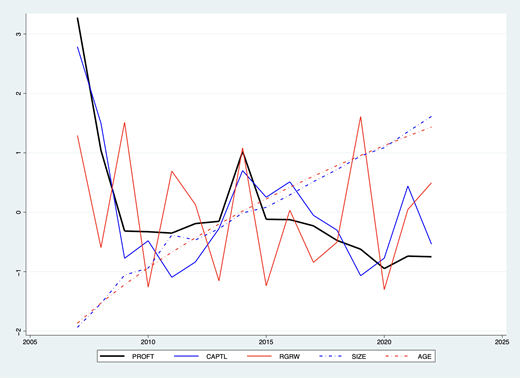
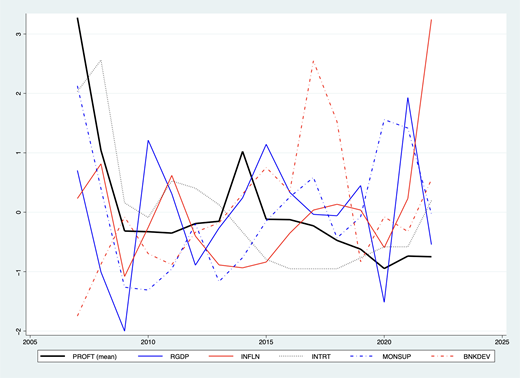
Figure 1 shows the standardized mean of bank-specific variables, including CAPTL, RGRW, SIZE and AGE, against the standardized profitability mean. The path of CAPTL and profitability shows alignment, which supports the hypothesis that a strong capital base leads to better returns. The RGRW line shows distinct yearly variations that may stem from different growth patterns and environmental responses. Similarly, Figure 2 shows the external factors, including real GDP (RGDP), inflation (INFLN), interest rates (INTRT), money supply (MSP) and banking sector development (BNKDEV), against the standardized mean of profitability. As shown in Figure 2, bank profitability shows significant changes during the financial global crisis periods (2008–2009) and subsequent crises (e.g. COVID-19). Real GDP and inflation rates follow cyclical patterns, but interest rates become more unpredictable after policy adjustments. The rise in money supply during the final observation period likely stems from enhanced monetary conditions that reduce credit availability and impact profitability. These visuals demonstrate that Swedish banks’ profitability depends on management decisions and macroeconomic factors.
5.2 Correlation table
The correlation matrix in Table 3 provides essential information regarding the interrelations between the variables. Bank profitability (PROFIT) shows a strong positive correlation with its lagged value (LPROFT), equal to 0.757. It may be helpful for the regulators when evaluating the long-term stability of financial institutions. Similarly, capital ratio (CAPTL) also shows a moderate positive correlation with PROFT (0.644), which aligns with the regulatory requirements concerning capital adequacy as a measure to prevent systemic risks. Bank size (SIZE) shows a weak negative correlation with PROFIT (−0.191) and CAPTL (−0.567), which may suggest that larger banks experience profitability problems, which could be attributed to increased regulatory pressure or poor operational management. Bank-specific factors dominate the macroeconomic variables, such as real GDP growth (RGDP) and inflation (INFLN), which show weak correlations with profitability. Furthermore, the variance inflation factor (VIF) test results in Table 4 show no severe multicollinearity among the independent variables. The highest VIF value of 4.25 is observed for the central bank interest rate (INTRT), which is well below the threshold of 10.
5.3 Results of regression analysis
Table 5 shows the results of regression analysis across the three models of OLS, FE and PCSE. We first discuss variables with consistent support across models (lagged profitability, capital ratio, revenue growth), examine model-sensitive results (size, age) and finally address our surprising findings regarding macroeconomic variables.
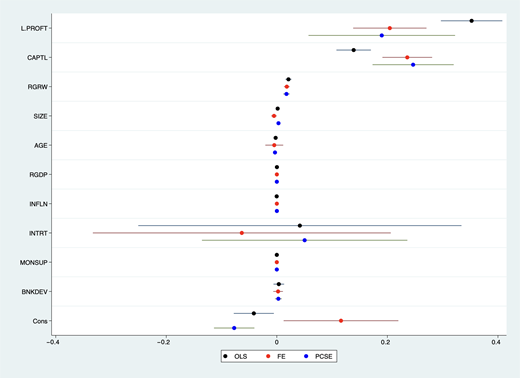
Three variables demonstrate robust positive relationships with profitability across all specifications, supporting their role as fundamental determinants of bank performance. The coefficient of L.PROFT shows a significant positive relationship with profitability across all models (0.352*** in OLS, 0.204*** in FE and 0.190*** in PCSE), demonstrating that past profits strongly predict current profitability. Capital ratio (CAPTL) also exhibits positive and significant relationships with profitability at 0.139*** in OLS, 0.236*** in FE and 0.247*** in PCSE, suggesting that higher capital banks have better profitability. The models show consistent positive effects of revenue growth (RGRW) on profitability, suggesting that revenue growth leads to better bank profit opportunities. The uniform findings from different econometric approaches support the reliability of the variables lagged profits, capital strength and revenue growth as essential factors for bank profitability.
Several variables show sensitivity to model specification, highlighting the importance of our multimethod approach. The results show that bank size (SIZE) has a positive relationship with profitability in OLS (0.001**) and PCSE (0.003***) but a negative relationship in FE (−0.005*). The divergent results for bank size across models merit careful interpretation, particularly given our revenue-based measure. In the OLS specification, SIZE shows a positive coefficient (0.001***), capturing primarily cross-sectional variation where banks with higher revenue generation may benefit from economies of scale, market power or superior business models. However, in the FE model, SIZE turns negative (−0.005*), reflecting within-bank variation over time. This negative coefficient does not necessarily indicate diseconomies of scale but rather reflects the complex dynamics of revenue-based size measures. When interest rates rise, bank revenues may increase mechanically through higher interest margins without changing underlying scale or efficiency. Similarly, shifts in portfolio composition or fee pricing can affect revenues independently of genuine scale changes. The negative FE coefficient likely captures that periods of rapid revenue growth (driven by favorable interest rate environments or aggressive pricing) may coincide with compressed profit margins as banks compete for market share. The PCSE estimate (0.003***) falls between these extremes, accounting for cross-sectional correlation while maintaining both within and between variation. The sensitivity of the size-profitability relationship to model specification, combined with the complex nature of our revenue-based measure, suggests caution in interpreting size effects. In addition, the adverse impact of AGE is observed in all models except FE, and it is significant in OLS (−0.002**) and PCSE (−0.003***), indicating that older banks may face declining profitability.
Our most striking departure from theoretical predictions and prior empirical evidence is the negligible impact of macroeconomic variables on bank profitability. GDP growth (RGDP) shows coefficients of 0.000 across all models. This starkly contrasts with international evidence, which reported higher GDP coefficients (e.g. Albertazzi and Gambacorta, 2009; Bourke, 1989; Athanasoglou et al., 2008). Similarly, inflation (INFLN) shows near-zero effects (−0.000 in OLS, 0.000 in FE and, PCSE), contradicting studies’ findings of significant inflation impacts on bank profitability through nominal rate adjustments. Central bank interest rates (INTRT) show no significant effects despite sign changes across models (0.042 in OLS, −0.063 in FE, 0.050 in PCSE), with all coefficients statistically insignificant. This finding is shocking given Sweden’s experience with negative interest rates during 2015–2019, where theory would predict significant margin compression effects. The insignificance persists even during this unconventional monetary policy period, challenging traditional bank lending channel theory and recent work on negative rates (Brunnermeier and Koby, 2018).
The money supply variable (MONSUP) shows insignificant effects in OLS and FE models but becomes negative and significant in PCSE (−0.000***), suggesting complex or unstable relationships. Our use of money supply growth rate rather than levels may conflate fundamentally different economic mechanisms. Money growth during economic expansions likely reflects healthy credit demand. It would positively affect profitability, while money growth through quantitative easing during the zero lower bound period represents a crisis response that may negatively impact profitability through compressed margins and risk-taking pressures. The instability of results across models and the sign change between specifications suggest that the money supply-profitability relationship may be non-linear or state-dependent, varying with the underlying reason for monetary expansion. This complexity may explain why money supply effects are insignificant in most specifications; our linear models cannot adequately capture a relationship that potentially reverses depending on economic context. Banking sector development (BNKDEV) similarly shows no significant effects (coefficients of 0.002–0.004), suggesting that the overall depth of financial intermediation does not significantly influence individual bank profitability in Sweden’s mature financial system.
The model fit statistics provide evidence that the results are robust and assist in choosing the best model. R-squared values are high and equal to 0.72 for OLS and 0.69 for FE, indicating that these models explain a large part of the profitability variance, with OLS slightly outperforming the others in explanatory power. The F-values for OLS (74.25, p = 0.000) and FE (57.51, p = 0.000), together with the Wald Chi2 for PCSE (247.72, p = 0.000), confirm the overall significance of each specification. The Hausman test (χ2 = 31.54, p = 0.000) indicates that FE is preferred over the random effect model and unobserved heterogeneity is essential, which means that FE is the best model to capture bank-specific effects. However, PCSE’s correction for panel-specific autocorrelation and heteroskedasticity provides a complementary perspective to FE and balances the specificity of FE and the generality of OLS. These results support the stable positive influence of lagged profits, capital and revenue growth on bank profitability, but also indicate that the impacts of size, age and macroeconomic variables are different, which highlights the importance of selecting an appropriate econometric framework that is suitable for the underlying structure of the data and can enhance the insights for financial policymakers and bank managers.
Figure 3 shows the coefficient plot based on the findings from Table 5. It shows how determinants of bank profitability vary across OLS, FE and PCSE models, which helps to understand the results better. The plot demonstrates that lagged profitability (L.PROFT), capital ratio (CAPTL) and revenue growth (RGRW) have positive effects in all models with L.PROFT between 0.190 and 0.352, CAPTL between 0.139 and 0.247 and RGRW between 0.017 and 0.021 while their confidence intervals remain above zero thus supporting their role in profitability enhancement and regulatory objectives of financial stability maintenance through capital strength. Bank size (SIZE) demonstrates different results between OLS and PCSE, which show minor positive effects (0.001–0.003). Still, FE reveals a negative impact (−0.005) because larger banks may have efficiency problems after controlling for unobserved heterogeneity, which regulators must monitor for systemic risk assessment. The visual presentation demonstrates that essential bank-specific factors remain strong. Still, regulatory policies need to be developed with awareness of how size and macroeconomic factors affect banks differently depending on the model used.
6. Discussion and conclusion
This study investigates the determinants of bank profitability in Sweden using three econometric approaches: OLS, FE and PCSE. Our analysis of 19 commercial banks over 2007–2022 reveals that bank-specific factors, particularly capital adequacy and lagged profitability, strongly predict performance, while macroeconomic variables traditionally considered crucial show negligible effects. Most strikingly, GDP growth, inflation and interest rates display coefficients at or near zero across all specifications, challenging conventional banking theory and contrasting sharply with international evidence. These findings suggest that in Sweden’s highly regulated and concentrated banking system, internal management decisions and regulatory compliance matter far more than economic cycles for profitability determination. This section compares our results with prior literature, examines their theoretical implications, discusses practical applications for stakeholders and acknowledges limitations while suggesting future research directions.
6.1 Comparison with prior literature
Our findings reveal both consistencies and striking divergences from established patterns in the bank profitability literature, providing insights into how institutional context shapes these relationships. Some of our key findings reveal systematic differences compared to major prior studies, warranting detailed discussion.
Capital ratio effects: Our analysis demonstrates that capital ratios have a substantially more positive effect on profitability than typically found in international studies. While studies such as Dietrich and Wanzenried (2011) and Athanasoglou et al. (2008) found positive but modest capital effects, our results show this relationship is considerably more pronounced in Sweden. Within the Swedish context, our findings extend the work of Öhman and Yazdanfar (2018), who also documented positive capital-profitability relationships but with a weaker magnitude. The historical perspective Larsson (2024) provided on Swedish banking crises during 1915–1935 suggests that the substantial capital-profitability nexus has deep institutional roots in Swedish banking. Our stronger findings likely reflect the full implementation of Basel III and Sweden’s particularly stringent capital requirements.
Profit persistence: Our study finds extreme profit persistence, exceeding patterns documented in most international markets. While Goddard et al. (2011) found relatively weak persistence across EU banks and Dietrich and Wanzenried (2014) reported minimal persistence in high-income countries, our results show Swedish banks maintain profitability advantages over extended periods. This aligns more closely with Trujillo‐Ponce’s (2013) findings for Spanish banks during consolidation, suggesting that concentrated markets enable more durable competitive advantages. The strong persistence we document indicates that successful Swedish banks can sustain their performance advantages. In contrast, struggling banks face persistent challenges, a pattern that Berger et al. (1999) attribute to market power and competitive barriers in concentrated systems.
Macroeconomic variables: Perhaps our most surprising finding is the negligible impact of macroeconomic variables on bank profitability, which starkly contrasts with international evidence. While studies by Albertazzi and Gambacorta (2009), Bourke (1989) and Bikker and Hu (2002) consistently find strong positive relationships between GDP growth and bank profitability across diverse markets, we find no such relationship in Sweden. Even Madaschi and Pablos Nuevo’s (2017) study of Nordic banks found significant though modest GDP effects, making our null findings particularly striking. This divergence cannot be attributed to our study period or methodology, as the pattern persists across all model specifications and subperiods, suggesting a fundamental difference in how Swedish banks operate relative to economic cycles.
Interest rate effects: Our study’s complete absence of interest rate effects contradicts theoretical predictions and empirical evidence from other markets. Borio et al. (2017) documented significant positive relationships between policy rates and profitability across developed economies, while Campmas (2020) found adverse but significant effects in European banks. Even Madaschi and Pablos Nuevo’s (2017) specific analysis of Swedish banks during the negative rate period found that banks maintained profitability through volume adjustments. Our contrasting findings suggest Swedish banks have developed effective strategies to insulate profitability from rate changes, whether through sophisticated hedging, business model adaptations or the protective buffer provided by high capitalization.
Bank size: Our mixed findings regarding bank size, positive in cross-sectional analysis but negative in within-bank analysis, echo the ambiguous results in prior literature, though for different reasons. While Athanasoglou et al. (2008) attributed mixed size effects to nonlinearities and Goddard et al. (2004) emphasized economies of scale, our divergent results likely stem from our revenue-based size measure. The pattern we observe suggests that larger banks in Sweden generate higher revenues cross-sectionally but face challenges when growing revenue within-firm over time, possibly reflecting competitive pressures or the complexities of managing growth in a concentrated market.
The systematic divergences revealed in our results suggest that Sweden’s institutional environment, characterized by high concentration, stringent regulation and sophisticated risk management, fundamentally alters traditional banking relationships. The dominance of bank-specific factors (capital, persistence) coupled with the irrelevance of macroeconomic variables indicates that Swedish banks operate in a distinctly different paradigm from their international peers. This is not simply a matter of stronger or weaker effects but represents a qualitative transformation in how profitability is generated and sustained in highly regulated, mature banking systems.
6.2 Theoretical implication
Our findings provide important insights into the relative explanatory power of three theoretical frameworks, capital buffer theory, resource-based view and bank lending channel theory, in understanding bank profitability in highly regulated, concentrated banking systems.
Our results strongly support the capital buffer theory’s predictions. Capital adequacy emerges as a robust positive driver of profitability across all models, with coefficients substantially larger than typically found in less-regulated markets. This suggests that the benefits of strong capitalization are particularly pronounced in Sweden’s high-capital environment. This aligns with capital buffer theory’s prediction that higher capital enhances profitability through reduced funding costs, greater operational flexibility during downturns and the ability to pursue profitable opportunities without regulatory constraints (Marcus, 1984; Milne and Whalley, 2001).
The resource-based view also finds strong empirical support through profit persistence and the importance of dynamic capabilities. The significant lagged profitability coefficient across all models confirms that bank-specific resources and capabilities create sustained competitive advantages (Barney, 1991). Revenue growth consistently enhances profitability, validating the importance of dynamic capabilities in identifying and exploiting new opportunities (Teece et al., 1997). Together, these findings suggest that competitive advantages in concentrated markets like Sweden are more durable and firm-specific factors dominate performance differences, supporting policies that allow successful banks to leverage their capabilities while providing targeted support to struggling institutions.
However, our findings fundamentally challenge the bank lending channel theory’s predictions about macroeconomic transmission to bank profitability. Real GDP growth, inflation and interest rates show coefficients at or near zero with confidence intervals crossing zero across all models, contradicting the theoretical expectation that monetary policy and economic conditions significantly influence bank performance (e.g. Bernanke and Blinder, 1988; Kashyap and Stein, 2000). This stark divergence from international evidence (e.g. Albertazzi and Gambacorta, 2009; Athanasoglou et al., 2008; Bourke, 1989) and significant interest rate effects (e.g. Borio et al., 2017) cannot be dismissed as a marginal difference. The negligible impact persists even during Sweden’s negative interest rate period (2015–2019), contradicting traditional theory and recent work on unconventional monetary policy (Brunnermeier and Koby, 2018). Two interpretations emerge from this surprising finding. First, Sweden’s stringent regulatory framework may create buffers that insulate banks from macroeconomic fluctuations, high capital requirements, comprehensive deposit insurance and active supervision may enable banks to maintain stable profitability regardless of economic cycles. Second, the extended period of unconventional monetary policy may have fundamentally altered or severed traditional transmission mechanisms in ways that existing theory has not yet captured.
Given our revenue-based measure, the mixed results for bank size warrant careful interpretation. While size shows positive effects in OLS and PCSE, the negative coefficient in FE likely reflects revenue’s procyclical nature rather than accurate scale diseconomies. As mentioned, our revenue measure conflates genuine scale effects with interest rate movements, portfolio shifts and fee pricing changes. The divergent results across models underscore that cross-sectional size differences (captured in OLS) may reflect efficiency advantages. In contrast, changes in within-bank size over time (captured in FE) may be driven by cyclical factors unrelated to operational efficiency. Age similarly shows model-dependent effects, with negative and significant coefficients in OLS and PCSE but insignificance in FE, suggesting that any disadvantages of organizational age are primarily cross-sectional rather than developing within banks over time.
6.3 Practical implications
Our findings have direct practical implications for multiple stakeholders in the Swedish banking sector. For bank managers, the strong capital-profitability relationship suggests that maintaining capital buffers above regulatory minimums is not merely a compliance cost but a profitability strategy. The persistence of profits indicates that investments in capabilities and competitive advantages generate lasting returns, justifying long-term strategic investments over short-term profit maximization.
For bank supervisors and regulators, our evidence that Swedish banks’ profitability is essentially decoupled from macroeconomic cycles challenges conventional supervisory frameworks. Rather than focusing on macroeconomic stress testing, supervisors might achieve better outcomes through microprudential tools targeting individual bank capital and risk management. Even during the negative rate period, the negligible impact of interest rates on profitability suggests that concerns about monetary policy harming bank stability may be overstated in well-capitalized systems.
For investors and analysts, our findings suggest that bank valuation models should weight bank-specific factors (capital strength, management quality, competitive position) more heavily than macroeconomic forecasts when assessing Swedish banks. The high profit persistence indicates that historical performance provides valuable signals about future profitability, supporting momentum-based investment strategies. The insignificance of GDP and interest rates means that economic cycle timing may be less critical for Swedish bank investments than commonly assumed.
For policymakers, the dominance of micro over macro factors implies that supporting banking sector health requires targeted interventions rather than broad economic stimulus. Policies encouraging capital accumulation (such as tax incentives for retained earnings) may be more effective than monetary policy adjustments. The finding that bank-specific factors dominate also suggests that banking sector problems are unlikely to be resolved through macroeconomic policy alone; direct regulatory and supervisory measures are essential.
6.4 Limitations and future research
We acknowledge several vital limitations in our study that provide directions for future research. Our analysis estimates conditional correlations rather than causal effects, as we lack exogenous variation in key variables. Without natural experiments, regulatory discontinuities or valid instruments, we cannot definitively establish whether capital causes higher profitability or profitable banks choose higher capital ratios. Future research should exploit regulatory changes or merger events for better identification, potentially using difference-in-differences or regression discontinuity designs when regulatory thresholds create quasi-experimental variation.
Our 15-year study period (2007–2022), while capturing critical regulatory changes and unconventional monetary policy, may be insufficient to identify long-term structural relationships in Swedish banking. Data consistency issues, particularly adopting IFRS accounting standards in 2005 and changes in regulatory reporting requirements, prevented extension to earlier periods. Future research could benefit from longer time horizons, using hand-collected historical data to examine whether the relationships we document hold across different regulatory regimes, such as the heavily regulated period of the 1950s–1960s or the deregulation era of the 1980s–1990s. In addition, the analysis is based exclusively on Swedish banks, which may limit the generalizability of results to other banking systems with different regulatory and economic frameworks. Our focus on bank-specific and macroeconomic factors may also miss other vital determinants such as competition intensity, regulatory changes or international spillover effects.
We also acknowledge specific measurement limitations that complicate interpretation. While capturing modern banking’s fee-generation aspects, our revenue-based size measure conflates genuine scale effects with price changes, portfolio shifts and interest rate impacts. This complicates interpretation, particularly in FE models where the negative coefficient may reflect revenue cyclicality rather than true diseconomies of scale. Future research using asset-based measures could provide a cleaner identification of scale effects. Similarly, our money supply variable presents interpretative challenges. Using growth rates rather than levels means we cannot distinguish between “good” money growth reflecting economic expansion and “bad” money growth from crisis-driven stimulus. The relationship between money supply and profitability likely depends on the underlying economic state and reason for monetary expansion, a non-linearity that our linear models cannot fully capture. Future research could address this using regime-switching models or decomposing money growth into cyclical and policy-driven components.
Beyond addressing these limitations, several promising avenues for future research emerge. Organizational structure effects on profitability warrant particular attention, especially the role of branch networks versus centralized operations. The historical example of Stockholm’s Enskilda Bank, which maintained strong profitability for decades with only one office specializing in medium and large corporate clients, suggests that the relationship between geographic presence and profitability may depend on strategic positioning and client focus. Modern Swedish banks’ varying approaches to digitalization and branch rationalization provide a natural experiment for testing whether decentralized office structures enhance or diminish profitability in the digital era. Such analysis would require detailed branch-level data and consideration of customer segmentation strategies, extending beyond the current bank-level analysis. Future research should also compare results across Nordic countries to determine whether our findings reflect Swedish specificity or broader patterns in highly regulated systems.
Despite these limitations, our study contributes significantly to understanding bank profitability in modern, highly regulated banking systems. We demonstrate that established relationships between macroeconomic conditions and bank profitability may not hold in all institutional contexts, challenging researchers to reconsider the generalizability of findings from less regulated or more competitive markets. Our methodological contribution, applying PCSE to address cross-sectional dependence in concentrated banking systems, provides a template for future research in similar contexts. Most importantly, our findings suggest that the traditional paradigm of bank profitability being primarily driven by economic cycles may be obsolete in highly regulated systems, where institutional factors and firm-specific capabilities dominate. As banking systems globally move toward stronger regulation following financial crises, our results from Sweden’s regulatory frontier may preview patterns that will emerge more broadly, making this study relevant beyond its specific geographic context.