L. N. Y. Wong and A. J. Whittle, Massachusetts Institute of Technology
The authors have proposed an admirably simple formulation for modelling the non-linear vertical load–settlement response of single piles and pile groups in homogeneous soils that extends linear solutions of Randolph and Wroth23 and Randolph.4 In implementing this technique, we have found several errata in the formulation and flowchart, as summarised in Table 2.
We have also found some difficulties in reproducing the examples reported in the paper. Although the authors report limiting skin friction values, fs, for the single pile tests, they do not specify the actual limiting values of shaft resistance and base resistance forces (Rslim and Rblim) used in their calculations. It would be very helpful to give a complete table of these values (for both the single pile and pile groups). We have retrieved pile capacity information from the source references (Table 3) and found further inconsistencies with the authors' stated assumptions, as follows.
For Case C,27 the authors report fs = 23 kPa and qb = 25 kPa for a single pile, whereas Liu et al. measured fs = 19–24 kPa for single piles and an average range of 16–23 kPa for each pile in the group. They also report qb = 173 kPa for a single pile and 700 kPa for each pile in the group test. There is no explanation given for the large change in end bearing of the group, but clearly the qb value quoted by the authors is incorrect. The authors also report their analysis for a 3 × 3 pile group with spacing-diameter ratio s/D = 3 (and D = 200 mm), whereas the only 3 × 3 group tested by Liu et al. has s/D = 6, with D = 100 mm (group G-6). After accounting for these discrepancies, we have found generally good agreement with the initial stiffness parameter (KsiD = 3·5) quoted by the authors.
For case B, we have had to artificially increase the end bearing resistance, Rblim (compared with results reported by O'Neill et al.20) in order to achieve a reasonable match to the measured load–deformation curves for the pile groups. This behaviour reflects the measured softening of the shaft resistance in this very stiff, overconsolidated clay, a feature that is not captured by the proposed analysis. Again, there is good agreement with the initial stiffness parameter quoted by the authors (KsiD = 24·7) for both the single pile and pile groups.
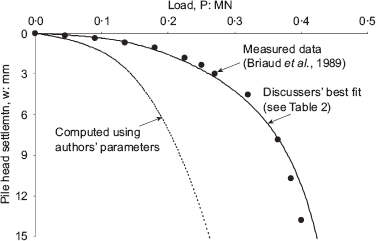
We have found that much higher initial pile stiffness (KsiD = 43 rather than 6·23) is necessary to match the measured load–settlement curve for the single pile of Case A installed in medium dense sand (Fig. 12), whereas the results for the pile group are more consistent with results presented by the authors (KsiD = 7·5 rather than 6·23). We are confident of our results, and suspect an error in the calculations reported by the authors for the single pile. The analyses imply that each pile in the group has a much lower initial stiffness than the single pile driven in this hydraulic fill material. This result is consistent with the findings of Briaud et al.,26 who attributed this behaviour to effects of residual stresses from pile driving.
Authors' reply
The authors thank the discussers for their great interest in the paper, and for their suggestions for the corrections of errata. The following points are added to the discussion.
For case C27 the authors wrongly reported the value qb = 25 kPa in the text instead of qb = 173 kPa, which is the actual value reported by Liu et al. However, it should be pointed out that the calculations in Fig. 9 are made for the correct value of the limit unit load at the pile base, qb.
For case B20 the authors agree with the discussers that the load–settlement curve is better reproduced if one increases the end bearing resistance for the single pile and the pile groups. Actually, in the calculations, we assumed Rblim = 200 kN instead of Rblim = 147 kN as reported by O'Neill et al. For the pile groups we simply assumed a Rblim multiplying the end bearing resistance of the single pile by the number of the piles in the group. This is in agreement with the findings of O'Neill et al.20, which suggest an efficiency of near-unity for the pile group.
It is worthwhile to note that, for both cases B and C, the authors and the discussers agree on the evaluation of the initial stiffness to be introduced in the calculation.
For case A the value KsiD = 6·23 MPa reported by the authors in the paper has been wrongly attributed to the single pile. Actually this is value for the pile group. For the single pile the authors quoted the value KsiD = 2·18 MPa. However, we suspect an error in the calculations of the discussers because of the great differences between the values of KsiD for the single pile (43 MPa) and the pile group (7·5 MPa). The diameter of the single pile is 0·273 m, whereas the equivalent diameter Deq is 1·24 m, and this suggests that the product KsiD should be larger for the pile group than for the single pile. Indeed the authors quoted a value Ksi = 80 MN/m3 for the single pile and Ksi = 50 MN/m3 for the equivalent pier.
Finally, the authors are glad that the discussion was confined to the evaluation of the model parameters, as this implies that the method of analysis presented has been appreciated by the discussers.
Errata
Equations (2), (3), (19) and (22) should read as follows:
In the flow chart the following lines should be corrected:
Line 4:
Line 7:
The corrected flowchart is therefore as shown in Figure 13.