May I apologize to our readers for the late arrival of the last issue of Geotechnical Engineering, which was caused by distribution difficulties following introduction of new computer software.
Although new software often brings with it teething problems, it inevitably improves the end product or service provided. For subscribers to Geotechnical Engineering, advances in web technology mean that you can now download copies of papers that appear in the journal up to three weeks ahead of the publication date. The journals section of the Institution's web site (www.ice.org.uk) is soon to be re-launched with
better searches across all the text in both papers and abstracts
more information and guidance on writing papers
provision for supplementary data not available in the written version of the paper to be published electronically
easier password access, especially for libraries
A sneak preview of one of the new web pages is given in Fig. 1.

Screenshot of the home page of the new journals on-line web site
Screenshot of the home page of the new journals on-line web site
The Geotechnical Engineering Advisory Panel is well aware of the frustrations caused when manuscripts submitted to this journal take too long to review. One of the aims of my editor-ship is to reduce the turn-around time and hence make the journal more topical. We have therefore reorganized the panel into separate sub-committees dealing with short (1000 word), medium (2000 word) and long (5000 word) papers. These sub-committees will consider manuscripts on a more frequent basis than before and hopefully speed up the review process considerably. Please bear with us while these changes take effect.
In this quarter's issue, we have papers covering the bearing capacity of foundations, interface shear strength of fine-grained soils, construction of a major highway, shaft capacity of driven piles and auger mixing treatment of a contaminated site.
Sieffert and Bay-Gress compare the methods used in various European countries to evaluate the bearing capacity of shallow foundations. They find considerable variation in the approaches adopted in different countries and, as a consequence, large differences in the capacities obtained (see Fig. 2). Surely there could be no better demonstration of the need for a common European standard?
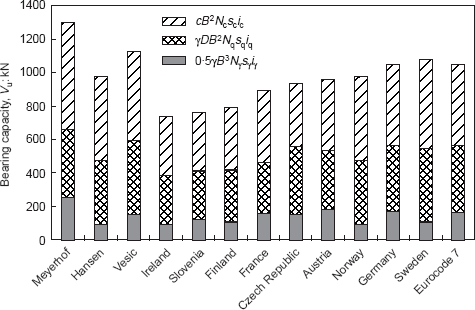
Bearing capacities predicted by different authors and countries for the same worked example, as reported by Sieffert and Bay-Gress
Bearing capacities predicted by different authors and countries for the same worked example, as reported by Sieffert and Bay-Gress
Subba Rao, Allam and Robinson report the results of an investigation into the effective angle of friction between fine-grained soils and solid surfaces of different roughness. They find that the angle of friction is independent of the soil's overconsolidation ratio and propose an empirical correlation between friction angle and relative roughness of the surface.
Geotechnical Engineering had a major role to play in the construction of the A34 Newbury Bypass. Perry, Field, Davidson and Thompson describe the benefits of an innovative approach to overcoming environmental and cost restraints, resulting in a major reduction in the movement of materials to and from the site.
The paper by Lehane, Chow, McCabe and Jardine investigates potential relationships between the shaft capacity of driven piles in clay and the end resistance measured in cone penetration tests. The proposed approach builds on the results of high quality instrumented pile tests conducted by various research establishments over the past 15 years.
Finally, Al-Tabbaa and Evans continue their study of in situ auger mixing treatment of a contaminated site, by looking at the time-related performance of seven soil–grout mixes in the laboratory. Parts 1 and 2 of this series of papers appeared in previous editions of Geo-technical Engineering.1,2