

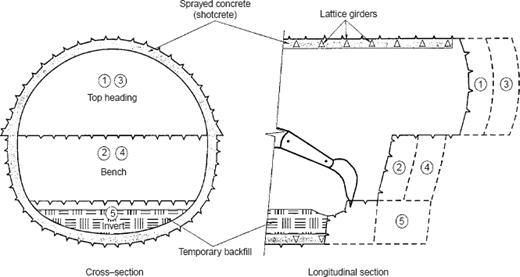
Those of you who attended the recent meeting at the Institution of Civil Engineers on the Observational Method will have heard Professor Ralph Peck tell the fascinating story of the construction of the Chicago subway in the 1940s. Under the guidance of Terzaghi, Peck continuously adjusted the benched excavation sequence (see Fig. 1 for a modern example) on the basis of feedback from simple measurements of the ground's response. Nowadays, we have sophisticated instruments at our disposal, but deciding what purpose they serve is still an essential decision in any field monitoring exercise. The paper by Clayton et al. in this issue addresses this important subject.
Geotechnical engineering (the discipline) is all about adopting, adapting, and improving* conventional methods of construction. Geotechnical Engineering (the journal) strives to report on such progress, whether it occurs in the research laboratory, the design office, or the construction site. This issue features papers that demonstrate the wide spread of original thought that exists in our profession.
Clayton et al. present an evaluation of field instrumentation used to monitor sprayed concrete lined tunnels in soft ground. They argue for a strategy of using a small core of reliable and well-understood instrumentation rather than a proliferation of diverse apparatus and techniques.
A project as extensive and complicated as London's Jubilee Line Extension requires special means of storing and retrieving valuable geotechnical and construction information. Withers et al. describe the database that was developed for this task, its user interface, and the type and quantity of data stored.
Blanchfield and Anderson describe a laboratory investigation of wetting collapse in opencast coalmine backfill. They suggest that recording only average voids during compaction may give a highly misleading indication of field settlement.
Determining temporary prop loads in deep excavations is one of the more difficult tasks facing geotechnical engineers. These loads are influenced by factors such as temperature, wall installation, dissipation of excess pore pressures, plan geometry of the wall, etc. Batten and Powrie consider these effects in their paper, which compares measurements from London's Canary Wharf underground station with the results of finite-element and limit equilibrium calculations.
Sridharan et al. propose a new way of determining the liquid limit of soils from one-dimensional normal compression tests. They argue that the new procedure is simple and relatively error-free and, as such, is not subject to the limitations of the existing percussion and fall cone tests.
Finally, we bid farewell to Tom Aldridge, who has been forced to resign from the Advisory Panel owing to increasing work commitments. On behalf of the readership, I would like to thank Tom for his efforts during the past two-and-a-half years.

Motto of the National Association of Round Tables of Great Britain and Ireland.

