

A self-boring load cell pressuremeter has been developed which represents a significant advance in the reliable determination of in situ lateral stresses in stiff clays. This paper describes its design and gives details of its field evaluation.
1. INTRODUCTION
In the design of geotechnical structures, reliable predictions of soil deformation under load and the loads developed in the structure are primarily dependent upon the accuracy with which the stress regime in the ground is known. Self-boring pressure-meters are commonly used for in situ testing to establish these data. The principles of both the self-boring expansion pressure-meter (Camkometer) and the load cell pressuremeter were first developed by Windle and Wroth,1 who acknowledged that the latter was potentially better for in situ stress determination. However, further developments tended to concentrate on the expansion pressuremeter because of its ability to give additional data on soil modulus and shear strength parameters.
2. PRESSUREMETER DESIGN
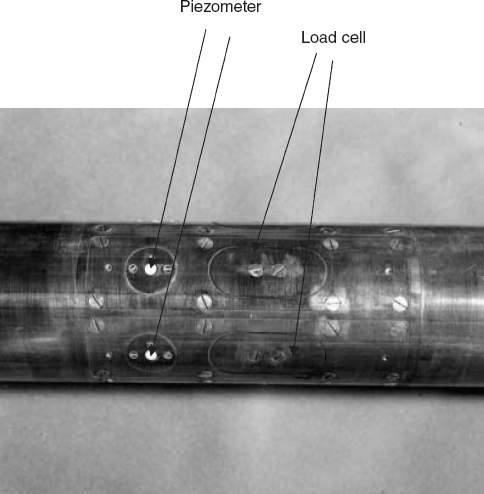
The instrumentation technology now available has meant that a redesign of the original self-boring load cell pressuremeter has been rewarding. The innovative design of the new pressure-meter incorporates six ‘null sensing’ load cells and six piezo-meters equi-spaced around its circumference for the measurement of in situ lateral stress and pore water pressure respectively. The ‘null sensing’ load cells record total stress without any movement of the cell plate. This is achieved by maintaining the mean output from four strain-gauged pillars beneath each cell plate constant by applying a known internal gas pressure. Each of the six cells has an independent gas supply and control system so that the magnitude of this internal pressure, which balances the external soil pressure, can be measured. The design of the six piezometers to measure pore water pressure is unchanged from that used in the expansion pressuremeter. A photograph of two of the six cell clusters is shown in Fig. 1.
The main advantages of the new device are as follows
Total stresses and pore water pressures are read directly and continuously whereas, with the expansion pressuremeter, interpretation of the stress-strain plots from strain arms to determine lateral stress is somewhat subjective and depends on the skill of the analyst.
The test duration can be extended until stresses and pore water pressures have reached stable values. With the expansion pressuremeter there is no way of knowing if sufficient time has elapsed before the ‘spot’ test.
The use of six cell clusters rather than three enables better definition of any inherent ground anisotropy. It also gives some redundancy in the event of one of the cells failing and some guidance as to the quality of the test.
The absence of a rubber membrane and ‘chinese’ lantern improves the accuracy of measurement by ensuring that the stress cells are in more intimate contact with the ground.
The diameter of the new pressuremeter and its method of self-boring operation are identical to that of the expansion pressuremeter so that the same driving equipment can be employed.
3. FIELD EVALUATION
Field evaluation of the load cell pressuremeter has been carried at two sites, one in London Clay and the other in Gault Clay. Full details of the findings from these tests are reported in reference two and three respectively.2,3
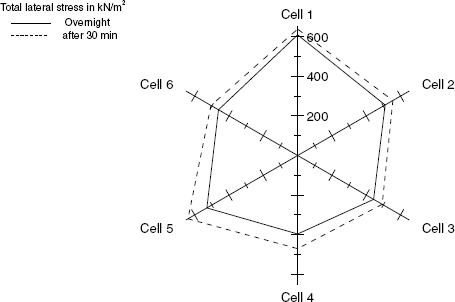
In the field evaluations a suitable test duration was decided on site by continuously monitoring soil stress until stability was reached. At test depths of greater than 5 m in these stiff and impermeable clays, durations of about 16 h were frequently needed for stresses and pore water pressures around the probe to stabilise. Fig. 2 shows the distributions of total lateral stress measured using the six load cells around the probe at a test depth of 15 m in the London Clay. Results are shown both at 30 mins after drilling to the required depth and after leaving the pressuremeter overnight so that stresses and pore water pressures were fully stable. Each of the six load cells recorded a lower stress when stability was reached overnight. In this particular instance, the mean reduction in stress corresponded to a reduction in K (i.e. the ratio of effective horizontal to vertical stress) from 2·4 to 2·0.
4. CONCLUSIONS
Use of the new pressuremeter, at site investigation stage, is strongly recommended for those geotechnical designs which are particularly sensitive to the in situ stress regime such as the design of retaining walls, cut-and-cover and bored tunnels, and piled foundations. The device is also a useful tool for measuring lateral stresses and pore water pressures acting close to existing structures. For example, the pressuremeter has recently been used for measuring the swelling pressures developed in stiff clay backfill behind an old masonry retaining wall as part of an assessment of the wall's stability.
The design and evaluation of the new pressuremeter was carried out by TRL and was funded by the Highways Agency. The production of the pressuremeter was subcontracted to Cambridge Insitu.

