1. BRIEFINGS
In this issue of Geotechnical Engineering we publish the final instalment of Dr Penman's essay on the UK's Building Research Station (BRS), covering the period from the 2nd to the 4th International Conferences on Soil Mechanics and Foundation Engineering. Find out what disaster beset the BRS's mobile laboratory at Daer embankment dam in Scotland and how the ru > 1 problem was investigated.
I hope you have enjoyed reading this series of articles about the BRS from one of its most prominent and colourful characters. We are very grateful to Dr Penman for providing us with such a fascinating account of one of the leading geotechnical institutions in the UK, if not the world.
2. PAPERS
It gives us great pleasure to publish one of the winning papers from the Institution of Civil Engineers Hong Kong Association's 2001 paper competition, which was organised by its Graduates and Students Division. Siew-Wei Lee's paper, on the use of compensation grouting on the London Docklands Light Railway Lewisham Extension twin-tunnelling project, is a fine example of an interesting story well told.
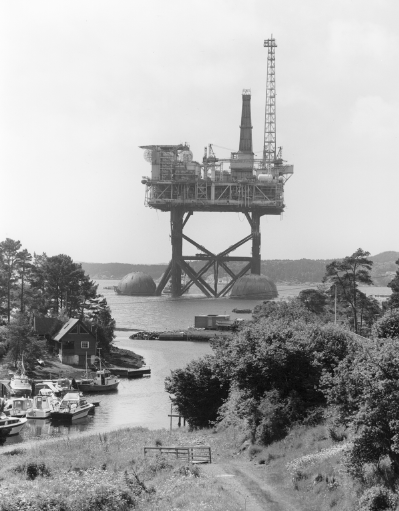
Next up, Broughton et al. describe the geotechnical engineering works associated with the hydraulic skirt extraction/jacking of the Maureen gravity platform (see Fig. 1 and front cover), together with a summary of the results from the actual extraction process. The authors believe that the confidence gained from the successful execution of these works may lead to less conservative approaches being adopted for future platform removals.
The estimation of active and passive earth pressures on retaining walls is a problem of considerable significance to practising engineers. Soubra and Macuh present a kinematical method of determining earth pressure coefficients, based on the upper bound theorem. The implementation of their method in a spreadsheet provides a simple way of using the theory in routine design.
Finally, Winter and Clarke discuss the problems caused by pulverised fuel ash (PFA) being treated as a manufactured material in current specifications for highways works. The authors argue the case for a new method-based specification for PFA, which would encourage its use as a general fill and so decrease the need to dispose of it in landfill sites.
3. DISCUSSION
4. MONITOR
From this issue onwards, we aim to bring you regular reviews of publications of interest to practising geotechnical engineers in our new section entitled ‘Monitor’. We kick off with a summary of papers that have appeared in the Japanese journal Soils and Foundations and a round-up of papers that have recently appeared in Gaotechnique.
5. CORRECTION
6. FEEDBACK
Despite several pleas by me for positive or negative feedback on the changes we have made to the journal over the past year or so, we are still only getting anecdotal evidence that we are making the sort of improvements that you, the readership, would like to see.
A welcome exception to this is the following email received from Dr Penman regarding January's issue:
Dear Andrew
Thank you for putting such a clear picture of my 1945 VW piezometer in your Editorial in the January issue of Geotechnical Engineering. I am very glad to see Skempton's first paper to the Proceedings reproduced in nice large print which reminds me all too vividly of the work I was thrown into during my first days at BRS.
The first paper in this issue by Pugh about the effect of climate on shallow footings on clay fits well with my ‘3.3. Shallow foundations and trees’ six pages further on. Then a bit further on, a paper with this year's Rankine Lecturer as a co-author; and discussion on one of Andrew Charles' papers. You are producing a most interesting journal—congratulations.
Arthur Penman
If you are interested in raising an issue within the pages of this journal, please contact me (via andrew.bond@geocentrix.co.uk) to discuss the best way to get your ideas published.
7. NEXT ISSUE
We have briefings by Prof. John Atkinson entitled ‘What is the matter with geotechnical engineering?’ and by Prof. Kerry Rowe on excavations in gassy soils, plus papers on the performance of in situ auger mixing treatment of a contaminated site (part 4 of Al-Tabbaa's series of articles on this topic) and a comparison of tube-a-manchette and lance grouting to assist tunnel excavation through chalk. Make sure you get your copy.