

If a piling rig overturns there can be a risk of casualties. Working platforms are critical for plant stability, and a good practice guide to the design, installation, maintenance and repair of ground-supported working platforms for tracked plant has been prepared. A simplified approach to the design calculations has been based on a punching shear failure mechanism. The platform design is an integrated package, from track loading through to geotechnical design.
| NOTATION | |
|---|---|
| cu | undrained shear strength of cohesive subgrade |
| D | depth of platform material |
| Kp tan δ | punching shearing resistance coefficient |
| L | effective track length of plant |
| Nc | bearing capacity factor for cohesive subgrade |
| Nγp | bearing capacity factor for granular platform material |
| R | bearing resistance |
| Rc | bearing resistance of cohesive subgrade when no platform is present |
| Rp | bearing resistance of working platform when platform is sufficiently deep that bearing resistance is unaffected by underlying cohesive subgrade |
| sc, sp and sγ | shape factors; functions of W and L |
| W | track width of the plant |
| γp | bulk unit weight of platform material |
| φ′ | angle of shearing resistance of granular material |
1. INTRODUCTION
Working platforms are critical for plant stability, and while most ground-supported working platforms perform well, overturning of rigs has occurred more frequently than it should. Although serious incidents involving working platforms are relatively rare, when they do occur there can be a risk of casualties. A good practice guide for ground-supported working platforms for tracked plant has been prepared at the instigation of the Federation of Piling Specialists (FPS). A contract was let by FPS to the Building Research Establishment Ltd (BRE) to prepare the guide under the direction of a Steering Group appointed by FPS. The guide was published in June 2004.1
The principal objective of the guide is to facilitate the design, specification, installation, operation, maintenance and repair of ground-supported working platforms constructed of granular material, so that an acceptable level of safety is achieved. A secondary objective of the guide is that safety should be achieved without unnecessary or excessive expenditure.
The guide is not intended to replace or reduce the designer's input, but rather to promote the implementation of minimum design, installation and maintenance standards. The guidance has sought to avoid being over-prescriptive, as this might limit the scope for innovative solutions, and does not in any way limit the responsibilities of those parties involved in the provision and operation of a working platform, who must exercise their own knowledge, experience and judgement.
2. GOOD PRACTICE GUIDANCE
Following an introductory chapter, the guide has four chapters that deal with, respectively, site conditions, design, installation and, finally, operation, maintenance and repair.
The strength of the near-surface ground is critical for the design of the working platform, whereas for most construction projects it is the strength at greater depths that is important. The near-surface strength is unlikely to have been determined in the site investigation for the construction project, and it may be necessary to augment information obtained for the construction project with further investigation specifically for the working platform. The desk study and site inspection are critically important, and should be carried out with the platform in mind; it is particularly important to locate any weak and variable areas. Care must be taken in backfilling trial pits to avoid creating additional hazards.
The design of a working platform is a geotechnical design process, and should be carried out by a competent engineer who has full access to the health and safety plan, including the desk study and all other site investigation information. The quality of the granular platform material is crucial, and it should be such that all the performance requirements, in terms of compactibility, durability, trafficability and drainage, can be met. Materials that will undergo significant crushing when trafficked should be avoided for works of any significant duration, because drainage may be impaired. Sometimes it may be economic to incorporate geosynthetics to strengthen the working platform as an alternative to using a greater depth of granular material. A separating geofabric between a clay subgrade and the platform may improve long-term performance by preventing the granular platform material from being punched into the clay.
The platform should be installed to an appropriate specification that ensures that the design strength of the platform material is achieved, and there should be adequate supervision by competent staff during platform installation. Careful observation during placement of the working platform material may reveal weak areas of the subgrade that require design modifications. Where required, quality control tests should be carried out.
A formulation of good practice is of value only where it is applied with careful supervision, control and monitoring of the platform under appropriate contractual arrangements. Throughout its working life, the platform should be under the day-to-day control of appropriately experienced site staff. Contractual arrangements should ensure that the platform is adequately inspected, controlled and maintained. Site control should be adequate to ensure that it is not used by plant for which it has not been designed, and that working areas are clearly marked. Problems may arise where working platforms are also used as haul roads, because there is likely to be an incompatibility between the two uses.
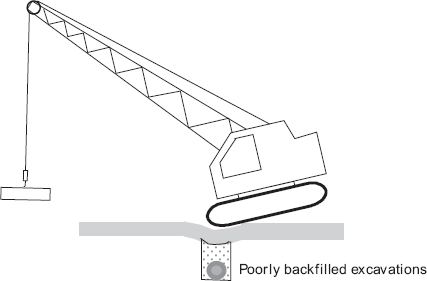
The integrity of the working platform should be preserved at the original designed standard throughout its working life. Inadequate performance of working platforms may be due to poor maintenance, and many problems experienced with rig instability can be associated with failure to adequately maintain and repair a working platform rather than with inadequacies in specification or installation. Figure 1 illustrates the hazard presented by a poorly backfilled excavation.
3. ROUTINE DESIGN CALCULATIONS
The guide has two appendices: the first provides an approach to routine design calculations, with some worked examples, and the second gives guidance on the determination of characteristic values of soil parameters.
Working platforms are subject to complex loading conditions, and it is not easy to reflect in the design calculations the loading that will actually be experienced. The pressure under the tracks should be calculated in accordance with EN 791:1996 Drill rigs–safety and EN 996:1996 Piling equipment–safety requirements. Using the weights of the various components of the rig or crane, the overturning moments can be calculated for the range of operations that will be carried out, including standing, travelling, handling, penetrating and extracting, for different jib and mast orientations. The bearing pressure distributions, which can be calculated from the overturning moments, may be triangular or trapezoidal, but radically simplified stress distributions are recommended for use in the design calculations. Non-uniform loading distributions can be transformed into equivalent uniform loads over a reduced areal extent using the method described by Meyerhof.2 For a more recent review of the problem, see Foundoukos and Jardine;3 further information on loading can also be found on the FPS website, www.fps.org.uk.
Two loading situations are considered.
Case 1 loading applies to the situation when the rig or crane operator is unlikely to be able to aid recovery from an imminent platform failure.
Case 2 loading applies to the situation when the rig or crane operator can control the load safely, for example by releasing the line load, or by reducing power, to aid recovery from an imminent platform failure.
The guide gives recommended partial factors to be applied to the loads derived according to EN 996:1996, which are converted to an equivalent uniform loading.
The design calculations indicate the depth of working platform that is required for the given soil and loading conditions. Where a working platform of relatively shallow depth is placed on a weak subgrade, a simple approach to the design calculations can be based on the analysis of punching failure, as illustrated in Figure 2. The bearing resistance R is considered to be the sum of the shear required to punch through a vertical plane in the granular platform material and the bearing capacity of the subgrade. It is considered that this mechanism can be applied to the design of granular platforms overlying subgrades of cu = 20–80 kPa.
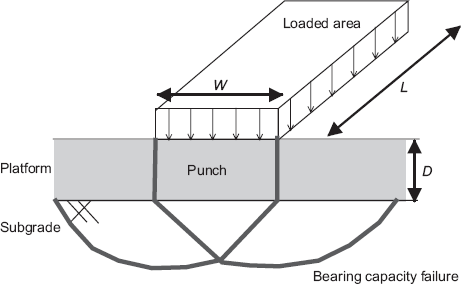
Using the simplified analysis for a footing punching through a dense granular layer overlying soft clay, the following expression is obtained for the bearing resistance of a platform on a cohesive subgrade with a low water table.
There are two limiting conditions.
(a) When D = 0, the bearing resistance is simply that of the cohesive subgrade
(b) When D is large, the bearing resistance is simply that of the platform material when unaffected by the underlying clay layer
Equation 1 used in conjunction with the limiting values given in Equations 2 and 3 indicates an increase in bearing resistance (R) with increasing depth of the platform (D), as illustrated in Figure 3 for some typical conditions. The graph is in the form of a dimensionless plot of bearing resistance, R/(cuNcsc), against platform depth and loaded width (D/W). When the platform depth D = 0, the bearing resistance is a minimum, corresponding to the subgrade alone, Rc/(cuNcsc) (see Equation 2); when D is large (corresponding to a very thick platform) the maximum bearing resistance is that provided by an infinite depth of platform material, Rp/(cuNcsc) (see Equation 3). For the conditions that apply in Figure 3, the latter state is reached when D/W = 2·5 and Rp/(cuNcsc) = 5·6. Between these two limits the bearing resistance of the combined system can be determined using Equation 1.
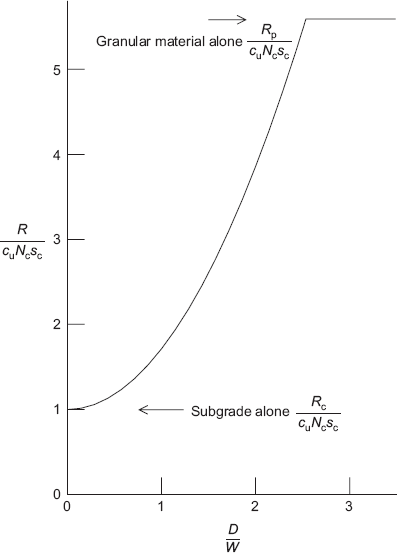
Typical increase in bearing resistance (R) with increasing depth of platform (D) for well compacted granular platform material on soft clay subgrade
Typical increase in bearing resistance (R) with increasing depth of platform (D) for well compacted granular platform material on soft clay subgrade
The guide recommends values for the punching shear coefficient, Kp tan δ, for a range of φ′ as well as shape factors for this coefficient and for the subgrade bearing resistance.
A simple addition to the capacity of the platform is suggested to take account of the effect of geosynthetic reinforcement.
This approach to the calculation of the required depth of the working platform contains many simplifying assumptions, which cannot fully represent actual soil behaviour. The method described in the guide has been calibrated against other design methods for strip loadings and the experience of FPS members. However, the results of calculations should be critically appraised by an appropriately experienced engineer, and in situations where the routine design calculations are not appropriate it may be necessary to carry out more sophisticated forms of analysis.

