

Ralph B. Peck, Figure 1 Professor Emeritus of Civil Engineering at the University of Illinois at Urbana-Champaign, and one of the most influential engineers of the twentieth century, died on 18 February 2008, at the age of 95. He was born in Winnipeg on 23 June 1912 to his American parents, Orwin K. and Ethel Huyek Peck, when his father had taken a job as a bridge engineer with the Grand Trunk Pacific Railroad in Canada.
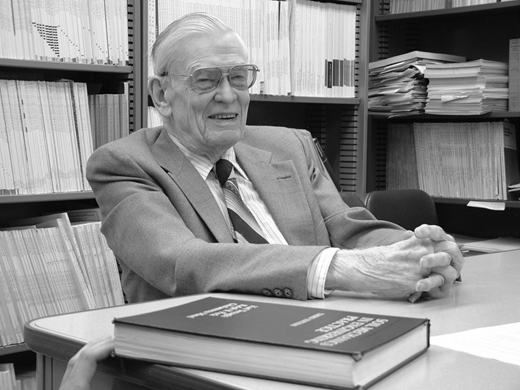
Ralph Peck earned a civil engineering degree in 1934 and a doctor of civil engineering degree in 1937, both from Rensselaer Polytechnic Institute in Troy, New York. He married Marjorie E. Truby on 14 June 1937. He is survived by his daughter and son-in-law, Nancy Peck (Allen) Young, his son and daughter-in-law, James (Laurie) Peck, and his grandchildren, Michael Young and Maia Peck.
Ralph Peck was employed from 1937 to 1938 as a structural detailer for the American Bridge Company. In 1938–1939 he attended the soil mechanics course at Harvard University, and was a laboratory assistant to Arthur Casagrande. From 1939 to 1942 Ralph was an assistant subway engineer for the City of Chicago, representing Karl Terzaghi, who was a consultant on the Chicago Subway Construction Project. Ralph joined the University of Illinois in 1942, and was a professor of geotechnical engineering from 1948 to 1974. After 1942, when Ralph became a faculty member at the University of Illinois, Karl Terzaghi became a frequent visitor to Urbana, and in April 1945 he was appointed a visiting research professor in the Department of Civil Engineering.
After 1974 Ralph was a professor emeritus at the University of Illinois, and a consultant in geotechnical engineering, residing in Albuquerque, New Mexico. He regularly returned to the University of Illinois twice each year to deliver a series of lectures, and to continue active interaction with students and faculty members until the age of 93. Ralph was celebrated at the University of Illinois with a symposium in 1987 on The Art and Science of Geotechnical Engineering at the Dawn of the Twenty-First Century, and an ASCE Geo-Institute conference in 1999 on GeoEngineering for Underground Facilities.
Together with Karl Terzaghi, in 1948 Ralph Peck published the most influential textbook in geotechnical engineering, Soil Mechanics in Engineering Practice.1 A third edition of this book, with additional co-author Gholamreza Mesri, was published in 1996.2 With Walt Hanson and Tom Thornburn, in 1953 Ralph Peck published a most widely used textbook, Foundation Engineering – a book for engineers to use in practice.3 At the University of Illinois Ralph built a premiere geotechnical programme, and succeeded in fulfilling Karl Terzaghi's hope for Peck ‘to educate a generation of geotechnical engineers who retain common sense and their sense of proportion'. From 1942 to 1974 Ralph directed 39 doctoral students. During the same period more than 5000 students attended his lectures at the University of Illinois. Among his major accomplishments at Illinois, Ralph Peck discovered Don Deere, and introduced engineering geology and rock mechanics as essential components of education in geotechnical engineering.
In a foreword to Karl Terzaghi: The Engineer as Artist by Richard Goodman,4 Ralph considered his ‘privilege to work for and with Karl Terzaghi for much of the last 30 years of his life'. Goodman quotes from a 1946 Terzaghi letter to F. E. Schmitte in which Terzaghi confided that Ralph ‘is the best disciple I have gotten so far'.
Ralph taught the practical art of problem-solving, always ingrained with the observational approach. He had a profound influence on numerous students. One distinguished engineer has written about Ralph Peck: ‘To meet him, to listen to him, to be influenced by him at an early age have been gifts I value.'
Ralph Peck's life and work have been detailed in two books and a Norwegian Geotechnical Institute (NGI) publication. Judgment in Geotechnical Engineering: The Professional Legacy of Ralph B. Peck was published in 1984 by John Dunnicliff and Don U. Deere.5 Ralph B. Peck: Engineer, Educator, A Man of Judgment was edited by Elmo DiBiagio and Kaare Flaate for dedication in 2000 of the Peck Library, side by side with the Terzaghi Library at the Norwegian Geotechnical Institute in Oslo.6 Ralph B. Peck, Educator and Engineer: The Essence of the Man, published in 2006 by John Dunnicliff and Nancy Peck Young, is the most recent and detailed.7 It includes a revealing ‘self-portrait' recounting in interesting detail the formative years, jobs, teaching, consulting, and friendships, including with Alec Skempton and Laurits Bjerrum.
In addition to co-authoring two most influential textbooks, Ralph Peck's list of technical publications include 260 invited lectures, journal and conference articles and discussions, and reports. Some key lectures and publications include ‘Earth-pressure measurements in open cuts, Chicago (Ill.) subway',8 ‘Deep excavations and tunneling in soft ground',9 ‘Advantages and limitations of the observational method in applied soil mechanics',10 ‘The direction of our profession',11 ‘Influence of nontechnical factors on the quality of embankment dams',12 ‘Pitfalls of overconservatism in geotechnical engineering',13 ‘Where has all the judgment gone?',14 ‘The last sixty years',15 and ‘Gaining ground'.16
Ralph Peck recognised that ‘no theory can be considered satisfactory until it has been adequately checked by actual observations.' He was actively engaged in bridging the gap between academia and engineering practice. He served as a consultant on over 1000 civil engineering projects in the United States and 33 foreign countries. Major projects concerned dams and tunnels. These include Portage Mountain Dam in British Columbia, Lower Notch Dam in Ontario, Churchill Falls Dams in Labrador, James Bay Dams in Québec, Itezhitezhi Dam in Zambia, Saluda Dam in South Carolina, Wilson Tunnel in Hawaii, the Bay Area Rapid Transit System, and the Washington, Baltimore, and Los Angeles metro systems. Ralph Peck also served as a consultant on numerous projects concerning foundations of structures, including the World Trade Center in New York. One of Ralph's last projects concerned the foundations of the Rion-Antirion Bridge in Greece.
Ralph Peck was a member of the Executive Committee of the Soil Mechanics and Foundation Division of the American Society of Civil Engineers (ASCE) from 1954 to 1957, and Chairman in 1957. He was a member of the Board of Directors of ASCE from 1962 to 1965. He was the President of the International Society of Soil Mechanics and Foundation Engineering from 1969 to 1973. The Ralph B. Peck Lecture and Medal was established in 1999 by the Geo-Institute of ASCE.
Ralph Peck was awarded the honorary degree of Doctor of Engineering by Rensselaer Polytechnic Institute in 1974, and the honorary degree of Doctor of Science by Laval University, Québec in 1987. He was invited to give the Ninth Rankine Lecture of the British Geotechnical Society in 1969 at the Institution of Civil Engineers in London, UK.
Other major recognitions of Ralph B. Peck include the ASCE's Norman Medal in 1944, the ASCE's Wellington Prize in 1965, the ASCE's Karl Terzaghi Award in 1969, The National Society of Professional Engineers Award in 1972, the US Army's Outstanding Civilian Service Medal in 1973, the Western Society of Engineers' Washington Award in 1976, the ASCE's Rickey Medal in 1988, the John Fritz Medal (from the ASCE, ASME, AIMME, AIChE, and IEEE) in 1988, and the ASCE's OPAL (Outstanding Projects and Leaders) Award for Outstanding Lifetime Achievement in Education.
Ralph B. Peck was elected a member of the National Academy of Engineering in 1965. He was presented with the National Medal of Science by President Gerald Ford in 1975 ‘for his development of the science and art of subsurface engineering, combining the contributions of the sciences of geology and soil mechanics with the practical art of foundation design'.
Ralph Peck no doubt possessed remarkable and once-in-a-lifetime technical knowledge and experience. But what distinguished Ralph was his exceptional ability to communicate at every level and in every form, and his superb judgement and wisdom. These qualities combined to make Ralph Peck a kind, considerate, thoughtful, and humane man. He communicated with eloquence and humility. In the words of one distinguished engineer, Ralph Peck was not only a gentleman but also a gentle man. This sentiment is shared by all colleagues, co-workers, and friends of Ralph B. Peck.
On a personal note, it was a special privilege to work with Ralph on the third edition of Soil Mechanics in Engineering Practice.2 It was during such an important long-term collaboration that I came to realise that Ralph was no ordinary engineer. He often edited and polished what I had prepared; but he never rejected the technical content of my work. We had many discussions over a period of more than 10 years, but never a major disagreement. On one occasion, after Ralph had been mildly critical of something that I had written, he told me that his relationship with me was similar to his relationship with Karl Terzaghi during their work on the first edition of Soil Mechanics in Engineering Practice.1 I was so humbled and overwhelmed by the comparison that I did not ask Ralph to elaborate.

