

Consoli, N. C., Festugato, L. and Heineck, K. S. (2009). Strain-hardening behaviour of fibre-reinforced sand in view of filament geometry. Geosynthetics International, 16, No. 2, 109–115.
The authors have made a useful contribution by emphasizing the effects of monofilament extensible fibres on the stress–strain–strength behaviour of microreinforced sands, a material category of interest in the present geotechnical domain. However, the discussers would like to present experimental and conceptual arguments contrary to the authors' conclusion that the very thin and long monofilament polypropylene fibres have reduced effectiveness. Some clarifications would be beneficial.
1. The fibre type used by the authors has two different diameters (0.023 and 0.1 mm) and, in fact, the only major diameter selected in this study was 0.1 mm. The very thin fibres have no longitudinal rigidity and problems related to tangling were mentioned. For meaningful comparison of the effects of filament geometry, it seems that a particular mixing procedure may be needed in order to prepare ideal fibre-reinforced specimens. This study did not report any attempt for controlling the composite quality during specimen preparation, which may have masked the relative comparison of the effects of such important fibre variables on the basis of drained triaxial tests. The discussers are curious to know more about the relative experimental difficulties encountered by the authors during specimen preparation, particularly when both the longer fibres were used.
2. The discussers fully agree with the general conclusion regarding the effect of fibre length. Further evidence is given in Figure 6, plotted from some of the discusser's results (Falorca 2002), despite the use of a simplified test method. However, even at the same fibre content and fibre lengths, the very thin fibres are more effective, as supported by the discusser's results in Figure 7 (Pinto et al. 2008). Other researchers also recognized the effect of thinner fibres when dealing with the mechanical performance of fibre-reinforced granular soils (Santoni et al. 2001).
3. As a final note, the discussers suggest that the strain-hardening behaviour of monofilament extensible fibre-reinforced sands is not a material behaviour but is the result of homogeneous deformation. There is much evidence that the effect of the very thin monofilament extensible fibres is due to the increase in the number of contact points between the soil particles and the mobilization of a higher number of soil particles during shear deformation. Longer fibres contribute to the expansion of the active zone in shear and more soil particles are mobilized. Then, the state of the whole fibre-reinforced sand specimen is analogous to that which can be observed in the thin failure zone of the sand specimen and the strength is related to its dilatancy, a reflection of its fabric evolution. For that reason, the homogeneous deformation is a fundamental aspect of the microreinforced sand behaviour and the thinner and longer monofilament fibres are probably the more effective.
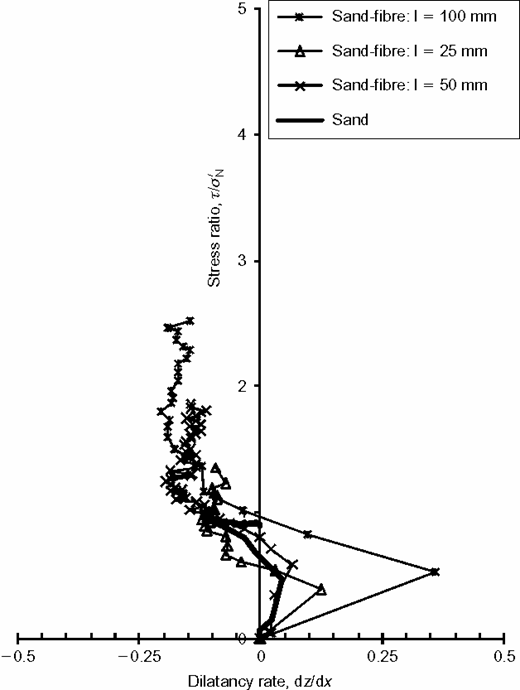
Stress ratio–dilatancy response of sand and fibre-reinforced sand (0.5% fibres of 0.031 mm diameter, and varying length) from standard direct shear tests under normal stress of σ′N = 110.43 kN/m2
Stress ratio–dilatancy response of sand and fibre-reinforced sand (0.5% fibres of 0.031 mm diameter, and varying length) from standard direct shear tests under normal stress of σ′N = 110.43 kN/m2
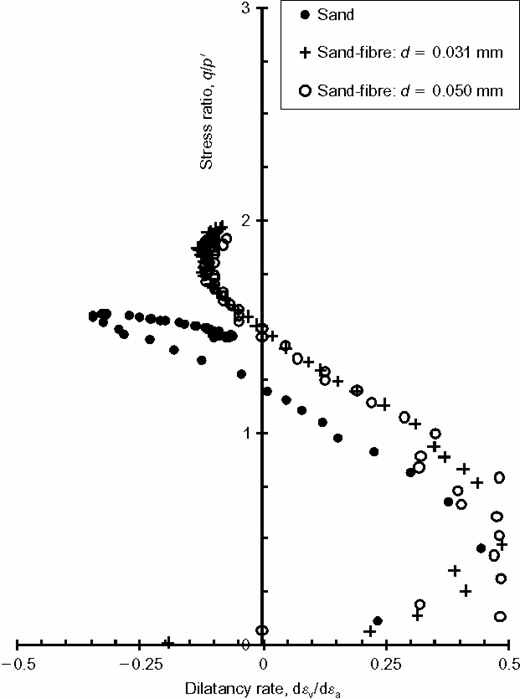
Stress ratio–dilatancy response of sand and fibre-reinforced sand (0.5% fibres 75 mm long, and varying diameter) from standard triaxial tests under confining stress of 100 kN/m2
Stress ratio–dilatancy response of sand and fibre-reinforced sand (0.5% fibres 75 mm long, and varying diameter) from standard triaxial tests under confining stress of 100 kN/m2
Response by N. C. Consoli1, L. Festugato2 and K. S. Heineck3
1Associate Professor, Department of Civil Engineering, Federal University of Rio Grande do Sul, Av. Osvaldo Aranha, 99, 3 Andar, CEP: 90035-190 Porto Alegre, Rio Grande do Sul, Brazil, Telephone: +55 51 3308 3552, Telefax: +55 51 3308 3999, E-mail: consoli@pq.cnpq.br
2PhD student, Department of Civil Engineering, Federal University of Rio Grande do Sul, Av. Osvaldo Aranha, 99, 3 Andar, CEP: 90035-190 Porto Alegre, Rio Grande do Sul, Brazil, Telephone: +55 51 3308 3552, Telefax: +55 51 3308 3999, E-mail: lufega@yahoo.com.br
3Associate Professor, Department of Civil Engineering, Federal University of Rio Grande do Sul, Av. Osvaldo Aranha, 99, 3 Andar, CEP: 90035-190 Porto Alegre, Rio Grande do Sul, Brazil, Telephone: +55 51 3308 3552, Telefax: +55 51 3308 3999, E-mail: karla@ppgec.ufrgs.br
The authors would like to thank the discussers for their comments and interest in our paper. The discussers provided valuable information on the behaviour of long monofilament polypropylene fibres. With regard to the points raised by the discussers, the authors would like to provide the following clarifications.
1. The method of mixing soil, water and fibres was developed in order to prepare ideal fibre-reinforced specimens. The compacted soil and fibre-reinforced soil specimens used in the triaxial tests were carefully prepared by hand-mixing dry soil, water and polypropylene fibres (when used). It was found to be important to add the water prior to adding fibre, to prevent floating of the fibres. A 100 mm diameter, 200 mm high triaxial specimen with 0.023 mm diameter, 24 mm long fibres placed at 0.5% fibre content contains over 1 400 000 fibres. Due to the high number of fibres, the control of every single micro-reinforcement is not feasible. As evidence of the quality control of the specimens, visual and microscopic examination of exhumed specimens provided confirmation that the mixtures were satisfactorily uniform. The authors also tested this mixing procedure in the field with results that corroborate the tests performed in the laboratory (e.g. Consoli et al. 2009).
2. Figure 8 shows further results of the authors' main study, where the stress ratio-dilatancy response of sand and fibre-reinforced sand (0.5% fibre content of 0.023 and 0.100 mm diameter and length of 24 mm) standard triaxial tests under a confining stress of 100 kPa is presented. The arrows indicate the final portion of each test. Dilatancy (dεv/dεs) is kept practically unchanged when introducing fibres in the sand; however, the stress ratio (q/p′) increases as fibre diameter decreases. Fibres with higher aspect ratios are more effective. Not only longer, but also thinner fibres produce better results.
3. Evidence that the inclusion of the very thin and longer monofilament extensible fibres is more effective due to the increase of the number of contact points between the soil particles and the mobilization of a higher number of soil particles during shear deformation was previously presented by other researchers (e.g. Heineck et al. 2005; Consoli et al. 2007), where the results of various soils reinforced with polypropylene fibres are shown.
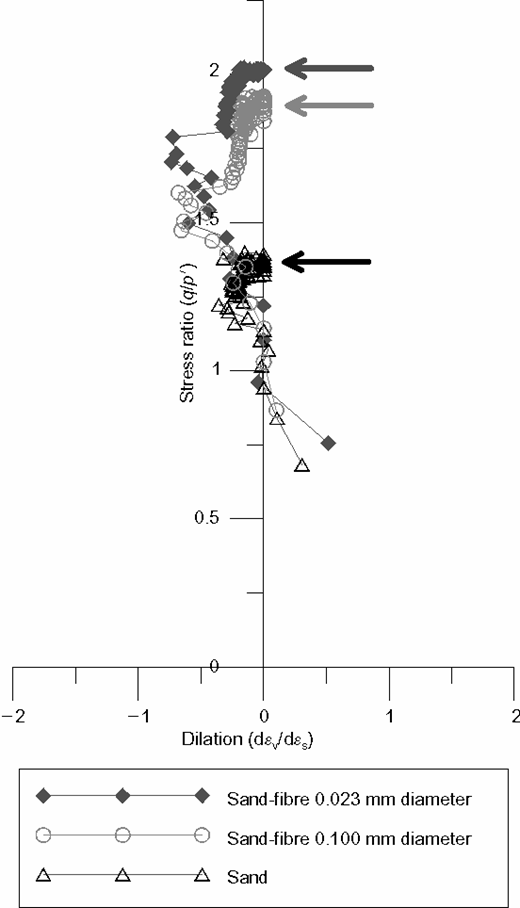
Stress ratio–dilatancy response of sand and fibre-reinforced sand (0.5% fibre content of 0.023 and 0.100 mm diameter and length of 24 mm) standard triaxial tests under confining stress of 100 kPa
Stress ratio–dilatancy response of sand and fibre-reinforced sand (0.5% fibre content of 0.023 and 0.100 mm diameter and length of 24 mm) standard triaxial tests under confining stress of 100 kPa

