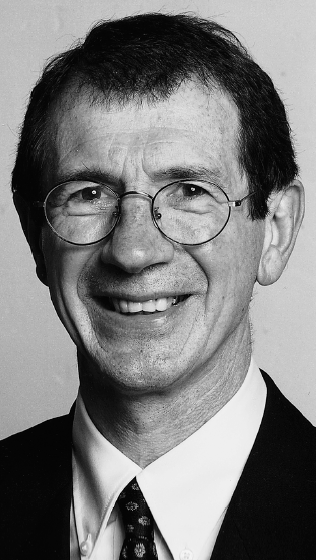
The 40th Lecture of the British Geotechnical Society was given by Professor John H. Atkinson at Imperial College, London, on 15th March 2000. The following introduction was given by Professor R. N. Taylor, City University
It is an honour and a privilege to introduce Professor John Atkinson, the British Geotechnical Society's 40th Rankine Lecturer.
John Herbert Atkinson was born in 1942. The family moved to Norfolk when he was six years old, and it was there, as he recollects, that he first saw a beach. This must have made a lasting impression, and his fascination with soil and water remains to this day. He was educated at Norwich School and later read Civil Engineering at Imperial College from where he graduated in 1964. After spending 18 months at Binnie and Partners, he felt the need to broaden his perspective of the world. He bought a £10 ticket and took a 48-hour flight to Australia. He spent some time discovering the country, which included a brief spell working for a sheep-shearing gang in North Queensland, before he started to earn a living as a civil engineer. This culminated in his joining the then newly formed company, Coffey and Hollingsworth, now Coffey and Partners, where he was involved in many site investigations and geotechnical designs in and around Australia. It was while trying to solve a particular design problem that he became dissatisfied with his understanding of soil mechanics. He returned to the UK to start on what was to prove a long and fruitful academic career.
Back at Imperial College, John completed the MSc in Soil Mechanics and then moved straight into PhD research under the supervision of Professor Alan Bishop. It was at a time when uncertainties in the knowledge and in the understanding of soil stiffness were becoming apparent, and also when the merits of stress-path testing were being appreciated. With characteristic enthusiasm, John set about designing and commissioning the first hydraulic soil-testing cell, which was the forerunner of what later became known as the Bishop and Wesley cell. His research provided significant new insights into the understanding of soil stiffness and was of a lasting quality which informed much of the research he subsequently supervised.
John spent two periods away from London. During 1973–1976, he was Senior Assistant in Research at Cambridge University's Engineering Department. There he led a group engaged in research on tunnelling for the then Transport and Road Research Laboratory. In that period John, with Professor David Potts, conducted some of the first tests on the newly commissioned beam centrifuge. And it was there that he is said to have had one of his ‘eureka’ moments when he devised an elegant upper-bound collapse mechanism for a tunnel in sand, apparently while having a bath. Also during his time in Cambridge, he wrote the textbook The Mechanics of Soils with Dr Peter Bransby, which aimed and succeeded in explaining the mysteries of Critical State Soil Mechanics. This text became a bible for many students in geotechnical engineering. In 1976 he moved to Cardiff as a lecturer and there became senior lecturer, and while developing as an academic, he published his second textbook concerning the analysis of geotechnical structures.
John returned to London in 1980 to take the post of Reader, and later Professor, in Soil Mechanics at City University. It is at City University that John has established his reputation in leading geotechnical research. He quickly transformed the soil mechanics laboratories and took advantage of the University's incentives to develop research. The Geotechnical Engineering Research Centre was established in 1983. Since its modest beginnings John has been at the forefront of its development and it now boasts many sophisticated stress-path apparatus with state-of-the-art instrumentation, as well as a geotechnical centrifuge and leading numerical analysis. He is loyal and supportive to his research group and colleagues alike. He has a strength of determination which is second to none and he will fight tooth-and-nail to get the resources required for conducting research of the highest quality. I, personally, have been fortunate to have benefited from his unstinting support and drive. John has also always been keen to encourage the younger generation, and at City University he initiated the Young Geotechnical Research Workers symposia. The idea was subsequently adopted by both the British Geotechnical Society and by the International Society for Soil Mechanics and Geotechnical Engineering, and Young Geotechnical Engineers symposia and conferences are still held regularly in the UK and overseas.
Over the years, John has developed close links with industry. Recently, during 1995– 1997, he was a part-time Royal Society Research Fellow at Ove Arup and Partners. Almost at the same time as this fellowship commenced, the failure occurred on the Heathrow Express tunnels. Arup Geotechnics was called in as one of the teams investigating the collapse, and John was quickly in the thick of it pulling together information, reviewing previous assessments of ground conditions and considering likely soil parameters for further analyses. He still acts as a consultant for Arup Geotechnics, but also finds other projects to which to put his mind, including being an expert witness on the loss of a ship carrying iron ore cargo.
But John's passion is not limited to soil mechanics and geotechnics. He is a keen and accomplished sailor. While a student at Imperial College, John was a member of an extremely successful ‘12-foot National’ crew, winning the Burton cup twice, and the Silver National on three occasions. He has owned a boat, or rather a collection of boats, for most of his teenage and adult life, and regularly races in the laser class at weekends in London, and occasionally on the Norfolk Broads.
He is fond of life in Norfolk, and his flat in Cromer has been an important outpost to get away from the traumas of university life. It has been used to very good effect to reflect on some new research idea or to write a paper or to have an away day with his research students and assistants to discuss their work. And in London too, John and his family, his wife Jo and two sons Robert and Nicholas, have given tremendous support and hospitality to all the members of the Geotechnical Engineering Research Centre.
If there is one thing that characterizes John, it is his ability to make difficult things simple. He has a clarity of thought that enables him to transpose the complexities of soil behaviour into simple concepts that are understandable to geotechnical engineers, students and even solicitors. It is with this in mind that I have great pleasure in calling upon Professor John Atkinson to deliver the 40th Rankine Lecture.