The author is correct in pointing out that the bearing capacity factors for deep foundations developed by Berezantzev et al. (1961), often just referred to as Berezantzev, have been adopted by many engineers in the piling industry. However, the reason for this preference over other more rigorous and justifiable theories is difficult to explain, particularly as the Berezantzev method tends to give more conservative values for Nq and Nγ that are lower than those given by many other theories. Despite the improvement in accuracy of the depth correction factor αt calculated by the author, there are still some underlying concerns regarding the validity of the resultant Nq values. These are discussed briefly below.
It is important to recognise that the Nq factors presented by Berezantzev comprise two components: a bearing factor Bk, and a depth correction factor αt. Most references to Berezantzev cover the relationship between Bk and ϕ′ (Poulos & Davis, 1980; Fleming et al., 1992; Randolph et al, 1994). Apart from Tomlinson (1994), the discusser is unaware of any other significant reference that includes the depth correction factor αt. This may be due to the fact that αt is a reduction factor, which implies that the effective end bearing capacity factor Nq = αtBk reduces with pile penetration. This is not an intuitive result. It is also in direct conflict with other bearing capacity theories such as those presented by Brinch Hansen (1961), Vesic (1967), or Meyerhof (1975). Nor is it supported by studies based on cavity expansion theories such as Vesic (1972) or Yu & Houlsby (1991/1992). As a result, it is believed that most practitioners who use the Berezantzev bearing capacity factors use just the Bk component and tend to disregard αt.
Part of the difficulty in justifying the use of the Berezantzev bearing capacity factors is that the 1961 paper concentrates on the development of the reduction factor αt and does not give any background theory for Bk. It is necessary to go back to the original paper by Berezantzev (1952). Unfortunately, even this background paper does not hold up too well against proper scrutiny. The Ak and Bk factors in the 1952 paper are slightly different from those given in the 1961 paper. Although based on a mathematical framework, it is clear that key functions used to compute the Bk factor have been approximated based on model test results at low stress levels, which may not be applicable to the higher stresses appropriate to the soil zones below the base of deep foundations. Likewise, the theoretical basis for the reduction factor αt is questionable, and does not allow for any interaction between the pile shaft and the end bearing mechanism.
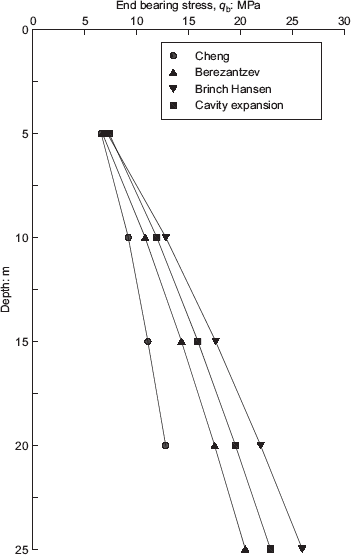
With regard to the reducing rate of increase in end bearing stress and the apparent threshold or limiting value suggested by a number of authors including Vesic (1970), the technical note presents an attractive approach, resulting in a rapid reduction of Nq with increasing pile penetration. This is illustrated in Fig. 1, where end bearing stresses given in the note are compared with those computed using the Berezantzev Bk factor alone, and with Brinch Hansen (1961) theory, both based on the approach given by Randolph et al. (1994) and Bolton (1986/1987). Fig. 1 also includes stresses based on a cavity expansion approach following Yu & Houlsby (1991/1992). Tabulated values for qb, Nq and ϕ′ are given in Table 3.
Unfortunately the technical note gives little theoretical justification for use of the reduction factor αt, and does not give an explanation for the inconsistency with other bearing capacity theories. Many authors have argued that the apparent threshold or limiting end bearing stress is not a real phenomenon, and can be fully explained by a combination of other effects, including suppression of dilation under high confining stresses, soil compressibility, or even pile test interpretation problems. Examples include Bolton (1986/1987), Neely (1990), Kraft (1991) and Randolph et al. (1994). There are clearly sufficient alternative rational explanations available in the literature to explain the reducing rate of increase in end bearing stress.
In conclusion, although the improved accuracy of the Berezantzev reduction factor αt is welcome, the discusser believes that the continued use of a bearing capacity theory that was developed more than 40 years ago is difficult to justify, particularly as it is based on a somewhat questionable theoretical background, and does not implicitly include for the effects of soil compressibility or variation in ϕ′. Alternative methods based on cavity expansion theory seem to be the most promising direction for future research and development. This is a topic area that should perhaps be revisited by researchers, and it would certainly benefit from the application of 21st century computer-based numerical modelling techniques.