The authors of the technical note correctly validated the use of the discrete element method (DEM) to model ballast abrasion during simulated track conditions. The work presented in the technical note is original and, as suggested by the authors, no such work has been developed before. The results obtained from the simulations also correspond with experimental observations from previous research: permanent axial strain accumulates linearly with the logarithm of the number of load cycles for ballast material subjected to cyclic loading. As reported by the authors, ballast abrasion seems to play an important role in particle breakage and the associated settlement, occurring mainly beneath the sleeper (cross-tie) where the load is being applied. As pointed out in the technical note, it is time consuming to simulate individual ballast particles in DEM with agglomerates of smaller particles bonded together. Thus the approach used by the authors of using clumps with two smaller spheres attached at the ends seems to be more efficient. However, as conceded in the note, this is only a simplification of a more complex geometry being justified to allow reasonable computational times (although the reported times still seem excessive: for test 3 it took approximately 1 week to run 20 load cycles).
The technical note correctly focuses on the behaviour during the first stage of a real load test, showing the importance of the first few cycles with regard to deformation and particle abrasion (first 20 cycles). A very interesting feature showed by the simulations is that most of the broken asperities were located below but not directly in contact with the sleeper, since they were distributed from the bottom of the sleeper to the bottom of the box.
This writer would like to comment about the role of bulk fracture as a form of particle breakage that was not included in the technical note. A rail track ballast bead is composed of uniform particles with typically large sizes (6·4–64 mm) subjected to low lateral confining stresses. This condition presents the possibility of particle fracture in the form of total fragmentation, since each particle has a limited number of confining neighbours, and tensile stresses due to diametrical compression are induced. Depending on the strength of the rock, particle crushing could or could not take place, being a potential problem. This writer has studied the effects of total degradation of a simulated ballast bead subjected to dynamic loading using the computer program PFC2D (a two-dimensional program rather than the three-dimensional version used by the authors of the technical note). Instead of using agglomerates of smaller bonded particles or using clumps, the writer developed a model that replaced a particle fulfilling a failure criterion with a group of smaller particles. Each of the generated smaller particles could later fulfil the failure criterion and break again, defining what is called a generation of crushing. This model is fully explained in Lobo-Guerrero & Vallejo (2005a, 2005b, 2006) and could be applied to particles of every size.
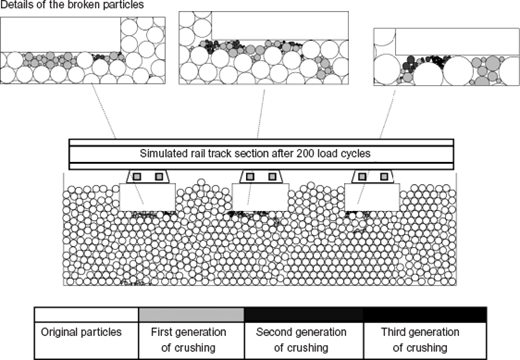
As shown in Fig. 7 and explained in Lobo-Guerrero & Vallejo (2006), a simulated rail track section was subjected to 200 load cycles (62 kN). Most of the particle crushing concentrated directly underneath the sleeper, with only a small number of broken particles. A similar simulation was developed, but particle crushing was not allowed to occur. After 200 load cycles the recorded permanent deformation for the case considering crushable particles (Fig. 7) was 1·51 times higher than the permanent deformation for the case considering uncrushable ballast, being an important phenomenon.
In conclusion, depending on the strength of the ballast, bulk fragmentation could be an important feature that should be included to simulate the behaviour of a ballast bed realistically. However, if good-quality ballast and good construction procedures are used, bulk fragmentation could be avoided, and abrasion could take place as the only form of crushing, corresponding to the case studied in the technical note. Finally, this writer would like to congratulate Dr McDowell and his colleagues for the remarkable contributions that they have made during the past years to the better understanding of ballast mechanics and crushable materials in general.
Authors' reply
We are very grateful for Dr Lobo-Guerrero's comments. He is right that bulk fracture is a possibility. In our Railway Test Facility (described by Brown et al., 2007) we load three sleepers with actuators which are out of phase by 90° to simulate a moving train. The sleepers are embedded in ballast over a silt subgrade. We are finding that, under traffic loading, abrasion occurs. Bulk fracture occurs under maintenance tamping, when the tamping tines plunge into the ballast, but our laboratory work has not shown bulk fracture to be significant during traffic loading. We are aware of the good work that Dr Lobo-Guerrero has done on the 2D discrete element modelling of the fragmentation process, and it would be interesting to try to model bulk fracture during the tamping process. We would like to thank him for his kind comments. There is still much work to be done!