

Introduction
The authors have presented an important contribution concerning the assessment of earthquake effects on the stability of slopes. The contribution is concerned primarily with estimations of permanent displacments along slip surfaces based on the sliding-block model, also well-known as the Newmark model. A destructiveness potential factor PD, defined as a ratio of Arias intensity IA and the square of the number of zero crossings per second of an accelerogram, is used to represent the whole acceleration–time history. Statistical relationships have been developed relating s, the displacement of a rigid block along a horizontal surface with PD and kc, the yield acceleration factor which is also known as the critical seismic coefficient. Two such relationships are presented for s50, the estimated displacement at a confidence level of 50%, and s90, the estimated displacement at a confidence level of 90%. The displacement of a slope s is obtained as a product of the rigid block displacement on a horizontal surface and a correction term A which accounts for a translational mechanism within a slope, or a correction factor Als which accounts for a log-spiral failure mechanism within a slope.
The estimation of kc is an important part of any procedure for assessment and displacement based on the sliding-block model, including that presented by the authors. Whereas estimation of PD requires only a numerical integration procedure based on the chosen acceleration–time history, the estimation of kc is based on the concept of limit equilibrium applied to the particular slope. This parameter is a function of the slope and slip surface geometry as well as the shear strength parameters relevant to the slip surface considered. In order to get the value of kc applicable to a slope, the critical slip surface with respect to kc has to be determined. The authors have first developed charts relating kc to slope angle for an ‘infinite slope’ analysis. They have also provided charts to determine minimum values of kc for both the plane failure and log-spiral mechanisms.
Importance of failure mechanism
The method proposed by the authors enables a good understanding of the influence of failure mechanism on the permanent displacements of slopes during seismic shaking. Firstly, it becomes very clear that displacement along a surface is constant only if it is a plane corresponding to a translational failure mechanism. A potential failure mechanism or any other complex failure mechanism will be associated with displacements which vary along the slip surface. Secondly, the magnitude of the critical seismic coefficient, which may be expressed as a function of the static factor of safety, can be significantly smaller for a rotational failure mechanism in comparison to that for a translational failure mechanism. From examples 2 and 3 the ratio of kc (translational) to kc (log-spiral) for a particular slope is 6·2. The displacements corresponding to the log-spiral mechanism are consequently larger and from examples 2 and 3
the ratio s50 (log-spiral)/s50 (translational) varies from 10·68 at the crest of the slope to 14·6 at the toe
the ratio s90 (log spiral)/s90 translational varies from 6·42 at the crest to 8·2 at the toe.
Thus the ratio of displacements can be significantly greater than the ratio kc values when comparing translational and rotational failure mechanisms.
Potential decrease of shear strength and critical seismic coefficient
The significance of these findings is more profound than is apparent from the limited framework of classical soil mechanics chosen by the authors for their contribution. They do point out that their contribution would be ‘useful in practical design for estimating the displacements of engineered slope’. However, it also has application for hazard and risk assessment related to natural slopes and landslide areas.
Whether considering an engineered or natural slope, it is important to look at the decrease of shear strength associated with large displacements along a slip surface. Laboratory studies have shown that strain softening does not occur during cyclic loading of soil specimens. However, the decrease of shear strength associated with large relative displacements along real slip surfaces in the field is widely accepted. It is immaterial whether such displacements occur under static or earthquake conditions.
As earthquake-induced displacements will be spatially variable for any non-planar (non-translational) failure mechanisms, the shear strength mobilized along a slip surface during and after seismic shaking may vary significantly. Decreased shear strength implies a decreased static factor of safety and a decreased value of the critical seismic coefficient. Thus, it would be appropriate to consider the potential for shear strength decrease in estimating the final displacements of a slope. Innovative procedures combined with engineering judgement would be required to identify situations in which reduced shear strengths, which may approach residual shear strength values, would be adopted.
In general, the critical seismic coefficient may also be regarded as a function of time t elapsed after the start of seismic shaking, thus
Consequently, permanent displacement is also a function of time t elapsed after the start of seismic shaking. The use of a seismic destructiveness potential factor means, however, that the change in kc can not be simulated as a function of time.
Using generalized limit equilibrium solutions in combination with an extended sliding-block model, the decrease of kc and increase of displacements with time can be simulated and it has been shown that the final displacements are significantly dependent on a ‘brittleness factor’ which describes the shape of the post-peak portion of the curve representing the relationship between shear strength parameter and relative displacement along the slip surface considered, that is, curves of cohesion c plotted against displacement s and frictional coefficient tan ϕ plotted against displacement s (Chowdhury & Xu, 1994).
It may also be important to consider the reduced shear strength parameters for the analysis of displacements associated with future earthquakes where a past seismic event is known to have occurred and analyses have shown that significant desplacements may have been caused during that past event.
Landslide hazard assessment under seismic conditions
In recent years, significant attention has been given to the assessment of seismically induced landslide hazard and the availability of geographical information systems (GIS) has facilitated such assessments. The use of dynamic factors of safety utilizing pseudo-static coefficients has been found to be unreliable and it is widely acknowledged that displacement-based assessments are significantly more reliable. Unfortunately, there is an increasing tendency for assuming the ‘infinite slope’ failure mechanism as a basis for the estimation of displacements using the sliding-block model. This is done ‘for simplicity’ and is also justified on the basis that most seismically induced slope failures are shallow. However, most observed failures would not correspond to the ‘infinite slope’ mechanism and a significant proportion may be associated with rotational or other complex mechanisms. Considering the findings of the authors, it is obvious that only the use of appropriate rotational failure mechanisms will allow further significant increase in the reliability of hazard assessment. Of course there are more complex considerations to be taken into account when analysing natural slopes and the use of sophisticated numerical models is often necessary.
Topographic effects can be significant for seismically induced deformations as shown by Chowdhury & Tabesh (1998) in their studies using the computer program FLAC. However, these studies did not consider permanent deformations along particular slip surfaces and are, therefore, not comparable with those carried out on the basis of a sliding-block model.
Direction of inertia force
The authors have assumed a horizontal direction for the inertia force in their equations. It is well-known that the magnitude of kc and its relationship with the static factor of safety FS depend on the assumed direction of the inertia force. For example, if the direction of the inertia force acting on a rigid block resting on an inclined plane is along that plane, that is, β = θ (where β is the inclination of the force to the horizontal), then
which is different from the equation for the horizontal inertial force assumption, that is
Also assuming c = 0 along the contact between the block and the plane, minimum kc is associated with an inertia force direction to the horizontal βc where
and the associated minimum kc is
Solutions needed for special cases
The authors have presented general solutions for a cohesive soil assuming zero pore water pressure. In this connection, two special cases would be of considerable interest. Firstly, the authors could present the charts for the special case when cohesion c = 0. Such charts would correspond to dry cohesionless soil such as clean sand.
Secondly, the authors could consider the well-known ‘ϕ = 0’ assumption for saturated clay under undrained conditions. For this assumption, the log-spiral becomes a circle as a special case of the rotational failure mechanism. The writer hopes that the authors will be able to present the results for these special cases in the form of charts similar to those provided by them for the more general case c ≠ 0, ϕ ≠ 0.
Inclusion of pore water pressure
The authors have so far not included pore water pressure as a parameter in their analysis procedure. In general, there will be an initial pore water pressure distribution along a potential slip surface. As these pore water pressures increase in magnitude, the critical seismic coefficient applicable to a particular slip surface decreases and hence the seismically induced displacements increase.
In addition to these initial pore water pressures, seismic shaking induces excess pore water pressures in cohesionless soils. The inclusion of these pore pressures introduces further complexity in the assessment of seismically induced displacements in slopes.
It is interesting to recall (Sarma, 1975) that for fully saturated sand, βc = θ gives the critical direction of the inertia force. The critical seismic coefficient is found to be minimum for this direction. It is noteworthy that βc is thus independent of the initial pore water pressure.
Finally, it is important to remember that inclusion of pore water pressure may significantly influence the location of the particular slip surface which yields the minimum kc, whether assuming a translational or a rotational failure mechanism. Thus the inclusion of the pore water pressures, where applicable, is important not only because the value of kc on a particular slip surface is a function of these pore water pressures, but also because the location of the surface which gives the minimum value of kc also depends on these pore water pressures. Using generalized limit equilibrium procedures together with the concept of dynamic pore water pressure coefficient An (Sarma & Jennings, 1980), an extended sliding block model has been developed to simulate excess pore water pressure generation with time, and the associated decrease of kc and FS with time (Chowdhury, 1997, 1998).
Returning to further consideration of the authors’ solutions, it is pertinent to investigate if equations (1) and (2) are independent of pore water pressure. Assuming a particular level of pore water pressure, new statistical relationships corresponding to equations (1) and (2) would need to be developed. These equations are already independent of the shear strength parameters c and ϕ except in as much as kc is dependent on these parameters. Therefore, it would be interesting if further analyses, with pore water pressure included, led to the conclusion that these equations are also independent of the pore water pressure. The authors have not stated what values of c and ϕ are actually used in the analyses carried out to produce the relationships in Fig. 1. For completeness, this information may be provided in their closure to the discussion.
It would also be of interest to publish the values of the destructiveness potential factor PD for single acceleration pulses of different shapes. Such information would enable readers to get a better feel of this factor which is not yet widely known among geotechnical engineers.
Authors' reply
We thank Professor Chowdhury for his words of appreciation for our work, for his general considerations, and for his precise and valuable remarks. We hope to have understood his critical observations and to be able to reply to them in an exhaustive manner.
Professor Chowdhury's observations concern the following points
importance of failure mechanism
potential decrease of shear strength and critical seismic coefficient
landslide hazard assessment under seismic conditions
direction of inertia force
solutions needed for special cases
inclusion of pore water pressure
values of the destructiveness potential factor PD for single acceleration pulses of different shapes.
Importance of failure mechanism
We agree completely with Professor Chowdhury's observations. The ratio of displacements can be significantly greater than the inverse ratio of kc values when comparing translational and rotational failure mechanisms.
Potential decrease of shear strength and critical seismic coefficient
All methods based on an empirical relationship between permanent displacement and some synthetic seismic parameters (A, V/A, V2/Ag, IA, PD, etc.), and not on the integration of the equation of motion, necessarily assume a single reference value for the critical seismic coefficient, kc. This reference value is not necessarily the one that corresponds to the peak shear strength, or to small deformations and displacements. A simplified procedure could be the following.
The kc values of the slope for both displacements of less than a minimum threshold and for greater displacements are calculated.
The displacement of the slope is estimated by utilizing the highest initial kc value.
If the estimated displacement is greater than the threshold value, the calculation is repeated, utilizing the reduced kc value for large displacements.
Obviously, if the displacement of the slope is calculated by intergration of the equation of motion, it is possible to take into account the instantaneous kc value, which is variable in time. A procedure of this type can be found in Crespellani et al. (1990, 1992, 1994).
Landslide hazard assessment under seismic conditions
It is appropriate to point out that, like all methods that utilize elementary models, the method proposed is suitable for natural slopes that can be attributed to the model of the infinite slope, or for artificial slopes (embankments, earth dams, etc.) with a simple, regular geometry, made of soil-building material, uniform, homogeneous, with well-known mechanical charateristics. For these simplified models of a slope comparable to a single rigid block limited by a plane surface or one in the shape of a logarithmic spiral, the acceleration time history must necessarily be unique.
In the case of natural slopes that are complex in their morphology and stratigraphic and geotechnical conditions, we can take into account topographic effects, as well as the variability of the acceleration on time history in the different parts of the slope, with methods that provide for discretization in blocks of the landslide mass (Crespellani et al. (1990, 1992, 1994).
Directions of inertia force
The correlations between block displacement and synthetic seismic parameters (A, V/A, V2/Ag, IA, PD, etc.) are generally obtained by using a database of earthquake horizontal component records. We assumed a horizontal direction for the inertia forces for this reason.
Solutions needed for special cases
In order to be synthetic and for reasons of space, in the technical note we presented only illustrative graphs. A more complete review of tables and graphs, which also includes the special cases ‘c = 0’ and ‘ϕ = 0’, where permitted by the analytical solution, is contained in Madiai & Vannucchi (1997).
Inclusion of pore water pressure
Professor Chowdhury's observation is, also on this subject, correct and shareable. What has already been said is valid by way of reply; namely, that methods for estimating displacements based on correlations to critical seismic parameters require single reference values for shear strength, pore pressure, the critical seismic coefficient, and so forth. Naturally, these parameters are not necessarily the ones that correspond to the conditions preceding the beginning of seismic shaking. As far as pore pressure is concerned, it is taken into account in the (c/d·γ) ratio or in the Ns = γ · H/c stability ratio, since the d ·γ (or γ·H) product represents the effective vertical pressure in the depth of the slip surface. We can consider the evolution of the geotechnical parameters and conditions and, therefore, of the pore pressure, in time by using the methods that calculate block displacement through integration of the equation of motion.
To solve many geotechnical problems (stress distribution, foundation bearing capacity, slope stability, etc.), reference is often made to a medium that is ideal, continuous, homogeneous and uniform, of specific weight γ, elastic or rigid perfectly plastic, with a shear strength given by the equation: T = c + σ·tan ϕ. The geotechnical engineer's task is to evaluate, case by case, in what way, when and under what conditions, the real soil can be compared with the ideal medium of the model and, consequently, to decide whether to carry out the analysis in terms of total (γ = γsat, c = cu, ϕ = ϕu) or effective (γ = γ′, c = c′, ϕ = ϕ′) stresses. The model and its solution lie outside these ‘engineering’ choices. In the particular case, the critical seismic coefficient kc isa function of both the geometry and the mechanical physical characteristics of the ideal medium (γ, c ϕ), and is therefore different by analysis in terms of effective stresses or in terms of total stresses.
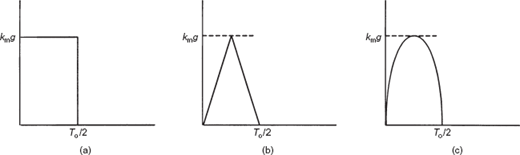
Finally, as Professor Chowdhury suggests, it would be useful to provide the values of the destructiveness potential factor, PD, for single acceleration pulses of different shapes. For a rectangular pulse (Fig. 9(a)), a triangular pulse (Fig. 9(b)), and a half sine pulse (Fig. 9(c)), of duration To/2 and amplitude kmg, the destructiveness potential factor is given, respectively, by the following expressions
With reference, for example, to the case of a rectangular pulse, it can be observed that the relationship between the permanent displacement of the rigid block on a horizontal base, s, the maximum acceleration of the base, kmg, and the yield acceleration kcg, is a follows
By combining equation (15) and equation (12) we obtain
In spite of the considerable difference between a single acceleration pulse and an actual acceleration time history, the previous equation shows that in both cases the exponent of the terms PD and kc are equal to about 1 and –1, respectively.

