

The authors have addressed an important study on the permeability of clay suspensions, which has various practical implications in sedimentology, chemical and environmental engineering. The two independent approaches suggested for determining permeability are steady-state fluidation and transient sedimentation. Analysis of data for the permeability of two clays with wL of three-fold variation (52–162%) has shown that two constant-power functions can be used to represent the variation of k of over seven orders (10−9 to 10−2 m/s) in the range of very large variation in the void ratios considered (1– 300). To employ the authors' method to describe the variation of permeability of a clay with the void ratio it is necessary to determine the constants C and D. In the present discussion the writers reexamine the authors' data with the stress-state–permeability relations developed earlier for normally overconsolidated clays (Nagaraj et al., 1993, 1995) to explore and suggest the predictive method for a clay whose water-holding capacity in terms of wL is known. This forms an independent check on experimental determination.
As a consequence of clay–water interactions, in the absence of external loading, clay particles approach each other to form stable clusters. Particle orientation within the cluster, their size and stability are influenced by the physico-chemical forces arising out of pore fluid chemistry and the nature of the clay and non-clay minerals of the deposit. Only when soils acquire a low but measurable effective stress do they begin to exhibit mechanical properties. Water content at the liquid limit state of soils is one such situation realised at a low but measurable effective stress (matric suction) of the order of 6–7 kPa (Russel & Mickle, 1970). According to the effective stress principle, the shear strength of clays at their liquid limit state should be of the same order. The shear resistance, CuL, of soils at water contents corresponding to their liquid limit state varying from 36 to 159 measured by laboratory vane has been reported by Federico (1983) to fall within the limits of 1·7–2·8 kPa, with most of the values around 2·3 kPa. The hydraulic conductivity of clays at their liquid limit state is of the same order: that is, 10−7 cm/s (Nagaraj et al., 1993). The water content of clays at their liquid limit state has all the attributes necessary to be a reference state parameter. Considering e/eL as the intrinsic soil parameter in the analysis and assessment of soil behaviour of saturated uncemented and cemented clays, partially saturated clays have been studied in detail (Nagaraj et al., 1994). Data in Fig. 11 (p. 286) reveal that for the Speswhite at e = 1·3 with e/eL= 0·94, k = 2 × 10⁻⁹ m/s and for phosphatic clay at e = 4·5 with e/eL = 1·01, k = 1 × 10⁻⁹ m/s (10−7 cm/s). This confirms that eL can be used as a reference parameter. It has been shown that e–log k paths of different clays in both their normally and overconsolidated states by normalisation with the void ratio, eL = wL G, have been expressed as (Nagaraj et al., 1994b):
with a correlation coefficient of 0·98, leading to the constants a = 2·162 and b = 0·195 for the data examined, where k is in cm/s. Since clays in the laboratory are normally or overconsolidated in the effective stress range of 25–800 kPa, the e/eL values are less than 1.
In the present context the authors' data have been examined for possible generalisation in terms of their eL values for void ratios greater than their respective eL values. It can be seen in the authors' Fig. 9 (p. 284) that the void ratio–permeability relation is highly non-linear, and hence a power function has been suggested (equation (20), p. 286) by the analysis of data on a log–log basis. From the trend of variation of k with void ratio, the functional form can be expressed as
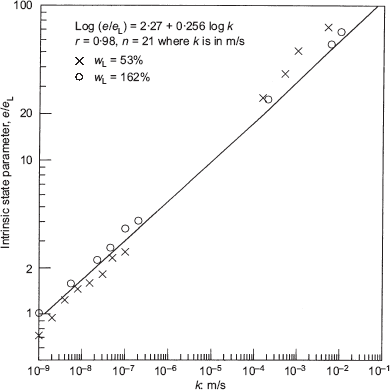
Analysis of the extracted data from the authors' Fig. 11 on p. 286 in relation to the the intrinsic state parameter, e/eL, yields the following relation:
with a correlation coefficient of 0·98, where values of k are in m/s. In Fig. 12 the plot of log e/eL against log k is shown. This provides an independent means for verifying the authenticity of experimental permeability data of other clay suspensions. It might also make it possible to reexamine the type of micro-fabric that is possible at very high void ratios, since the equilibrium void ratios at different k values bear the same ratio as that of their respective liquid limit water contents.
Authors' reply
As Géotechnique readers probably know, Bob Schiffman passed away in the summer of 1997. Hence the reply to the discussion is taken over by the first author only.
The contribution by T. S. Nagaraj and P. S. R. Narasimba Raju is much appreciated. It indicates that normalisation procedures such as the one suggested by the discussers can provide a valuable means for pinpointing some fundamental intrinsic parameters serving as reference states for the mechanical and flow behaviours of soils and suspensions. One such reference state may indeed be the water content—or the void ratio—at the liquid limit, as shown by previous researchers (e.g. Skempton, 1970; Burland, 1990). Pursuing further the discussers' suggestion, it is noted that for the two clays considered the soil-formation void ratios (em) are in the same ratio as their respective liquid limits, since
Hence it appears that the liquid limit state can also provide useful information about the process of sedimentation and soil genesis.
On the other hand, the author does not agree with the discussers about the capability of the suggested normalisation procedure to assess and validate the results of experimental permeability measurements. In fact, the empirical nature of the discussers' equation (23) restricts its validity to the two particular clay–water mixtures considered. More experimental work is deemed necessary to verify its applicability to other clay suspensions.
Furthermore, it can be theoretically shown that when the suspended soil particles are spaced sufficiently apart—that is, when the void ratio of the suspension tends to infinity—the fluid flow should hardly be influenced by the interaction among solid particles, and the settling velocity (υs) should approach the one described by Stokes' law (see equation (19)). For such extremely diluted suspensions, the values of D and D′—appearing respectively in equations (20) and (22)—should approach unity. That is:
Further experimental evidence on the behaviour of diluted suspensions should be directed towards validating—or unvalidating—the above theoretical consideration, and empirical approaches and correlations devised for practical use should conform to such results.

